
UV400, Polarized & Mirror Coatings by Market
If you buy sunglasses for retail, distribution, or private label, the lens spec affects cost, returns, and compliance more than many buyers expect. This guide shows how to choose UV400, polarized, and mirror coatings by channel and market without over-specifying each SKU. It is written for B2B buyers who need a working spec, not a sales pitch. The goal is simple: fewer rejects, fewer confused options, better sell-through, and a cleaner approval path from sample to mass production.
Start With the Selling Job
Many lens specs fail because they start with technology and end with confusion. A buyer asks for UV400, polarized lenses, and mirror coating on every model, then wonders why cost rises, lead time slips, and inventory gets harder to manage. Wrong starting point.
Ask a simpler question: what job does this pair need to do in the market?
For a convenience, promo, or festival order, the buyer usually wants a clean UV400 lens, a simple tint, and a low landed price. For a fishing, driving, or outdoor channel, polarization matters because glare is the complaint customers notice. For fashion retail, mirror finish may help a product stand out on shelf, but only if the base tint still works in daylight and under store lighting.
Think in channel economics. A low-ticket SKU can only absorb so much process complexity. Every added layer, including polarization film, mirror coating, hard coat, or special tint formula, adds material cost, labor touchpoints, and rejection risk. More layers mean more sampling, tighter color control, and stricter replenishment discipline. That is normal. It is also where buyers lose margin without improving the product.
If the order needs to hit a target retail price, lock the commercial objective first: target landed cost, desired sell-through, and acceptable feature set. Then specify the simplest lens stack that meets that target. Use one core lens platform per channel. Vary only the tint or finish where the market actually pays for it.
Rule of thumb: specify only the lens features that solve a customer problem. Everything else adds cost and complexity.
What UV400 Covers
UV400 is the baseline for serious sunglass buying. It means the lens is designed to block ultraviolet radiation up to 400 nanometers, covering UVA and UVB wavelengths within that range. For overseas B2B buyers, this is not a premium add-on. It is the starting point.
Do not confuse dark tint with UV protection. A dark gray lens can still fail UV requirements if the base material, dye system, or coating is wrong. UV performance depends on the full stack: base material, pigment or dye concentration, coating chemistry, and process consistency. If one part shifts, the transmission curve can shift too. That is why procurement should ask for the test method and compliance documents, not just a color name.
In production, UV rejection is usually controlled by the lens material and tint system. Common fashion lenses may use polycarbonate, TAC, or other lens materials depending on the design, while acetate-based or laminated constructions can rely on dyed layers or films. The important point is repeatability. A lens that passes at one tint depth may not pass when the color is made lighter. A change from dark smoke to light brown should be checked again, not assumed.
For most markets, UV400 belongs on every sunglasses line unless the product is a fashion-only display item or a novelty item with no sun-protection claim. Even at a low selling price, it is usually smarter to simplify the frame, hinge, or decoration than to delete UV protection. Non-compliant optics create avoidable returns, customs issues, and retailer rejection.
As a sourcing standard, buyers should request the exact lens color name, visible light transmission target, UV test result, and approved sample used for mass production. If the product file says "smoke lens," but the approved sample is a different gray tone, that mismatch becomes a QC problem later. Good factories want the same naming in the tech pack, carton marks, and inspection sheet so the line checks against one standard.
When a supplier references compliance, confirm the actual report or declaration, the exact model tested, and the destination market. Real-world eyewear programs commonly rely on CE EN ISO 12312-1, FDA registration, ANSI Z80.3, AS/NZS 1067, REACH, ISO 9001, and BSCI, but the buyer still needs the correct product spec from the start. Certification only helps when the product definition is stable enough to test and repeat.
Polarized Lens: Where It Pays
Polarized lenses reduce reflected glare from flat surfaces such as water, roads, wet pavement, and windshields. That makes them useful for driving, fishing, boating, and outdoor sports. It also makes them easier to sell when the customer understands the use case, because the benefit is immediate.
But polarization is not free. The polarization film, lamination step, and extra inspection time all increase cost. On a low-ticket fashion model, the added feature can push the SKU above the price ceiling of the channel. If your retail target is price sensitive, polarization can turn a workable product into a slow mover. That is the blunt answer many buyers need early.
Polarized lenses also change the viewing experience. Some LCD and OLED screens can become harder to read at certain angles. That is not a defect. It is a normal trade-off of blocking reflected light. Buyers should understand this before writing claims into packaging, listings, or retailer sell sheets. If the product is meant for drivers, the trade-off is usually fine. If it is meant for broad everyday fashion use, it may create avoidable complaints.
From a process standpoint, polarization requires tighter control than plain tint. The factory should check film alignment, lamination bond, optical distortion, and haze. Ask whether the lens uses full polarization film or a different construction, because not every supplier uses the same process. For approval, the practical standard is to lock the target visible light transmission, then compare the production run to the approved sample under the same light source and inspection conditions.
Use polarization where the consumer will feel the benefit immediately: driving, fishing, boating, and outdoor utility. Do not force it into every colorway. For mixed assortments, keep the core fashion line non-polarized and reserve polarized lenses for a smaller set of outdoor SKUs with clear use-case labeling. That keeps buying simpler, keeps inventory cleaner, and protects margin where the market does not value the feature.
Mirror Coating: Shelf Impact and Trade-Offs
Mirror coating is mainly a visual feature. It adds a reflective finish that changes the look on shelf and can help a product stand out in a crowded display. In some channels that matters more than technical performance, especially when the buyer is trying to create a fashion story or a premium feel without changing the frame design.
Mirror coating should be treated as a finish layer, not a substitute for UV protection or polarization. A mirrored lens still needs the base lens specification to do the actual filtering work. If the base tint is weak, unstable, or too light for the target market, the mirror finish will not fix it.
There are practical downsides. Mirror surfaces can show scratches more easily during packing and handling, and they can highlight dust, fingerprints, and small coating marks. They also require better process consistency, especially on curved lenses and darker bases. Typical issues include edge pull, uneven reflectance, and color shift between left and right lenses. If you are building a wide color range, expect more sampling rounds for mirror consistency than for plain tint.
Manufacturers may apply mirror effects through vacuum metallization, sputter coating, or other reflective finishing methods, depending on plant capability and lens material. Each method has its own visual profile and durability profile. Ask whether the mirror layer is on the outer surface or protected by a top coat, because that affects scratch resistance. A practical approval method is to review the finish under the same light source used for final inspection, such as a controlled daylight-style booth or white-light inspection area.
For fashion retail, mirror is often a better shelf-impact feature than polarization. For outdoor utility, it is usually secondary. Ask whether mirror finish is helping sell-through or simply making the purchase order more expensive. If the channel pays for visual impact, mirror can be the right choice. If the customer is buying for function, keep the stack simpler and put the money into lens clarity and compliance.
Common Lens Stacks by Channel
| Channel | Recommended Stack | Typical Buyer Goal | Commercial Trade-Off |
|---|---|---|---|
| Value retail / promo | UV400 + standard tint | Hit target cost and keep supply stable | No glare reduction, lower premium perception |
| Driving / outdoor | UV400 + polarization + neutral or gray tint | Reduce glare and returns | Higher cost, screen visibility issues, more process control |
| Fashion retail | UV400 + mirror coating + fashion tint | Strong shelf appeal and color story | Scratch sensitivity, more coating control needed |
| Mass private label | UV400 + one approved tint family | Repeatable replenishment and cleaner QC | Less visual differentiation, but easier reorders |
The cleanest buying structure is simple: define one core stack per channel, then allow limited color variation. That keeps the factory process repeatable. It also simplifies QC because the team checks fewer lens combinations against the approved sample. A narrow platform is usually better than a long list of optional features that get ordered inconsistently.
Match the stack to the order size. A promotional run of 50 pairs may justify only the simplest UV400 lens because setup cost is hard to amortize. A repeat retail order of 300 pairs can support one added feature if the channel pays for it. Once you move into 1000 or 5000+ pair programs, the economics improve because setup and inspection time are spread over a larger base. That is where mirror or polarization becomes more viable, provided the sell-through is real and the SKU can be replenished on time.
For buyers working with a custom supplier, minimum order quantity, price breaks, and lead time should be confirmed in writing before sample approval. A simple lens stack is usually the fastest to run. More complex stacks should be ordered only when the market supports them and the product file can stay stable through production.
How the Factory Builds and Checks the Lens Stack
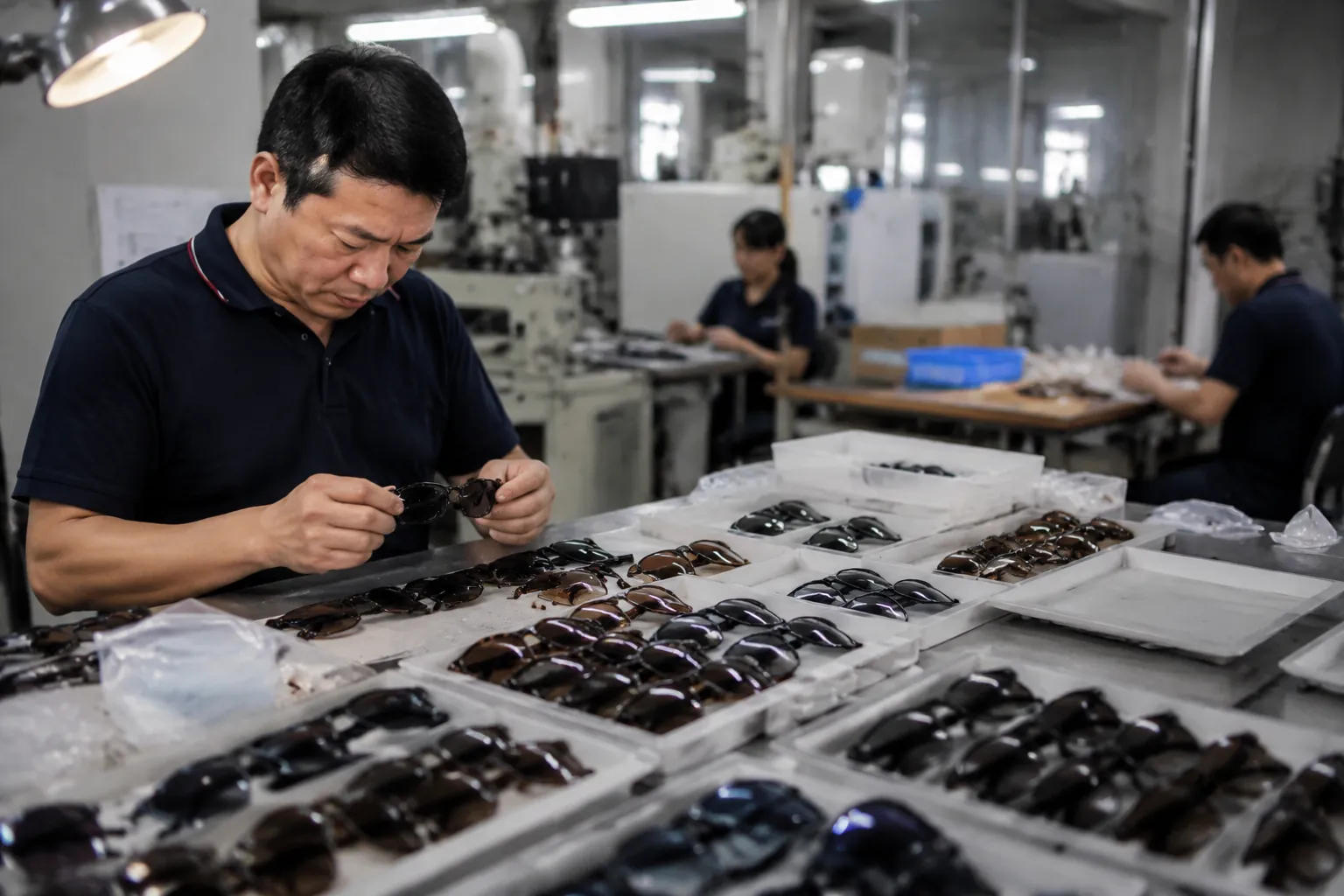
Good lens specification is only useful if the factory can repeat it. In a typical eyewear workflow, lens-related work sits inside a broader process that may include frame forming, cutting, tinting, decoration, assembly, and QC. Defects often come from handoffs between steps rather than from one machine alone. A lens can pass in production and still fail later if the frame groove, coating cure, or packing method is wrong.
In a standard workflow, the factory first confirms the base material and lens color standard against the approved sample. Next it runs tinting or coating on the specified batch, not mixed lots. Then it checks optical clarity, color consistency, and surface defects under controlled light. After that, the lens is verified in the frame groove or rim before final assembly. Finally, packing inspection makes sure mirrored or coated surfaces are not rubbed, scuffed, or contaminated during bagging and carton loading.
Buyers should ask for a pre-production sample and then compare bulk output against that approved standard. If the spec includes mirror finish, ask for extra packaging protection such as lens film, pouch separation, or carton dividers. If the spec includes polarization, make sure the approval sample reflects the exact final tint, because changing from gray to brown can alter the visual impression even when the feature still functions correctly.
Typical control points include lens thickness uniformity, surface finish, tint density, and alignment between left and right lenses. Many buyers do not ask for numbers, but factories still work to internal tolerances. A practical QC conversation should cover tint shade tolerance, acceptable surface defect criteria, and whether a cosmetic mark can be seen under white light at normal inspection distance. If the buyer wants tighter standards, state that before production, not after inspection.
Decoration also matters. If the lens stack is paired with logo printing, hot stamping, laser marking, or pad printing, the ink or foil must be tested for adhesion and compatibility with the coating. A lens can be technically acceptable but still fail the product brief if a logo smears or scratches during packing. This is especially important on mirror surfaces, where decorative marks are more visible than on plain tints.
Samples usually take 7–10 days when the spec is stable. Bulk production is often 25–35 days, depending on order size, material availability, and whether the job triggers re-sampling. If you change lens color late, expect the schedule to move. That is the normal cost of changing optical input after the line is set.
Compliance and Claims You Can Stand Behind
For overseas markets, lens claims need to match the target standard. The safest path is to anchor the product to the right compliance set before launch. Common real-world references include CE EN ISO 12312-1, FDA registration, ANSI Z80.3, AS/NZS 1067, REACH, ISO 9001, and BSCI. The buyer still needs to confirm which apply to the destination market and the specific product file.
Do not write broad claims that the product cannot support. If you sell into Europe, the spec and test path must fit CE EN ISO 12312-1. For the United States, make sure the product file aligns with FDA expectations and any relevant testing requirements. For Australia and New Zealand, AS/NZS 1067 matters. If you ship to multiple markets, build one base spec that can support the strictest applicable requirement, then manage labeling and paperwork by destination.
REACH is not a lens feature. It is a chemical compliance issue. Tint chemistry, coatings, and decoration inks all matter. If you add mirror coating or pad printing, confirm that those materials are within scope. A product can look fine and still fail on restricted substances. That is a supply-chain issue, not a design issue.
Claims discipline matters too. UV400, polarized, and mirror coating should be stated only when they are tested and documented. If the buyer cannot support the claim with product documentation, it should not appear on hangtags, listings, or retailer sheets. A clean claim set is usually better than an ambitious one because it reduces disputes when a retailer audits packaging or requests support files.
If the same SKU will ship to multiple destinations, build the spec around the strictest applicable requirement and then use market-specific labeling to keep the file clear. That is usually easier than running separate product logic for each country. It also reduces the chance that a small wording difference causes a compliance review or customs delay.
Buyer Checklist Before the PO
Before you order, lock the lens spec in writing. Use the same terms in the tech pack, sample approval, carton marks, and test request. If one document says gray polarized and another says smoke lens, confusion is almost guaranteed. If the factory cannot quote against one clear statement, the line will likely guess somewhere.
- Define the market: fashion, driving, promo, sports, or mixed retail.
- State the exact lens stack: UV400 only, UV400 plus polarization, or UV400 plus mirror.
- Approve one master sample for color, reflection level, and finish.
- Confirm the compliance target: CE EN ISO 12312-1, FDA registration, ANSI Z80.3, AS/NZS 1067, or REACH where relevant.
- Set the packaging requirement for mirrored lenses to reduce rub damage.
- Ask for a clear MOQ and price ladder at 50, 300, 1000, and 5000+ pairs.
- Confirm sample lead time of 7–10 days and bulk lead time of 25–35 days.
- Ask whether decoration methods such as printing or stamping are compatible with the selected coating.
Confirm a few practical details before release: target visible light transmission, acceptable shade tolerance, whether left and right lenses must match under the same daylight lamp, and whether the supplier will keep the same material batch for the full order. Those are small questions. They prevent expensive surprises later.
If you need multiple markets, do not create one oversized SKU with every feature packed into it. Split the line. That usually gives better price control, cleaner inventory, and fewer complaints from customers who only wanted one thing: good-looking sunglasses that work as promised.
Have a custom sunglasses project in mind?
Send us your styles, target market and quantities and we will return a detailed quote with MOQ, lead time and a sample plan.
Get a QuoteWhy source this from Wenzhou with LumiShades
Wenzhou in Zhejiang Province is widely regarded as China’s eyewear manufacturing capital, producing a large share of the world’s sunglasses. That concentration matters to buyers: a deep local supply chain for acetate sheet, hinges, lens blanks, plating and packaging means shorter component lead times, easier color and material matching, and a workforce with decades of eyewear-specific skill. LumiShades has manufactured in this ecosystem since 2009, and our vertical integration — in-house injection molding, acetate cutting, CNC milling, lens tinting, decoration and quality control — means no part of your order is quietly subcontracted to a workshop you cannot audit.
For international buyers, that vertical control translates into accountability. When a single factory owns every step, defects are traced and fixed at source rather than bounced between vendors, and your specifications survive intact from first sample to bulk. For procurement review, buyers can request process records, approved samples, quality checkpoints and project-specific compliance files before placing a bulk order. Required testing and documentation are confirmed against the destination market and product specification rather than assumed from a generic certificate list. Explore our manufacturing capabilities and quality control process to see how this works in practice.
Frequently asked questions
Do I need polarized lenses for every sunglasses order? No. Use polarization when the customer will clearly value glare reduction, such as driving, fishing, boating, and outdoor utility. For fashion or promo lines, UV400 plus a plain tint is often the better cost-to-value choice, especially when the channel is price sensitive.
Is UV400 enough for most retail sunglasses? UV400 is the baseline, but it is not the whole sourcing decision. The lens still needs to be tested, documented, and matched to the destination market's compliance path. Ask the supplier for the exact test record, approved sample, and market-specific paperwork before you approve production.
Does mirror coating improve sun protection? No. Mirror is a visual finish, not a replacement for UV protection or polarization. It can change the look and sometimes reduce brightness slightly depending on the base lens, but claims should still rely on the tested UV performance of the full lens stack.
What is the safest spec if I sell into several countries? Start with a UV400 lens that can support the strictest applicable compliance requirement for your markets, then add polarization or mirror only where the channel pays for it. Keep the core lens platform consistent so testing, reorders, and QC stay predictable.
How do I avoid surprises on a custom lens order? Approve one master sample, freeze the lens wording in the tech pack, and confirm the test standard before mass production. Also lock the visible light transmission target, packaging method, and decoration compatibility. If the lens changes after sample approval, expect cost, lead time, and color-consistency risk to move with it.
Ready to start?
Explore our cat-eye sunglasses or request a quote — our sales team replies within 12 hours.
Request a Quote