
UV400 Custom Sunglasses: What Bulk Buyers Must Specify
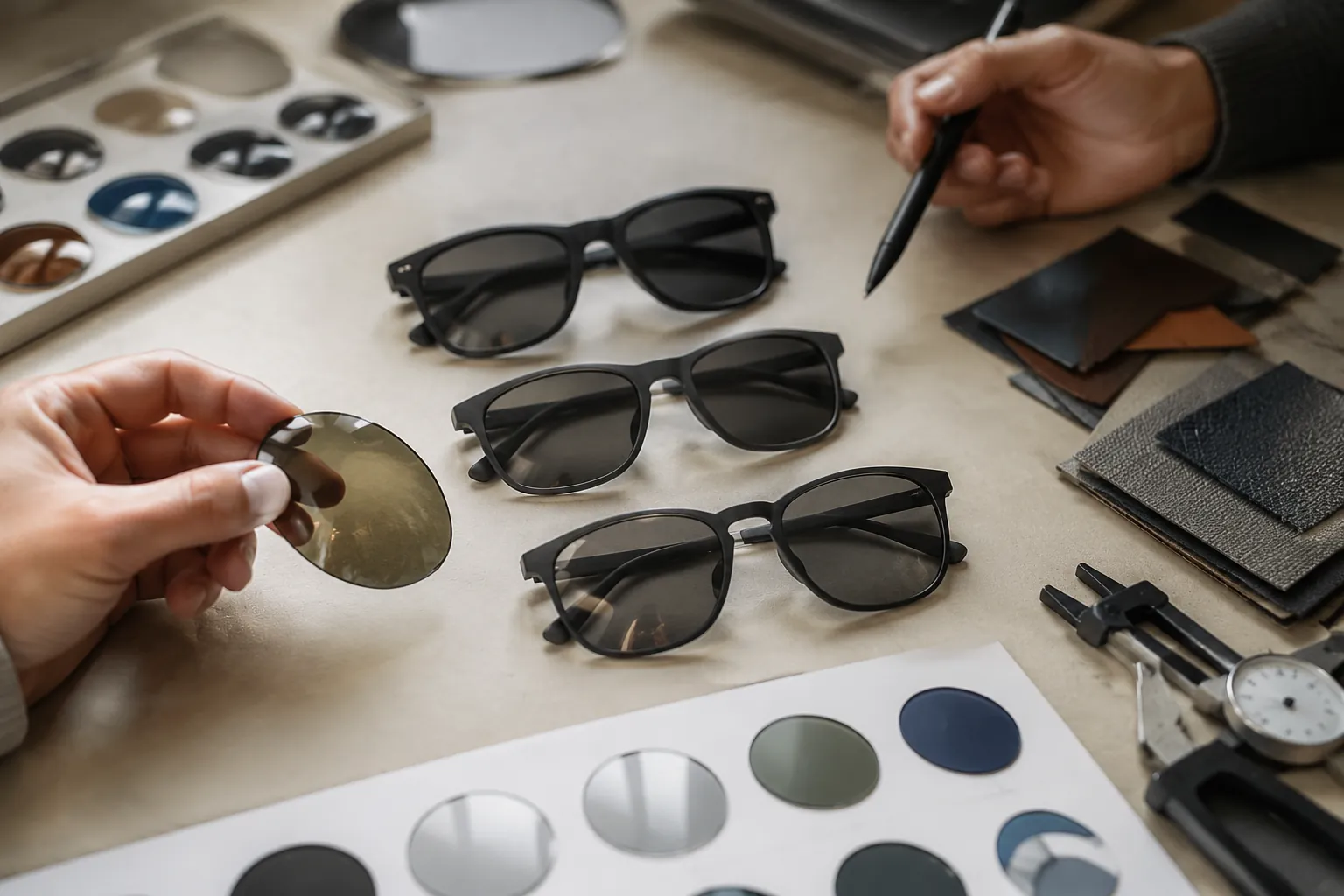
This guide is for brands, importers, distributors, and retailers buying custom sunglasses in volume. It covers the purchasing details behind a UV400 claim: what to specify, which standard fits the sales market, how lens constructions behave in production, and where paperwork or cosmetic mismatches usually start. The aim is simple: reduce sample-to-bulk drift, avoid compliance surprises, and make the handoff from design brief to mass production easier to control.
UV400 Is A Claim, Not A Full Specification
Many buyers treat UV400 as if it settles lens performance. It does not. In general use, UV400 means the lens is intended to block ultraviolet radiation up to 400 nanometers, covering UVA and UVB. That matters. It still does not tell you which lens material is used, whether UV protection comes from the substrate or a coating, which finished-product standard was used for evaluation, or whether the approved sample and the production lot will match.
For procurement, the real question is not Does this sunglass have UV400? It is How is UV protection achieved, under which standard, on which lens material and tint, and how will that be controlled across production lots?
A workable purchase brief should separate four points clearly:
- Protection claim: UV400 or another defined UV cutoff requirement.
- Compliance target: CE EN ISO 12312-1 for Europe, ANSI Z80.3 for the US, AS/NZS 1067 for Australia and New Zealand, plus REACH where chemical substance restrictions are relevant.
- Lens construction: PC, TAC polarized, nylon, CR-39, or acrylic, including nominal thickness, tint, mirror, hard coat, or anti-reflective back coat.
- Verification method: sample report, in-process quality checks, and shipment documents tied to the approved style.
If those points stay vague, the supplier fills the gaps. One factory may quote molded PC with UV absorbers in the material. Another may quote acrylic with a surface treatment. Both may be described as UV400. The sample may look similar. The durability, consistency, and paperwork quality may not.
What Buyers Should Put On The PO
If you want the UV claim to survive sampling, quality control, customs review, and retailer onboarding, the purchase order needs more than one line that says UV400 lens. Keep it measurable. Tie it to the finished product.
For a standard sunglass project, the PO should state lens material, nominal thickness, visible light transmission category where relevant, UV requirement, test standard, decoration method, and cosmetic tolerance. If the style is polarized, add a polarization requirement. If the frame has a heavy wrap angle, small eye size, or light tint, flag that at quotation stage. Those details can affect optical performance, labeling, and yield.
- Lens material and thickness: for example injection-molded PC, TAC polarized, or CR-39, with nominal thickness stated.
- UV requirement: UV400, with the finished product evaluated to the destination-market standard.
- Standard: CE EN ISO 12312-1, ANSI Z80.3, or AS/NZS 1067 depending on sales market.
- Lens color and category: for example smoke, brown gradient, or a light fashion tint, with transmission category or use limitation where required.
- Coatings: hard coat, mirror, anti-reflective back coat, or no coating.
- Defect limits: scratch visibility, bubble or black-dot tolerance, edge chip limit, and color variation against approved sample.
- Decoration: pad print, laser logo, metal logo plate, foil print, or inside-temple print, including placement tolerance.
A practical cosmetic standard for mass-market sunglasses often states no visible scratches under defined inspection conditions, no edge chips visible from the front, lens color matched to the master sample, and logo placement held within an agreed tolerance. Serious buyers also define the approval sequence: lens swatch first, then complete prototype, then pre-production sample for larger orders or multi-color runs.
That sequence matters. A lens can pass early evaluation and still shift after changes to tint concentration, mirror color, or coating settings made for bulk efficiency. If several subcontractors are involved, tracing that change gets slow and expensive.
Standards Must Match The Sales Market
Buyers often ask for every certificate listed on a factory website. That is weak procurement. Ask for the standard that fits the destination market and product type, then confirm that the report is relevant to the actual lens construction or finished style.
For sunglass purchasing, these are the references that usually matter:
| Requirement | What It Covers | Typical Buyer Use |
|---|---|---|
| CE EN ISO 12312-1 | General-use sunglasses sold into Europe | Used to assess UV transmission, filter category, labeling, and related product-performance requirements for EU distribution |
| ANSI Z80.3 | Non-prescription sunglasses and fashion eyewear for the US market | Used as a product standard for lens performance, impact-related requirements where applicable, and labeling expectations in US programs |
| AS/NZS 1067 | Sunglasses and fashion spectacles for Australia and New Zealand | Relevant when selling into Australia or New Zealand and when local category and labeling requirements apply |
| REACH | Chemical substance restrictions for materials and coatings in the EU context | Relevant for frames, paints, soft-touch coatings, nose pads, and metal trims entering Europe |
| FDA registration | US establishment registration context sometimes held in supplier files | Supporting supply-chain document only; not proof that a sunglass style meets CE EN ISO 12312-1, ANSI Z80.3, or AS/NZS 1067 |
| ISO 9001 | Quality management system certification | Useful for supplier qualification and process review, but not a substitute for product-level test evidence |
| BSCI | Social compliance audit framework | Useful for supplier screening and retailer onboarding where social compliance is required |
One rule helps. A factory certificate list is not the same as an SKU-specific compliance file. ISO 9001 and BSCI can support supplier selection. FDA registration may appear in importer files. None of them proves that a specific smoke lens, gradient lens, or mirrored lens in a specific frame meets the product standard required for that market.
Ask whether the report applies to the approved sample, the same lens material, the same tint family, or at minimum the same product class. That question filters out a lot of generic paperwork fast.
Lens Materials Behave Differently In Production
UV protection can come from the lens resin itself, from additives mixed into the substrate, from surface coatings, or from a combination. Buyers should care. The method affects durability, lot consistency, edge performance, and cost.
| Lens Material | Typical Use | Production Strength | Buyer Risk Point |
|---|---|---|---|
| PC | Volume fashion and sports styles | Light weight, impact resistant, and efficient for injection molding; UV control is often incorporated into the material system | Can show stress marks or optical distortion if molding, edging, or assembly pressure is poorly controlled |
| TAC polarized | Programs that want glare reduction through a polarized laminated lens | Delivers a polarized feature that is easy to position at retail | Laminated construction can show edge separation, rippling, or delamination if process control is weak |
| CR-39 | Programs prioritizing lens clarity and appearance | Known for good optical quality in many sunglass applications | Usually higher cost and less common in low-volume fashion programs |
| Nylon | Performance and wrap frames | Good toughness and design flexibility for sporty shapes | Material and processing requirements are usually higher than basic fashion-lens options |
| Acrylic | Entry-price fashion eyewear | Lower raw-material cost | More risk around scratch resistance, coating adhesion, and consistency across lots |
Polycarbonate is common in volume programs because it is light, impact resistant, and efficient to mold at scale. TAC polarized lenses are common when buyers want a stronger polarized retail story, but the laminated structure means edge finishing and sealing matter more. Poor trimming or aggressive assembly pressure can create whitening at the edge or later separation.
CR-39 and nylon suit more technical or higher-spec programs, but they usually increase cost and may not fit a low-MOQ private-label launch. Acrylic can lower the opening price. It also calls for harder questions about scratch performance, coating adhesion, and repeatability from sample to bulk.
Process flow changes by material too. Molded PC may move through coating, tint, mirror treatment, edging, cleaning, and assembly. TAC adds lamination-control concerns. Acrylic may need closer cosmetic sorting because yield can vary more. Specify the full lens stack, not just the color.
Where UV400 Orders Usually Fail
Most sourcing failures around UV400 are not dramatic. They are small specification gaps that pile up during production.
- Sample passed, bulk drifted: the tint formula, UV additive batch, or mirror recipe changed after sample approval.
- Paperwork mismatch: the supplier sends a general report unrelated to the sold style, lens thickness, or final coated version.
- Wrong market standard: the buyer asked only for UV400 and later learns that the retailer requires CE EN ISO 12312-1 alignment, ANSI Z80.3, or AS/NZS 1067 with specific labeling.
- Coating changed appearance: a hard coat or mirror layer shifts color, reflection, or haze, but the buyer approved only the uncoated lens.
- Edge cracking or stress: lens bevel depth, frame groove, and assembly force do not match the lens material, especially on sharp fashion shapes or wrapped styles.
- Light tint confusion: the buyer wants a pale fashion lens and assumes it can be sold and labeled the same way as a dark sunglass lens in every market.
The fix is practical. Approve the actual finished lens stack, not just a tint chip. Confirm whether the document package must cover the finished product or the lens substrate. During pre-production, check lens color, transmission category where relevant, logo placement, hinge function, and assembly stress.
At factory level, disciplined control usually means incoming material inspection, molding or cutting inspection, tinting record, coating inspection, edging verification, assembly fit check, cosmetic inspection, and spot checks for UV or transmission during quality control. If any one of those steps changes, the claim should be rechecked, not assumed.
Cost, MOQ, And Lead Time
UV400 itself is usually not the main cost driver. Larger cost changes come from lens material, polarization, coating complexity, tooling, packaging, and the number of colorways approved in one order.
For low-MOQ custom orders, unit cost stays high because setup, color matching, artwork preparation, and quality-control overhead are spread over very few pieces. As order volume increases, those fixed costs are absorbed more efficiently and suppliers may have more room to standardize material planning and line scheduling. The exact breakpoints vary by supplier, frame construction, lens program, and packaging scope, so buyers should ask for a quoted ladder by quantity instead of relying on rough assumptions.
| Order Stage | Typical Buyer Goal | Cost Logic | Lead-Time Effect |
|---|---|---|---|
| Low MOQ trial order | Market test, capsule launch, or sample retail run | Highest unit cost because setup and inspection cost are spread across a small quantity | Can move quickly if specification complexity stays limited |
| Small wholesale order | Early account testing or regional launch | Better absorption of tooling, printing, and QC setup than trial quantities | More stable for custom lens tint, logo print, and standard packaging |
| Mid-volume core style | Established retail program | Better material utilization and clearer per-piece cost reduction | Usually easier to plan around production scheduling and raw-material allocation |
| Large-volume chain or distributor order | National retail or distributor volume | Best pricing leverage when construction, packaging, and approval status are stable | Requires earlier raw-material booking and tighter QC scheduling |
Lead time shifts with construction too. Straightforward styles using standard materials and colors usually move faster than programs using polarized TAC, custom mirror colors, multiple lens categories within one frame family, metal logo plates, or custom packaging from outside vendors.
Decoration method affects both cost and timing. Pad print is commonly the most economical temple-logo option. Laser marking depends on material response and surface finish. Metal logo plates can improve perceived value, but they also add tooling, assembly steps, and rework risk if the artwork changes late. Lock the lens stack and logo method early. That is how schedule risk stays manageable.
A Practical One-Page Spec Sheet
Buyers do not need an engineering dossier for every fashion sunglass order. They do need a clean one-page lens and decoration section that can be approved without guesswork.
A useful specification block should include:
- Lens material and thickness: for example PC, TAC polarized, or nylon, with nominal thickness.
- UV requirement: UV400.
- Compliance target: CE EN ISO 12312-1, ANSI Z80.3, or AS/NZS 1067 as required by destination market.
- Lens color reference: internal visual code plus an approved physical sample as master standard.
- Transmission category or use note: especially important for lighter tints, darker categories, or any driving-related limitation.
- Coatings: hard coat, mirror finish, anti-reflective back coat, or no additional coating.
- Polarization: yes or no, with the required verification method if applicable.
- Decoration: pad print, laser, hot stamp, or metal trim, with artwork size and placement tolerance.
- Cosmetic standard: acceptable scratch, dot, streak, color variation, and edge-defect limits at a defined inspection distance and lighting condition.
- Document requirement: test report, shipment file, carton marks, barcode labels, and any market-specific warning text or user information required by the buyer.
If a team sells across multiple markets, it is often smarter to build separate SKUs when labeling or compliance requirements differ. Do not assume one generic UV400 sunglass can be sold everywhere with identical packaging and claims. That mistake gets expensive once private-label branding has already been printed, engraved, or assembled.
The cheapest time to fix a sunglass program is before mass decoration starts. After that, every correction hits labor, scrap, packaging, and freight timing.
How To Buy Without Getting Burned
A good sourcing flow is simple. It just needs discipline.
- Start with market destination. Define where the goods will be sold before asking for tests, labels, or warnings.
- Choose lens construction by use and price. PC often suits value-volume programs; TAC polarized adds glare reduction; nylon or CR-39 fits more specialized programs.
- Approve the finished lens stack. Do not approve only frame shape or a raw color chip.
- Request relevant test documents. Match them to market, lens construction, and ideally the approved style or a directly comparable sample.
- Lock the bulk standard in writing. Tie production to the approved sample, spec sheet, artwork, and packaging file.
- Run pre-shipment QC on finished goods. Include lens appearance, assembly stress, decoration position, carton marks, and document completeness.
Ask short, exact questions. Which lens material is being quoted? Which standard is the UV claim tied to? Is the approved sample made with the same lens construction and decoration method as bulk? Is the test report style-specific, material-specific, or only a general reference file?
Routine questions. Expensive problems avoided.
Have a custom sunglasses project in mind?
Send us your styles, target market and quantities and we will return a detailed quote with MOQ, lead time and a sample plan.
Get a QuoteWhy source this from Wenzhou with LumiShades
Wenzhou in Zhejiang Province is widely regarded as China’s eyewear manufacturing capital, producing a large share of the world’s sunglasses. That concentration matters to buyers: a deep local supply chain for acetate sheet, hinges, lens blanks, plating and packaging means shorter component lead times, easier color and material matching, and a workforce with decades of eyewear-specific skill. LumiShades has manufactured in this ecosystem since 2009, and our vertical integration — in-house injection molding, acetate cutting, CNC milling, lens tinting, decoration and quality control — means no part of your order is quietly subcontracted to a workshop you cannot audit.
For international buyers, that vertical control translates into accountability. When a single factory owns every step, defects are traced and fixed at source rather than bounced between vendors, and your specifications survive intact from first sample to bulk. We back this with 15+ years of experience, shipments to 60+ countries, more than 5 million pairs produced per year and a 98.5% on-time delivery rate. Our certifications — CE EN ISO 12312-1, FDA registration, ANSI Z80.3, AS/NZS 1067, REACH, ISO 9001 and BSCI audit — mean the compliance documentation your market requires already exists. Explore our manufacturing capabilities and quality control process to see how this works in practice.
Frequently asked questions
Is UV400 enough for selling sunglasses in Europe? No. UV400 is only a UV-protection claim. For sunglasses sold into Europe, buyers should verify alignment with CE EN ISO 12312-1 and confirm that the labeling, technical file, and approved production item are consistent. Before bulk approval, ask the supplier which report applies to the style, whether the report reflects the same lens construction and tint, and what user information or warnings must appear in packaging or accompanying documents.
Can a clear or very light fashion lens still be called UV400? Possibly, yes, if the lens blocks ultraviolet radiation to the required cutoff. That still does not settle marketability on its own. Very light lenses can raise separate issues around visible light transmission category, product classification, use limitations, and labeling under the applicable market standard. Buyers should approve the exact finished lens, request the relevant test evidence, and confirm how the product must be labeled before committing to bulk packaging.
Does polarization mean better UV protection? No. Polarization and UV protection are different performance points. Polarization reduces reflected glare. UV protection concerns transmission in the ultraviolet range. A polarized TAC lens can be compliant on both points, on one point, or on neither if the specification and testing are unclear. Buyers should state polarization as a separate requirement on the PO and ask for the applicable product-standard report for the actual lens construction.
What should I ask for before approving bulk production? Ask for the final pre-production sample made with the exact bulk lens material, tint, coating, and decoration method. Ask for the applicable test documentation, approved artwork, packaging file, labeling text, and a written specification sheet tied to the PO. Also confirm whether any late process change, such as mirror color adjustment, coating substitution, or lens-material change, triggers a new approval or retest requirement.
How do MOQ and price usually change on custom sunglasses? At low MOQs, unit cost is higher because setup, decoration preparation, sampling, and quality-control overhead are spread across fewer units. As volume increases, suppliers can usually allocate those fixed costs more efficiently and may offer better pricing if the construction and packaging stay stable. Buyers should request a quantity-based quotation ladder, ask which cost drivers change with volume, and confirm whether lens material, polarization, coating, and packaging are included in each quoted tier.
Ready to start?
Explore our rimless sunglasses or request a quote — our sales team replies within 12 hours.
Request a Quote