
5 Sunglass Frame Assembly Methods for Buyers
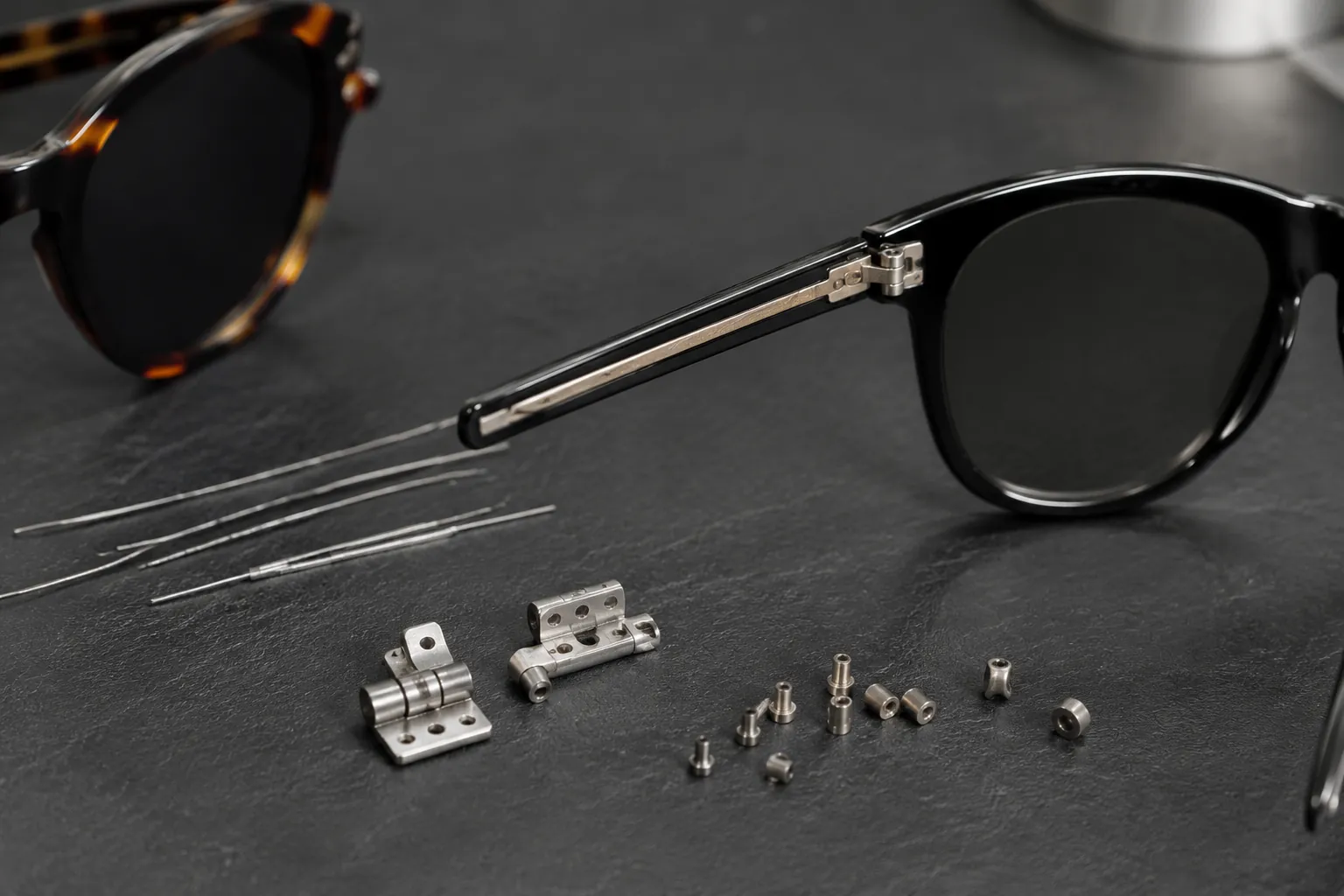
For brands, importers, distributors, and retailers buying custom sunglasses in volume, the assembly method is not a small detail. It affects defect risk, repairability, unit cost, and the speed from sample approval to bulk production. This guide compares the main frame assembly routes used in acetate, injection, metal, and hybrid builds, with the trade-offs that matter in procurement. It also explains how in-house tooling, molding, cutting, CNC, tinting, and QC can affect process control.
1. What assembly method actually controls
Most buyers start with lens tint, color, and logo placement. Those matter. But they are not usually where production fails first. Assembly controls how many parts must be aligned, bonded, riveted, screwed, or heat-set before a frame is stable enough to ship. More touch points usually mean more variation.
For sunglasses, the assembly route affects hinge alignment, temple swing, lens retention, stress whitening, screw loosening, and the chance a frame survives packing and transit. A clean sample can still fail in bulk if the sequence is not stable.
MOQ and lead time should be discussed with the factory using actual capacity, not sales language. At low volume, manual fitting and finishing can dominate cost and timing. At higher volume, repeatability and process control matter more. Sample timing and bulk timing depend on the design, the materials, the mold or cutting path, and whether specifications are frozen before production starts.
The rule is simple. Fewer assembly variables usually means fewer defects. That is not always the best design choice, though. Some styles need premium surface detail, custom metal work, or replaceable hardware. Then the extra steps are part of the product, not a mistake.
2. Method 1: Full acetate build with riveted hinges
Full acetate frames are still common for fashion-led custom sunglasses. The usual process is acetate sheet cutting, CNC shaping, edge finishing, hinge placement, rivet setting, lens fitting, and final polishing. If hinge holes or block placement are off, the whole batch can be affected.
This method is strong on perceived value and color depth. It also gives room for design changes because front shape, temple thickness, and surface finish can be adjusted without rebuilding a full metal tooling stack. The trade-off is labor. Acetate needs controlled heat and careful manual fitting. If temperature, timing, or finishing sequence drifts, the result can be warpage, stress marks, or inconsistent temple action.
Watch for these failure modes:
- Hinge holes drifting out of position, which causes uneven temple closing.
- Lens grooves cut too tight, which can crack lenses during press-fit.
- Polish burn on edges, which shows up fast on dark colors.
- Rivet heads sitting proud, which can affect appearance and packaging fit.
Acetate works best when the order needs strong color options, a premium shelf feel, and moderate design complexity. It is not usually the lowest-cost route. It is often the most forgiving route for branded retail programs.
3. Method 2: Injection-molded frame assembly
Injection frames are built for repeatability. Fronts and temples come out of the mold close to final shape, then get trimmed, assembled, and checked. For high-volume programs, this is often the most efficient path once the mold is stable. Part-to-part consistency is the point.
The main advantage is control. If the mold is correct, operators are not forcing parts into position. That reduces stress on the parts and shortens line adjustments. An in-house injection setup can help because mold corrections, gate tuning, and cosmetic fixes can be handled without sending work to another supplier. Feedback is faster. Problems show up earlier.
Injection frames do have limits. Thin walls can warp. Poor cooling can create sink marks. Overpacked hinges can fail later. Resin selection also matters. Low-grade material may feel brittle or unstable in use. Buyers should ask which resin is being used, how the hinge is anchored, and whether temple action has been cycle-tested before bulk approval.
This method suits recurring programs, promotional orders, and price-sensitive retail where consistency matters more than hand-finished character. It is also easier to scale once the design is fixed.
4. Method 3: Metal frame assembly with soldered or riveted joints
Metal frames use a different assembly logic. The line may include wire forming, nose pad mounting, temple hinging, soldering or welding, lens rim setting, and screw hardware. Compared with acetate, the focus shifts from shaping plastic to keeping many small parts aligned.
The upside is light weight and a cleaner technical look. The downside is sensitivity to alignment and finish quality. A small hinge error is immediately visible in the open-close feel. Solder overflow, surface scratches, and plating defects can turn into rejects quickly. Repairs are harder, too. Once plating or coating is damaged, touch-up is rarely invisible.
Metal frames make sense when the design needs thin profiles, adjustable nose pads, or a more formal retail position. They are less forgiving than acetate in assembly, so the factory needs disciplined fixtures and final inspection. A supplier with in-house CNC, QC, and decoration can usually control the process better than a trading setup that outsources most steps.
Buyers should ask how hardware is sourced, how plating is verified, and how screws are secured. Loose hardware is one of the most common post-shipment complaints in metal eyewear. It is a small problem that becomes expensive later.
5. Side-by-side comparison
| Method | Lead-time behavior | Defect risk | Repair risk | Best fit |
|---|---|---|---|---|
| Acetate with riveted hinges | Moderate; polishing and fitting add manual time | Medium; sensitive to drilling and heat control | Medium; hinges and lenses can sometimes be reworked | Fashion retail, color-heavy programs, premium feel |
| Injection molded assembly | Fast once the mold is stable; best for repeat runs | Low to medium; depends on mold quality and resin | Low; many failures are batch-level rather than field-fixable | Volume retail, promo orders, stable SKUs |
| Metal soldered or riveted build | Moderate to slow; more inspection and hardware control | Medium to high; alignment and plating are critical | Low; cosmetic damage is hard to hide | Lightweight, technical, or higher-end metal programs |
| Hybrid acetate-metal assembly | Usually slower; two material systems to manage | Medium; interface issues are common | Medium; some parts can be replaced, some cannot | Fashion styles that need mixed-material appearance |
One thing this table hides: the cheapest-looking assembly route is not always the cheapest landed cost. If the method creates rework, extra QC, or replacement pairs, the unit-price advantage disappears quickly. Fast is not free. Neither is pretty.
6. How to choose by order size and risk
Start with volume. At 50 to 300 pairs per design, you want an assembly method that tolerates manual work and small design tweaks. At 1000 pairs and above, consistency matters more than artisanal finishing. At 5000 pairs and above, the line needs to behave like a repeatable process, not a custom bench.
- Choose acetate if the order needs premium color, thicker temples, or a stronger retail presentation.
- Choose injection if speed, repeatability, and cost stability matter most.
- Choose metal if the design requires thin profiles, adjustable pads, or a lighter build.
- Avoid hybrid construction unless the design really needs it. Mixed-material styles add failure points at the interface.
The other issue is change control. If the buying team keeps changing logo placement, temple finish, lens tint, or packaging after approval, any assembly method becomes harder to control. Freeze the specification before bulk.
Sample and bulk timing depend on the method, the amount of customization, and whether the factory has already stabilized tooling or cutting data. A supplier can only hold a quoted schedule when the design is locked early and production variables stay fixed.
7. Compliance and QC checkpoints
Assembly quality does not replace compliance. It sits on top of it. For export programs, buyers should ask for the specific standard that matches the target market. Common references include CE EN ISO 12312-1, ANSI Z80.3, AS/NZS 1067, REACH, FDA registration, ISO 9001, and BSCI where relevant to the supply chain.
The QC checkpoints that matter most are straightforward:
- Hinge opening and closing force.
- Temple symmetry and front alignment.
- Lens seating pressure and edge chip rate.
- Surface finish around logos, plates, and pad-print areas.
- Packaging abrasion after carton vibration and transit handling.
For acetate, watch for lens crack points and polishing defects. For injection, watch for sink, flash, and gate marks. For metal, watch for weld cleanup, plating scratches, and loose screws. The factory should catch these before shipment, not after a retailer opens the cartons.
A serious supplier should provide pre-production samples, an approved reference sample, and written QC criteria. If the assembly method is more complex, the inspection plan should be tighter, not looser.
8. Buyer takeaways before you place the order
The right assembly method is the one that fits your price band, volume, and tolerance for rework. There is no universal winner. Acetate gives the strongest visual value. Injection gives the cleanest repeatability. Metal gives a lighter, more technical product, but it is less forgiving.
If you are comparing suppliers, ask for the actual process route, not vague promises. Ask how hinges are set, how lenses are retained, how many QC checks happen before packing, and what happens if temple alignment drifts during production. That tells you more than a product photo ever will.
For buyers working with a factory that controls tooling, molding, cutting, finishing, and QC in-house, the useful question is not only what styles are available. It is whether the method fits the order size, the compliance requirements, and the tolerances the factory can hold at your target quantity. That is what separates a stable bulk run from one that creates claims and credits.
Do not buy sunglasses assembly by appearance alone. Buy the process that can survive your order size, your compliance needs, and your return policy.
Have a custom sunglasses project in mind?
Send us your styles, target market and quantities and we will return a detailed quote with MOQ, lead time and a sample plan.
Get a QuoteWhy source this from Wenzhou with LumiShades
Wenzhou in Zhejiang Province is widely regarded as China’s eyewear manufacturing capital, producing a large share of the world’s sunglasses. That concentration matters to buyers: a deep local supply chain for acetate sheet, hinges, lens blanks, plating and packaging means shorter component lead times, easier color and material matching, and a workforce with decades of eyewear-specific skill. LumiShades has manufactured in this ecosystem since 2009, and our vertical integration — in-house injection molding, acetate cutting, CNC milling, lens tinting, decoration and quality control — means no part of your order is quietly subcontracted to a workshop you cannot audit.
For international buyers, that vertical control translates into accountability. When a single factory owns every step, defects are traced and fixed at source rather than bounced between vendors, and your specifications survive intact from first sample to bulk. We back this with 15+ years of experience, shipments to 60+ countries, more than 5 million pairs produced per year and a 98.5% on-time delivery rate. Our certifications — CE EN ISO 12312-1, FDA registration, ANSI Z80.3, AS/NZS 1067, REACH, ISO 9001 and BSCI audit — mean the compliance documentation your market requires already exists. Explore our manufacturing capabilities and quality control process to see how this works in practice.
Frequently asked questions
Which assembly method is best for 300 to 1000 pair runs? It depends on the design and the priority. For premium appearance and richer color, acetate is often the better fit. For repeatability and lower labor variation, injection is usually the better choice. Ask the supplier which method will hold alignment and finish most consistently at your exact quantity, then confirm with a pre-production sample.
What defect should I watch first in metal frames? Start with hinge alignment and loose hardware. If the frame opens or closes unevenly in hand, the batch needs closer inspection. Also check plating quality, because scratches and finish defects are often the first visible sign of process drift.
Can a supplier really keep bulk lead time at 25 to 35 days? A factory can only hold that kind of schedule when the specification is frozen, the tooling or cutting path is stable, and the assembly route is already proven for that style. Any late change to frame finish, logo placement, lens tint, or packaging can extend the timeline.
How does MOQ affect assembly choice? At low MOQ, you want a method that can tolerate more manual fitting and small setup adjustments. At higher MOQ, the advantage shifts toward the method that gives the most repeatable output with the least rework. In practice, acetate often suits smaller fashion-led runs, while injection becomes more attractive as volume rises and the design stays fixed.
What compliance documents should I ask for on export orders? Ask for the documents that match the market you are selling into: CE EN ISO 12312-1 for the EU market, ANSI Z80.3 for the U.S. market where applicable, AS/NZS 1067 for Australia and New Zealand, REACH for chemical compliance in the EU, FDA registration where relevant to the U.S. supply chain, and ISO 9001 or BSCI if you need quality-system or social compliance evidence. Do not accept a generic statement in place of the actual document.
Ready to start?
Explore our sport wrap sunglasses or request a quote — our sales team replies within 12 hours.
Request a Quote