
TR90 vs Acetate vs Metal for Prescription Sunglasses
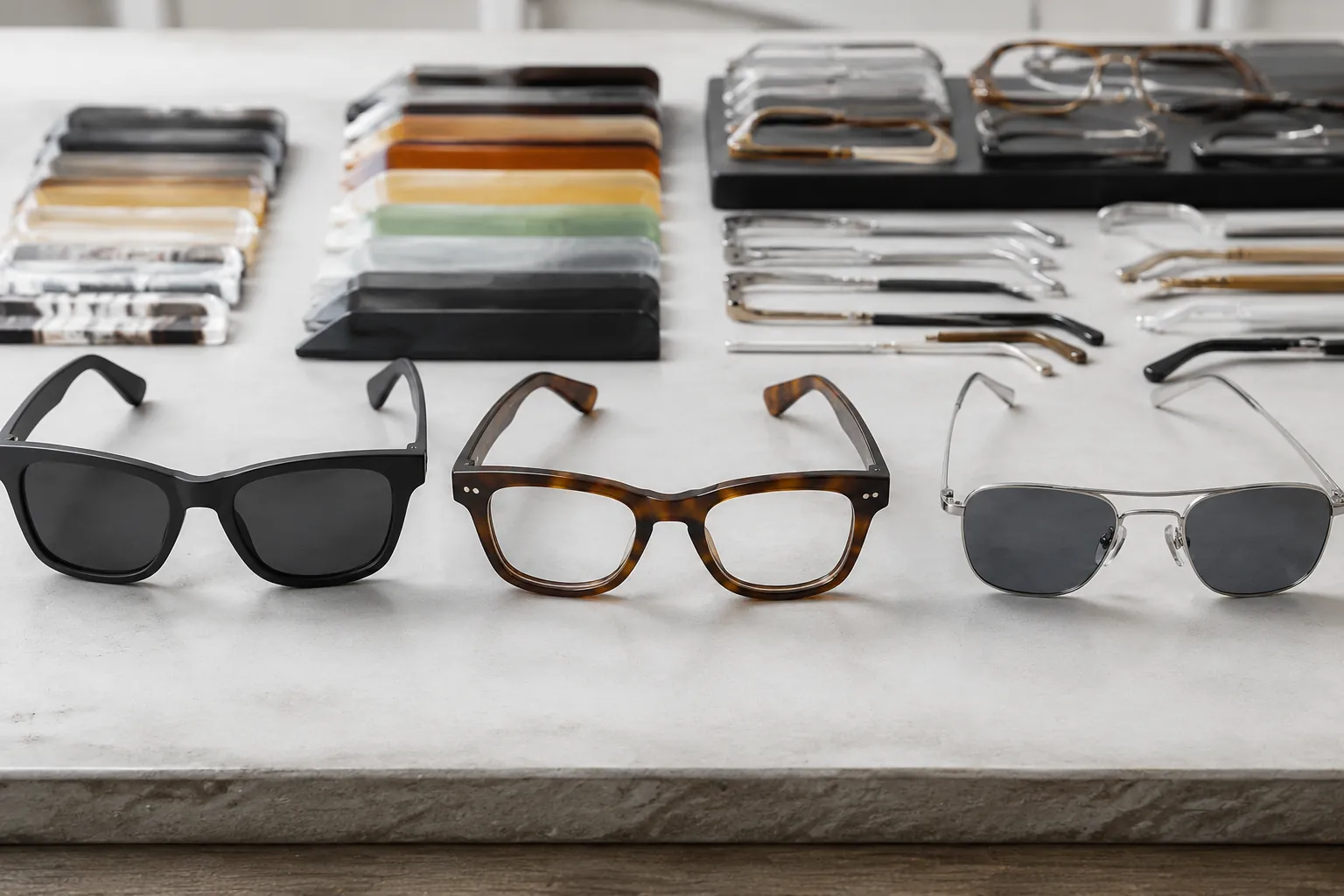
For custom prescription sunglasses, frame material sets the budget, glazing method, lead time, and failure risk. This guide compares TR90, acetate, and metal on the factors procurement teams use: weight, lens compatibility, torque retention, heat tolerance, order volume, and QC limits. No filler. Only production data that affects sourcing decisions.
Why frame material matters
Prescription lenses depend on stable frame geometry. If the optical center shifts, edging and mounting accuracy suffer, and lens performance drops. TR90, acetate, and metal each behave differently during drilling, grooving, heating, and final assembly.
At LumiShades, production is checked to CE EN ISO 12312-1 and ANSI Z80.3. The decision usually comes down to four variables:
- Weight - Heavier frames need stronger bridges, thicker temple cores, and more precise balance.
- Torque retention - How well the frame holds alignment after repeated opening and closing cycles.
- Heat tolerance - Determines whether the frame can be bent, grooved, or glazed without distortion.
- Unit cost - Resin, sheet stock, and alloy cost differently, but process cost matters just as much as raw material.
As a baseline, TR90 resin is low-cost and mold-friendly, acetate is more expensive to process but stronger on appearance, and metal delivers the best hinge stability when the lens design allows it.
TR90: Light, flexible, lens-friendly
TR90 is a nylon-based thermoplastic widely used for sport and prescription sunglasses. Density is about 1.0 g/cm3, which keeps finished frames light. A standard TR90 frame typically weighs 12-16 grams before lenses. That matters because lens mass can easily dominate total wear weight, especially with mineral glass or thicker high-index options.
TR90 handles impact well and returns to shape after moderate flex. In production, it is suitable for snap-fit and grooved prescription builds, and it is one of the easier materials for repeatable high-volume molding.
Lens compatibility details:
- Grooving - Works well with snap-fit and groove mount systems. Typical groove depth is 0.6-1.2 mm depending on the lens profile and rim design.
- Drilling - Can be drilled, but heat buildup must be controlled. We use low-to-moderate RPM with diamond bits and steady feed to avoid edge stress.
- Heat sensitivity - Suitable for standard insert molding and moderate warm fitting, but not for aggressive steam bending or high-heat reshaping.
Typical commercial terms: MOQ 50 pairs per design, sample lead time 7-10 days, bulk lead time 25-35 days. At higher volumes, TR90 is usually the lowest-cost option for prescription sunglasses where the lens design is not drill-mount dependent.
Acetate: Premium appearance, tighter process control
Acetate, or cellulose acetate, is made from cotton linters and wood pulp. It is cut from sheet stock rather than injection molded, so the process supports richer color layering, tortoise patterns, translucent effects, and more premium visual depth. Density is about 1.3 g/cm3. Finished frames usually land in the 24-32 gram range.
For brands that sell on aesthetics, acetate is often the default choice. The material accepts polished edges, laminated layers, and custom color blocks better than TR90 or basic metal builds.
Prescription constraints are stricter:
- Shrinkage - Acetate can shrink over time as plasticizer content changes. That makes lens opening design more sensitive than TR90.
- Heat window - It can be adjusted with controlled heat, but excessive temperature causes bubbling, surface haze, or gloss loss.
- Groove depth - The lens seat cannot be cut too deep without weakening the bridge and front structure.
- Logo application - Pad printing, metal plaques, and laser engraving are all used, but the finish must be matched to the polish level of the frame.
Acetate is best when appearance matters and the order size supports more manual processing. Typical MOQ is 50-100 pairs per colorway depending on the pattern. Sample lead time is 7-10 days, and bulk lead time is usually 25-35 days.
Metal: Stable hinges, strongest drill-mount option
Metal frames are usually stainless steel, titanium, or a stainless front with titanium temples. Density is much higher than TR90, but the material delivers the best hinge stability and the cleanest drill-mount performance when the lens specification supports it.
Finished weight depends on alloy and construction. Stainless frames usually land at 18-28 grams. Titanium frames are often 14-20 grams. On higher-wrap prescription styles, metal can still feel heavier than TR90 once lenses are installed.
Prescription trade-offs:
- Drill-mount requirement - Most metal prescription sunglasses use drilled or semi-rimless lens mounting. Hole placement must be exact, and lens edge thickness must support the hole without chipping.
- Hinge durability - Metal hinges hold alignment well under repeated use and are the best choice for long cycle life.
- Corrosion resistance - 316L stainless performs well in sweat, humidity, and coastal use. Titanium is stronger on corrosion and lower in weight.
- Logo application - Laser marking is the cleanest and most durable option. Pad print needs surface prep and tends to wear sooner than laser mark or embossing.
Metal is usually the right choice for higher-end prescription builds, premium finishing, or orders that need a rigid lens interface. Sample lead time is typically 10-14 days because polishing, coating, and hinge finishing add process steps. Bulk lead time is generally 30-40 days.
Head-to-head comparison: TR90 vs acetate vs metal
| Property | TR90 | Acetate | Metal |
|---|---|---|---|
| Density | ~1.0 g/cm3 | ~1.3 g/cm3 | ~7.9 g/cm3 stainless, ~4.4 g/cm3 titanium |
| Typical frame weight | 12-16 g | 24-32 g | 18-28 g stainless, 14-20 g titanium |
| Best prescription mount | Grooved or snap-fit | Grooved | Drill-mount or semi-rimless |
| Heat tolerance | Moderate | Lower | High |
| Hinge stability | Good | Good | Best |
| Impact resistance | High | Moderate | High |
| Unit cost at scale | Lowest | Mid | Mid to high |
| Bulk lead time | 25-35 days | 25-35 days | 30-40 days |
| Logo options | Pad print, laser, plate | Pad print, laser, plate | Laser, print, rivet, plate |
Use this table as a sourcing filter, not a brand preference chart. A light frame that fails on lens fit is not a workable commercial option.
Production constraints you must know
Most sourcing errors come from ignoring how the material is made. The right frame material on paper can still fail in production if the process does not match the lens spec, finish target, or volume plan.
- Injection molding vs. CNC machining - TR90 is injection molded, which supports lower unit cost at scale after mold investment. Acetate is cut from sheet stock and requires more handwork, polishing, and finishing time. Metal adds stamping, forming, welding, coating, and final polishing steps.
- Lens finishing sequence - Tinting and coating are handled before final assembly in most runs. That sequence affects color consistency, coating adhesion, and batch acceptance.
- QC tolerances - Frame width, temple length, and lens opening all need separate tolerance bands. If the opening is too tight, the lens cracks during insertion. If it is too loose, the lens rattles in use.
- Design file review - CAD files should be checked before tooling starts. Undercuts, sharp corners, weak bridges, and bad hole placement create avoidable rework.
For custom projects, send Step or IGES files early. That lets the factory flag mold-release issues in TR90, stress points in acetate, and hole-placement problems in metal before tooling is locked.
Which material fits which order profile?
There is no universal winner. The right choice depends on lens type, target retail position, and order size.
- Lightweight sport or kids prescription sunglasses - TR90. Best for low weight, impact resistance, and stable groove mount performance.
- Fashion-driven premium collections - Acetate. Best for color depth, layered patterns, and a more upscale visual finish.
- Higher-end drilled or semi-rimless builds - Metal. Best for hinge stability, structural precision, and premium hardware.
- Budget programs at volume - TR90. Best unit economics when design flexibility is less important than cost and speed.
A practical sourcing rule: if the frame must stay light and carry prescription lenses comfortably, start with TR90. If the product sells on color and finish, start with acetate. If the lens design demands rigid hardware and precise drill placement, start with metal.
LumiShades handles all three materials in-house, so QC stays under one process control system. That matters when you need matched temples, repeatable finish, and the same lens spec across batches.
For higher-risk launches, run a 50-pair sample in two materials and compare weight, hinge torque, lens fit, and logo adhesion. That is cheaper than holding inventory that fails on comfort or glazing.
Have a custom sunglasses project in mind?
Send us your styles, target market and quantities and we will return a detailed quote with MOQ, lead time and a sample plan.
Get a QuoteWhy source this from Wenzhou with LumiShades
Wenzhou in Zhejiang Province is widely regarded as China’s eyewear manufacturing capital, producing a large share of the world’s sunglasses. That concentration matters to buyers: a deep local supply chain for acetate sheet, hinges, lens blanks, plating and packaging means shorter component lead times, easier color and material matching, and a workforce with decades of eyewear-specific skill. LumiShades has manufactured in this ecosystem since 2009, and our vertical integration — in-house injection molding, acetate cutting, CNC milling, lens tinting, decoration and quality control — means no part of your order is quietly subcontracted to a workshop you cannot audit.
For international buyers, that vertical control translates into accountability. When a single factory owns every step, defects are traced and fixed at source rather than bounced between vendors, and your specifications survive intact from first sample to bulk. We back this with 15+ years of experience, shipments to 60+ countries, more than 5 million pairs produced per year and a 98.5% on-time delivery rate. Our certifications — CE EN ISO 12312-1, FDA registration, ANSI Z80.3, AS/NZS 1067, REACH, ISO 9001 and BSCI audit — mean the compliance documentation your market requires already exists. Explore our manufacturing capabilities and quality control process to see how this works in practice.
Frequently asked questions
Can I mix frame materials in one order, such as acetate fronts with metal temples? Yes. This is common for premium collections. The acetate front is cut and polished separately, and the metal temples are formed and finished as a second component. It adds cost and usually adds 10 or more days to lead time. The hinge interface must be checked for screw fit and alignment before production starts.
Which frame material is easiest for glazing high-wrap prescription lenses? TR90. It tolerates flex during insertion and is the most forgiving for grooved or wrap-style prescription builds. Acetate is less forgiving at high wrap angles because the bridge and front can stress under insertion. Metal can work, but drill-point accuracy and lens edge thickness must be controlled tightly.
Do your frames pass CE EN ISO 12312-1? Yes. TR90, acetate, and metal frames are tested to CE EN ISO 12312-1 for UV protection, visible transmittance category, and basic durability requirements. Batch documentation can include a Declaration of Conformity on request.
What is the minimum order quantity for custom frame colors? TR90 usually starts at 500 pcs per color because mold color changes carry setup cost. Acetate can start lower if the sheet pattern is already available. Metal color changes depend on plating or coating method, but finish changes usually need at least 300 pcs to stay efficient.
How does frame material affect logo attachment? Metal supports laser marking best. TR90 and acetate can take pad print, laser, or metal plates, but bond performance depends on surface prep and finish. For long wear, laser marking on metal is the most durable option. On acetate, printed or plated logos need finish testing before approval.
What is the lead time difference for FDA-registered prescription frames? Lead time is driven more by material and finish than by registration status. Sample production is usually 7-14 days depending on the frame type. Bulk production is generally 25-40 days. Metal runs are often slower because of extra polishing and coating steps.
Ready to start?
Explore our shield & oversized sunglasses or request a quote — our sales team replies within 12 hours.
Request a Quote