
5 temple tip materials for wholesale sunglasses
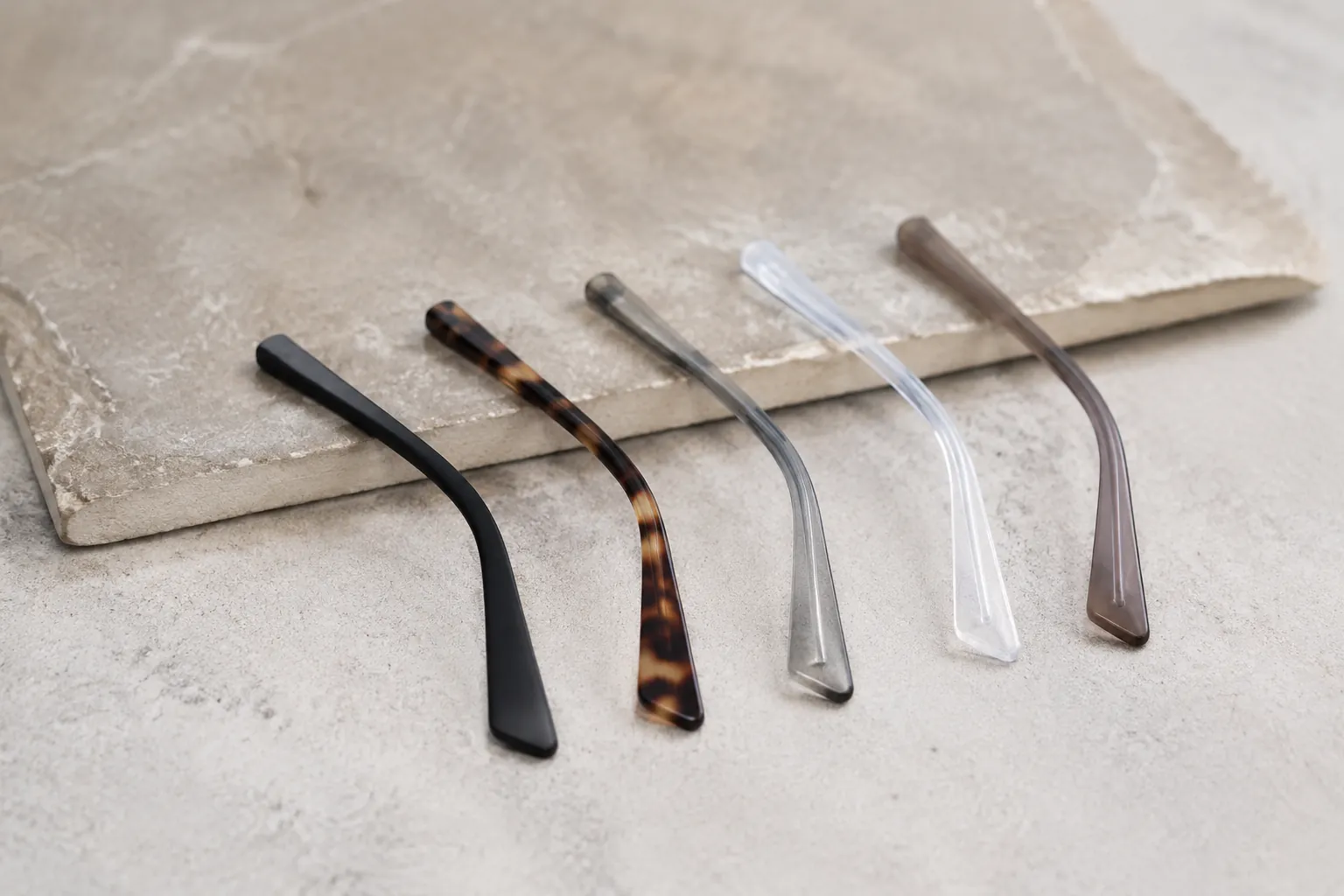
Temple tips are a small part. They carry a lot of weight. They affect comfort after a few hours, show wear early, and often sit behind return complaints. For importers, distributors, and brand owners sourcing custom sunglasses, the material choice changes per-unit cost, grip in sweat, durability, and the paperwork you need for compliance. This article compares the five materials used most often in commercial production: rubber, silicone, acetate, metal, and a bio-based compound. Use it to match material to price point, use case, and risk tolerance.
A fast material trade-off table
Below is the quick comparison. Costs are factory-side estimates for a standard temple tip pair at 3,000 units, not including mold fees where applicable. Lead times assume in-house production. Metal tips usually need outside finishing and add 3–5 days. Hardness is shown where it matters for rubber and silicone.
| Material | Unit cost (pair, 3k qty) | Grip when wet (coefficient of friction range) | Typical durability | Hardness (Shore A) | Mold fee range | Return risk factor | Lead time impact (bulk) |
|---|---|---|---|---|---|---|---|
| Rubber (TPR/TPE) | $0.12–$0.18 | 0.6–0.8 (high) | 12–18 months regular use | 55–65 | $400–$800 | Low | None (standard) |
| Silicone | $0.18–$0.28 | 0.8–1.0 (very high) | 18–24 months | 50–70 | $600–$1,200 | Very low | None (standard) |
| Acetate | $0.22–$0.40 | 0.3–0.5 (low–moderate) | 2–5 years | N/A (rigid) | N/A (cut from sheet) | Moderate (fit precision) | +3–5 days |
| Metal (brass or zinc, plated) | $0.30–$0.55 | 0.2–0.4 (low) | 5+ years | N/A (rigid) | N/A (CNC or casting) | Moderate (skin sensitivity) | +8–12 days |
| Bio-based compound (45% renewable) | $0.25–$0.38 | 0.5–0.7 (moderate–high) | 18–24 months (accelerated aging tests) | 55–65 | $800–$1,500 | Low–moderate | +5–7 days |
Return risk factor combines QC feedback and reorder patterns. It reflects how often a material triggers a complaint, a fit issue, or a skin reaction. Silicone and rubber score best. Acetate and metal need tighter tolerance control.
1. Rubber (TPR/TPE): the volume play
Rubber temple tips, usually TPR or TPE, are injection molded directly onto the metal core of the temple. This is the most common choice in the $3–$8 wholesale sunglass range. It is cheap, fast, and predictable.
In a standard facility, steel molds are machined in-house. One mold can run four to eight cavities. Cycle time per shot is usually 25–35 seconds. At 3,000 units, mold amortization adds about $0.03–$0.05 per pair. At 10,000 units, it drops below $0.01.
Hardness matters. Typical specs run Shore A 55–65 for temple tips. Softer than 50, and the tips deform too easily in heat. Harder than 75, and grip falls off, especially in humidity. TPR can contain phthalates if you do not specify otherwise. For EU shipments, phthalate-free compounds with full REACH documentation are standard. FDA registration covers the base material for skin contact, but the exact compound still needs to be listed in the technical file.
The usual failure mode is plasticizer migration after 18 months. The tip hardens. Then it cracks. For brands selling sunglasses that get replaced often, that is acceptable. For premium positioning, rubber tips read as lower cost. That is the trade-off.
2. Silicone: the grip and skin-safety default
Silicone temple tips cost roughly 40–60% more than rubber at the same volume. The reason is material cost and slower cycle times. Liquid silicone rubber (LSR) injection molding needs dedicated feeding systems and runs about 45–60 seconds per shot. Flash is also harder to trim cleanly, so mold precision has to be better.
The upside is straightforward. Grip in sweat is strong. Silicone keeps a high coefficient of friction, around 0.8–1.0 when wet. Skin reaction complaints are also lower than with the other common tip materials. Silicone holds up better to UV and temperature cycling than TPR. Accelerated aging at 70°C for 168 hours usually shows minimal hardness change.
That is why silicone shows up so often on sport and kids' frames. MOQ is usually 50 pairs per design, but the per-unit price improves at 1,000 pairs and again at 5,000 pairs. A pair that costs $0.24 at 1,000 units can fall to $0.17 at 5,000 units. Silicone also fits cleanly into standard EN ISO 12312-1 and ANSI Z80.3 documentation, so it usually causes less friction in the technical file.
3. Acetate: the look, the cost, the tolerance problem
Acetate temple tips are cut from block or sheet on a CNC mill, then tumbled, polished, and fitted onto the metal core. There is no mold fee, but setup and finishing labor are higher. One CNC operator can produce about 400–500 pairs per shift, which is far fewer than an injection mold can turn out.
Brands choose acetate for the color and the match. A tortoiseshell frame with matching tortoiseshell tips is a real detail. Silicone cannot copy that. Acetate also feels cooler and denser than rubber or silicone. That matters in hand, and buyers notice it. If the temple body is acetate too, using the same sheet or block keeps the pattern aligned. A clear lacquer coating can push gloss levels to around 90%.
The problem is fit. Acetate tips are mechanically fitted, not overmolded. The inner bore has to match the temple core diameter within ±0.05 mm. Too tight, and the tip cracks during assembly. Too loose, and it slips in use. Standard QC usually includes a 100% pull-force test. The minimum is 15 Newtons axial pull without separation. Anything below that gets reworked.
Acetate is covered by REACH and ISO 9001 documentation, but it is not automatically hypoallergenic. Some wearers react to residual plasticizers or polishing compounds. A post-polish ultrasonic cleaning step helps. For Australia, acetate tips do not create extra AS/NZS 1067 hurdles as long as the full frame passes the mechanical tests.
4. Metal: weight, skin sensitivity, and plating
Metal temple tips are usually brass or zinc alloy, cast or CNC-turned, then plated with nickel, palladium, or a gold-toned finish. They are used on higher-end optical frames and fashion sunglasses, usually in wholesale bands above $12.
The main cost driver is plating and skin-sensitivity compliance. Nickel release is regulated in the EU under REACH Annex XVII. Any metal temple tip sold into the EU must release less than 0.5 µg/cm²/week of nickel. Third-party lab testing is standard, and the report goes into the shipment file. Palladium-based or nickel-free plating adds $0.08–$0.12 per pair and adds 3–5 days to lead time. Logo options include laser engraving up to 0.3 mm depth or colored epoxy fill.
Weight is the other issue. Metal tips add about 1.5–3 grams per temple, compared with 0.5–1 gram for rubber or silicone. On a frame already at 35 grams, that can push total weight past the comfort line for many wearers. Returns tend to climb on frames above 40 grams, and metal tips add to that pressure. If you spec metal tips, keep the total frame weight under 38 grams. That usually means thinner acetate fronts or titanium temples.
Metal is durable. It will not crack or degrade under UV. But plating failures are expensive. If pitting or peeling shows up within six months, returns spike. A 24-hour salt spray test under ISO 9227 is a normal specification for plated metal components. Parts that fail get replated or scrapped before assembly.
5. Bio-based compound: the newer option with thin data
Bio-based temple tip materials are usually blends of plant-derived polymers, such as castor oil-based or corn starch-based inputs, with conventional thermoplastics to improve processing. The marketing claim is often 30–60% renewable content. The reality is narrower.
A limited run using a bio-based TPE with 45% renewable content has shown that it molds on standard TPR equipment with minor temperature adjustments. Cycle times are close to rubber, around 25–35 seconds. Grip sits between rubber and silicone, with a coefficient of friction around 0.5–0.7. That is fine for casual wear. It is not ideal for high-sweat sports use. The compound has passed internal skin irritation patch tests, but multi-year aging data on UV stability and plasticizer migration is still thin.
Cost is the blocker. The raw material price per kilogram is about 2.5–3x standard TPR. Mold fees are also higher because the compound has a narrower processing window. It needs tighter temperature control, around ±2°C instead of ±5°C for rubber, and sometimes higher-cavity molds to offset slower cooling. At 3,000 units, a pair of bio-based tips runs $0.25–$0.38. At 10,000 units, it can drop to $0.18–$0.22.
For brands making a specific sustainability claim, bio-based tips are defensible. Only if the paperwork is real. You need a material certificate from the compounder stating renewable content and batch traceability. Without that, the premium is hard to defend to a buyer who only cares about cost and comfort.
Decision logic for buyers: match material to use case
The pattern is simple. Once the wholesale price band and the main use case are fixed, the material choice usually narrows fast.
Under $5 wholesale: Rubber is the default. At 3,000+ units, rubber tips cost about $0.12–$0.15 a pair and work fine for fashion sunglasses worn occasionally. Specify phthalate-free if you ship to the EU.
$5–$12 wholesale, sport or active: Silicone is the right call. The grip in sweat is real. Return rates on silicone-tipped sport frames tend to run lower than rubber-tipped equivalents. The extra $0.06–$0.10 per unit is usually cheaper than handling one extra return per hundred units.
$8–$20 wholesale, fashion-focused: Acetate tips add perceived value. Matching color and polish signal quality. Budget for tighter QC on fit and a slightly higher defect rate during assembly. Internal defect rates on acetate fitting often run 1.2–1.8%, versus about 0.3% for injection-molded tips.
$15+ wholesale, optical or luxury hybrid: Metal tips can work, but run the weight math first. Prototype the frame with the exact temple and tip combination. If total weight exceeds 38 grams, change the temple material or switch to a lighter front.
Sustainability as a hard requirement: Bio-based is the only option here that supports a renewable-content claim on packaging. The trade-off is weaker long-term data. For a launch, a small pilot batch and 12 months of wear testing is the sensible move before you commit to full production.
Production lead times and MOQ by material
Material choice affects schedule as much as unit cost. In a standard facility with in-house temple tip production, the timing usually looks like this:
- Rubber and silicone (injection molded): Mold fabrication takes 7–10 days. Sample tips are ready in 3–4 days after mold approval. Bulk production runs alongside frame assembly. Total sample lead time is 7–10 days. Bulk lead time is 25–30 days. MOQ is 50 pairs per design. Mold fee is separate.
- Acetate (CNC cut): No mold, but programming and setup take 2–3 days for each new shape. Sample tips take 5–7 days. Bulk production is slower because cutting is sequential. Add 3–5 days to the standard 25–35 day bulk lead time for a new acetate design. MOQ is still 50 pairs, but at that level the unit price is high, around $0.60–$0.90 a pair.
- Metal (CNC or cast, plus plating): This is the slowest route. If the tip shape is standard, allow 10–12 days for machined parts plus 5–7 days for plating and testing. Custom shapes add another 5–7 days for programming. Total bulk lead time is usually 30–40 days on a new frame order. MOQ is effectively higher, often 100–200 pairs, so the setup cost makes sense.
- Bio-based compound: Similar to rubber for molding, but material procurement adds 5–7 days because the compound is not always stocked. Ordering per job is common. Total bulk lead time is usually 30–40 days for a new design.
All of these lead times assume in-house production. If plating or specialty finishing is outsourced, add 3–5 business days. Holiday periods in China can stretch that further.
Have a custom sunglasses project in mind?
Send us your styles, target market and quantities and we will return a detailed quote with MOQ, lead time and a sample plan.
Get a QuoteWhy source this from Wenzhou with LumiShades
Wenzhou in Zhejiang Province is widely regarded as China’s eyewear manufacturing capital, producing a large share of the world’s sunglasses. That concentration matters to buyers: a deep local supply chain for acetate sheet, hinges, lens blanks, plating and packaging means shorter component lead times, easier color and material matching, and a workforce with decades of eyewear-specific skill. LumiShades has manufactured in this ecosystem since 2009, and our vertical integration — in-house injection molding, acetate cutting, CNC milling, lens tinting, decoration and quality control — means no part of your order is quietly subcontracted to a workshop you cannot audit.
For international buyers, that vertical control translates into accountability. When a single factory owns every step, defects are traced and fixed at source rather than bounced between vendors, and your specifications survive intact from first sample to bulk. We back this with 15+ years of experience, shipments to 60+ countries, more than 5 million pairs produced per year and a 98.5% on-time delivery rate. Our certifications — CE EN ISO 12312-1, FDA registration, ANSI Z80.3, AS/NZS 1067, REACH, ISO 9001 and BSCI audit — mean the compliance documentation your market requires already exists. Explore our manufacturing capabilities and quality control process to see how this works in practice.
Frequently asked questions
Which temple tip material causes the fewest returns? Silicone. Across large shipment volumes, silicone-tipped frames tend to generate the fewest comfort and skin-reaction complaints. Rubber is close behind if the compound is phthalate-free.
Do I need separate mold tooling for rubber and silicone tips? Yes. Rubber TPR/TPE and silicone LSR cure differently and need different mold designs. A rubber mold cannot run silicone without modification. Mold fees are separate: about $400–$800 for rubber and $600–$1,200 for silicone, depending on cavity count.
Are acetate temple tips compliant with REACH and ANSI Z80.3? Yes, if the acetate supplier provides REACH documentation and the finished frame passes ANSI Z80.3 mechanical tests. The material itself is not the main issue. Fit and finishing decide whether the tip stays secure and whether it creates skin issues.
What is the minimum order quantity for bio-based temple tips? MOQ is usually 50 pairs per design. The unit cost at that level is high, often $0.60–$0.90, because the material is bought in a small batch and setup time is spread over too few units. At 1,000 pairs, the cost typically drops into the $0.25–$0.38 range.
Can you match acetate temple tip color exactly to the temple body? Usually, within commercial tolerances. If the tips are cut from the same acetate sheet or block as the temple, the base color and pattern will match closely. Polishing and thickness can still create small visual differences. That should be checked at sampling, before bulk production.
How do metal temple tips affect CE certification for sunglasses sold in Europe? Metal tips add a nickel-release requirement under REACH Annex XVII. Plated parts must be tested to show nickel release below 0.5 µg/cm²/week, and the test report should sit in the technical file. That is part of the compliance path for CE marking under EN ISO 12312-1. Without the test, the frame is not ready for EU sale.
Ready to start?
Explore our sport wrap sunglasses or request a quote — our sales team replies within 12 hours.
Request a Quote