
5 Sunglasses Frame Styles Ranked for E-Commerce
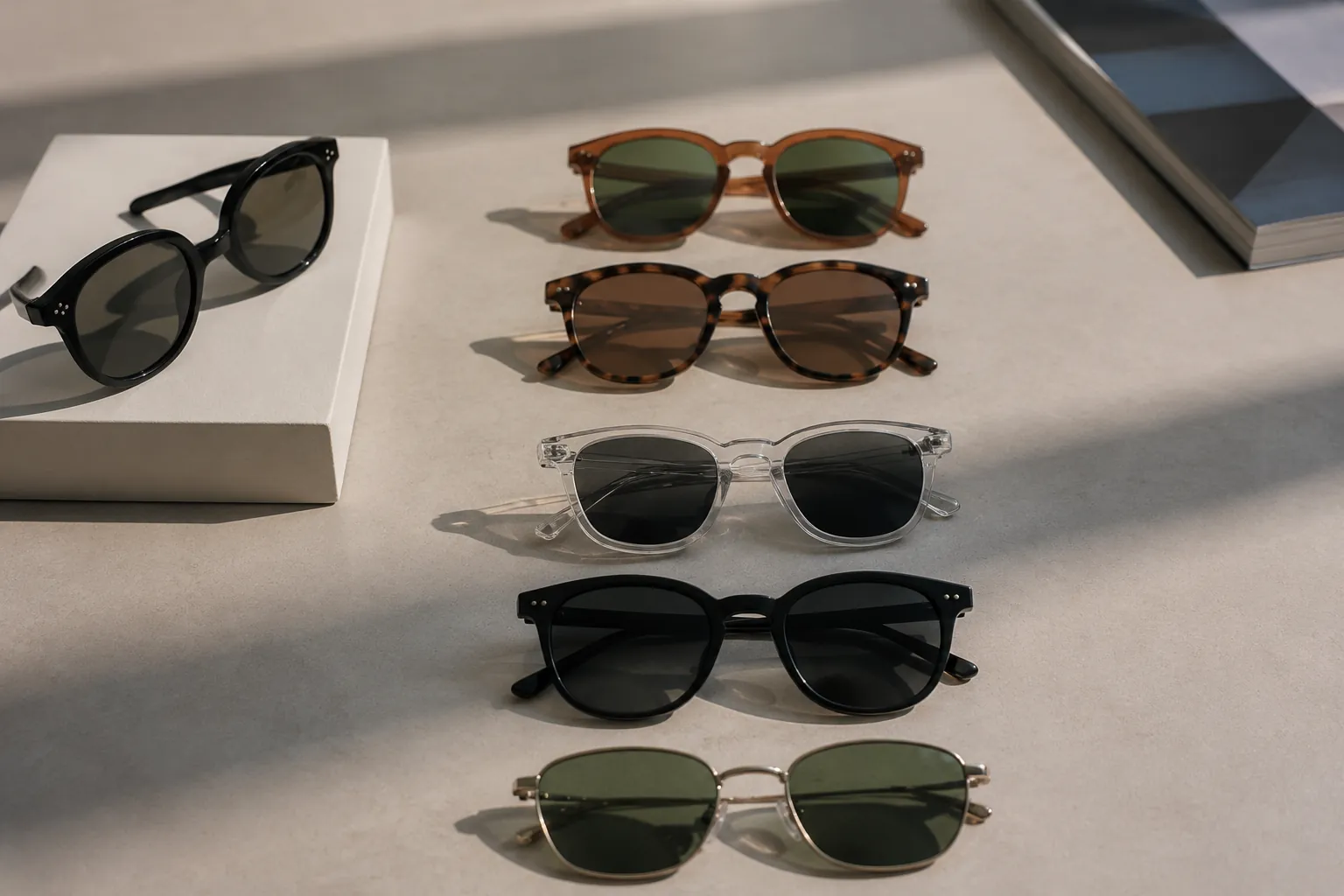
If you buy sunglasses for online retail, frame style matters as much as lens color or finish. Some frames look good in a product shot and then fail in cartons, in transit, or at the first return. This guide ranks five frame styles by breakage risk, packability, and how they hold up in cross-border fulfillment. It is written for brands, importers, distributors, and retailers that need fewer claims, fewer damaged cartons, and cleaner margin math.
How the ranking works
This is not a style ranking. It is a fulfillment ranking. The question is not which frame gets the most clicks. It is which frame arrives straight, passes inspection, and can be replenished without turning into a packaging problem.
I am weighting four things: breakage risk in transit, how tightly the frame packs in master cartons, how well the material holds shape under heat and pressure, and how much hand-finishing the style usually needs before ship-out. A frame that tolerates stacking, vibration, and compression will usually cost less to move. It will also create fewer returns.
Set measurable QC tolerances before bulk approval. Common checks include temple alignment, hinge symmetry, lens retention, visible surface defects, and pack-out performance with the exact pouch, tray, and inner box that will ship. Put the tolerances in the purchase specification. Then confirm them against approved samples.
| Factor | What I look at | Why it matters |
|---|---|---|
| Breakage risk | Temple hinge stress, front thickness, lens retention, material brittleness | Higher risk means more rejects, returns, and spare-parts work |
| Packability | Stack height, temple fold profile, bridge clearance, carton density | Poor packability increases freight cost per pair |
| Fulfillment survival | Resistance to deformation, scuffing, and carton pressure | Frames need to reach customers looking straight, not warped |
Process matters too. Injection molding is usually the most repeatable for e-commerce basics. Acetate needs tighter cutting and polishing control. Mixed-material frames need stricter inspection because every interface adds a failure point. If the factory cannot explain the build clearly, the style is probably not ready for scale.
1. Injected full-rim rectangle frames
This is the safest default for e-commerce. A straight, full-rim rectangle in injection-molded plastic packs efficiently, stacks cleanly in trays, and handles compression better than thin or highly contoured silhouettes. It is the most forgiving shape for first-time programs and replenishment-heavy programs.
Why it ships well: the front is usually rigid enough to hold lens geometry, while the temples fold flat without protruding corners that catch inside polybags or inner boxes. A well-made injected frame can keep the front stable in packing and reduce contact points that create scuffing or hinge stress.
The real advantage is consistency. Injection molding gives repeatable wall thickness, consistent hinge placement, and better color stability across large runs. That matters when you need 300, 1,000, or 5,000+ pairs to look the same across multiple cartons. It also supports repeatable decoration methods like pad printing, hot stamping, or laser marking when the material is stable and the artwork sits away from high-stress areas.
Watch the details. If the material is too brittle, thin temple tips can whiten or snap at the hinge boss after repeated opening. If the temple wire is embedded poorly, the temple may not lie flat in the carton. Ask for hinge cycle checks, visual inspection after repeated opening and closing, and pack-out approval with the final packaging. The pass condition should be simple: no visible twist, no hinge looseness, and no stress whitening at the hinge shoulder after handling.
MOQ and pricing are usually favorable here because tooling is standard and cycle times are efficient. At 50 pairs, you are paying mostly for setup and inspection. At 300 pairs, unit cost becomes more rational if the color is stock or close to stock. At 1,000 pairs and above, the style is easier to price predictably because mold amortization, resin waste, and packing time behave consistently. For private-label buyers, this is the first style to use when you want stable quality without complex assembly.
2. Round acetate frames
Round acetate frames rank slightly lower on packability, but they still ship well when the geometry is controlled. Acetate is denser, feels more premium, and often fits fashion positioning better. It also asks for tighter cutting, polishing, and hinge assembly discipline.
The upside is structure. A properly made acetate frame resists surface scuffing better than softer plastics and gives the customer a more substantial first impression. The downside is bulk. Acetate fronts are often thicker than injection-molded basics, so they occupy more carton volume and create more pressure points if the divider layout is sloppy. A round silhouette can also waste space because it does not nest as efficiently as a rectangle.
For e-commerce, the most common failure mode is pressure distortion rather than catastrophic breakage. If the temples are forced against a hard divider, the front can arrive slightly out of round or with a lifted lens edge. That is enough to trigger returns, especially when buyers compare multiple pairs side by side and spot asymmetry.
Acetate also behaves differently in production. Sheet material can move during cutting, so the factory should control tolerances on lens grooves, bridge symmetry, and temple insertion. A sensible buyer request is a final visual check for lens seating, symmetry, and polish quality against the approved sample. Poor edge finishing creates stress marks, and stress marks become customer complaints.
Use this style when the brand position justifies the extra handling discipline. It is a better fit for moderate volume than for ultra-thin margin programs. Pricing usually depends on how fixed the acetate color, temple length, and finish are before production starts. Expect more labor in hand-polishing, more checking at the bridge, and more careful carton separation than with injection basics.
3. Soft-square metal-accent frames
Soft-square frames with metal accents sit in the middle of the pack. They can sell well online because the geometry reads cleanly in photos, but the mixed-material build adds risk. Metal trims, wire temples, or decorative plates can bend, rub, or detach during transit if the build is not locked down properly.
The frame shape is not the problem. The problem is the interface between materials. A metal accent attached to a plastic front can loosen if the fastening method is weak or if the part is packed under side pressure. Ask the factory exactly how the accent is fixed: embedded, riveted, screwed, ultrasonically welded, or glued. Glue alone is the weakest answer for a shipment-heavy program, especially if the package sees heat or humidity in transit.
In volume work, the spec needs to be more explicit than "good appearance." A metal logo plate should sit flush, and any exposed edge should be smooth enough that it will not snag on a polybag or rub through an inner pouch. If the part includes a wire insert, the factory should show bend recovery and pull-strength evidence in its QC process, not just a cleaned-up sample.
This style is best when the decoration is low-profile and functional. Small logo plates, thin temple lines, and modest contrast details work. Oversized decorative pieces do not. They raise snag risk in packing, complicate carton stacking, and often require more hand inspection before ship-out. That is where unit cost climbs.
If you need this style at scale, specify vibration and drop checks on packed units. A frame that looks fine on a table may still fail after handling if the accent loosens or the hinge shifts. For most importers, this is a mid-tier style: commercial, useful, but not the lowest-risk choice for replenishment.
4. Wayfarer-style mixed-material frames
The classic wayfarer shape is still common for a reason. It is easy to recognize, it photographs well, and it fits a wide range of face sizes. In e-commerce, though, mixed-material versions rank below simpler full-plastic builds because the shape often encourages thicker temples, harder corners, or decorative details that make packing less forgiving.
For shipment, the key question is whether the frame is designed as a production object or just a style reference. The production version should have controlled temple width, stable hinge alignment, and a bridge that does not press against lens surfaces inside the box. If the temples flare too much, carton density drops fast. If the front is too wide, you lose the ability to nest pairs efficiently in trays.
A practical way to control this style is to keep the front geometry standard and vary only the finish or lens color. That reduces tooling changes, keeps rejection rates down, and makes reorder planning easier. Injection-molded versions usually price better at lower-to-mid volume, while acetate or decorated builds often need stronger volume commitment before the unit economics become comfortable. At higher volumes, a stable wayfarer program can become efficient if the packing spec is disciplined.
This style works best when you want a safer fashion frame without moving into fragile territory. It can be built in injection-molded plastic or with selected acetate elements depending on price point. The buyer should ask for front flatness, temple spread, and carton-fit samples before production. If the frame needs force to sit in the tray, the packing design is wrong.
For channel buyers, this is a sensible middle program. It is familiar to consumers and easy to merchandise, but it should not be treated as the lowest-damage option. It is a good choice when you care about style coverage and still need workable logistics.
5. Thin pilot and oversized metal frames
These are the hardest fit for rough cross-border fulfillment. Thin metal frames and oversized pilot styles can sell, but they ship with more risk. They bend more easily, the nose area can deform, and the large front profile wastes carton space. Even when the frame is not broken, it is more likely to arrive slightly asymmetric. That is enough to generate a return in a customer-facing channel.
Small impact damage on metal frames is especially difficult because it often shows up as slight misalignment rather than a visible crack. A unit may pass a quick warehouse scan and still fail when the customer puts it on. Oversized frames create a separate problem: they are harder to nest, harder to protect, and more likely to force larger cartons or lower carton density, which raises freight cost per pair.
If you insist on this style, tighten the specification. Set the acceptable temple spread, nose bridge alignment, and finish standard in writing. Require packed sample approval, not just bare frame approval. Ask the factory to show a completed pack-out sample with the exact pouch, divider, and inner box that will ship. That is the only way to see whether the frame survives real handling.
For metal styles, it is reasonable to request a bend-recovery check and a finish rub test before bulk. A stable metal frame should return close to spec after light flexing and should not show obvious plating loss or coating scuff after normal handling. For larger pilots, make sure the bridge geometry prevents lens contact under pressure, because hard lens rub is a common hidden defect.
These frames are usually better for lower-volume fashion drops than for replenishment-heavy e-commerce programs. They can work. They just demand more control, more testing, and more careful packing, which means higher cost.
Comparison table: which style survives fulfillment best
The table below is the practical ranking for online sales programs, from easiest to hardest to move through cross-border channels. It reflects damage risk, packing efficiency, and the amount of production control required before a style is ready to scale.
| Frame style | Breakage risk | Packability | Typical fulfillment use | Buyer warning |
|---|---|---|---|---|
| Injected full-rim rectangle | Low | High | Core catalog, replenishment, private label basics | Do not under-spec hinge strength or wall thickness |
| Round acetate | Low to medium | Medium | Premium basics, fashion core lines | Avoid poor carton separation and pressure points |
| Soft-square with metal accents | Medium | Medium | Mid-tier fashion and branded promotions | Check how the accent is fixed and whether it can loosen in transit |
| Wayfarer-style mixed material | Medium | Medium to low | Mainstream retail programs | Watch temple flare, bridge contact, and carton density |
| Thin pilot / oversized metal | High | Low | Fashion drops, limited runs | Expect more rejects unless packing and inspection are tight |
For most e-commerce buyers, the safest procurement move is to build volume around the first two rows and treat the last two as controlled fashion programs, not backbone SKUs. That does not mean you cannot sell them. It means you should price them, pack them, and forecast them differently.
What to specify to the factory
The frame style is only half the job. The production spec decides whether the style survives fulfillment. When ordering custom sunglasses, buyers should pin down the details that move damage rate and landed cost.
- Material: injection-molded plastic, cellulose acetate, metal, or mixed-material build.
- Wall thickness and front thickness: enough to keep shape, but not so heavy that freight cost climbs unnecessarily.
- Hinge type: standard metal hinge, reinforced hinge, or spring hinge if repeated opening is a concern.
- Lens retention: groove depth, snap fit, or locking method for the lens rim.
- Finish: matte, gloss, soft-touch, polished acetate, or plated metal.
- Decoration: pad printing, laser engraving, hot stamping, metal logo plate, or embossing.
- Packing method: individual polybag, microfiber pouch, tray divider, inner box, master carton.
- Compliance target: CE EN ISO 12312-1, ANSI Z80.3, AS/NZS 1067, REACH, FDA registration, ISO 9001, BSCI.
Ask for tiered pricing, not one number. A useful structure is sample price, 50-pair trial price, 300-pair production price, 1,000-pair reorder price, and 5,000+ pair volume price. That shows whether the supplier is absorbing setup cost or hiding it in unit price. For a new design, sample timing is commonly 7 to 10 days. Bulk production is commonly 25 to 35 days after approval if the frame, packaging, and decoration are already frozen.
Ask for inspection coverage on hinge alignment, lens tint consistency, decorative placement, and cosmetic defects before packing. That matters when a buyer wants a 50-pair MOQ for testing but plans to scale to 300, 1,000, or 5,000+ pairs after approval. The factory should also be able to show carton drop and vibration protection on the final packed unit, not just the bare frame.
Short version: ask for the frame style you want, then ask for the shipping behavior you need. Those are not the same thing. The second one protects margin.
How to choose the right style for your channel
If your channel is Amazon, DTC, marketplaces, or distributor replenishment, pick styles with low return risk and strong carton density. That usually means injection-molded rectangles first, acetate rounds second. If your channel is boutique retail or fashion drops, you can tolerate more complex styles, but the packing spec has to tighten and the inspection plan has to get stricter.
Use a simple rule. If a frame looks delicate in your hands, it will usually cost more to move than it first appears. If it stacks cleanly, stays flat in a tray, and keeps its shape after repeated handling, it is easier to scale. That difference shows up in freight cost, return rate, and customer service workload more than it shows up in the product photo.
Sample timing matters too. A 7 to 10 day sample window is enough to test fit, packing, and logo placement before you commit to bulk. Bulk at 25 to 35 days is workable only if the spec is frozen early and the carton plan is approved before production starts. If you change temple length, lens tint, or decoration after sample approval, add time and expect the quote to move.
The best e-commerce frame is not the prettiest one. It is the one that arrives straight, passes compliance, does not create avoidable claims, and can be reordered without reworking the packing system. That is the frame style that keeps a channel healthy.
Have a custom sunglasses project in mind?
Send us your styles, target market and quantities and we will return a detailed quote with MOQ, lead time and a sample plan.
Get a QuoteWhy source this from Wenzhou with LumiShades
Wenzhou in Zhejiang Province is widely regarded as China’s eyewear manufacturing capital, producing a large share of the world’s sunglasses. That concentration matters to buyers: a deep local supply chain for acetate sheet, hinges, lens blanks, plating and packaging means shorter component lead times, easier color and material matching, and a workforce with decades of eyewear-specific skill. LumiShades has manufactured in this ecosystem since 2009, and our vertical integration — in-house injection molding, acetate cutting, CNC milling, lens tinting, decoration and quality control — means no part of your order is quietly subcontracted to a workshop you cannot audit.
For international buyers, that vertical control translates into accountability. When a single factory owns every step, defects are traced and fixed at source rather than bounced between vendors, and your specifications survive intact from first sample to bulk. We back this with 15+ years of experience, shipments to 60+ countries, more than 5 million pairs produced per year and a 98.5% on-time delivery rate. Our certifications — CE EN ISO 12312-1, FDA registration, ANSI Z80.3, AS/NZS 1067, REACH, ISO 9001 and BSCI audit — mean the compliance documentation your market requires already exists. Explore our manufacturing capabilities and quality control process to see how this works in practice.
Frequently asked questions
Which frame style is safest for first-time e-commerce orders? Injected full-rim rectangle frames are the safest starting point. They pack well, hold shape better in transit, and are easier to control at volume than mixed-material or oversized metal styles. For a first order, ask the factory to confirm hinge cycle behavior, front flatness, and final pack-out with the exact pouch and tray you plan to use.
How much should I order before pricing gets materially better? Ask for tiered pricing at 50, 300, 1,000, and 5,000+ pairs per design. In practice, unit price often improves when setup cost is spread across a larger run, but the real break point depends on material, decoration, and packing method. A quote is only useful if it shows each volume tier separately.
What compliance documents should I request for sunglasses shipments? Request the documents that match the market you are selling into and verify the tests on the actual product. The certifications and registrations listed for this supplier are CE EN ISO 12312-1, ANSI Z80.3, AS/NZS 1067, REACH, FDA registration, ISO 9001, and BSCI. Ask for the test report, registration record, or audit evidence that supports each claim, rather than accepting a generic certificate sheet.
Can logo decoration affect breakage or returns? Yes. Pad printing, laser engraving, and hot stamping are usually fine when they are placed cleanly and away from stress points. Returns risk rises when decoration adds a raised edge, interferes with hinge movement, or creates a snag point in packing. For metal logo plates or deep embossing, ask for a packed sample and check whether the part stays flush after vibration and handling.
How fast can I move from sample to bulk? A normal working range is 7 to 10 days for samples and 25 to 35 days for bulk after approval. That assumes the spec, artwork, packaging, and compliance needs are already frozen. If you change temple length, lens tint, finish, or packaging after sample approval, the schedule should be reset and the quote should be revisited.
Ready to start?
Explore our aviator sunglasses or request a quote — our sales team replies within 12 hours.
Request a Quote