
Injection vs Acetate vs 3D-Printed Frames by Volume
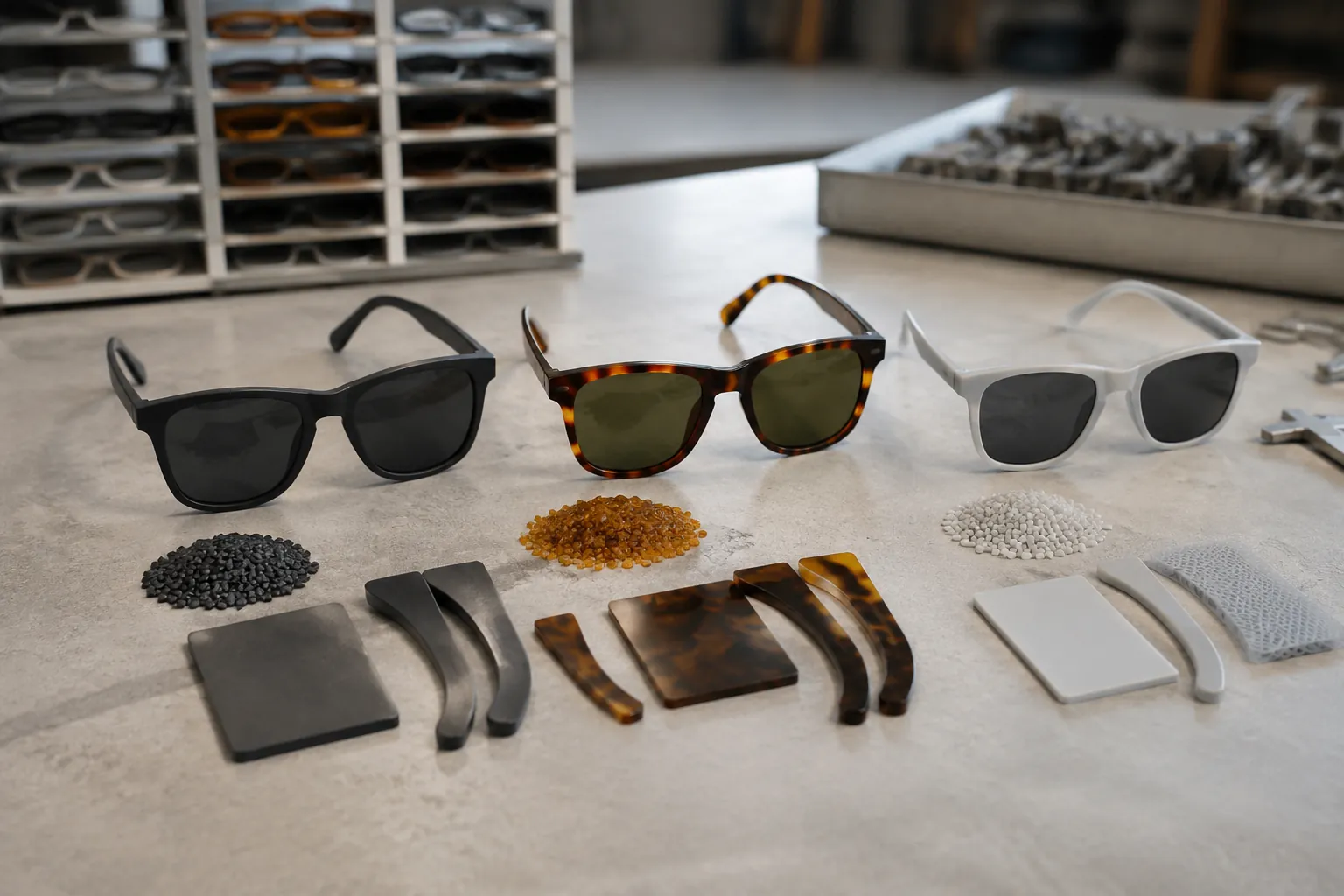
Pick the wrong process and you burn cash in tooling or overpay on every unit. This article matches frame production methods to real order volumes, from 50-piece tests to 50,000-unit replenishment runs. It gives you the breakpoints, the lead times, and the design limits buyers usually learn too late.
The Three Processes at a Glance
Each method owns a different volume band. Push outside that band and the economics turn fast.
| Process | Ideal volume per design | Typical unit cost at volume | Tooling investment | Lead time (bulk) | Design flexibility |
|---|---|---|---|---|---|
| Injection-molded (PC/TR90) | 1,000–50,000+ | $2.10–$4.50 | $3,500–$6,000 per mold (three cavities: front + 2 temples) | 25–35 days (bulk, existing mold); 45–55 days (new tool) | High complexity possible, but no undercuts without side actions; ±0.10 mm typical tolerance on critical dimensions |
| Cut-and-bent acetate | 50–3,000 | $4.80–$12.00 | $0 (uses CNC programs at $80–$150 per design and bending fixtures at $50–$100 per SKU) | 30–40 days (standard sheet stock); add 10–14 days for custom laminate sheets | Very high; layered colors, custom laminations, hand-filed shaping; ±0.5 mm variance in frame wrap from hand bending |
| 3D-printed (PA12/MJF) | 1–500 | $6.00–$22.00 | $0 | 10–20 days (print time 2–3 days, post-processing 5–8 days) | Maximum; impossible geometries (lattice temples, hollow sections) possible; surface finish 8–12 µm Ra; requires vapor smoothing or tumbling for polished look |
The tooling numbers are not soft estimates. An injection mold for one front and two temples, across three steel cavities, usually lands around $3,500 to $5,500 at a capable shop. Add side actions for undercuts or deeper logo recesses and you move past $6,000 quickly. Acetate and 3D printing avoid tooling. Good at low volume. Expensive to ignore at scale.
Injection Molding: Best Past 1,000 Units
Most mass-market sunglasses are injection molded. Polycarbonate or TR90 pellets are melted at 260–300°C, forced into a steel mold under high pressure, cooled, and ejected. Cycle time is usually 35–60 seconds per shot. One mold can produce 1,500–2,000 frames per day. That is why unit cost drops hard as volume rises.
Typical factory cost bands, including a basic polycarbonate CAT 3 lens, spring hinge, single-color frame, and no decoration:
- 50–299 units: Unit price $4.50–$6.80. Mold amortization can exceed $70 per frame at 50 units.
- 300–999 units: $3.20–$4.50.
- 1,000–5,000 units: $2.50–$3.20.
- 5,000–50,000+ units: $2.10–$2.80 depending on decoration and lens spec.
Decoration adds cost. Pad printing with two colors runs $0.15–$0.25 per unit. Laser engraving is $0.08–$0.12. A metal logo plate is $0.30–$0.50. Polarized TAC lenses at 0.75 mm add $1.00–$1.50. Material choice matters too. Polycarbonate, such as Bayer Makrolon 2458, has a modulus of 2.3 GPa and passes ANSI Z80.3 impact tests. TR90, such as EMS-Grivory Grilamid TR90, is lighter at 1.06 g/cm³ versus 1.20 for PC, more flexible, and usually costs 15–20% more in raw material.
Watch the constraint: mold changes are slow and costly. Fixing a fit issue in a cavity can cost $300–$800 and take 5–8 days. Finalize the design before steel is cut. Use acetate or 3D printing to test shapes first.
Cut-and-Bent Acetate: The 50-to-3,000 Pair Range
Acetate frames start as flat sheets, 4 mm to 8 mm thick, usually sourced from Mazzucchelli in Italy or other mills. A CNC router cuts the shape from sheet stock. The blanks are heated to 60–70°C and hand-bent over mandrels. Direct labor per frame is about 40–60 minutes. A trained operator typically handles 8–12 frames per hour in bending.
There is no mold cost. That is the appeal. A Mazzucchelli cellulose acetate sheet, for example 6 mm thick and 0.6 m by 1.2 m, costs about $25–$45 and yields 12–18 fronts. Around 30% can be lost to kerf and offcuts.
Volume pricing per frame, including basic lens and hinge:
- 50–99 units: $8.00–$12.00.
- 100–500 units: $6.50–$8.50.
- 500–3,000 units: $4.80–$7.00.
Acetate wins on design range. Custom laminations, hand-filed contours, and many colorways are all practical. A 20-color split at 100 units each can work.
Consistency drops above 3,000 units. Hand-bending introduces about ±0.5 mm variance in frame wrap. QC can tighten sampling, but if the spec demands very low defect rates, injection molding is the better answer at higher volume.
3D-Printed Frames: Fast, But Not Cheap
Most B2B 3D-printed eyewear uses Multi Jet Fusion, usually with PA12 nylon powder such as HP 3D HR PA12. Layer thickness is about 0.08 mm. Tensile modulus is around 1.7 GPa. Parts come out matte gray, then are dyed and vapor-smoothed. Surface roughness can drop from roughly 12 µm Ra to about 4 µm Ra after finishing.
There is no tooling cost. Finished and dyed unit prices usually fall into these bands:
- 1–50 units: $18.00–$22.00 per frame.
- 50–200 units: $10.00–$16.00.
- 200–500 units: $6.00–$10.00.
Lead time is usually 10–20 days. Print time for 50 frames on an HP MJF 4200 is about 12–18 hours. Post-processing, including depowdering, dyeing, drying, vapor smoothing, and QC, adds another 10–12 hours. Queue time can add 3–7 days.
Compliance note: the finished sunglass must meet CE EN ISO 12312-1 or ANSI Z80.3. PA12 material data alone does not certify the product. The complete assembly, frame and lenses together, must be tested. Budget $600–$1,000 for third-party testing such as Intertek or SGS. Check that dyes and smoothing chemicals do not introduce restricted substances. A factory with ISO 9001 and BSCI should provide full material traceability.
Pick the Process by Volume
Do not ask which process is best in the abstract. Ask how many units you need per design, and how fast you need them.
- 1–50 units per design, need in 14 days: 3D-printed PA12. Expect about $18 per unit. Use it for sampling and market tests.
- 50–500 units, 30–40 day lead time, premium feel required: Acetate. Budget $6.50–$12 per unit. No tooling risk.
- 500–3,000 units, seasonal line with multiple colorways: Acetate still makes sense. CNC changeovers are manageable.
- 1,000–5,000 units, single design, repeat orders likely: Start with acetate or 3D print the first run. Validate the design, then cut injection molds for run two.
- 5,000–50,000+ units, commodity pricing required: Injection-molded PC or TR90. Below $2.50 per unit by 5,000 units. The other processes will struggle.
Geometry can override volume. Some frames cannot be molded cleanly, so 3D printing stays in play even at higher volume. Some brands accept that tradeoff for a unique shape. Material certification can also push the decision. Injection molding gives the cleanest resin lot traceability. Acetate sheets carry batch numbers. Shared powder beds in 3D printing need tighter lot control.
Lead Times and the Sampling Trap
Quoted lead times are averages. They are not promises.
New injection molds add 15–20 days for machining and about 5 days for trial. Always ask whether the quote includes mold trial and sample sign-off. Acetate orders depend on sheet availability. Standard colors usually take 3–5 days from the mill. Custom laminates add 10–14 days. Minimum order for custom laminate sheets is often 50–100 sheets.
3D printing is fast, but finishing queues can wipe out the advantage. Black dye baths are shared. Custom colors may need dedicated baths, which can add 2–3 days. Sample timing usually looks like this: 3D-printed samples take 7–10 days; acetate samples need CNC programming and can be ready in a few days; injection-molded samples from a new tool usually take 20–30 days.
Break-Even Math Buyers Should Run
Acetate has no tooling cost, but the unit price stays higher. Injection molding has the opposite profile: tooling up front, lower cost later. The break-even point is easy to calculate.
Example: Acetate at $6.50 per unit, no tooling. Injection at $2.80 per unit, $5,000 mold. At 1,000 units: acetate total = $6,500; injection total = $7,800. At 2,000 units: acetate = $13,000; injection = $10,600. Break-even is $5,000 / ($6.50 - $2.80) ≈ 1,351 units. Above 5,000 units, injection saves more than $13,000.
Do not ignore mold wear. A steel mold, usually P20 or H13, can produce 100,000–150,000 shots before refurbishment is needed. Refurbishment typically costs $800–$1,500. Replacement can run $4,000–$6,000. For a staple SKU, spread that cost across more than one year. For a seasonal design that dies after two runs, the first mold can still beat acetate.
3D printing does not beat injection on unit cost. Use it for uncertainty, not for price leadership.
What to Put in the RFQ
Name the process in the RFQ. If you do not, quotes are hard to compare.
- Process method: Injection-molded PC, TR90, cut-and-bent acetate, or 3D-printed PA12 MJF. Include grade details where possible, such as Makrolon AL2447, Grilamid TR90, Mazzucchelli sheet stock, or HP 3D HR PA12.
- Finish: Matte, gloss, polished, or dyed-and-tumbled.
- Decoration: Pad printing with the number of colors, laser engraving, or a metal logo plate. State quantities per method.
- Lens spec: TAC polarized, polycarbonate tinted, or nylon. Include thickness and category, from CAT 0 to CAT 4. UV400 blocking should be mandatory.
- Certification: CE EN ISO 12312-1:2013, ANSI Z80.3-2015, REACH, and FDA registration if applicable. Ask for test reports on the complete assembly, not just the raw material. Third-party tests from Intertek or SGS usually run $500–$1,500 per model.
- Volume bands: Quote 500, 1,000, 3,000, and 10,000 units with tooling amortized across the first 3,000 units. A banded quote shows fixed cost far better than one flat number.
Have a custom sunglasses project in mind?
Send us your styles, target market and quantities and we will return a detailed quote with MOQ, lead time and a sample plan.
Get a QuoteWhy source this from Wenzhou with LumiShades
Wenzhou in Zhejiang Province is widely regarded as China’s eyewear manufacturing capital, producing a large share of the world’s sunglasses. That concentration matters to buyers: a deep local supply chain for acetate sheet, hinges, lens blanks, plating and packaging means shorter component lead times, easier color and material matching, and a workforce with decades of eyewear-specific skill. LumiShades has manufactured in this ecosystem since 2009, and our vertical integration — in-house injection molding, acetate cutting, CNC milling, lens tinting, decoration and quality control — means no part of your order is quietly subcontracted to a workshop you cannot audit.
For international buyers, that vertical control translates into accountability. When a single factory owns every step, defects are traced and fixed at source rather than bounced between vendors, and your specifications survive intact from first sample to bulk. We back this with 15+ years of experience, shipments to 60+ countries, more than 5 million pairs produced per year and a 98.5% on-time delivery rate. Our certifications — CE EN ISO 12312-1, FDA registration, ANSI Z80.3, AS/NZS 1067, REACH, ISO 9001 and BSCI audit — mean the compliance documentation your market requires already exists. Explore our manufacturing capabilities and quality control process to see how this works in practice.
Frequently asked questions
Can I mix processes within one frame, like an acetate front with injection-molded temples? Yes. It is common. A hybrid can reduce cost, since a PC temple may run around $0.80 versus about $2.50 for acetate, while keeping the look of an acetate front. The hinge must account for thermal expansion mismatch: acetate is about 110 × 10⁻⁶ m/mK, PC about 70 × 10⁻⁶, and steel about 12 × 10⁻⁶. Use a monoblock hinge or thread-locking compound such as Loctite 243 on the screw. Test with thermal cycling at 50°C for 2 hours and check hinge torque at 0.40–0.60 Nm.
What is the real minimum order for injection-molded frames if I pay extra? You can run 50 units, but you still pay the full mold cost of about $3,500–$6,000 plus a high per-unit price, often $6.80 or more. At 50 units, total cost can exceed $106 per frame. Acetate would be far lower. Injection below 500 units only makes sense if reorders are likely. At 2,000 units, the total can fall to about $3.70 per frame. Some factories will split mold cost across the first two orders.
Can 3D-printed frames be certified to CE EN ISO 12312-1? Yes, but the certificate applies to the finished product, not the raw PA12 material. The frame with lenses mounted must pass lens retention, side coverage, and robustness testing. Ask for third-party reports from Intertek or SGS covering UV400, lens retention, and filter category. Do not accept a material datasheet as proof of sunglass compliance.
How many colorways can I run in one acetate MOQ of 50? You can split 50 units across several colors, but the unit price rises because of CNC changeovers and cleaning time. For 5 colors at 10 units each, expect a 15–25% surcharge over a single-color run. Many factories want at least 20–30 units per color. At LumiShades, 5 colors at 10 units each carries a 20% surcharge on base price.
Does LumiShades run 3D printing in-house or subcontract it? LumiShades runs injection molding, acetate cutting, CNC milling, lens tinting, and decoration in-house. 3D printing for sampling and short runs is handled through approved partners with dedicated dyeing and finishing agreements. QC and assembly are done under one roof. First-run QC on partner-made 3D-printed fronts sits around 95%, compared with 98% for in-house acetate, but the gap narrows after vapor smoothing.
When should I switch from acetate to injection molding? Switch when one design repeats past 1,000 units per run and you expect at least two more reorders. The rough break-even is 1,351 units based on typical costs. Past that point, injection molding lowers cost and tightens tolerance, around ±0.10 mm versus ±0.5 mm for acetate. In one case, an acetate frame had a 3% temple-alignment defect rate at 500 units with a Cpk of 0.80. The injection version dropped to 0.5% at 5,000 units with a Cpk of 1.33. Injection also allows thinner walls, roughly 1.8 mm versus 2.5 mm minimum, which lowers weight.
Ready to start?
Explore our shield & oversized sunglasses or request a quote — our sales team replies within 12 hours.
Request a Quote