
Private Label Sunglass Lenses: PC, TAC, Nylon, CR-39
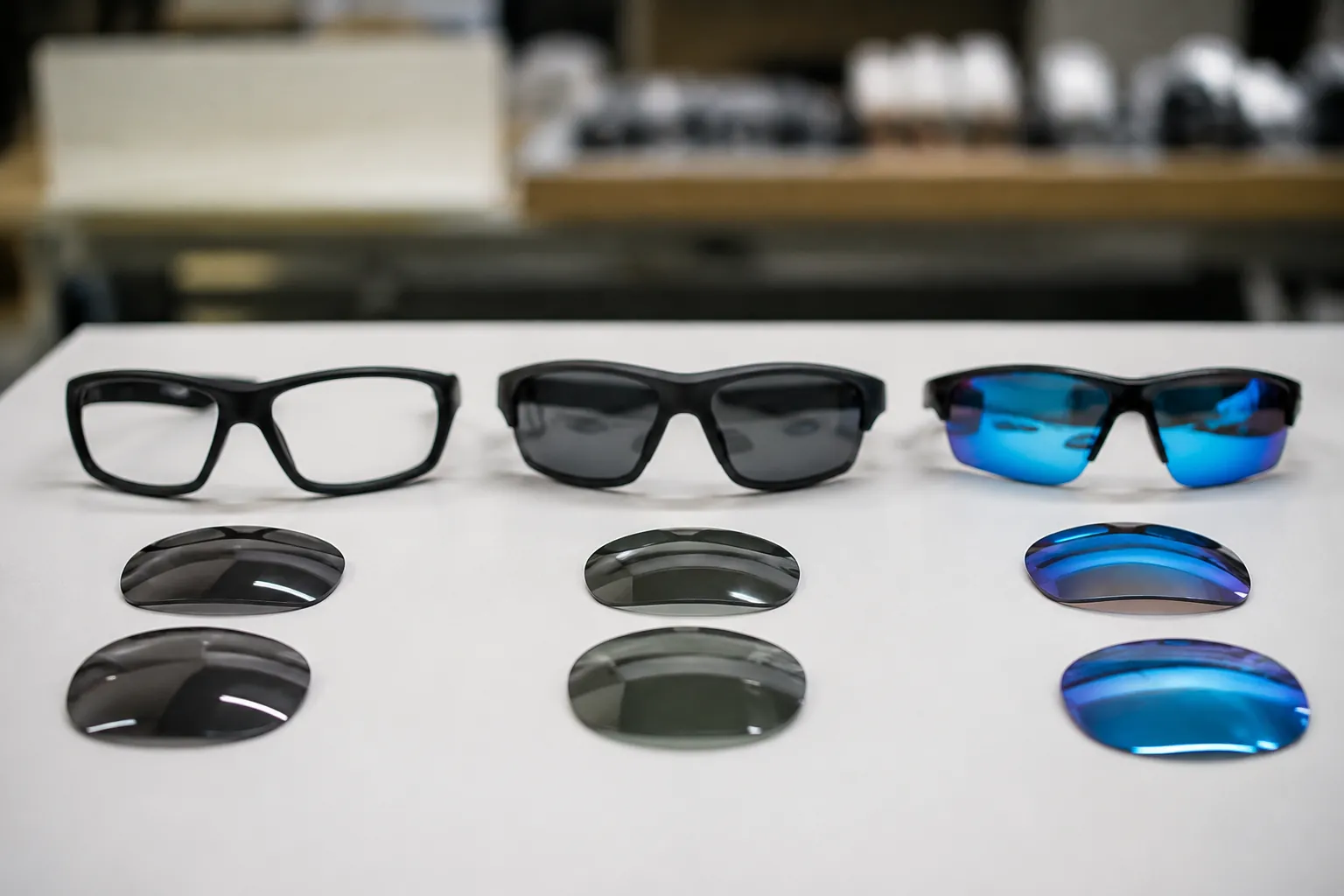
This guide helps overseas brands, importers, distributors, and retail buyers choose lens materials for private label sunglasses without production surprises. It compares PC, TAC, nylon, CR-39, and acrylic by optical performance, impact resistance, polarization, coating behavior, scratch risk, order planning, decoration fit, lead time risk, and finished-product testing. The point is practical. Approve the right lens before bulk production. Write the specification clearly. Do not make claims that the finished sunglasses cannot support under market requirements such as CE EN ISO 12312-1, ANSI Z80.3, AS/NZS 1067, REACH, FDA registration context, ISO 9001, and BSCI where applicable.
Match the Lens to the Sales Channel
Most private label sunglass problems do not start with the frame shape. They start when the lens is chosen by unit price alone. A festival giveaway, a polarized driving style, a children's retail program, and a premium acetate line should not share the same lens specification.
The right material depends on the product claim, sales channel, wear conditions, destination market, and test standard named in the compliance file. For private label sunglasses, the common choices are PC, TAC, nylon, CR-39, and acrylic. Each can work. Each can also fail if the buyer approves only a photo and leaves material, coating, filter category, thickness, and testing undefined.
| Lens Material | Best Use | Typical Thickness | Impact Resistance | Polarized Option | Buyer Tier |
|---|---|---|---|---|---|
| PC | Kids, sport-inspired fashion, low-breakage retail | Commonly about 1.8-2.2 mm, subject to design | High | Available | Entry to mid |
| TAC | Affordable polarized fashion and driving sunglasses | Common laminated sheet options include about 0.74 mm and 1.1 mm | Moderate | Main advantage | Entry to mid |
| Nylon | Premium sport, shield, cycling, fishing, outdoor | Often about 1.6-2.2 mm, subject to mold and curve | High | Available at higher cost | Mid to premium |
| CR-39 | Premium acetate and optical-style sunwear | Often about 1.8-2.0 mm for plano sun lenses | Lower than PC and nylon | Available | Mid to premium |
| Acrylic | Promotional and very price-sensitive programs | Often about 1.8-2.0 mm | Low to moderate | Not preferred | Budget promo |
Compare failure risk before comparing pennies. Scratches, delamination, edge chips, visual distortion, weak UV performance, wrong filter category, or material substitution can cost more than the saving from the cheapest lens. The purchase order should name the material and the finished sunglass requirement, not just the tint color.
PC: Impact Resistance for Volume Orders
PC, or polycarbonate, is widely used for private label sunglasses because it is light, impact resistant, and efficient to process in volume. It suits injected frames, sport-inspired fashion styles, children's sunglasses, beach retail, and programs where breakage risk matters.
The main advantage is impact resistance. PC resists breakage better than CR-39 or acrylic and is usually more forgiving during assembly. Still, do not stretch the claim. A PC lens does not make every sunglass suitable for every impact statement. Any impact claim should be backed by testing of the finished sunglasses under the relevant market standard.
The trade-off is surface hardness. Uncoated PC scratches more easily than many buyers expect, so a hard coating is usually appropriate for retail sunglasses. A clear specification should state the material, UV requirement, filter category, tint, coating, thickness range, and retained approval sample. For darker lenses, visible light transmission must be controlled. A lens that looks fine in a photo may fall into the wrong filter category.
Optically, PC is acceptable for many plano sunglasses, but it is not automatically the cleanest option. Poor molding, uneven cooling, coating stress, aggressive edging, or a tight frame groove can create wave, prism effect, or distortion near the edge. Wrap styles need extra checks for curve, bevel consistency, and frame stress after assembly.
- Good fit: children's sunglasses, sport-inspired retail, beach programs, and private label lines where impact resistance is a priority.
- Key process control: confirm hard coating adhesion and appearance after tinting, mirror coating, edging, and assembly.
- Inspection point: check scratches, coating dots, lens wave, center thickness, edge quality, and frame stress after assembly.
- Compliance note: finished sunglasses should be tested against the market requirement being claimed, such as CE EN ISO 12312-1, ANSI Z80.3, or AS/NZS 1067. REACH, FDA registration context, ISO 9001, and BSCI may be relevant to the supplier file or market access, but they do not replace finished-product lens testing.
For order planning, PC usually works from small trial runs through larger production programs. Confirm minimum order quantity, color setup, coating availability, sample approval process, and retained samples before deposit. If several SKUs share the same lens shape and tint, setup control is simpler than when every SKU uses a different lens color, mirror, or curve.
TAC: Affordable Polarization With Limits
TAC is common when buyers need affordable polarized sunglasses. It is a laminated lens construction, usually with a polarizing film between outer layers. Its commercial advantage is clear: glare reduction at a price point that works for beachwear brands, driving styles, resort retail, online sellers, and distributor catalogs.
TAC also exposes weak process control fast. Because it is laminated and relatively thin, it can be sensitive to moisture, heat, pressure, poor edging, and unsuitable frame curves. Defects may include edge lifting, bubbles, milky edges, delamination, uneven polarization, or visible film lines. A sample photo will not show enough. Check physical samples, then check again during bulk inspection.
A serious TAC specification should include material, UV requirement, filter category, base color, polarization requirement, mirror or non-mirror finish, thickness, edge quality, and inspection method. Common TAC sheet thicknesses include about 0.74 mm and 1.1 mm, but the right option depends on frame groove, curve, target price, and durability expectations. For inspection, use a polarization tester or a controlled LCD-screen method. Check the finished sunglasses as assembled, not only loose lenses.
TAC works best in conventional frame shapes: wayfarer, round, aviator, square, panto, and modest wrap styles. It is less suitable for aggressive sport curves or shield designs because the laminated structure can be stressed by high curvature. If the design needs a deep base curve, exposed shield lens, or premium sport claim, evaluate PC or nylon before approving TAC.
Factory-floor rule: TAC is acceptable when the lamination is stable, polarization direction is correct, and the edge remains clean after cutting. If the edge turns milky before assembly, the frame will not fix it.
Approve TAC alongside the full SKU: frame color, mirror color, logo method, pouch, case, cloth, label, barcode, and carton artwork. A polarized lens can pass technically and still look wrong if the mirror color, temple logo, and packaging palette are approved separately.
Nylon: Stability for Sport and Shield Designs
Nylon lenses cost more than basic PC or TAC, but they solve problems cheaper materials often cannot. They are light, impact resistant, and well suited to high-wrap sport frames and shield-style sunglasses when the frame and lens are engineered together. Cycling, running, fishing, sailing, ski-inspired, and premium outdoor programs are typical use cases.
The main value is stability in demanding geometry. A high-wrap frame can make a basic lens show distortion near the edge, especially when the curve, bevel, or groove fit is poorly controlled. Nylon can provide better optical consistency in these shapes when the mold, coating, and assembly process are managed well.
For sport programs, the specification should cover base curve, center thickness, edge thickness, ventilation cutouts, groove fit, bevel, coating stack, and whether the lens design has already been used in production. Shield lenses need tighter coordination than ordinary two-lens frames. Bridge fit, temple pressure, bevel accuracy, and frame flexibility all affect final assembly.
Nylon can be tinted, mirrored, polarized, and, in some supply chains, photochromic. Each option needs physical sample approval and clear test expectations. Mirror coatings should be checked for pinholes, color drift, and adhesion. Polarized nylon generally costs more than TAC, but it fits premium sport positioning better. Photochromic options require approval of activation color, fade-back behavior, operating conditions, and destination market expectations because performance varies with temperature and UV exposure.
A nylon shield lens is not a generic insert. Check it on the actual production frame or a production-equivalent sample. Request assembled samples, retained samples, and a clear defect standard for lens movement, stress marks, distortion, coating defects, and edge finish.
CR-39: Clarity for Optical-Style Sunglasses
CR-39 is an allyl diglycol carbonate lens material widely used in optical-style eyewear. For plano sunglasses, it is valued for optical clarity, tint depth, and a more premium feel than acrylic or basic PC. It is heavier than PC and nylon, but that weight is often acceptable in acetate, stainless steel, and classic metal frames.
Buyers choose CR-39 when clarity and appearance matter. Smoke, brown, green, gradient gray, wine, amber, and fashion tints can look rich and controlled when the tinting process is stable. CR-39 can also take hard coating and mirror coating well if the supplier has the right process.
The trade-off is impact resistance. CR-39 is not the first choice for children's eyewear, exposed-edge shields, rimless sport styles, or products making strong durability claims. Use it where the channel and claim fit. A boutique acetate sun line can use CR-39 well. A youth action-sport line should usually start with PC or nylon.
Edge quality is a key production detail. CR-39 can chip if cutting speed, wheel condition, bevel angle, or operator pressure is not controlled. This risk may be missed in a small sample run and then appear during bulk QC. Review edge quality on production-equivalent lenses and confirm the groove fit in the actual frame.
For documentation, the test report should match the finished sunglasses, lens color, filter category, and production specification. CE EN ISO 12312-1, ANSI Z80.3, and AS/NZS 1067 are finished-product sunglass standards for relevant markets. REACH, FDA registration context, ISO 9001, and BSCI may support supplier or market documentation, but they should not be presented as proof that a specific lens color or finished sunglass passed optical requirements.
Acrylic: Promo Use, Tight Claim Control
Acrylic is the low-cost option. It has a legitimate place, but it should not be sold as a premium lens under vague wording. It is best for adult promotional sunglasses, event merchandise, novelty collections, tourism programs, and price-sensitive orders where expected product life is limited and the claim is modest.
The limits are clear. Acrylic usually has lower optical quality than PC, nylon, or CR-39. Scratch resistance is often weak unless a coating is added, and coating can reduce the original cost advantage. Impact resistance is also limited compared with PC and nylon. Acrylic can look acceptable in catalog photography and then show surface marks during packing, retail display, cleaning, or repeated use.
Where acrylic works best is simple: standard tint colors, simple frame shapes, adult promotional use, and non-premium positioning. Where it becomes risky is just as predictable: children's products, sport collections, polarized claims, premium retail, high-scratch display environments, and any program where the buyer expects long-season repeat use.
The biggest commercial risk is substitution. A buyer approves a PC sample, but the bulk order is made with cheaper acrylic because the purchase order only says "smoke lens" or "UV lens." That wording is too loose. The PO should state acrylic, PC, TAC, nylon, or CR-39; UV requirement; filter category; tint color; coating; polarization status; thickness; and retained sample reference.
- Acceptable: adult event sunglasses, short-term giveaways, novelty drops, and simple non-polarized promotional styles.
- Risky: children's eyewear, sport collections, premium retail, polarized programs, and scratch-sensitive displays.
- PO control: prohibit material substitution unless the buyer approves a new physical sample, updated specification, and revised cost sheet in writing.
Acrylic may help hit a tight landed-cost target, but calculate more than unit price. Returns, complaints, damaged brand positioning, and failed inspection can erase the initial saving. For any claim beyond basic adult promotional use, review PC, TAC, nylon, or CR-39 first.
Cost, MOQ, Lead Time, and Decoration Logic
Lens choice affects more than the lens line on the quotation. It changes sampling time, coating risk, rejection rate, packaging protection, inspection workload, and the number of approval steps before bulk production. A plain PC lens in a standard frame is usually straightforward. A polarized TAC gradient mirror in several colors needs tighter control. A nylon shield with a new frame mold needs fitting trials before bulk approval.
Minimum order quantity should be confirmed by design, material, color, decoration method, and packaging. A low-MOQ sample or trial order can validate appearance, fit, logo position, and packaging. It does not prove full-scale batch stability. As order size increases, small defect percentages become real quantities. Incoming lens checks, retained samples, and final random inspection become more important.
| Order Stage | Typical Use | Lens Risk | Practical Control |
|---|---|---|---|
| Trial order | Showroom sample, small launch, buyer approval | Limited proof of batch consistency | Approve fit, tint, logo position, packaging, retained sample, and inspection criteria |
| Small retail drop | Distributor test, online launch, boutique order | Color variation if swatches are vague | Lock physical lens swatch, mirror finish, frame color, and carton details before deposit |
| Commercial bulk production | Regular retail or wholesale program | Scratches, edge chips, coating defects, and assembly stress become costly | Add AQL-based checks for lens surface, distortion, polarization, frame fit, and packing |
| Volume program | Repeat production or multi-SKU rollout | Batch drift, coating variation, material substitution | Require batch records where available, retained samples, incoming lens checks, and final random inspection |
Lead time should be quoted after the supplier knows the lens material, tint, mirror, coating, frame, logo method, packaging, compliance requirement, and whether third-party testing is needed. Standard materials and existing frame tooling are usually faster than new molds, shield lenses, custom mirror colors, photochromic options, special packaging, or added testing.
Decoration also affects lens planning. Pad printing, silk-screen temple logos, laser engraving, metal logo plates, heat-transfer pouch graphics, printed microfiber cloths, and custom box artwork should be reviewed with the lens color. A blue mirror lens, gold temple logo, and kraft box may each look acceptable alone and weak together. Approve the full product system: frame, lens, logo, pouch or case, cloth, label, barcode, carton, and compliance file.
Spec Sheet and QC Checklist Before Bulk Approval
A useful sunglass lens spec sheet can be short, but it must be exact. Words such as "premium," "UV protected," "smoke," "anti-scratch," and "polarized" are not enough for production control. Do not make the factory interpret the buyer's intent after the deposit is paid.
- Material: State PC, TAC, nylon, CR-39, or acrylic. State that substitution is not allowed without written approval and a new retained sample.
- Filter category: Confirm the sunglass filter category required for the destination market and use case under CE EN ISO 12312-1, ANSI Z80.3, or AS/NZS 1067 as applicable.
- UV requirement: Define UV400 or the required ultraviolet transmittance limit for the destination market. Do not rely on the phrase "UV lens" alone.
- Thickness and curve: Confirm center thickness, edge thickness, base curve, bevel, and groove fit for the actual frame.
- Polarization: State polarized or non-polarized. For polarized lenses, require bulk checks for orientation and glare reduction.
- Color and finish: Define solid tint, gradient, mirror, flash mirror, clear fashion tint, or photochromic behavior. Use physical swatches when color matters.
- Coating: Specify hard coating, mirror coating, anti-scratch expectation, or no coating. Do not leave this to assumption.
- Inspection: Check incoming lenses, scratches, coating dots, tint consistency, edge chips, lens wave, frame stress, temple alignment, logo placement, packing, barcodes, and retained samples.
- Compliance file: Keep relevant documents such as CE EN ISO 12312-1, ANSI Z80.3, AS/NZS 1067, REACH, FDA registration context, ISO 9001, or BSCI where they apply. Avoid using supplier certificates as substitutes for finished-product sunglass testing.
The best lens is the one that matches the channel, claim, and price point. PC is the impact-resistant volume choice. TAC is the value polarized choice. Nylon is the sport and shield choice. CR-39 is the clarity choice for premium optical-style sunglasses. Acrylic is the budget promotional choice, with strict limits. Good private label production is not about choosing the most expensive lens. It is about locking the correct lens, documenting it clearly, and testing the finished sunglasses before bulk shipment.
Have a custom sunglasses project in mind?
Send us your styles, target market and quantities and we will return a detailed quote with MOQ, lead time and a sample plan.
Get a QuoteWhy source this from Wenzhou with LumiShades
Wenzhou in Zhejiang Province is widely regarded as China’s eyewear manufacturing capital, producing a large share of the world’s sunglasses. That concentration matters to buyers: a deep local supply chain for acetate sheet, hinges, lens blanks, plating and packaging means shorter component lead times, easier color and material matching, and a workforce with decades of eyewear-specific skill. LumiShades has manufactured in this ecosystem since 2009, and our vertical integration — in-house injection molding, acetate cutting, CNC milling, lens tinting, decoration and quality control — means no part of your order is quietly subcontracted to a workshop you cannot audit.
For international buyers, that vertical control translates into accountability. When a single factory owns every step, defects are traced and fixed at source rather than bounced between vendors, and your specifications survive intact from first sample to bulk. We back this with 15+ years of experience, shipments to 60+ countries, more than 5 million pairs produced per year and a 98.5% on-time delivery rate. Our certifications — CE EN ISO 12312-1, FDA registration, ANSI Z80.3, AS/NZS 1067, REACH, ISO 9001 and BSCI audit — mean the compliance documentation your market requires already exists. Explore our manufacturing capabilities and quality control process to see how this works in practice.
Frequently asked questions
Which lens material should I choose for a first private label polarized sunglasses order? For most entry-to-mid polarized fashion orders, start by evaluating TAC because it gives glare reduction at a controlled cost. Ask for physical samples and specify material, UV requirement, filter category, polarization direction, thickness, tint, mirror or non-mirror finish, and edge inspection after assembly. If the frame is high-wrap, shield-style, or positioned as premium sport eyewear, evaluate polarized nylon or PC instead.
Is PC better than TAC for sunglasses? PC is better when impact resistance, children's eyewear, sport-inspired styling, or lower breakage risk is the priority. TAC is usually better when affordable polarization is the main selling point. Choose based on the product claim: PC for toughness, TAC for value polarization. Then confirm the finished sunglasses against the relevant market standard before making compliance claims.
Can a supplier make samples before bulk production? Yes, but the sample request should be specific. Ask for the exact lens material, tint, coating, polarization status, thickness, frame color, logo method, packaging, and retained sample reference that will be used for bulk approval. Do not approve bulk production from photos alone. Check physical samples for lens color, distortion, edge quality, coating defects, frame fit, logo position, and packaging.
What standards should overseas buyers specify for sunglass lenses? Specify the standard for the destination market and test the finished sunglasses, not only loose lenses. Common references include CE EN ISO 12312-1 for Europe, ANSI Z80.3 for the United States, and AS/NZS 1067 for Australia and New Zealand. REACH, FDA registration context, ISO 9001, and BSCI may be relevant to market access or supplier evaluation, but they do not replace finished-product testing for lens category, UV transmittance, optical quality, and related sunglass requirements.
When does nylon justify the higher price? Nylon is worth reviewing when the design uses high-wrap geometry, shield lenses, exposed edges, ventilation cutouts, or premium outdoor positioning. It is especially relevant for cycling, fishing, sailing, running, and sport-fashion programs where optical stability and frame fit matter. For simple promotional sunglasses or flat fashion frames, nylon may add cost without solving a real production problem.
How do I prevent a supplier from changing lens material after approval? Put the exact lens material, tint, coating, polarization status, filter category, UV requirement, thickness, curve, and approved sample reference in the purchase order. Add a written no-substitution clause. Keep retained samples, require incoming lens checks, and make material, color, coating, edge quality, polarization, and finished-sunglass testing part of the inspection plan.
Ready to start?
Explore our sport wrap sunglasses or request a quote — our sales team replies within 12 hours.
Request a Quote