
How to Prevent Lens Pop-Out in Custom Sunglasses
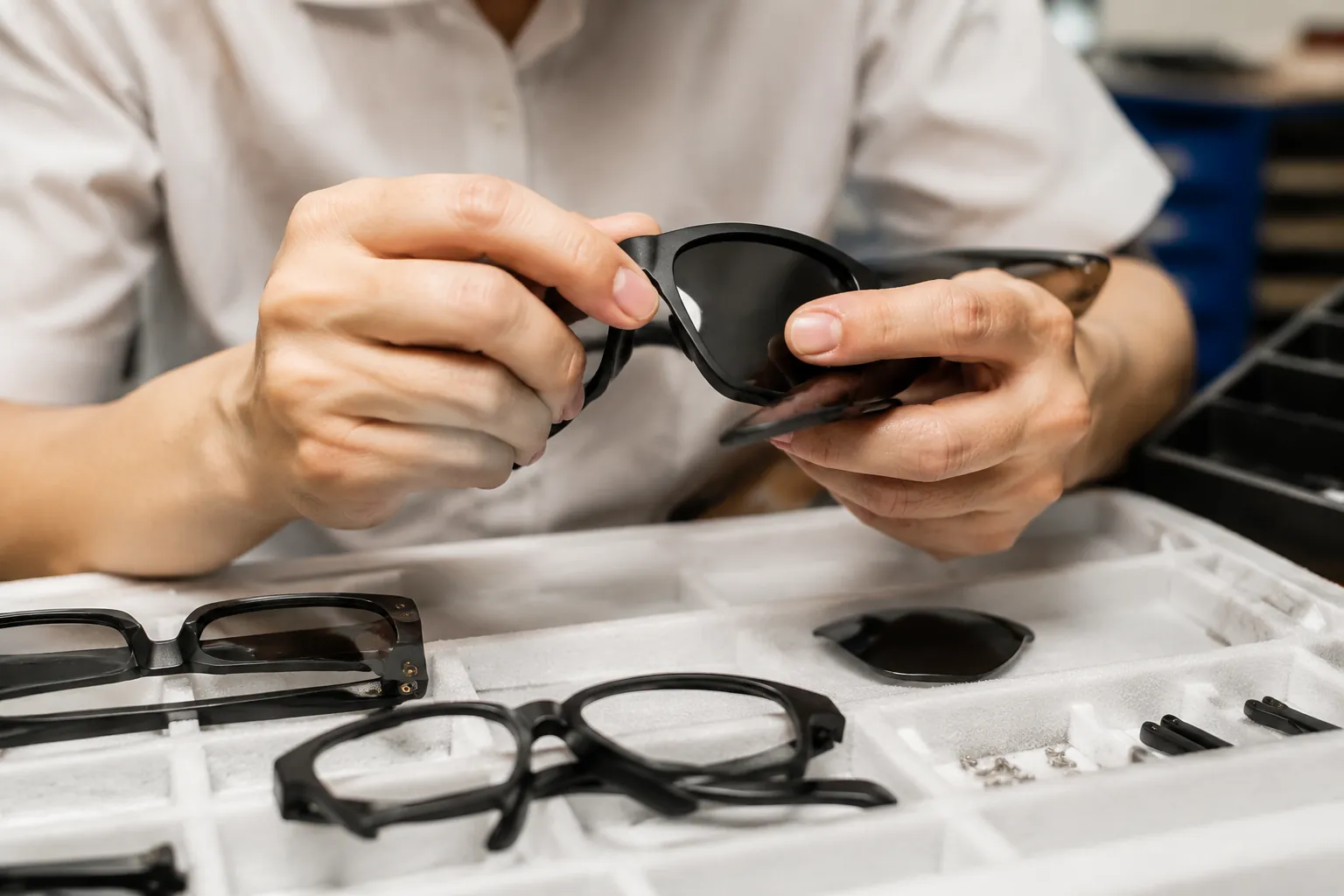
Lens pop-out in custom sunglasses rarely comes from one defect. It usually comes from tolerance stack-up: a lens that is thinner than the approved sample, a groove that is too wide or too shallow, a frame that relaxes after molding or polishing, decoration that weakens the rim, or QC that checks appearance but not retention. The lens looks fine. Then it moves. This guide is for overseas brands, importers, distributors, and retailers buying custom sunglasses in volume. Use it before tooling approval, pre-production samples, and bulk release so lens retention is controlled by specifications, not guesswork.
The real failure mode: weak lens retention
A sunglass lens stays in place because the frame groove, eyewire, nylon cord, or rim structure captures the lens edge under controlled pressure. The fit must be tight enough to withstand handling, frame twisting, heat during storage, transport vibration, and repeated try-ons. It must not be so tight that the rim whitens, cracks, distorts, or leaves stress marks around the lens opening.
A lens can look fully seated during sample review and still work loose later. That is the trap. The approved sample may use a 2.0 mm lens, while bulk production uses a thinner lens. The groove may be slightly wider than the sample. The frame may relax after molding, polishing, heating, or assembly. Each shift may look minor. Together, they reduce the pressure that holds the lens in place.
Your control sheet should name the variables that affect retention: lens material, measured lens thickness, base curve, bevel profile, groove depth, groove width, frame material, rim thickness, decoration near the lens opening, conditioning time before measurement, and QC method. If frame and lens work are handled by different suppliers, require both parties to use the same approved drawing, sample, and measurement method. Otherwise, each supplier may meet its own standard while the finished sunglasses still fail.
Lens thickness: set a number and tolerance
Lens thickness is often missed because buyers focus on color, mirror coating, polarization, or logo placement. Do not leave it open. The purchase order and technical sheet should state the nominal thickness, allowed tolerance, lens material, and measurement points. A common error is approving a sample with one lens construction, then accepting bulk production with another because the tint looks similar.
Thin lenses can reduce weight and cost, but they flex more and need a groove designed for that thickness. Thicker lenses can improve edge engagement, but they can also add assembly stress if the rim is narrow, brittle, transparent, highly polished, or made from recycled or blended plastic with less predictable behavior. Oversized lenses, shield-like shapes, high-wrap sport frames, semi-rimless designs, flat tops, and sharp corners need extra review. They load the lens and rim harder.
| Lens option | Common use | Retention notes | Buyer control point |
|---|---|---|---|
| 1.8 mm PC or TAC | Promotional and lightweight fashion sunglasses | Can work when the groove and bevel are designed for this thickness; higher risk if the rim is flexible or the groove is loose | Confirm actual bulk thickness and require push, twist, and gap checks |
| 2.0 mm TAC, PC, nylon, or equivalent lens | Mainstream full-rim fashion and retail sunglasses | Often a practical starting point for full-rim designs, but still depends on groove fit and frame material | Use only when the groove, bevel, and sample approval are based on the same thickness |
| 2.2 mm lens or thicker | Larger lenses, heavier frames, or designs needing more edge engagement | May improve retention but can increase assembly stress, rim whitening, lens edge chipping, or distortion if the groove is not matched | Inspect for stress marks, cracking, lens edge damage, and frame distortion after assembly |
| Custom blank or prescription-ready lens | Optical-style sunglasses, RX-ready programs, and special lens shapes | Retention depends heavily on bevel geometry, edge finish, lens curve, and frame design | Approve the drawing, edged lens, bevel sample, and finished assembled frame together |
Ask the factory or lens supplier to record lens thickness with a calibrated micrometer or equivalent measuring tool. Measurements should be taken at agreed points, such as the center and selected edge areas. Sheet material, molded lenses, tinting, coating, and edging can all create variation. The approved sample and bulk production should use the same lens material, construction, coating stack, and nominal thickness unless the fit is revalidated.
Groove design: depth, width, bevel, and corners
The frame groove is the mechanical seat for the lens in most full-rim plastic sunglasses. In injection frames, the mold creates the groove, then material shrinkage, cooling, and post-processing change it. In acetate frames, the groove is usually routed or CNC cut after the front is shaped, then affected by heating, tumbling, polishing, and cleaning. In metal frames, retention depends on eyewire channel shape, screw closure, soldering accuracy, bridge alignment, and whether the rim closes evenly around the lens.
For plastic full-rim sunglasses, correct groove depth and width depend on lens thickness, bevel geometry, frame material, front curve, rim thickness, and lens size. There is no universal groove number. Require the supplier to document the approved sample dimensions and acceptable production tolerance. A groove that is too wide lets the lens move even when it looks seated. A groove that is too narrow can force the lens into the frame and create stress marks, whitening, cracking, distortion, or later release.
- Groove depth: controls how far the lens edge enters the rim. Too shallow, and the lens edge can climb out during twisting. Too deep, and assembly can create stress.
- Groove width: must match the actual lens thickness and bevel shape. Require a measurable target and tolerance, not a visual fit check.
- Bevel profile: the lens edge should seat into the groove without cutting the frame or leaving corner gaps. Inconsistent bevel height often causes uneven fit.
- Corner radius: square, cat-eye, flat-top, and angular shapes need enough radius and edge control to reduce stress concentration and poor seating.
- Rim section thickness: very thin fronts may not provide enough material for a deep, stable groove, especially near decorated or drilled areas.
Request a retention review before final tooling, mold correction, or CNC programming is approved. Fixing groove geometry, bevel shape, or lens thickness during pre-production is far easier than sorting finished goods after assembly.
Material behavior changes the fit
Frame material affects how stable the lens seat remains after production. Injection-molded PC, nylon, TR90-type materials, recycled plastics, and mixed compounds can shrink or relax as they cool and stabilize. The change depends on resin, mold design, gate position, part thickness, mold temperature, cooling time, and conditioning period before measurement. A frame measured immediately after molding may not match the same frame after stabilization.
Acetate behaves differently. It is cut from sheet, heated, formed, tumbled, polished, cleaned, and adjusted. Each step can change the front curve, soften the rim, round the groove edge, or leave polishing residue in the groove. For acetate sunglasses, check the groove after final forming, polishing, and cleaning. Do not rely only on the CNC-cut measurement.
Metal frames have less plastic shrinkage, but they have alignment risks. If an eyewire screw does not close fully, soldering pulls the rim out of round, the bridge angle is inconsistent, or plating buildup changes the channel fit, the lens may be tight in one area and loose in another. For rimless and semi-rimless styles, drilling accuracy, notch quality, nylon cord tension, lens edge polish, and screw torque become part of the retention system.
Define when dimensions are measured. For example, injection frames should be checked after the supplier's normal stabilization period. Acetate frames should be checked after final forming, polishing, and cleaning. Ask the supplier to record the measurement timing on the inspection report. Same part, different stage, different reading.
Decoration and branding can weaken the rim
Decoration is not only cosmetic. It can affect lens retention when it changes the rim, hinge area, or front alignment. Metal logo plates, rivets, drilled trims, heat transfer, thick pad printing, embedded glitter, laminated acetate layers, plating, and deep laser engraving can introduce local stress or remove material. Even temple decoration can matter if hinge installation or heating pulls the front out of alignment.
For plastic frames, drilling or inserting metal trim near the lens opening can reduce the remaining rim section and weaken the groove. On transparent frames, an over-tight lens can create visible whitening around decorated areas. On mirrored lenses, rough assembly can scratch the coating if workers force the lens into a tight or misaligned groove. On polarized lenses, excess heat during decoration, adjustment, or packaging preparation can create visual distortion or delamination risk, depending on the lens construction.
Test the final decorated version. A plain sample may pass while the decorated version fails because the rim has been drilled, heated, plated, pressed, or stressed. List decoration details on the purchase order and sample approval sheet: logo position, pad print location, logo plate size, metal insert position, drilling distance from the lens opening, laser depth where relevant, plating or heat process, hinge type, and any packaging insert that presses on the lens or frame. This matters even more for private-label programs where the same frame is offered with several logo options.
Buyer spec sheet: stop disputes early
A purchase order that says only "black frame, smoke lens, logo on temple" leaves too much open. The spec sheet does not need to be long, but it must define the parts that decide whether the lens stays in place. For small trial orders, the factory can help convert the approved sample into critical dimensions. For repeat orders or larger runs, lock those dimensions and inspection criteria before bulk production starts.
- Frame material, color, construction method, approved sample reference, and drawing revision if available.
- Lens material, nominal thickness, tolerance, base curve, tint, coating, mirror finish, and polarization status.
- Groove depth, groove width, bevel type, corner radius, rim thickness, and any agreed retention dimensions or sample-based limits.
- Decoration process, location, heat exposure, drilling, logo plate size, metal insert details, plating, and hinge construction.
- Acceptable limits for visible gaps, lens movement, stress marks, whitening, scratches, coating damage, lens edge chips, and assembly damage.
- QC checks: lens push check, twist check, gap check, heat conditioning where relevant, vibration review, carton compression review, and inspection sample size.
- Market requirements such as CE EN ISO 12312-1, ANSI Z80.3, AS/NZS 1067, REACH, FDA registration, ISO 9001, or BSCI where applicable to the order, market, supplier, or customer requirement.
- Packaging method, inner bag, lens protector, tray, pouch, carton strength, carton quantity, and whether packaging pressure can contact the lens or frame front.
Separate verified requirements from assumptions. If a supplier cannot measure a requested dimension, agree on another control method: a signed reference sample, go/no-go gauge, documented push test, or third-party inspection checklist. The goal is simple. Decide what passes before production starts.
QC checks that catch weak retention before shipping
Visual inspection is not enough. A loose lens can sit flush on the inspection table and still fail when the frame is twisted, packed tightly, stored in heat, or handled repeatedly. Check lens retention at sample approval, pre-production sample approval, first article inspection, inline inspection, and final inspection. For bulk orders, name lens pop-out, visible lens movement, and major corner gaps as defects in the AQL or inspection plan.
Useful checks include manual pressure from the inner lens side at the top, bottom, nasal corner, and temporal corner; gentle frame torsion to see whether the lens edge climbs out; full-rim gap inspection under consistent lighting; and heat conditioning when the material or shipping route makes heat exposure relevant. Agree on pressure, temperature, time, and pass/fail criteria with the supplier or test lab. Different materials and designs tolerate different loads.
Packaging also needs review. A frame that passes on the bench can fail after being compressed by a tight pouch, heavy carton load, lens protector, display tray, or poorly shaped insert. Use vibration, drop, and carton compression reviews when the order ships long distance or moves through several warehouses.
Compliance documents matter, but they do not prove retention on a custom design. CE EN ISO 12312-1, ANSI Z80.3, AS/NZS 1067, REACH, FDA registration, ISO 9001, and BSCI address market access, safety, quality management, chemical, registration, or social compliance requirements depending on the standard and context. Pair them with design-specific inspection on the actual frame, lens, decoration, and packaging used for the order.
Sample approval and lead-time logic
Rushed sample approval is one of the fastest ways to approve a weak frame. The sample stage should test construction, not only color, lens shade, logo placement, and packaging appearance. Confirm whether the sample uses the same material, lens stock, tint process, decoration process, and assembly method planned for bulk production.
| Stage | What to verify | Why it matters | Timing |
|---|---|---|---|
| Prototype or first sample | Lens thickness, groove fit, bevel, visible gaps, assembly stress, and basic push/twist retention | Confirms whether the design can hold the lens before bulk release | Before tooling approval, mold correction, or final sample sign-off |
| Pre-production sample | Actual bulk resin or acetate, lens stock, tint, coating, logo process, hinge setup, and packaging | Prevents approval based on materials or processes that will not be used in mass production | Before bulk production starts |
| First article inspection | Conditioned frame dimensions, groove width, lens seating, decoration effect, and assembly method | Catches tooling, CNC, material, or assembly drift at the start of the run | At the beginning of bulk production |
| Final inspection | Retention checks, gap checks, carton pressure, finished appearance, labeling, and packaging condition | Helps stop loose lenses and packaging-related failures before shipment | Before shipment release |
Low-MOQ trials can reduce commercial risk, but they do not remove engineering risk. A small trial can show whether a shape is too thin, too flat, too flexible, too sharp at the corners, or too hard to assemble consistently. In larger production, the same weakness becomes returns, rework, or shipment rejection. Approve the sample only after lens retention has been tested on the same material, lens thickness, decoration, and packaging planned for bulk.
Have a custom sunglasses project in mind?
Send us your styles, target market and quantities and we will return a detailed quote with MOQ, lead time and a sample plan.
Get a QuoteWhy source this from Wenzhou with LumiShades
Wenzhou in Zhejiang Province is widely regarded as China’s eyewear manufacturing capital, producing a large share of the world’s sunglasses. That concentration matters to buyers: a deep local supply chain for acetate sheet, hinges, lens blanks, plating and packaging means shorter component lead times, easier color and material matching, and a workforce with decades of eyewear-specific skill. LumiShades has manufactured in this ecosystem since 2009, and our vertical integration — in-house injection molding, acetate cutting, CNC milling, lens tinting, decoration and quality control — means no part of your order is quietly subcontracted to a workshop you cannot audit.
For international buyers, that vertical control translates into accountability. When a single factory owns every step, defects are traced and fixed at source rather than bounced between vendors, and your specifications survive intact from first sample to bulk. We back this with 15+ years of experience, shipments to 60+ countries, more than 5 million pairs produced per year and a 98.5% on-time delivery rate. Our certifications — CE EN ISO 12312-1, FDA registration, ANSI Z80.3, AS/NZS 1067, REACH, ISO 9001 and BSCI audit — mean the compliance documentation your market requires already exists. Explore our manufacturing capabilities and quality control process to see how this works in practice.
Frequently asked questions
What lens thickness should I choose to reduce pop-out risk? Do not choose lens thickness from a generic rule alone. For many full-rim fashion sunglasses, around 2.0 mm is a common starting point, but the right choice depends on groove width, groove depth, bevel profile, lens size, frame material, rim thickness, and curvature. Ask the supplier to state the nominal lens thickness, allowed tolerance, lens material, and measurement points. Then approve the assembled sample using the same lens construction planned for bulk production.
What groove tolerance should I ask for? Ask for measurable groove width, groove depth, bevel profile, and inspection method based on the approved sample or drawing. The exact tolerance depends on construction, material, tooling, and factory capability, so do not copy a number without validation. Require the supplier to measure the approved sample, define acceptable production variation, and confirm that the bulk lens cannot move under the agreed push, twist, and gap checks.
Can a pair pass CE or ANSI testing and still have lens pop-out issues? Yes. CE EN ISO 12312-1, ANSI Z80.3, AS/NZS 1067, REACH, FDA registration, ISO 9001, and BSCI relate to specific market, safety, chemical, registration, quality management, or social compliance requirements. They do not replace design-specific retention checks on your actual frame, lens, decoration, and packaging. Include lens retention criteria in your sample approval and final inspection checklist.
Does acetate have less pop-out risk than injection plastic? Not automatically. Acetate can be cut accurately, but heating, forming, tumbling, polishing, cleaning, and adjustment can change the groove or front curve. Injection frames can also be stable when resin selection, mold design, cooling, shrinkage, and conditioning are controlled. Compare assembled samples, measured groove dimensions, and retention test results instead of relying on the material name.
How does decoration affect lens retention? Decoration can affect retention if it removes rim material, adds heat, creates local stress, changes alignment, or interferes with assembly. Metal logo plates, drilling, rivets, laser engraving, heat transfer, thick printing, plating, and embedded trims should be tested on the final decorated sample. Do not approve retention based only on a plain frame if the bulk order will include decoration near the rim or hinge area.
What MOQ is practical for testing a new sunglass shape? The practical MOQ depends on the supplier and construction method. For a new shape, the first goal is not volume. It is proving that the design can be made consistently. Use the trial order to check lens thickness, groove fit, bevel, decoration, packaging pressure, and actual retention. Before increasing quantity, lock the approved sample, technical sheet, defect definitions, and inspection method.
What should be listed on my PO to avoid lens fit disputes? List the frame material, lens material, lens thickness and tolerance, approved sample reference, groove or retention requirements, bevel type, decoration method, acceptable gap and movement limits, QC checks, compliance targets, packaging method, carton requirements, and inspection standard. If a dimension cannot be measured reliably, define a signed reference sample, go/no-go gauge, or functional retention test so both sides know what will pass or fail.
Ready to start?
Explore our aviator sunglasses or request a quote — our sales team replies within 12 hours.
Request a Quote