
Lens Tint Matching for Sunglasses Reorders
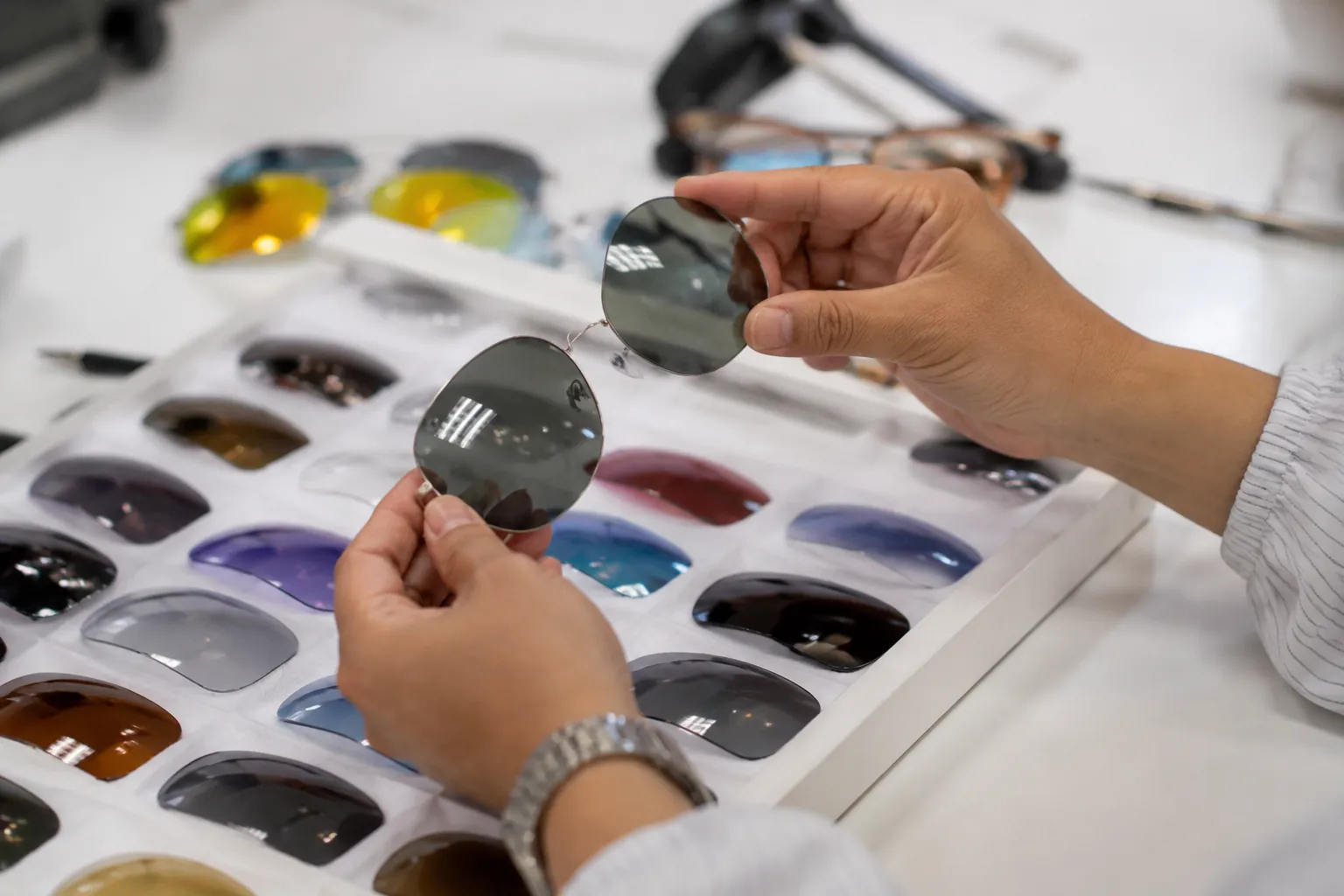
This guide is for brands, importers, distributors, and retailers placing repeat orders for private label sunglasses. The goal is simple: fewer rejected cartons, fewer arguments about "close enough," and clearer tint expectations before bulk production starts. Lens tint matching is not controlled by a photo or a color name. It needs physical master samples, written tolerances, VLT checks, controlled lens materials, coating approval, and QC records that both buyer and factory can use.
Start With One Approved Standard
Most tint disputes begin before production. A buyer approves a photo. A merchandiser saves a phone image. The next reorder uses an aged sample from someone's desk. Then the lens room is told to match a target no one has properly controlled.
That is not color control. It is guesswork.
For private label sunglasses, the approved standard should be a physical lens or finished sunglass sample, clearly approved by both buyer and factory. A practical system is simple: the buyer keeps one master, the factory keeps one master, and QC keeps one sealed working reference. Protect the working reference from daily handling, direct sunlight, humidity, dust, scratches, and chemical contamination. If it fades, scratches, warps, or becomes contaminated, do not replace it informally. Buyer and factory should approve the new reference in writing.
Label the standard properly. A useful label includes style number, lens material, lens base curve, lens thickness if relevant, tint name, solid or gradient construction, mirror coating if any, polarization status, intended filter category or VLT range, approval date, buyer name, and PO or sample reference number. If the lens is a brown gradient, do not label it only as "brown." Write the real target: "Brown gradient, TAC polarized, no mirror, target Category 3, top and bottom VLT points to be confirmed against approved master."
Blunt rule: if the factory cannot compare the reorder lens with the approved physical master under agreed lighting, it is not matching tint. It is guessing.
Choose the Right Reference Method
Not every program needs the same control level. A small trial run may not need the same test plan as a large retail replenishment. Still, every reorder needs a documented target. The second order is often where weak first-order approvals become expensive.
| Reference method | Best for | Useful numbers or controls | Main risk |
|---|---|---|---|
| Physical master sample | Most private label reorders | Compare under agreed lighting, commonly D65 daylight or a specified light box condition | Can fade, scratch, or be lost if not sealed, labeled, and logged |
| Color chip or Pantone-style reference | Frame colors, acetate discussion, logos, printed decoration, packaging | Useful for pad print, silk print, enamel badge, temple color, and packaging color | Not sufficient by itself for transparent, polarized, mirror, or gradient lens tint |
| Spectrophotometer readings | Large programs, strict retailers, repeated replenishment | Use agreed instrument settings, illuminant/observer, backing, measurement point, and Delta E formula | Readings lose value if the measurement setup changes between approval and reorder |
| Visible light transmission test | Sun filter category and product claim control | Common sunglass filter category ranges include Cat. 2: over 18% to 43% VLT; Cat. 3: over 8% to 18% VLT; Cat. 4: over 3% to 8% VLT, subject to the applicable standard and market rules | Confirms darkness/transmittance but does not fully describe perceived hue, gradient position, or mirror color |
| Finished sunglass approval | Transparent frames, mirrors, gradients, rimless styles, fashion colors | Judge lens tint together with frame color, lens edge, logo, and decoration | Slower than approving loose lenses only, but safer for retail appearance |
For most B2B buyers, the practical setup is a physical master plus defined measurements. Use the master sample to judge appearance. Use measurement data to control VLT, filter category, and repeatability. This is especially important when a product is sold with claims or markings linked to CE EN ISO 12312-1, ANSI Z80.3, or AS/NZS 1067. REACH, FDA registration, ISO 9001, and BSCI may also matter for supplier qualification or market access. They do not replace a tint specification.
Set Tolerances Before the PO
"Same as last time" is not a tolerance. It is an instruction that still needs a controlled reference and acceptance criteria. Lens tint can shift because of dye lot, material lot, lens thickness, coating, bath condition, process time, and inspection method. Agree on acceptable variation before the PO is released.
If Delta E is used, specify the complete method: color space or formula, illuminant, observer angle, instrument model if required, calibration method, backing, lens side measured, and measurement point. There is no universal Delta E limit that fits every sunglass lens. Critical fashion colors and premium retail programs usually need tighter limits. Lower-risk smoke or brown lenses may allow wider limits, but only if the visual match, left-right consistency, and VLT category remain acceptable. Put the agreed limit in the PO or approved specification. Do not leave it buried in an email comment.
- Solid lens: define one or two measurement points near the optical center, away from drilled holes, edges, logos, or stress marks.
- Gradient lens: define top, center, and bottom points. For example, measure a stated distance from the top edge, at optical center, and a stated distance from the bottom edge. Use the same points for approval and reorder inspection.
- Mirror lens: approve base tint and mirror appearance separately. A silver mirror over smoke will not look the same as a silver mirror over brown.
- Polarized lens: confirm tint, VLT, polarization performance, axis alignment, and visual uniformity after assembly.
- Category control: write the required filter category or VLT range directly on the PO, and confirm which standard and target market apply.
Be realistic. Tight tolerances need sampling time, measurement time, and clear rejection rules. If the buyer wants strict tint control, the timeline and cost structure must allow for it.
Account for Lens Material
Tint drift is rarely one clean defect. It is usually several variables stacking up. Lens material is one of the biggest.
PC, TAC polarized, nylon, CR-39, and other lens types can absorb or display color differently. A tint approved on PC should not automatically be treated as approved for TAC polarized or nylon.
PC lenses are common in fashion, sport, and value programs because they are lightweight and impact resistant. Their final appearance can be affected by dye control, lens thickness, injection stress, and coating. TAC polarized lenses are laminated, so the polarizing film, adhesive layers, base tint, and hard coating can all change perceived color. Nylon lenses are often used in performance eyewear because of clarity and toughness; small color differences may be easier to see on a clearer lens. CR-39 and other materials need their own approval because their optical and tinting behavior differs from PC and TAC.
Base curve also changes perception. A flatter fashion lens and a high-wrap sport lens may not look identical even if the same dye target is used. A wrap lens creates more viewing angle and thickness variation, so edges can appear darker or shift in hue. Lens thickness matters too. A thicker lens can look deeper, darker, or less clean than a thinner lens. For rimless and semi-rimless styles, check the lens edge because consumers can see it directly.
The safest rule: approve a separate master for each lens material, base curve, and construction. One "smoke" master cannot control PC solid smoke, TAC polarized smoke, nylon smoke, and mirror smoke across different frame shapes.
Control Tinting and Coating Together
Factory process detail matters. A lens tint can change with dye bath concentration, bath temperature, dwell time, cleaning quality, dip angle, withdrawal speed, lens orientation, operator handling, and material lot. With gradient lenses, a small change in dipping angle or withdrawal speed can move the fade line. If a dye bath is adjusted during production without a new first-piece comparison, later cartons may not match earlier cartons.
Start with clean lenses. Finger oil, polishing residue, release agent, dust, and water contamination can cause streaks, spots, cloudy areas, uneven absorption, or coating defects. The lens room should record the formula or process setting used for the approved sample, check bath condition, and compare first pieces against the master before bulk production continues.
During production, QC should pull samples at defined points: start, middle, and end of run. Pull again after any bath adjustment, operator change, material lot change, or coating change. Small process changes can create visible shade shifts.
Mirror coating adds risk. The reflected color interacts with the base tint, lens curve, and frame color. Blue mirror over gray can look colder than blue mirror over brown. Red mirror over amber can appear more orange under warm retail lighting. If the program uses flash mirror, multilayer mirror, or full mirror, approval should cover reflected color, base tint, pinholes, obvious shade difference, rub resistance if required by the buyer, and edge condition after cutting.
Decoration also changes perceived tint. Pad printed lens logos, laser marks, metal logo plates, hot stamping, enamel inlays, transparent frames, and packaging color can all affect how the finished sunglass is seen. If retail appearance matters, approve tint with the frame and decoration, not as an isolated loose lens.
Build Approval Gates Into the Timeline
A clean reorder needs checkpoints. The point is not to slow the order. The point is to catch drift before thousands of lenses are tinted, cut, assembled, packed, and booked for shipment. Lead times vary by material, quantity, lens construction, decoration, packaging, and testing requirements. Confirm the current sample and production schedule in the quotation or PI.
- PO and spec confirmation: buyer confirms style number, lens material, base curve, tint name or code, filter category or VLT range, logo decoration, packaging, compliance requirements, and reference sample ID.
- Pre-production tint sample: factory makes current-batch lens samples or finished sunglasses using the actual material and process intended for bulk production.
- Buyer approval: buyer approves under agreed lighting or gives specific technical comments, such as "top area darker," "bottom fade too red," "mirror too purple," or "VLT too low for requested category."
- First-piece check: QC compares first production lenses with the approved master before the full run continues.
- In-process inspection: lens room or QC pulls samples during tinting and after any bath adjustment, operator change, coating change, or material lot change.
- Assembly check: QC reviews tint after lenses are mounted because frame color, lens stress, and edge exposure can affect appearance.
- Final QC: finished sunglasses are checked for tint consistency, VLT or category evidence if required, scratches, coating defects, left-right mismatch, packaging accuracy, labeling, and required compliance markings.
Skipping the pre-production tint sample may save a few days early. It can cost much more at final inspection. For chain retail, distributor replenishment, or seasonal launches, written approval gates are practical risk control.
Write a QC-Ready Lens Spec
A useful lens specification is short, precise, and inspectable. A QC inspector should be able to accept or reject a lens without asking a sales manager to interpret the buyer's taste. Vague words create arguments. Controlled references, numbers, and defect definitions reduce them.
Include the technical basics: lens material, lens color, solid or gradient construction, polarization status, mirror coating, UV requirement, VLT range or filter category, applicable market standard, and approved master sample ID. List eyewear standards or market requirements only when they apply to the product and target market. Common buyer-facing references include CE EN ISO 12312-1, ANSI Z80.3, AS/NZS 1067, REACH, FDA registration, ISO 9001, and BSCI. Be exact about what each item means. Product performance standards, chemical restrictions, factory management certifications, and social compliance audits are not the same thing.
Then add cosmetic criteria. State whether any shade difference between left and right lens is allowed. For branded sunglasses, left-right mismatch should normally be treated as a serious defect because consumers notice it quickly. Define unacceptable defects: cloudy tint, streaks, water marks, dye spots, mirror pinholes beyond the approved limit, uneven gradient line, obvious shade variation, edge discoloration after cutting, coating scratches, and visible stress marks after assembly.
Use photos only as support. Photos help with defect examples, gradient position, logo placement, and packaging layout. They should not replace the approved physical master. Camera white balance, phone screens, compression, and office lighting can all distort lens color.
Reorder Checklist for the PO
Use this checklist before sending the reorder PO. It prevents a common failure: one team believes tint is approved while another team believes it is still pending.
- Approved physical master sample is identified by style number, lens code, approval date, and PO or sample history.
- Buyer and factory both hold a master sample or sealed reference lens, and the factory QC reference is logged.
- Lens material is confirmed: PC, TAC polarized, nylon, CR-39, or other agreed type.
- Lens construction states solid, gradient, mirror, polarized, photochromic, or combined construction.
- Base curve and approximate lens thickness are confirmed when they affect appearance or measurement.
- Visible light transmission range or sun filter category is written on the PO.
- Applicable requirements are listed accurately: CE EN ISO 12312-1, ANSI Z80.3, AS/NZS 1067, REACH, FDA registration, ISO 9001, or BSCI, only where relevant.
- Color tolerance is defined by visual master and, for measured programs, by the agreed Delta E method or other agreed measurement method.
- Gradient measurement points are stated if the lens is not solid.
- Mirror approval includes base tint, reflected color, pinhole limits, and coating durability expectation if required.
- Pre-production sample approval is required before bulk tinting.
- Left-right mismatch, streaks, spots, water marks, cloudy areas, and mirror defects are listed as rejection points.
- Decoration method is confirmed: pad printing, laser engraving, hot stamping, metal plate, lens logo, temple logo, packaging label, or other approved method.
Send the checklist with artwork and packaging files. Do not leave lens tint buried in an email thread. The factory team needs one current source of truth.
Have a custom sunglasses project in mind?
Send us your styles, target market and quantities and we will return a detailed quote with MOQ, lead time and a sample plan.
Get a QuoteWhy source this from Wenzhou with LumiShades
Wenzhou in Zhejiang Province is widely regarded as China’s eyewear manufacturing capital, producing a large share of the world’s sunglasses. That concentration matters to buyers: a deep local supply chain for acetate sheet, hinges, lens blanks, plating and packaging means shorter component lead times, easier color and material matching, and a workforce with decades of eyewear-specific skill. LumiShades has manufactured in this ecosystem since 2009, and our vertical integration — in-house injection molding, acetate cutting, CNC milling, lens tinting, decoration and quality control — means no part of your order is quietly subcontracted to a workshop you cannot audit.
For international buyers, that vertical control translates into accountability. When a single factory owns every step, defects are traced and fixed at source rather than bounced between vendors, and your specifications survive intact from first sample to bulk. We back this with 15+ years of experience, shipments to 60+ countries, more than 5 million pairs produced per year and a 98.5% on-time delivery rate. Our certifications — CE EN ISO 12312-1, FDA registration, ANSI Z80.3, AS/NZS 1067, REACH, ISO 9001 and BSCI audit — mean the compliance documentation your market requires already exists. Explore our manufacturing capabilities and quality control process to see how this works in practice.
Frequently asked questions
Can I approve lens tint from photos or video only? Use photos and video for discussion only, not final approval. Camera settings, screen brightness, white balance, compression, and lighting can all change perceived tint. For final approval, send or approve a physical lens or finished sunglass sample, label it with the style and PO reference, and confirm the lighting condition used for review.
What tolerance should I use for a repeat order? Start with the approved physical master. Add measurable limits if the order size or retail risk justifies it. If using Delta E, specify the formula, illuminant, observer angle, backing, instrument setup, and measurement points. For gradient and mirror lenses, do not rely on one number. Approve top, center, bottom, base tint, and reflected mirror appearance separately. Also confirm that the finished lens remains inside the required VLT range or filter category.
Will a darker tint affect compliance? Yes. A darker lens lowers visible light transmission and may move the product into another sun filter category. Before production, confirm the required VLT range, target market, and applicable standard, such as CE EN ISO 12312-1, ANSI Z80.3, or AS/NZS 1067. If the lens becomes too dark, labeling, driving suitability, and retail claims may need to change.
How long should I allow for a tint-matched reorder sample? Confirm the current schedule with the factory before placing the PO. Timing depends on lens material, coating, decoration, packaging, and testing. Ask the factory to state three dates in writing: pre-production tint sample date, buyer approval deadline, and bulk production start date. Do not allow bulk tinting to start until the approved sample or written waiver is recorded.
Can I use the same tint across PC and TAC polarized lenses? You can target a similar appearance, but do not assume the same result. PC and TAC polarized lenses have different constructions and can show color differently. Approve a separate master sample for each lens material and construction. Then check VLT, visual shade, polarization performance for TAC, and left-right consistency after assembly.
What should I put on the PO to avoid tint disputes? List the approved master sample ID, lens material, tint name or code, solid or gradient construction, mirror or polarization details, VLT range or filter category, applicable standard, measurement method if used, and rejection defects such as left-right mismatch, streaks, dye spots, cloudy tint, and mirror pinholes. Attach photos only as support. The physical master and written spec should control the order.
Ready to start?
Explore our sport wrap sunglasses or request a quote — our sales team replies within 12 hours.
Request a Quote