
Lens Transmission Specs for Sunglasses Buyers
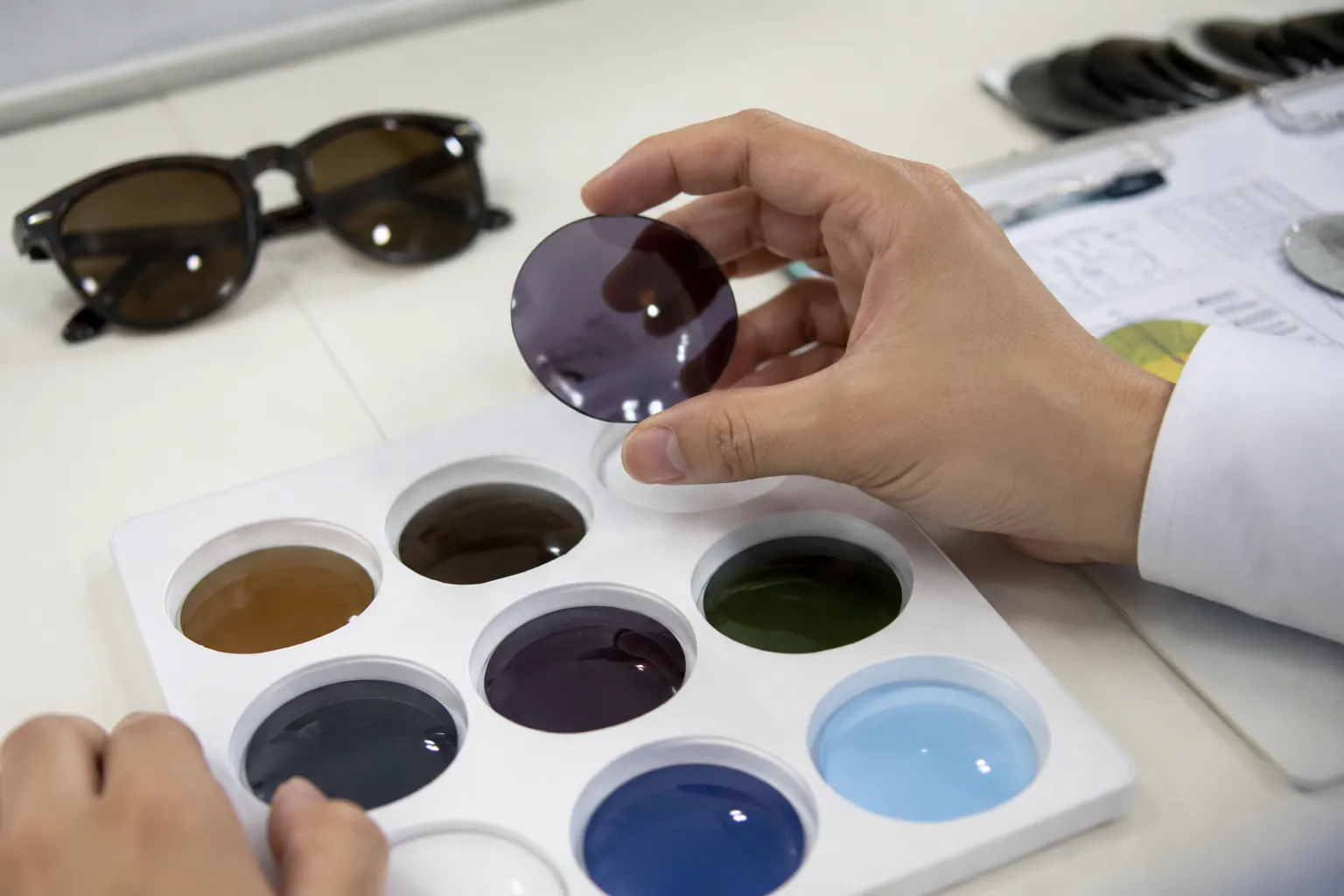
This guide is for importers, brand owners, distributors, and retail buyers ordering custom sunglasses in volume. It explains the lens transmission specs that affect comfort, compliance, sample approval, and repeat-order consistency. The aim is simple: write clearer RFQs, reduce failed samples, avoid shipment disputes, and place purchase orders a factory can build and inspect against measurable criteria.
Start With VLT, Not Lens Color
Visible light transmission, or VLT, is the percentage of visible light that passes through a lens. A 15% VLT lens transmits about 15% of visible light and reduces the rest.
That number matters more than a buyer's color description. Lens color and light transmission are not the same thing. A gray smoke lens, brown lens, and green G15-style lens can all sit near 15% VLT. They may still feel different because each tint changes contrast and color perception.
For sourcing, write VLT as a target range. A workable purchase specification might read: PC lens, gray smoke, category 3, VLT 10%-18%, UV400, non-polarized, base 6 curve, 1.8 mm center thickness, scratch-resistant hard coating. That gives the factory measurable targets. Dark gray lens like photo does not.
Most general retail sunglasses are specified as category 3, commonly 8%-18% VLT under widely used sunglass category systems. Category 2, at 18%-43% VLT, is used for lighter lifestyle products, overcast markets, and indoor-outdoor wear. Category 4, at 3%-8% VLT, is very dark. It is not suitable for driving under common sunglass standards and warning requirements.
For many commercial orders, a VLT tolerance of plus or minus 3 percentage points is a realistic starting point. Tighter tolerance may be possible, but it usually needs tighter material control, more inspection, and a clear reject or sorting plan.
At sample approval, approve both the physical lens appearance and the measured VLT. The sample protects the look. The measurement protects the purchase order.
Lens Category Is a Compliance Label
Lens category groups sunglasses by visible light transmission. It is not a fashion category. Do not use it as a loose marketing term.
Category affects product information, warnings, packaging, and whether the sunglasses are suitable for the claimed use. A buyer who ignores category can receive lenses that look acceptable but cannot be labeled or sold as planned.
| Lens category | Typical VLT range | Common use | Buyer risk |
|---|---|---|---|
| Category 0 | 80%-100% | Very light tint, fashion, indoor use | Can be mistaken for sun protection if labeling is weak |
| Category 1 | 43%-80% | Light tint, overcast days | Often too light for buyers expecting normal sunglasses |
| Category 2 | 18%-43% | Medium sunlight, lifestyle eyewear | May feel too bright for beach, resort, or summer ranges |
| Category 3 | 8%-18% | Strong sunlight, general sunglasses retail | Needs consistent tint control across bulk and repeat orders |
| Category 4 | 3%-8% | Very strong glare, mountain or snow use | Driving warnings and market restrictions matter |
Check the exact category ranges, test method, and required wording against the destination-market standard. CE EN ISO 12312-1, ANSI Z80.3, and AS/NZS 1067 address sunglass lens performance and related requirements. Still, buyers should not assume one label, one report, or one artwork file covers every sales territory.
Europe, the United States, and Australia/New Zealand may require different documentation, markings, warnings, or retailer files. Put the target markets and standards into the RFQ before quoting.
Common compliance references for eyewear sourcing include CE EN ISO 12312-1, ANSI Z80.3, AS/NZS 1067, REACH, FDA registration where applicable, ISO 9001, and BSCI. Do not print certification names, standard numbers, or compliance marks on packaging unless the correct documentation exists for that order, lens construction, and sales market.
UV400 Is Separate From Darkness
Dark lenses do not automatically protect against ultraviolet radiation. This is a common procurement mistake.
Darkness describes visible light reduction. UV protection describes blocking of ultraviolet radiation. A dark lens with weak UV blocking can create a false sense of protection. Specify UV400 or the exact ultraviolet protection requirement under the destination-market standard.
UV400 generally means the lens is intended to block ultraviolet radiation up to 400 nm, covering UVA and UVB wavelengths relevant to normal sunglasses. In sourcing terms, test the UV claim on the actual lens construction. Do not assume it from the material name, coating color, or tint depth.
A mirrored lens, gradient lens, or laminated polarized lens should still be checked after the final construction is confirmed.
Lens material affects optical performance, durability, processing, and cost. Polycarbonate is widely used because it has good impact resistance and typically strong UV absorption, but the finished lens still needs to match the stated claim. TAC polarized lenses are common in value and mid-market polarized sunglasses, but the polarizing film, adhesive, and lamination quality need control. Nylon lenses are often selected for higher-performance wrap frames because they can handle curvature and impact requirements well, but they usually cost more. Acrylic is low cost, but it is more limited in impact performance and optical clarity. Use it carefully for price-led fashion programs.
For bulk orders, UV testing should be part of incoming lens inspection or in-process QC, depending on whether the lenses are produced in-house or purchased from a lens supplier. Ask when UV and VLT will be measured, what instrument or test method will be used, how results will be recorded, and what action will be taken if a batch falls outside the approved range.
Material, Curve, and Coating Change the Result
A lens specification is not only color and category. Material, curve, thickness, coating, and frame construction all affect the final result.
A flat category 3 smoke lens and a base 8 wrap lens may not look or perform the same, even if both measure at similar VLT. High-wrap frames can create visual distortion if the lens material, curve accuracy, and edging process are not matched.
Thickness matters too. A thicker PC or nylon lens may absorb tint differently from a thinner lens, especially on custom solid colors and gradients. If the center thickness changes from 1.6 mm to 2.0 mm after sample approval, the lens may look darker or show a different color depth.
For repeat orders, lock the material grade, center thickness, curve, and coating stack. Do not lock only the visible tint.
Common coatings add their own process checks. A hard coat can improve scratch resistance but may affect the tinting sequence. Mirror coating adds color shift, adhesion risk, and handling sensitivity. Anti-reflective coating can improve comfort, but it raises cost and requires cleaner assembly. Hydrophobic or oleophobic coatings are useful for sport and premium lines, but rub, adhesion, and durability checks should be defined if those claims matter for the retail program.
Decoration can also affect lens quality. Pad printing near the lens rim, laser engraving on temple parts, hot stamping, metal logo plates, and inserted trim pieces all add handling steps. If workers assemble decorated frames before lens insertion, scratches and contamination become more likely. For custom sunglasses, the production route should define when lenses are edged, cleaned, inserted, inspected, and packed.
Tint Consistency Is Process Control
A buyer may approve a good sample and still receive bulk goods that look uneven. Common causes include tint bath variation, material lot changes, lens thickness differences, coating changes, uncontrolled gradient positions, and mixed batches during assembly.
These are process-control problems. Address them in the specification and inspection plan before production starts.
Solid tints are usually easier to control than gradients. Gray is often easier than rose, amber, blue, or green because small hue shifts are less visible. Mirrored lenses add another variable because coating thickness and base tint together determine the final appearance. Polarized lenses add film orientation, lamination, and distortion checks.
- Define the color standard: Use an approved physical lens sample, not only a Pantone reference. Pantone is designed for surface color, not transmitted lens color.
- Set a VLT tolerance: For many commercial sunglasses, target VLT plus or minus 3 percentage points is practical. Premium programs may request tighter control, but cost, sorting rate, and reject handling should be agreed first.
- Control left-right matching: The left and right lenses should be checked as a pair. Even a small difference can be visible after assembly.
- Lock material and thickness: Changing PC, TAC, nylon, acrylic, or center thickness can shift both tint appearance and transmission.
- Define gradient position: For gradient lenses, specify top darkness, fade direction, test point, and acceptable height variation, such as plus or minus 2 mm from the approved sample if the supplier can hold that tolerance.
- Keep retain samples: Keep approved samples on both buyer and factory side for repeat-order comparison.
MOQ changes the risk profile. A small custom order may be sorted manually. As volume increases, the factory should track batch consistency, keep inspection records, and prevent mixing of lens lots unless they have been checked against the same approved standard.
For seasonal or repeat programs, written controls beat memory and photo references.
Write a Spec the Factory Can Build
A good lens spec sheet is short, measurable, and tied to the sales market. It should include material, tint, VLT range, UV requirement, lens category, coating, polarization, curve, thickness, and test standard. It should also state whether the lens color is approved by physical sample, test report, or both.
- Choose the market first: EU, US, Australia/New Zealand, or mixed distribution. This determines which standards, documents, warnings, and markings may apply.
- Select lens category: For standard retail sunglasses, category 3 is the usual starting point. Do not use category 4 unless the product purpose supports it and the warning requirements are understood.
- Specify VLT: Use a numeric range. Example: 12%-16% VLT for a dark gray category 3 lens.
- Specify UV: State UV400 or the exact UV requirement under the relevant standard.
- Confirm construction: Non-polarized PC, TAC polarized, nylon, acrylic, mirrored, gradient, coated, or another defined build.
- Lock dimensions: Confirm base curve, center thickness, lens shape, and edging requirements.
- Approve measured samples: Do not approve only photos. Photos depend on lighting, screen, and camera settings.
- Set bulk QC method: Define sampling plan, tolerance, retain samples, inspection records, and what happens if a batch falls outside range.
Sampling and bulk lead times depend on frame material, lens construction, decoration, packaging, testing, inspection requirements, order size, and the factory's current production schedule. Confirm timing after the lens specification is complete.
Late changes to tint, polarization, mirror color, coating, or category can require new samples and new test checks. They can also move the ship date.
Polarized, Mirror, and Gradient Options
Lens options change performance, price, and QC workload. The lowest lens price on a quote is not always the lowest total cost after rejects, rework, customer complaints, and retailer returns.
Decide which lens upgrade is useful for the target customer before asking suppliers to cut unit price.
| Lens option | Main benefit | QC focus | Sourcing note |
|---|---|---|---|
| Solid non-polarized tint | Lower cost, stable for fashion programs | VLT, UV, left-right color match | Good for retail color runs where polarization is not required |
| Gradient tint | Fashion look, softer lower viewing area | Gradient height, symmetry, VLT at test point | Needs clear approved sample and position tolerance |
| Polarized TAC | Glare reduction for driving, water, and outdoor use | Polarization axis, delamination, VLT, UV, distortion | Costs more than basic non-polarized lenses and needs careful cutting orientation |
| Mirror coating | Strong shelf impact and glare reduction | Coating scratches, color shift, adhesion, handling marks | Packaging and assembly must prevent surface damage |
| Nylon performance lens | Better toughness and optical stability for demanding designs | Curve accuracy, stress, coating quality | Often used for wrap and sport frames, with higher material cost |
Polarized lenses need a simple but important check: the polarization direction must be correct after cutting and assembly. If the axis is wrong, the lens may pass a casual visual check but fail in actual use.
Mirrored lenses need stricter handling during assembly because fine scratches and fingerprints are more visible than on plain smoke lenses. Gradient lenses need a defined test point because VLT changes from top to bottom.
For price planning, ask suppliers to quote each lens construction separately. Do not treat lens complexity as a minor option. Frame material, lens type, coating, decoration, packaging, testing, inspection level, and order quantity can all change the final cost. A useful quote makes those variables visible.
Inspect Before Balance Payment
Lens inspection should happen before final payment and shipment release. Waiting until cartons arrive in the buyer's warehouse makes lens problems harder and more expensive to correct.
Pre-shipment inspection is especially important when the purchase order includes VLT, UV, polarization, mirror coating, gradient tint, or category claims.
A practical pre-shipment inspection should include visual inspection, VLT spot checks, UV checks, category confirmation, cosmetic checks, assembly checks, and packaging label review. For sunglasses with compliance claims, packaging and user information must match the tested category and intended market. A category 4 lens, for example, needs correct warning language for driving restrictions where required.
The inspection plan should state the sampling method, acceptable tolerances, inspection tools, records required, and decision rules for nonconforming goods. Buyers do not need to overcomplicate every order. They do need written criteria before the balance payment is released.
Treat lens changes after sample approval as material changes. They can affect VLT, UV performance, category, coating durability, labeling, and delivery timing.
Blunt rule: If the PO does not state VLT, UV requirement, lens category, material, and test standard, the sunglasses are not fully specified.
For importers and brand owners, the best lens specification is not the longest one. It is the one that matches the sales market, can be tested, can be repeated, and fits the target price. Write it before sampling. Then make the sample prove it.
Have a custom sunglasses project in mind?
Send us your styles, target market and quantities and we will return a detailed quote with MOQ, lead time and a sample plan.
Get a QuoteWhy source this from Wenzhou with LumiShades
Wenzhou in Zhejiang Province is widely regarded as China’s eyewear manufacturing capital, producing a large share of the world’s sunglasses. That concentration matters to buyers: a deep local supply chain for acetate sheet, hinges, lens blanks, plating and packaging means shorter component lead times, easier color and material matching, and a workforce with decades of eyewear-specific skill. LumiShades has manufactured in this ecosystem since 2009, and our vertical integration — in-house injection molding, acetate cutting, CNC milling, lens tinting, decoration and quality control — means no part of your order is quietly subcontracted to a workshop you cannot audit.
For international buyers, that vertical control translates into accountability. When a single factory owns every step, defects are traced and fixed at source rather than bounced between vendors, and your specifications survive intact from first sample to bulk. We back this with 15+ years of experience, shipments to 60+ countries, more than 5 million pairs produced per year and a 98.5% on-time delivery rate. Our certifications — CE EN ISO 12312-1, FDA registration, ANSI Z80.3, AS/NZS 1067, REACH, ISO 9001 and BSCI audit — mean the compliance documentation your market requires already exists. Explore our manufacturing capabilities and quality control process to see how this works in practice.
Frequently asked questions
What VLT should I choose for normal retail sunglasses? For general outdoor retail sunglasses, category 3 is usually the starting point, commonly 8%-18% VLT. A practical dark gray retail spec might be 12%-16% VLT, UV400, category 3, with the material, curve, thickness, coating, and test standard also defined. For lighter lifestyle products or cloudy markets, category 2 at 18%-43% VLT may be more comfortable.
Is UV400 the same as a dark lens? No. Darkness describes how much visible light the lens reduces. UV400 describes ultraviolet protection up to 400 nm. Specify both VLT and UV protection, then confirm them on the approved sample or test report for the actual lens construction.
Can I use one lens spec for Europe, the US, and Australia? Sometimes one physical lens design can work across multiple markets, but the buyer must verify the applicable standard, documents, labels, warnings, and retailer file requirements for each destination. Common references include CE EN ISO 12312-1 for Europe, ANSI Z80.3 for the United States, and AS/NZS 1067 for Australia/New Zealand. Do not print compliance marks or standard claims unless the documentation supports that exact order and market.
How tight should my VLT tolerance be? For many commercial sunglasses orders, plus or minus 3 percentage points is a practical starting tolerance. If the product is premium, uses difficult colors, has left-right matching sensitivity, or must sit tightly inside a category range, ask the supplier whether tighter control is possible and what it adds in sorting cost, reject rate, and lead time.
Do polarized lenses require different QC? Yes. Polarized lenses should be checked for VLT, UV protection, polarization axis, lamination quality, delamination, visual distortion, and correct orientation after cutting and assembly. The QC plan should state how the axis will be checked and what happens if one lens in a pair is misaligned.
When should I approve lens color for bulk production? Approve lens color at sample stage using a physical sample plus measured VLT and UV results. For gradient, mirror, or polarized lenses, also approve the gradient position, mirror appearance, polarization direction, and coating requirements. Photos are useful for communication, but they should not be the final approval standard because lighting, camera settings, and screens change the apparent color.
Ready to start?
Explore our shield & oversized sunglasses or request a quote — our sales team replies within 12 hours.
Request a Quote