
PC vs TAC vs Nylon vs CR-39 Sunglass Lenses
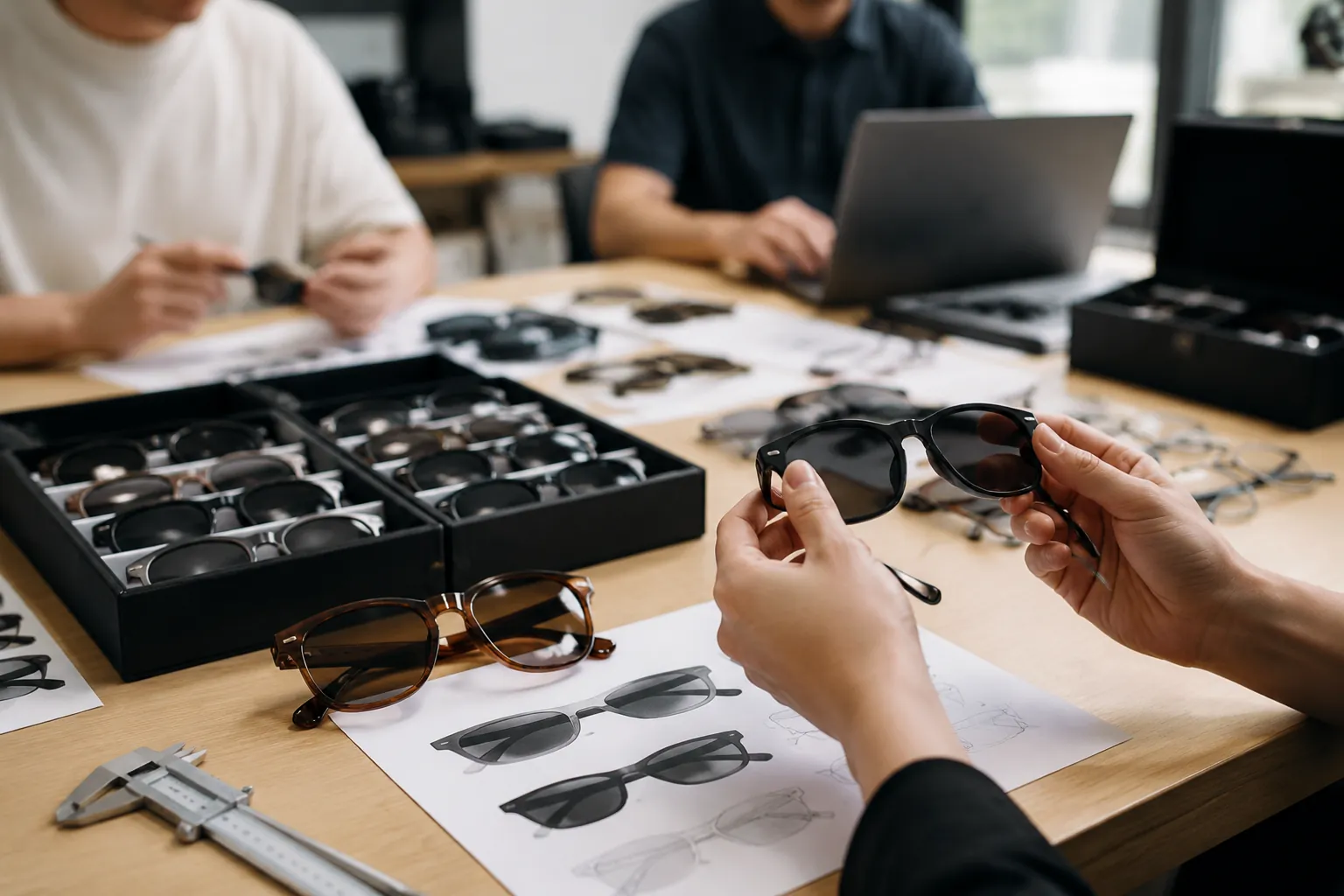
Lens material should be set before a custom sunglasses quote is finalized. It affects optics, impact behavior, lens thickness, coating choices, production flow, inspection points, and the documents a buyer needs for the sales market. This guide compares polycarbonate (PC), TAC polarized, nylon/polyamide, and CR-39 for promotional programs, fashion retail, sport lines, and premium private label collections. The aim is practical: choose the lens material that matches the product claim, target price, and inspection plan before samples are approved or bulk production starts.
Decide Lens Material Before Frame Decoration
Buyers often start with frame color, logo placement, or packaging. Those choices matter. Lens material should still come first because it sets the production route and the technical limits of the finished sunglasses.
Injection-molded PC and nylon require resin drying, mold control, cooling control, and, for polarized versions, accurate film placement. TAC polarized lenses are usually cut and edged from laminated sheet. CR-39 is cast, cured, tinted or coated, and then edged to fit the frame.
One frame design may not accept every lens material well. A low-wrap fashion frame is usually easier to fit with PC, TAC, nylon, or CR-39 after normal curve and edge checks. A high-wrap sport frame is less forgiving. Lens curve, edge thickness, groove fit, and frame flex can all affect retention and distortion.
For B2B buyers, the choice changes four commercial items: MOQ, price, sample timing, and compliance documents. MOQ is not set by material alone. It depends on the frame, lens shape, lens color, coating, tooling, packaging version, and whether the supplier can combine the order with other production. Ask for MOQ by style, material, color, coating, and packaging version. A single broad MOQ figure is not enough.
Four Lens Materials: B2B Comparison Table
| Material | Process | Impact Behavior | Optical Profile | Uncoated Scratch Resistance | MOQ Drivers | Lead Time Drivers | Best Fit |
|---|---|---|---|---|---|---|---|
| Polycarbonate (PC) | Injection molded; tint, coating, or polarized film may be added depending on construction | High impact resistance compared with many common plastic lens materials; final performance depends on thickness, design, and testing | Good for general sunglasses; stress birefringence can appear if molding is poorly controlled | Low; hard coat is strongly recommended for retail programs | Existing lens mold, standard colors, and simple coatings reduce MOQ pressure | Tool availability, resin color, coating queue, and inspection requirements | Promotional, kids, budget retail, and programs where impact resistance matters |
| TAC Polarized | Polarized laminate sheet cut and edged to lens shape | Lower impact resistance than PC or nylon; edge quality and laminate construction affect durability | Good glare reduction when the polarizing film and axis are correct; suitable for many fashion sunglasses | Low to medium; depends on outer layer and coating | Available sheet color, lens shape, edge finishing, and coating selection | Sheet availability, cutting capacity, mirror or gradient coating, and QC inspection | Low-cost polarized fashion, beachwear, festival merchandise, and seasonal retail |
| Nylon / Polyamide | Precision injection molded; commonly used for curved sport lenses and shield shapes | Excellent toughness and flex recovery when material, drying, and molding are controlled | Strong option for wraparound lenses; can deliver cleaner optics than stressed molded PC in demanding curves | Medium; hard coat is still recommended | Existing mold, lens curve, shield geometry, polarization, and coating package | Drying control, molding stability, coating complexity, and fit testing | Sport, outdoor, active lifestyle, fishing, cycling, and premium polarized lines |
| CR-39 | Cast thermoset plastic; cured, tinted or coated, and edged | Moderate impact behavior; not suitable for sport-impact positioning unless testing supports the claim | Excellent optical clarity; valued for low distortion and comfortable visual feel | Better than PC in uncoated condition, though hard coat is still recommended for retail | Blank availability, tint matching, coating, edging setup, and frame compatibility | Casting or blank supply, tinting, coating, edging, and final inspection | Premium fashion, acetate frames, optical-style sunglasses, and prescription-ready ranges |
Cost patterns are fairly predictable, but exact differences are quote-specific. PC is often the most economical route for high-volume basic sunglasses. TAC polarized usually costs more than basic non-polarized PC because the laminated polarized lens adds material and processing cost. CR-39 usually costs more than basic PC because the process is slower and edging control matters more. Nylon is often priced above PC because raw material handling, molding control, curved-lens accuracy, and reject control are more demanding.
Polycarbonate (PC): The Volume Workhorse
PC is widely used when sunglasses need impact resistance, low weight, fast scaling, and controlled unit cost. It is an injection-molded thermoplastic. It suits large production runs once the lens mold, frame fit, tint, and coating have been approved.
Do not assume a standard thickness from a catalog. Specify thickness by frame design, product claim, and test requirement.
Production details to verify: PC resin must be dried before molding to reduce bubbles, haze, and surface defects. Molding temperature, cooling, gate position, and demolding conditions affect lens stress. For polarized PC, the polarizing film must sit accurately in the mold. Poor placement can cause wrinkles, edge exposure, optical inconsistency, or the wrong polarization axis.
Where PC performs well:
- Impact resistance: a strong choice for kids, promotional, and durability-focused retail programs when the finished product passes the required tests.
- Weight: lighter than CR-39, which helps with larger fashion frames.
- Cost control: practical when the target price is tight.
- Production flexibility: common colors and existing molds are usually faster to develop than fully custom lens systems.
The main weakness is scratch resistance. Uncoated PC scratches easily during packing, shipping, display, and consumer use. Treat hard coating as a retail requirement unless the product is a very short-life giveaway. Before approval, check visual clarity, tint uniformity, coating defects, lens fit, UV performance, and stress under polarized inspection.
TAC Polarized: Affordable Glare Reduction
TAC stands for triacetate cellulose. In sunglass sourcing, TAC usually means a laminated polarized lens: a polarizing film combined with TAC layers, then cut and edged to shape. It is popular because it gives visible glare reduction at a lower cost than many molded polarized options.
TAC works for fashion retail, beachwear, event merchandise, and seasonal polarized collections. It can support grey, brown, green, gradient, flash mirror, and full mirror effects, depending on sheet availability and coating capability.
Polarization quality is not automatic. It depends on the film, lamination, cutting direction, and axis control. Confirm the polarization axis on samples and bulk production, especially when the order includes several lens colors.
Buyer risk points:
- Delamination: heat, humidity, saltwater exposure, and poor edge finishing can increase laminate failure risk.
- Impact performance: TAC is not the default choice for rugged sport, kids durability claims, or safety-style positioning.
- Coating adhesion: mirror and hard coatings need clean surface preparation and controlled curing.
- Edge quality: rough edging can expose laminate layers and speed up moisture-related defects.
TAC is a good fit when the selling point is affordable polarization, not technical sport performance. Request production samples with the final lens color, mirror or gradient effect, frame color, logo placement, and packaging. TAC appearance can shift under different lighting and display conditions.
Nylon / Polyamide: Sport and Outdoor Lenses
Nylon, also called polyamide, is used when lenses need to be light, tough, and stable in curved sport frames. It is common in cycling, running, fishing, sailing, snow, and active lifestyle sunglasses. It usually costs more than basic PC. The added cost can be justified when fit, curve, and lens performance are part of the product value.
Process details to verify: Nylon resin is moisture-sensitive and must be dried carefully before molding. Residual moisture can cause haze, bubbles, surface defects, or reduced mechanical performance. Shrinkage and lens curve control matter, especially for shields, interchangeable lenses, and high-wrap frames. For custom sport lenses, review gate position, lens curve, bridge stress, edge thickness, and frame retention before confirming tooling.
Nylon works well with premium lens packages, including polarization, mirror coating, hydrophobic coating, oleophobic coating, and anti-reflective back coating. A common outdoor specification is polarized nylon with hard coat, mirror front coating, and AR back coating. It costs more. It also supports a clearer claim: glare reduction, low weight, stable fit in curved frames, and better comfort in bright conditions.
The key sourcing question is simple: will the retail price carry the lens package? Nylon is usually right for sport and outdoor products where lens performance helps sell the frame. It is usually too much for event giveaways or basic fashion sunglasses where the buyer cannot recover the added cost.
CR-39: Optical Clarity for Premium Fashion
CR-39 is a cast thermoset plastic. It remains a strong option for buyers who care most about optical quality. It is valued for clear vision, low distortion, and a more refined visual feel than many low-cost molded lenses. It is common in optical-style sunglasses, acetate collections, and premium fashion frames.
CR-39 is not injection molded. It is cast and cured, then tinted or coated and edged to fit the frame. That workflow is slower than basic molded PC production and is less suited to very low-cost fast-turn promotions. Confirm whether the supplier is using finished blanks, semi-finished blanks, or a dedicated lens production route. That answer affects timing, consistency, and MOQ.
CR-39 tints well and suits solid, gradient, and fashion colors when tint matching is controlled. It also has better natural scratch resistance than PC, although hard coat is still recommended for retail sunglasses.
The trade-off is impact behavior. CR-39 can meet applicable sunglass requirements when design and thickness are correct, but it should not carry sport-impact claims unless the finished product has been tested against the relevant standard.
For premium private label orders, CR-39 pairs well with acetate frames, metal details, refined logo finishing, upgraded cases, and better cleaning cloths. The lens choice supports the positioning. It is less suitable for disposable promotions or low-priced marketplace listings where the customer will not value the optical improvement.
Coatings, Polarization, and Decoration
Lens material should be reviewed together with coating and decoration. Every added process changes cost, yield, timing, and inspection scope. A simple PC lens with tint and hard coat is not the same production plan as a polarized nylon lens with mirror front coating, AR back coating, hydrophobic top coat, and laser logo.
Common lens options:
- UV protection: specify the required UV performance and request test results for the finished lens, not only the raw material.
- Hard coat: recommended for all retail sunglasses and especially important for PC and TAC.
- Mirror coating: usually applied by vacuum deposition; common colors include silver, blue, green, gold, red, and purple.
- AR back coating: reduces reflection from behind the wearer and is useful for premium and sport lines.
- Hydrophobic or oleophobic coating: helps repel water, sweat, sunscreen, and fingerprints, but durability should be checked through the supplier's test method.
- Laser lens logo: possible on many coated lenses, but placement should avoid the main field of view and must be approved on real samples.
Frame decoration can also influence lens selection. Pad printing and silk printing suit many promotional frames. Laser engraving works well on metal temples and some coated parts. Metal logo plates, injected rubber logos, and heat-transfer marks are more common on sport and premium programs.
If the order includes mirror lenses, approve logo color, frame finish, lens color, and packaging together. Flat artwork does not show how the finished product will look under retail lighting.
For quality control, inspect pre-production samples in daylight, indoor light, and polarized screen conditions. For bulk orders, practical checks include lens color tolerance, coating scratches, polarization axis, UV performance, lens retention, hinge function, logo position, packaging count, and label accuracy.
Compliance Documents and Buyer Scenarios
Compliance depends on the sales market, product claim, sales channel, and importer responsibility. Suppliers can provide test reports and factory documents, but buyers should confirm the exact requirement with their importer, compliance consultant, or platform before production.
Do not rely on broad claims such as "UV certified" or "CE approved." Check the report scope, model description, test standard, date, and issuing laboratory.
For Europe, buyers commonly request CE documentation against EN ISO 12312-1 for sunglasses, along with applicable chemical compliance such as REACH. For the United States, buyers commonly review ANSI Z80.3 for non-prescription sunglasses, and the importer should confirm FDA registration or listing obligations where applicable. For Australia and New Zealand, buyers commonly request AS/NZS 1067 documentation. Factory documents such as ISO 9001 and BSCI can support supplier evaluation. They do not replace product-level sunglass testing.
A practical document pack may include the sunglass test report, UV transmittance results, lens category or filter category information, chemical compliance declarations or reports, product labeling artwork, batch inspection records, and factory audit or quality system documents where relevant. The report should match the actual frame, lens material, lens color, coating, and category being shipped. If the buyer changes lens color, mirror coating, or material after testing, review the compliance impact before shipment.
The right lens is the one that matches the use case, product claim, and landed-cost target. A low-cost giveaway does not need CR-39 optics. A premium sport line should not rely on a soft TAC laminate if customers expect rugged use. Start with the selling claim. Then choose the material and tests that support it.
Recommended choices by program type:
- Trade show or event giveaway: PC lens, UV protection, hard coat if the product will be kept and reused, simple tint, and printed temple logo. Use existing frame and lens options to reduce development risk.
- Budget fashion retail: TAC polarized if glare reduction is the selling point, or PC if durability and cost control matter more. Add hard coat and review mirror coating if shelf impact matters.
- Kids sunglasses: PC lens, flexible frame material, rounded edges, strong hinge testing, and clear compliance records. Avoid fragile lens constructions and unsupported impact claims.
- Outdoor sport line: nylon polarized lens with hard coat, mirror front coating, and AR back coating. Confirm curve, lens retention, optical distortion, sweat resistance, and sunscreen exposure during sample review.
- Premium acetate fashion: CR-39 lens with custom tint, hard coat, and optional AR coating. Match with better case, cloth, and logo finishing to support the higher retail price.
Before placing a bulk order, confirm the target market standard, lens category, UV requirement, warning or label language, packaging information, and importer responsibility. A buyer-ready quotation should state lens material, lens color, coating stack, polarization status, frame material, logo method, MOQ, sample terms, bulk lead time, inspection standard, and the compliance documents included.
Have a custom sunglasses project in mind?
Send us your styles, target market and quantities and we will return a detailed quote with MOQ, lead time and a sample plan.
Get a QuoteWhy source this from Wenzhou with LumiShades
Wenzhou in Zhejiang Province is widely regarded as China’s eyewear manufacturing capital, producing a large share of the world’s sunglasses. That concentration matters to buyers: a deep local supply chain for acetate sheet, hinges, lens blanks, plating and packaging means shorter component lead times, easier color and material matching, and a workforce with decades of eyewear-specific skill. LumiShades has manufactured in this ecosystem since 2009, and our vertical integration — in-house injection molding, acetate cutting, CNC milling, lens tinting, decoration and quality control — means no part of your order is quietly subcontracted to a workshop you cannot audit.
For international buyers, that vertical control translates into accountability. When a single factory owns every step, defects are traced and fixed at source rather than bounced between vendors, and your specifications survive intact from first sample to bulk. We back this with 15+ years of experience, shipments to 60+ countries, more than 5 million pairs produced per year and a 98.5% on-time delivery rate. Our certifications — CE EN ISO 12312-1, FDA registration, ANSI Z80.3, AS/NZS 1067, REACH, ISO 9001 and BSCI audit — mean the compliance documentation your market requires already exists. Explore our manufacturing capabilities and quality control process to see how this works in practice.
Frequently asked questions
Which lens material is cheapest for high-volume custom sunglasses? Polycarbonate is often the most economical complete-product route for high-volume basic sunglasses. It is injection molded, widely available, light, and impact resistant. Final price still depends on frame material, lens thickness, color, coating, packaging, inspection level, and existing tooling. Ask the supplier to quote PC with the exact coating and compliance documents required for your market.
When should I choose TAC polarized instead of PC? Choose TAC polarized when affordable glare reduction matters more than impact performance. It suits fashion retail, beachwear, festival merchandise, and seasonal polarized collections. Choose PC when durability, kids use, impact resistance, or lower complete-product cost is the stronger requirement. If you need polarization and higher toughness, compare tested samples of polarized PC or polarized nylon.
Is nylon worth the higher price for sport sunglasses? Yes, when the product is positioned for cycling, running, fishing, water sports, snow, or other active use where curved-lens fit, toughness, low weight, and premium coatings matter. Nylon is easiest to defend when the supplier supports the claim with lens retention checks, optical distortion review, polarization axis control, coating adhesion checks, sweat or sunscreen exposure tests, and the relevant sunglass standard for the sales market.
Why does CR-39 often have a higher MOQ and longer lead time? CR-39 is cast and processed differently from injection-molded PC or nylon. The workflow can include blank supply, tinting, coating, edging, and fit inspection, which makes very small custom runs less efficient. MOQ and timing vary by supplier, lens color, coating, and frame compatibility. Confirm whether the quote uses stocked blanks or custom lens production, and approve a real pre-production sample before bulk production.
Can one frame style be sampled with several lens materials? Often yes for low-wrap fashion frames, especially when the frame groove and lens curve can accept different materials without changing fit. It is harder for high-wrap sport frames, shield lenses, and tight semi-rimless designs because curve, edge thickness, and retention are more sensitive. Ask the supplier to confirm lens curve, edge thickness, retention, and optical review for each material, not just the frame appearance.
What coating should I specify for retail sunglasses? At minimum, specify the required UV protection and a hard coat for normal retail use. For polarized, sport, or premium sunglasses, consider mirror coating, AR back coating, hydrophobic coating, or oleophobic coating if those features support the retail price. Require samples with the final coating stack because adhesion, color, reflection, and scratch resistance can vary by lens material.
What compliance documents should B2B buyers request? Request product-level test reports that match the actual sunglasses being shipped. Depending on market, this may include CE EN ISO 12312-1 for Europe, ANSI Z80.3 for the United States, AS/NZS 1067 for Australia and New Zealand, REACH chemical compliance where applicable, and FDA registration information where relevant to the U.S. importer. Factory documents such as ISO 9001 and BSCI can help evaluate the supplier, but they do not replace product testing.
Ready to start?
Explore our cat-eye sunglasses or request a quote — our sales team replies within 12 hours.
Request a Quote