
Bulk Sunglass Lenses by Sales Channel
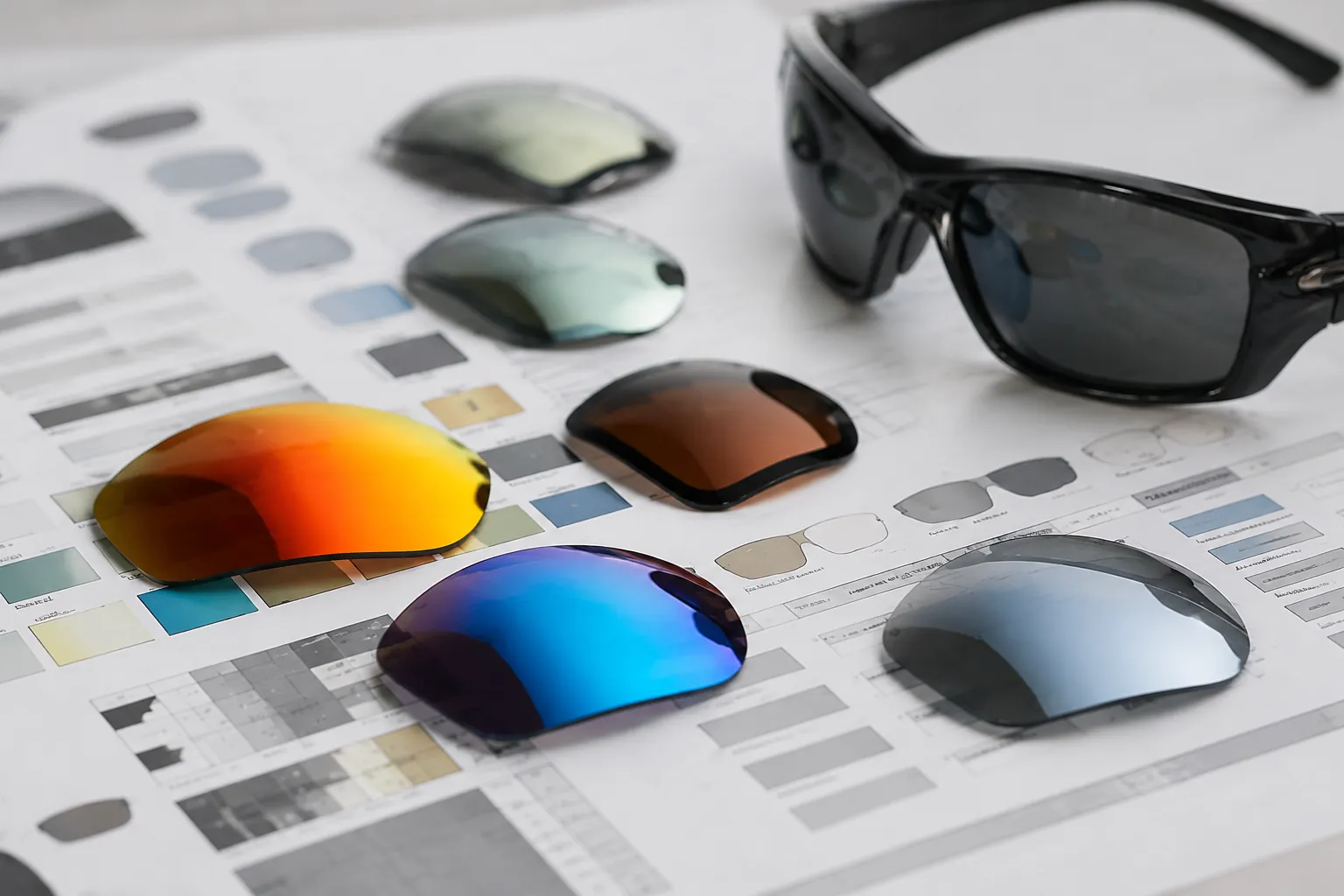
This guide is for procurement managers, brand owners, and merchandise teams buying custom sunglasses in volume. It compares the five plano lens types most often used in bulk sunglass production: solid tint, gradient tint, mirrored, polarized, and photochromic. The aim is practical selection. No inflated claims. Use it to match each lens type to retail, outdoor, corporate, promotional, and e-commerce channels, then confirm the details that affect sampling and bulk production: MOQ, cost drivers, coating steps, tolerances, decoration compatibility, QC checks, compliance documents, and lead-time risk.
Lens type overview: best use for each option
Most bulk sunglass programs use one of five plano lens types: solid tint, gradient tint, mirrored, polarized, and photochromic. The right choice depends on the channel, product claim, target price, and how much production complexity the project can carry.
Solid lenses use one tint across the full lens. Common colors include grey, smoke, brown, green, and amber. They are usually the simplest and lowest-cost option in bulk production. The key control point is visible light transmission, or VLT. Agree on the target VLT range before sampling. For standard tinted polycarbonate lenses, buyers normally approve a range, not a single exact number.
Gradient lenses are darker at the top and lighter at the bottom. They suit fashion, gifting, and retail programs that need a more finished look without the added cost of polarization, mirror coating, or photochromic treatment. They need closer visual inspection. The fade line, tint depth, and left-right lens match are easy to notice.
Mirrored lenses add a reflective coating over a tinted base lens. Common mirror colors include silver, blue, green, gold, red, and rose. They work well for outdoor, beach, sport-lifestyle, event, and resort programs because the effect is visible in product photos and on the shelf. Approve both the mirror color and the base tint. The combination affects VLT, appearance, and wearer comfort.
Polarized lenses use a polarizing film or laminated polarizing structure to reduce reflected glare from water, wet roads, snow, glass, and polished floors. They are a strong choice for retail and e-commerce when the product is sold on a clear functional benefit. The claim must be backed by QC checks for polarizing efficiency, axis alignment, lens clarity, and UV protection.
Photochromic lenses darken under UV exposure and become lighter again when UV exposure drops. They can help in changing light conditions, but they are harder to specify. Before bulk production, approve the light-state VLT, dark-state VLT, activation conditions, fade-back expectation, and temperature limitations.
Cost, MOQ, and lead-time comparison
The table below uses a standard adult plano sunglass frame as a planning reference. Exact pricing and timing depend on frame material, hinge construction, order quantity, lens material, coating, logo method, packaging, inspection requirements, seasonality, and test-report needs. Treat these ranges as quoting guides to confirm during sampling. Not guarantees.
| Lens type | Typical unit price at 1,000 pairs | MOQ per design | Sample lead time | Bulk lead time | Main cost driver |
|---|---|---|---|---|---|
| Solid tint PC | $2.80-$3.10 | 50 pairs | 7-8 days | 25-28 days | Frame, tint batch, logo method |
| Gradient tint PC | $3.10-$3.40 | 50 pairs | 8-9 days | 28-30 days | Gradient consistency and visual sorting |
| Mirrored PC or TAC | $3.60-$4.10 | 100 pairs | 9-10 days | 30-33 days | Mirror coating process and rejection control |
| Polarized TAC | $3.90-$4.50 | 100 pairs | 7-10 days | 30-33 days | Polarizing film, lamination quality, and axis control |
| Photochromic PC | $5.20-$6.20 | 200 pairs | 10-12 days | 33-38 days | Photochromic treatment, curing, activation check |
MOQ usually reflects process setup. Solid and gradient lenses can often run at lower quantities because tinting and edging are comparatively simple. Mirrored lenses need coating setup and color approval. Polarized lenses need polarizing-axis control before cutting and assembly. Photochromic lenses start higher because treatment, curing, UV activation checks, and batch comparison add fixed process time.
Price breaks may improve as order volume rises. Lead time may not. Coating, curing, inspection, packaging, and compliance-document preparation still set the calendar. For seasonal launches, confirm the critical path before approving artwork, especially for mirrored and photochromic lenses.
Materials and process details to check
Lens material affects weight, optical feel, impact resistance, tint stability, coating behavior, and cost. For bulk custom sunglasses, LumiShades commonly works with polycarbonate, TAC, nylon, and CR-39. Confirm the material before sampling. It affects quotation, tooling assumptions, QC method, and compliance testing.
Polycarbonate is widely used for promotional, fashion, and sport-style sunglasses because it is light and impact resistant. It can be used for solid, gradient, mirrored, and some photochromic programs. For non-prescription plano sunglasses, confirm lens thickness, base curve, VLT target, UV protection, hard-coat requirement, and whether the frame groove creates lens stress after assembly.
TAC is widely used for polarized sunglasses. A polarized TAC lens is typically built as a laminated structure with a polarizing film layer and protective outer layers. Key QC points include polarization efficiency, axis alignment, delamination, edge quality, surface marks, and left-right lens consistency.
CR-39 offers good optical clarity and scratch resistance for some fashion programs, but it is heavier than polycarbonate and has lower impact resistance. Nylon is used for selected wrap, shield, and performance-style frames where flexibility and optical quality are important. Cost and MOQ are usually higher than standard PC or TAC options.
A typical production route includes tinting or lens preparation, hard coating where specified, mirror or functional coating where specified, curing, inspection, edging, assembly, cleaning, and final inspection. Mirrored lenses need color and surface checks after coating and again after assembly. Reflective finishes show handling marks quickly. Photochromic lenses need UV activation checks because two lenses can look similar indoors but perform differently outside.
Retail: polarized is the safest functional upgrade
For brick-and-mortar retail, polarized lenses are often the safest first functional upgrade. The benefit can be shown in store with a polarized test card or glare comparison. Customers can see the difference. That makes the added lens cost easier to explain.
The frame still has to earn the price. A polarized lens will not save a weak frame. Check hinge movement, lens seating, lens rattle, temple printing, and packaging. For optical, resort, boutique, or gift retail, details such as laser-etched logos, metal logo plaques, molded temple inserts, printed pouches, barcode labels, and hangtags can support perceived value if they are cleanly executed.
- Best first SKU: polarized grey or polarized brown with UV400 protection and a category 3 sunglass tint where suitable for the market.
- Best second SKU: gradient polarized or mirrored, depending on whether the buyer wants fashion appeal or outdoor shelf impact.
- Target VLT: commonly around 10-18% for bright-sun sunglasses, but the final range should match the applicable market standard and product claim.
- QC priorities: UV400 verification, VLT check, polarization performance, axis alignment, lens surface quality, frame alignment, hinge tension, logo placement, and packaging accuracy.
- Packaging fit: printed pouch, barcode label, hangtag, care card, and polarized test card when the product is sold on polarization.
Do not treat lens and frame as separate decisions. A premium lens in a loose frame creates a mismatch. A basic solid tint can also disappoint if the hangtag, listing, or sales copy implies glare reduction. Claim, lens specification, frame build, and packaging must support the same price point.
Outdoor and sports: match the lens to the activity
Outdoor and sport programs should start with use case. Fishing, boating, beach, skiing, cycling, hiking, driving, and running do not need the same VLT range, lens color, or coating package. Mirrored lenses help when bright light and shelf impact matter. Polarized lenses help when reflected glare is the main problem. Photochromic lenses help when light conditions change during use.
Mirrored lenses often use a grey, brown, green, or amber base tint with a reflective coating. Blue or green mirror over a grey base is common for water-oriented styles. Silver mirror over grey is common for general outdoor use. Red, gold, and rose mirrors are more style-driven. Approve them carefully. Small color shifts can be visible across a production run. Confirm target VLT, mirror color, base tint, scratch-resistance expectation, and cleaning instructions.
Polarization is not automatically right for every sport. It is useful for water, driving, and high-glare environments, but some users may prefer non-polarized lenses when they need to read certain LCD screens or see surface details. Decide by activity and market position, not by the assumption that polarization is always better.
Photochromic lenses need realistic claims. They react to UV exposure, so they may darken less inside vehicles with UV-filtering glass. Temperature can also affect response. Approve samples outdoors in relevant conditions. Before bulk approval, confirm approximate light-state VLT, dark-state VLT, activation speed, fade-back behavior, and care instructions.
Corporate, gifting, and promotion: protect budget and date
Corporate, gifting, and promotional buyers usually care most about delivered cost, logo visibility, event timing, packaging count, and compliance documents. Solid single-tint lenses dominate this channel because they are predictable: lower cost, shorter lead time, fewer coating variables, and broad compatibility with stock frame programs.
Gradient lenses are a useful step up when the sunglasses need to feel more like a gift and less like a disposable event item. They cost more than solid tint, but they can improve perceived value on metal, TR90, acetate-style, and fashion plastic frames. Brown gradient and smoke gradient are usually safer for broad recipient groups than bright mirror colors.
Decoration method affects schedule and risk. Pad printing is common for temple logos and works well for simple one- or two-color artwork. Laser engraving works well on metal temples, bamboo temples, and some logo plaques. Heat transfer can handle more complex artwork when the frame has enough flat area. Metal badges and molded logo plates can look premium, but they usually require tooling and extra approval time.
For corporate programs, keep the lens claim simple and documented. UV400, CE EN ISO 12312-1, ANSI Z80.3, AS/NZS 1067, REACH, FDA registration where applicable, ISO 9001 factory quality-management documentation, and BSCI social-compliance documentation may be requested depending on the buyer and destination market. Do not add photochromic or polarized claims unless the lens specification, test plan, and packaging copy support them.
E-commerce: control claims and photo mismatch
E-commerce brands have to sell the lens without an in-person try-on. The product page must make a clear claim, and the delivered sunglasses must match that claim, the photos, and customer expectations. Risk areas are predictable: unclear polarization claims, lenses that look lighter or darker than photos, mirror colors that shift under different lighting, and surface marks that appear in close-up reviews.
Polarized lenses are often a strong default for mid-price e-commerce sunglasses because the benefit is specific and easy to explain. The listing should state that the lenses are polarized, give a simple glare-reduction explanation, and avoid implying that polarization improves every visual condition. Packaging can include a polarized test card when appropriate.
Photochromic lenses can work online when they are positioned as a premium or problem-solving SKU. The product page should state that the lenses react to UV, may not darken fully behind some car windshields, and may respond differently depending on temperature and sunlight intensity. Ask for sample photos or videos showing light-state and dark-state appearance under defined conditions.
Solid and gradient lenses can still work for fashion drops, festival merchandise, low-price bundles, and brand merchandise. Be precise. Do not describe them as polarized unless testing confirms it. If the target retail price competes with polarized products, make the reason for choosing a non-polarized lens clear through frame design, styling, packaging, or price.
Compliance, QC, and channel decision framework
Confirm compliance before mass production. Lens claims affect testing and labeling. For non-prescription sunglasses, buyers commonly request CE EN ISO 12312-1 for the EU, ANSI Z80.3 for the US, AS/NZS 1067 for Australia and New Zealand, REACH documentation for EU chemical requirements, and FDA registration where applicable for US market requirements. ISO 9001 and BSCI are factory-level documents. They are not lens-performance certifications. Industrial safety eyewear is a separate category and should not be treated as normal sunglass production.
| Channel | Best starting lens | Typical order logic | Risk to manage |
|---|---|---|---|
| Retail stores | Polarized | Use a visible functional benefit to support shelf price | Frame quality and packaging must match the lens claim |
| Outdoor and sports | Mirrored, polarized, or photochromic | Match VLT, coating, and lens color to the activity | Coating lead time, glare claim accuracy, and surface QC |
| Corporate gifting | Solid or gradient | Protect event budget, delivery date, and logo visibility | Logo durability, packaging deadline, and documentation |
| E-commerce | Polarized, then photochromic test | Use clear claims that can be shown in photos and verified by QC | Customer expectation, product-photo accuracy, and returns |
| Promotional events | Solid tint | Prioritize cost, repeatability, and fast production | Delivery timing, consistent tint, and logo placement |
Final QC should include lens surface inspection, UV400 verification, VLT check, lens fit, frame alignment, hinge tension, temple opening symmetry, logo position, packaging count, barcode scan where applicable, and carton-label accuracy. For polarized lots, add polarizing-axis and polarization-performance checks. For mirrored lots, add coating adhesion, color consistency, and post-assembly surface checks. For photochromic lots, add UV activation and fade-back checks by approved sample or agreed batch method.
Use this rule: choose polarized when the product needs to sell on glare reduction. Choose mirrored when outdoor appearance and bright-light use matter. Choose photochromic when the product story can support a higher price and more customer education. Choose solid or gradient when cost, delivery speed, and broad recipient acceptance matter most. If one frame must serve several channels, confirm whether the order can be split by lens type before sampling. Each lens type may carry its own MOQ, lead time, QC record, and packaging requirement.
Have a custom sunglasses project in mind?
Send us your styles, target market and quantities and we will return a detailed quote with MOQ, lead time and a sample plan.
Get a QuoteWhy source this from Wenzhou with LumiShades
Wenzhou in Zhejiang Province is widely regarded as China’s eyewear manufacturing capital, producing a large share of the world’s sunglasses. That concentration matters to buyers: a deep local supply chain for acetate sheet, hinges, lens blanks, plating and packaging means shorter component lead times, easier color and material matching, and a workforce with decades of eyewear-specific skill. LumiShades has manufactured in this ecosystem since 2009, and our vertical integration — in-house injection molding, acetate cutting, CNC milling, lens tinting, decoration and quality control — means no part of your order is quietly subcontracted to a workshop you cannot audit.
For international buyers, that vertical control translates into accountability. When a single factory owns every step, defects are traced and fixed at source rather than bounced between vendors, and your specifications survive intact from first sample to bulk. We back this with 15+ years of experience, shipments to 60+ countries, more than 5 million pairs produced per year and a 98.5% on-time delivery rate. Our certifications — CE EN ISO 12312-1, FDA registration, ANSI Z80.3, AS/NZS 1067, REACH, ISO 9001 and BSCI audit — mean the compliance documentation your market requires already exists. Explore our manufacturing capabilities and quality control process to see how this works in practice.
Frequently asked questions
What is the minimum order quantity for each bulk sunglass lens type? As a planning guide, solid and gradient lenses usually start at 50 pairs per design, mirrored and polarized lenses usually start at 100 pairs per design, and photochromic lenses usually start at 200 pairs per design. Final MOQ depends on the frame, lens material, coating process, color, logo method, packaging, and whether the order uses stock components or fully customized parts. Confirm MOQ before sampling, especially if you want to split one frame into several lens types.
Which lens type is best for retail sunglasses? Polarized lenses are usually the best starting point for retail sunglasses when the product is sold on function. The glare-reduction benefit can be demonstrated with a polarized test card or in-store display. Start with polarized grey or polarized brown for a broad retail SKU. Add mirrored, gradient polarized, or a fashion tint only after the frame quality, price point, packaging, and compliance documents support the shelf claim.
How long do polarized lens samples take? Polarized lens samples commonly take 7-10 days after the frame, lens color, logo artwork, and packaging direction are confirmed. Extra time may be needed for custom frame colors, special packaging, barcode labels, third-party testing, or revised artwork. Before approving the sample, check polarization performance, axis alignment, VLT, UV400 result, lens surface quality, frame fit, logo position, and packaging accuracy.
Can I mix solid, mirrored, polarized, and photochromic lenses in one order? Yes, but each lens type may have its own MOQ, lead time, QC steps, and packaging record. A mixed order can work when one frame serves different channels, such as solid tint for promotion, polarized for retail, and photochromic for an e-commerce premium SKU. Before confirming the order, ask for a split-lens production plan showing quantity by lens type, sample approval requirements, bulk timing, labeling, and carton separation.
Which certifications and documents matter most for EU and US sunglass sales? For EU sunglass sales, buyers commonly request CE EN ISO 12312-1 and REACH documentation. For US sales, ANSI Z80.3 and FDA registration may be requested depending on the buyer and product route. For Australia and New Zealand, AS/NZS 1067 may apply. ISO 9001 and BSCI are factory-level documents, not proof of lens performance. If the product is intended for industrial safety use, normal sunglass documents are not enough. The project must be specified and tested as safety eyewear.
Are photochromic lenses worth the higher cost in bulk orders? Photochromic lenses are worth testing when the product can support a higher retail price and the customer understands the limits. They are useful for variable-light use cases, but they react to UV, may not darken fully behind some vehicle glass, and can respond differently depending on temperature and sunlight intensity. Before bulk approval, confirm light-state VLT, dark-state VLT, activation behavior, fade-back expectation, care instructions, MOQ, and lead time.
What lens material should I choose for bulk custom sunglasses? Choose the material by claim and use case. Polycarbonate is common for solid, gradient, mirrored, and some photochromic programs because it is light and impact resistant. TAC is commonly used for polarized sunglasses because it supports a laminated polarizing structure at a practical cost. CR-39 can suit selected fashion programs where optical clarity is valued and weight is acceptable. Nylon is used for some wrap, shield, and performance styles where flexibility and clarity are important. Confirm material before sampling because it affects price, lens thickness, coating behavior, and testing.
How should I choose the best lens type for my sales channel? Start with the channel and product claim. For retail, use polarized when glare reduction helps justify the price. For outdoor and sport, choose mirrored, polarized, or photochromic according to the activity, VLT target, and glare conditions. For corporate gifts and events, use solid or gradient to protect budget and timing. For e-commerce, use polarized as the clearest functional default and test photochromic only when the listing can explain the behavior accurately. After choosing the lens type, confirm MOQ, lead time, lens material, VLT, UV400 requirement, logo method, packaging, and applicable compliance documents before approving the sample.
Ready to start?
Explore our square sunglasses or request a quote — our sales team replies within 12 hours.
Request a Quote