
Kids' Sunglass Frame Materials: A Buyer's Guide
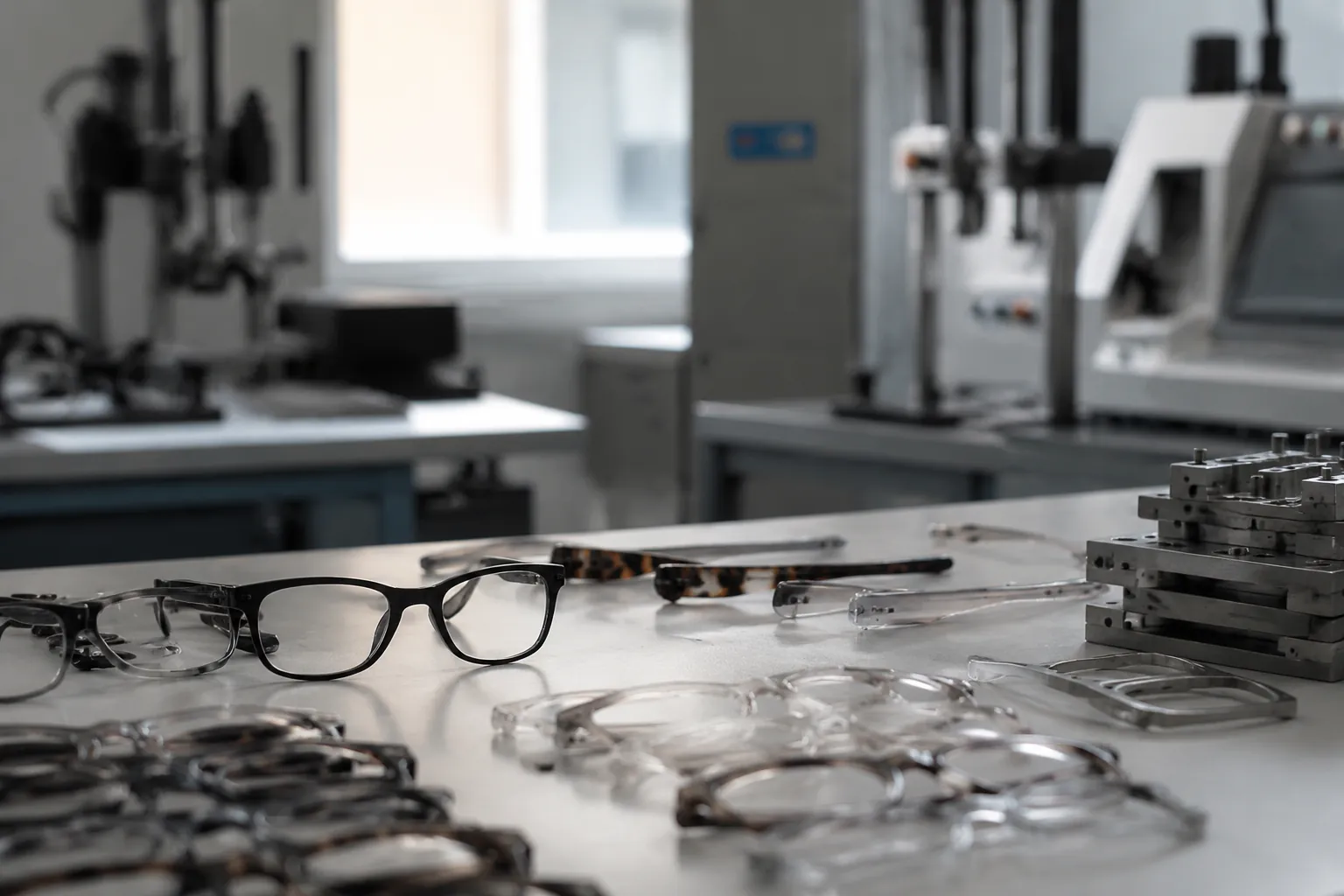
If you buy kids' sunglasses for a brand, retail chain, or distribution program, frame material is not a styling choice. It affects breakage rates, weight, compliance risk, tooling cost, and defect rates after shipment. This guide compares TR90, silicone, injection-molded plastic, acetate, and metal from a buyer's point of view. The goal is simple: choose a material that passes safety checks, survives real use, and does not create avoidable sourcing problems.
What matters in kids' frames
Kids' sunglasses are not adult sunglasses in a smaller size. They need to handle bending, drops, twisting, sweat, sunscreen, and rough use without turning sharp or warping badly. They also need to be easy to inspect. If a frame fails fast in sample testing, it will fail faster in the field.
Compliance comes first. For many markets, that means CE EN ISO 12312-1. For the U.S., buyers still need to pay attention to FDA-related handling and product claims. ANSI Z80.3 matters for impact performance, AS/NZS 1067 for Australia and New Zealand, and REACH for chemical restrictions. If the chosen material makes those checks harder, it is the wrong material.
Material choice also affects the factory process. Injection molding, acetate cutting, polishing, lens fitting, decoration, and QC all behave differently. A frame can look fine in a sample and still be a poor buy if it cracks at the hinge, prints badly, or needs too much handwork to stay consistent. That is where cost gets lost.
For kids' programs, buyers usually care about four things: flexibility, weight, surface safety, and repeatable production. Price matters. But the lowest unit price is not the same as the lowest landed cost.
TR90: the default winner for durability
TR90 is usually the best starting point for kids' sunglasses. It is light, flexible, and resilient under bending. That means fewer cracked temples, fewer hinge failures, and fewer complaints from retailers about dead-on-arrival stock. It is a practical material. Not glamorous. Practical.
TR90 works well for molded frame designs with soft edges and rounded profiles. It is not as premium-looking as acetate, but for children that is usually the wrong priority. What matters is how the frame behaves after repeated abuse. TR90 handles that better than rigid plastic and much better than metal in most school-age use cases.
For sourcing, TR90 supports efficient bulk production. On a program built around existing molds or a fresh custom mold, samples can typically be turned in 7-10 days and bulk in 25-35 days, depending on decoration and lens package. MOQ starts at 50 pairs per design, but pricing improves materially at 300, 1000, and 5000+ pairs. Tooling for a custom mold typically costs $500-$1000, amortized over the order quantity.
Buyer note: TR90 is the material most buyers should start with for a serious kids' line that needs real durability without extra weight or fragile feel.
Silicone: best for soft contact points
Silicone has a narrow but useful role. It is the best option when the buyer wants the softest feel against skin, especially for very young children or for temple tips, nose contact, or strap-style products. It reduces pressure marks and feels forgiving. That matters to parents.
The drawback is commercial, not technical. Silicone can be harder to keep looking clean. It can attract dust, and it is not usually the best standalone frame material for a full sunglasses body if the product needs a crisp retail look. It can also be sensitive in assembly, because soft materials behave differently around rigid lens grooves and inserts.
For a buyer, silicone makes sense in hybrid construction. Use it where the child touches the product. Do not force it to do everything. If the brief is a full fashion frame, silicone alone is usually the wrong answer.
A common hybrid approach is a TR90 frame body with silicone temple tips and nose pads. It adds comfort without turning the whole product into a specialty build.
Injection-molded plastic: cheap, fast, and easy to overuse
Generic injection-molded plastic is the workhorse of low-cost eyewear. It is easy to tool, easy to color, and fast to run. That makes it tempting for mass programs. The problem is simple: not all injection plastics behave the same way.
Some are fine for basic frames. Some get brittle after UV exposure, heat cycling, or repeated flexing at the temple hinge. For kids' sunglasses, that is a real problem. If the formulation is too rigid, the frame snaps. If it is too soft, the shape drifts. If the surface finish is poor, decoration and color consistency suffer.
Buyers sometimes discover this after the first container lands. That is a bad time to learn it. Typical defect rates for injection-molded plastic frames can range from 2% to 8%.
Injection plastic still has a place in entry-level programs where price pressure is severe and the design is simple. But it should be tested hard against drop, bend, and heat exposure. Ask for impact performance evidence tied to the relevant market standard, not just a pretty sample.
Acetate: better appearance, tougher sourcing
Acetate has a stronger fashion signal than TR90 or plain injection plastic. It can look richer, polish well, and support layered colors. For older kids or style-led retail collections, that matters. It gives the frame more visual depth.
The tradeoff is weight and processing complexity. Acetate is typically heavier, and kids feel that. A typical acetate frame might weigh 18-22 grams, while a TR90 frame might weigh 10-14 grams. It is also more labor-intensive to cut, polish, fit, and control consistently. That affects lead time and defect risk.
If the hinge alignment is off or the polishing is inconsistent, buyers see it quickly. Acetate production involves hand polishing, heat bending, and careful lens insertion. None of that is impossible. It just takes more control.
For buyers who want a more premium shelf presentation and can accept higher process discipline, acetate can work. I would not choose it first for very young children unless the market is clearly style-driven and the product brief tolerates extra weight. Typical defect rates for acetate frames can be 3% to 5%, with common issues including hinge misalignment, surface scratches, and color inconsistency.
Metal: the weakest fit for younger kids
Metal frames can work, but for kids they are usually the least forgiving option in this list. They are less tolerant of rough bending, can feel cold and heavy, and create more concern around sharp edges, exposed nose pieces, and deformation after impact. If the frame gets bent in use, parents often see that as damage even if the product is technically still serviceable.
Metal also adds complexity in compliance and quality control because there are more joints and more places for failure. Hinges, solder points, nose pads, and finish adhesion all become inspection points. Decoration can be clean, but the product has more parts that can fail.
I would only put metal into a kids' program when the buyer wants a specific look, usually for older children or teen-oriented fashion lines. For mainstream children's sell-through, metal is rarely the safest commercial choice. The cost is typically higher, and lead times may be longer because of the extra processes involved.
Head-to-head comparison
| Material | Durability (bend cycles, drop survival) | Weight (grams per pair) | Safety fit for kids | Manufacturing notes (cycle time, defect rate) | Best use case |
|---|---|---|---|---|---|
| TR90 | High bend recovery typical; survives repeated drops without cracking | 10-14 | Strong choice for CE EN ISO 12312-1, FDA, ANSI Z80.3, AS/NZS 1067 programs | 30-45 sec cycle; defect rate 1-3%; tooling cost $500-$1000 | Mainstream kids' sunglasses |
| Silicone | Soft and forgiving, but not a full structural frame by itself in many designs | 8-12 (for hybrid parts) | Best for touch points and comfort features | Needs careful assembly with rigid parts; tolerance sensitive | Toddler comfort parts, temple tips, nose contact |
| Injection-molded plastic | Variable; depends on resin quality; may show brittleness after UV or heat cycling | 12-18 | Acceptable only if impact and brittleness are controlled | 30-45 sec cycle; defect rate 2-8%; tooling cost $300-$800 | Entry-level volume programs |
| Acetate | Good if well-made, but less forgiving under impact; more prone to scratches | 18-22 | Can pass requirements, but comfort and weight matter | 45-60 min cycle (hand); defect rate 3-5%; more handwork | Style-led older kids' frames |
| Metal | Strong in appearance, weaker in rough-use tolerance; risk of deformation | 20-30 | Needs extra care on edges, pads, and deformation | More parts (hinges, pads, screws); defect rate 5-10%; tooling cost $1000-$2000 | Older child or teen fashion lines |
Bottom line: TR90 is the most balanced material for kids' sunglasses. Silicone is a support material, not usually the main structure. Acetate and metal are usable, but they raise weight, cost, or failure risk.
How to buy the right material spec
Do not ask for a material name only. That is too vague. Ask for a material spec tied to performance and compliance. A useful RFQ for kids' sunglasses should define the following:
- Target age range and intended market: children (0-3 years), youth (4-8 years), or toddler-style use
- Material for frame front, temples, temple tips, and nose contact points
- Compliance targets: CE EN ISO 12312-1, FDA registration handling, ANSI Z80.3, AS/NZS 1067, REACH
- Impact and bend expectations: what type of abuse the frame must survive, such as drop testing per ANSI Z80.3 or similar
- Decoration method: laser engraving, pad printing, or metal logo plate
- Target order size: 50, 300, 1000, or 5000+ pairs
- Packaging and lens color requirements, such as category 3 lenses for UV400 protection
A good supplier should answer with process, not slogans. They should be able to say whether the frame should be injection molded, cut from acetate, or built with mixed-material parts. They should also explain what changes from sample to bulk, including gate marks, color consistency, hinge tolerance, and how decoration behaves on the chosen surface.
Volume pricing has real breakpoints. A small run near MOQ will never price like a 5000-pair order. On this type of product, the price step-down is usually driven by tool utilization, batch efficiency, and finishing labor. Tooling amortization can materially affect unit cost at lower volumes.
If you need a low starting quantity, accept that the unit cost stays higher until the order scales. That is normal.
What to ask your factory before you place an order
- Which frame material will give the best pass rate for the target market standard?
- Can you show a real sample of the same material and finish, not just a color chip?
- What changes in lead time if we add laser engraving, pad printing, or a metal logo plate?
- Where are the likely defect points: hinge, temple bend, nose area, or surface finish?
- What is the mold and sampling plan if we need a custom shape?
- How will you test consistency across 300, 1000, and 5000+ pairs?
These questions force a supplier to talk about process, not slogans. That is where the real risk sits. The supplier who answers clearly is usually the one who has actually run production.
Have a custom sunglasses project in mind?
Send us your styles, target market and quantities and we will return a detailed quote with MOQ, lead time and a sample plan.
Get a QuoteWhy source this from Wenzhou with LumiShades
Wenzhou in Zhejiang Province is widely regarded as China’s eyewear manufacturing capital, producing a large share of the world’s sunglasses. That concentration matters to buyers: a deep local supply chain for acetate sheet, hinges, lens blanks, plating and packaging means shorter component lead times, easier color and material matching, and a workforce with decades of eyewear-specific skill. LumiShades has manufactured in this ecosystem since 2009, and our vertical integration — in-house injection molding, acetate cutting, CNC milling, lens tinting, decoration and quality control — means no part of your order is quietly subcontracted to a workshop you cannot audit.
For international buyers, that vertical control translates into accountability. When a single factory owns every step, defects are traced and fixed at source rather than bounced between vendors, and your specifications survive intact from first sample to bulk. We back this with 15+ years of experience, shipments to 60+ countries, more than 5 million pairs produced per year and a 98.5% on-time delivery rate. Our certifications — CE EN ISO 12312-1, FDA registration, ANSI Z80.3, AS/NZS 1067, REACH, ISO 9001 and BSCI audit — mean the compliance documentation your market requires already exists. Explore our manufacturing capabilities and quality control process to see how this works in practice.
Frequently asked questions
Is TR90 always the best choice for kids' sunglasses? No. It is usually the best overall choice for durability, weight, and mass production, but silicone works better for soft touch points such as temple tips and nose pads, and acetate can make sense for older kids' fashion lines. For very young children (0-3 years), silicone hybrids are often preferred for comfort. Always verify that the chosen material can pass the required certifications for your target market.
Can acetate pass kids' sunglasses compliance requirements? Yes, if the full product is designed and tested for the target market standard. The issue is not only compliance; weight, impact behavior, and comfort are harder to manage than with TR90. Acetate frames are typically heavier, which can affect comfort for young children. Ensure that the supplier provides test results for CE EN ISO 12312-1, ANSI Z80.3, or AS/NZS 1067 as applicable.
Why is metal a weaker choice for younger kids? Metal is less forgiving in rough play, can feel heavier, and creates more risk around deformation, edges, and hardware points. It is usually better for older children or teen styles. Metal frames also have a higher typical defect rate compared with TR90, making them riskier for high-volume kids' programs.
What certification set should I ask for on a kids' sunglasses order? For global B2B sourcing, ask for the relevant market set: CE EN ISO 12312-1, FDA registration handling for the U.S., ANSI Z80.3, AS/NZS 1067, REACH, plus ISO 9001 and BSCI for factory systems. Also verify that the materials used are lead-free, nickel-free, and phthalate-free per EU and U.S. regulations. Request copies of test reports from accredited labs.
What is the practical MOQ and lead time for a custom kids' frame program? For a typical factory, MOQ starts at 50-100 pairs per design. Samples are typically 7-10 days, including mold creation, and bulk production 25-35 days, with pricing improving at 300, 1000, and 5000+ pairs. Tooling costs for custom molds range from $500-$2000 depending on complexity. Confirm lead times and MOQ in writing before commitment.
Ready to start?
Explore our round sunglasses or request a quote — our sales team replies within 12 hours.
Request a Quote