
5 Frame Materials for Bulk Sunglasses Orders
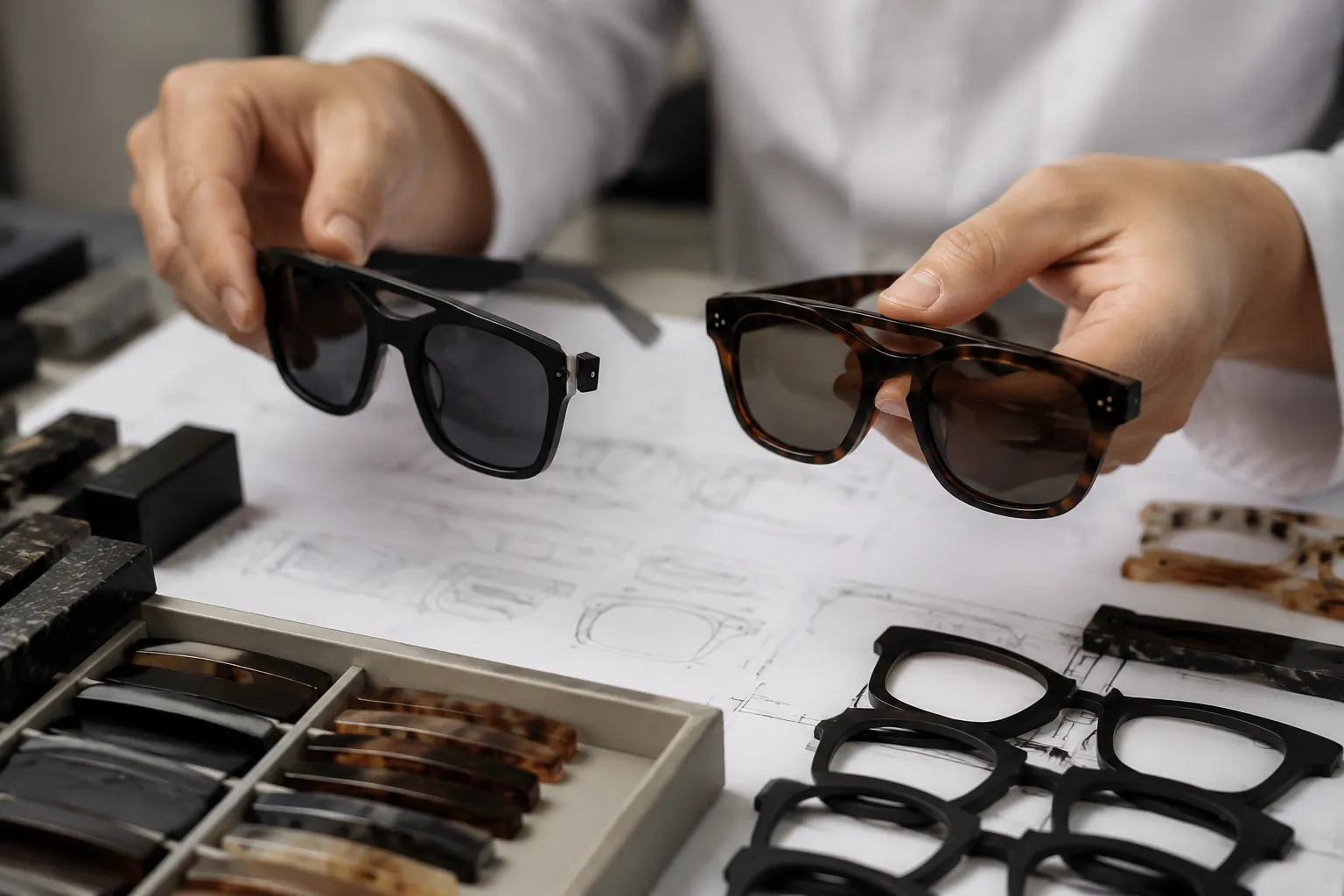
For bulk custom sunglasses, frame material is a commercial decision first. It sets tooling cost, minimum order quantity, geometry, decoration method, inspection points, lead time, and landed unit cost. This guide compares acetate, TR90, injection-molded PC/PA, metal, and bio-acetate from a buyer's production-planning view. The figures below are typical B2B planning ranges, not quotes. Actual price, MOQ, and lead time depend on design complexity, lens specification, hardware, finishing, color count, testing, and supplier capacity at the time of order.
Why frame material choice comes first
Confirm frame material before drawings, packaging, or lens specifications are locked. A 145 mm sunglass frame can look almost identical in acetate, TR90, and PC on a rendering. The factory route is not identical. Acetate is cut from sheet, then tumbled and polished. TR90 and PC/PA are injection molded in steel tooling. Metal frames are formed from wire or sheet, then bent, welded or soldered, plated or coated, assembled, and adjusted.
The cost structure changes quickly at volume. Acetate and metal often carry lower upfront tooling cost, which helps small launches and color tests. Injection PC/PA usually needs higher mold investment, but it can produce a lower unit cost when the same design repeats. TR90 also needs tooling. Buyers choose it mainly for low weight and flexibility, not for the absolute lowest price.
Material also changes the inspection plan. For acetate, check post-polish frame width, lens groove consistency, hinge alignment, warpage after lens insertion, and surface finish. For injection frames, inspect shrinkage, gate marks, sink marks, flash, short shots, color variation, hinge boss strength, and temple-opening force. For metal, inspect rim closure, solder or weld quality, plating or coating adhesion, corrosion resistance, nose-pad alignment, and lens fit. Sunglasses sold into regulated markets may also need documentation against CE EN ISO 12312-1, ANSI Z80.3, AS/NZS 1067, REACH, FDA registration status where applicable, ISO 9001 factory quality management, or BSCI social compliance. The requirement depends on the buyer's market and retail channel.
Quick comparison table: five materials at a glance
| Material | Typical frame-cost range at 5,000+ pairs | Practical MOQ per design | Tooling or setup | Typical bulk lead-time driver | Best use case |
|---|---|---|---|---|---|
| Acetate | Usually mid-range; often about $2.10-$2.90 before lens and premium hardware upgrades | Often 50+ pairs when sheet is stocked | No injection mold; CNC program, fixtures, and forming tools | Cutting, tumbling, polishing, assembly, and final adjustment | Fashion frames, thick rims, layered colors, tortoise effects, and low-MOQ launches |
| TR90 | Usually mid-range; often about $2.40-$3.30 before lens and coating upgrades | Often 300+ pairs because molding setup must be amortized | Dedicated injection mold; common planning range about $800-$1,500 for simpler tools | Mold making, resin drying, color approval, molding, trimming, and assembly | Sport, outdoor, kids, and lightweight flexible frames |
| Injection PC/PA | Usually lowest at repeat volume; often about $1.50-$2.20 before lens and coating upgrades | Often 1,000+ pairs because production tooling and machine setup are significant | Production injection mold; common planning range about $2,000-$5,000 depending on tool complexity | Mold making, mold trial, first-article approval, molding, finishing, and assembly | High-volume economy programs, complex molded shapes, integrated nose pads, and repeat orders |
| Metal: monel, stainless steel, or titanium | Usually mid-to-premium; monel often lower than titanium | Often 50+ pairs when standard components are used | Bending jigs, soldering or welding fixtures, polishing and plating or coating setup | Component forming, joining, surface finishing, plating or coating, adjustment, and corrosion checks | Aviator, navigator, rimless, thin-wire, adjustable nose-pad, and premium fine-line styles |
| Bio-acetate | Usually higher than standard acetate; often about $3.00-$4.20 depending on sheet and documentation | Often 50+ pairs when sheet is stocked | No injection mold; CNC program, fixtures, and forming tools | Sheet availability, cutting, tumbling, polishing, assembly, and final adjustment | Sustainability-positioned acetate collections with material documentation |
Use these ranges as planning references for frame production. Final FOB price can move sharply if the order includes polarized lenses, category-specific lens testing, premium hinges, custom metal plaques, crystal details, multi-color lamination, premium plating, complex spray coating, small color splits, special packaging, or third-party testing.
Acetate: depth, polish, and lower tooling risk
Acetate frames are cut from cellulose acetate sheet instead of injected into a mold. The usual process is sheet selection, CNC milling of fronts and temples, heat forming, tumbling, hand polishing, hinge fitting, lens assembly, and final adjustment. There is no production injection mold. That matters. Many design corrections can be made by changing the CNC file and fixtures before bulk cutting starts.
Cost and MOQ: Acetate is practical when a buyer needs a premium look without large mold investment. At 5,000+ pairs, many standard acetate frames sit in a mid-range cost band, often around $2.10-$2.90 before lens, hinge, and decoration upgrades. MOQ can be low when the required sheet color is in stock. Custom acetate sheets, exclusive colors, or special laminations can raise the practical MOQ because sheet suppliers may require minimum sheet production or full-sheet purchasing.
Tolerances and behavior: Acetate gives a high-gloss finish and strong color depth, but it is heat sensitive and must be adjusted correctly after lens fitting. Buyers should specify dimensional checks for frame width, bridge symmetry, lens groove depth, hinge alignment, temple opening angle, and warpage after stabilization. Acetate can become brittle in very cold conditions. It can also deform in high heat if material curing, lens fit, or final adjustment is poor.
Decoration: Acetate supports metal logo plaques, laser engraving, pad printing, hot stamping, embedded wire cores, visible temple cores, two-tone lamination, transparent effects, and tortoise patterns. Choose it when the brief depends on color depth, hand-polished finish, and a premium fashion look.
TR90: light, flexible, and tooling-dependent
TR90 is a nylon-family thermoplastic used for lightweight, flexible eyewear. Buyers often choose it for sport, outdoor, and children's styles because the frame can flex more than acetate or metal before permanent damage. It is not a blanket upgrade. The tradeoff is mold cost, tighter process control, and fewer premium sheet-color effects.
Tooling and MOQ: TR90 requires a dedicated injection mold. Simple sunglass tools are often planned in the low four figures. Complex wrap shapes, sliders, texture requirements, and higher-cavity tools can cost more. Practical MOQ is usually higher than acetate because the supplier must dry resin, set the machine, approve color, trial the mold, and inspect first articles before stable bulk production.
Process detail: TR90 resin must be dried according to the resin supplier's processing guidance. Poor drying or weak molding control can cause bubbles, silver streaks, weak flow lines, warpage, or inconsistent surface finish. Buyers should ask for first-article samples from the production tool. Check bridge symmetry, hinge boss strength, temple screw retention, color match, surface finish, and lens fit before approving bulk production.
Decoration limits: TR90 does not polish like acetate and does not naturally reproduce deep laminated patterns. It works better with solid colors, matte finishes, sprayed coatings, rubberized coatings, heat-transfer graphics, pad printing, suitable laser marking, and small metal badges. If the design depends on translucent depth or layered tortoise, acetate or bio-acetate will usually look more convincing.
Injection PC/PA: lowest unit cost at true volume
Injection-molded PC and PA frames are common in high-volume sunglasses programs. They make sense when the buyer needs repeatable geometry, low unit cost at scale, thin walls, integrated nose pads, molded hinge boxes, decorative ribs, vent holes, or wrap shapes that are inefficient to machine from sheet.
Cost logic: Injection molding shifts cost from labor into tooling and setup. A production mold may cost several thousand dollars depending on cavity count, steel grade, sliders, finish, and expected mold life. That is expensive on a small trial order. It becomes easier to justify when the same frame repeats over 10,000, 20,000, or more pairs. Calculate total landed cost with mold amortization included, not just the quoted frame price.
Material choice: PC is widely used because it is impact resistant and cost effective. The surface can scratch or mark more easily unless protected by texture, coating, or careful handling. PA grades, including higher-performance nylon materials used in eyewear, may cost more but can offer better dimensional stability, heat behavior, surface feel, and long-term performance depending on grade. Review the material datasheet and supplier processing recommendation before tooling approval, especially for hot-climate retail programs.
Defect controls: Injection frames need mold-flow and manufacturability review before steel is cut. Thick-to-thin transitions can create sink marks. Poor gate placement can leave visible weld lines or stress points. Buyers should include acceptance criteria for critical dimensions, gate trimming, flash, short shots, sink marks, warpage, color contamination, surface scratches, coating adhesion where used, hinge-cycle performance, and lens retention.
Metal: thin profiles and plating control
Metal frames follow a different production logic from plastic frames. Monel, stainless steel, and titanium components are formed from wire or sheet, then cut, bent, welded or soldered, polished, plated or coated, assembled, and adjusted. They do not need plastic injection molds. They do need accurate jigs, stable component sourcing, and skilled alignment.
Cost and MOQ: Metal can be practical at low MOQ when the frame uses standard rims, bridges, temples, hinges, and nose-pad components. Monel is common in value and mid-range metal eyewear. Stainless steel can support thinner, corrosion-resistant designs depending on grade and construction. Titanium is lighter and has stronger corrosion and skin-contact advantages, but raw material, welding, forming, and finishing are more demanding. Price rises accordingly.
Process detail: Metal quality depends on symmetry, solder or weld integrity, surface preparation, and final adjustment. Inspection should cover rim closure gap, bridge angle, eyewire tension, temple opening, hinge function, nose-pad arm position, plating or coating appearance, and lens fit. For markets with sweat, beach, or marine exposure, specify corrosion-resistance expectations and request salt-spray or equivalent test reporting when the channel requires it.
Use cases and risks: Metal suits aviator, navigator, cat-eye, rimless, semi-rimless, and thin-wire frames. It allows adjustable nose pads and a refined profile that is hard to achieve in thick plastic. It is less suitable for rough children's use because frames can bend out of alignment. Nickel exposure must be controlled in sensitive markets through material selection, plating, coating, and REACH documentation. Titanium can reduce corrosion and skin-contact concerns, but it raises cost and can complicate repair.
Bio-acetate: same process, stricter claims
Bio-acetate is made into eyewear frames much like standard acetate: sheet cutting, CNC milling, tumbling, polishing, hinge installation, lens fitting, adjustment, and final inspection. The difference is the material formulation. Bio-acetate typically uses cellulose from wood pulp or cotton linters with a bio-based plasticizer system. Exact content varies by sheet supplier and product line.
Cost and lead time: Bio-acetate usually costs more than standard acetate because sheet supply is narrower and documentation requirements are higher. At 5,000+ pairs, it often sits in a higher frame-cost band than standard acetate. MOQ can stay low when approved sheet is stocked. Non-standard colors, exclusive laminations, or retailer-specific documentation can increase both MOQ and lead time.
Performance: Do not assume bio-acetate is stronger, lighter, more flexible, or more heat resistant than standard acetate. Its machining behavior, polish level, adjustment requirements, heat sensitivity, and cold-weather brittleness are generally comparable. The commercial value is positioning and documentation: lower petroleum-based input compared with conventional plasticizer systems, phthalate-free claims where supported by the material supplier, and clearer material declarations for retailers.
Claims and documentation: Market bio-acetate with disciplined language. Do not describe it as home compostable, fully biodegradable, ocean biodegradable, or plastic-free unless the exact sheet lot is supported by a relevant third-party test report. Buyers should request supplier material declarations, REACH documentation, and any available bio-based content evidence for the approved sheet lot. If the sunglasses will be sold through a retailer with strict sustainability rules, confirm the required claim language before sampling.
Decision framework for a bulk order
Use material selection as a commercial filter before sampling. The wrong material can pass a rendering review and still fail the margin, timeline, durability requirement, or retail positioning of the program.
- If the target frame cost is below $2.00: evaluate injection-molded PC first, but include mold amortization, testing, coating, scrap allowance, and repeat-order probability in the cost model.
- If MOQ must stay under 300 pairs: start with acetate, metal, or bio-acetate using stocked colors, standard hinges, and available components.
- If the frame must flex under impact: evaluate TR90 or a suitable PA grade. Acetate and metal can be durable, but they do not recover from bending in the same way.
- If the design needs layered color, tortoise, or visible depth: choose acetate or bio-acetate. Sprayed injection frames can imitate color but usually cannot match real sheet depth.
- If the style needs thin rims and adjustable nose pads: choose metal, with monel or stainless steel for value-oriented programs and titanium for premium low-weight positioning.
- If the order depends on repeat volume: injection PC/PA or TR90 becomes more attractive because tooling cost is diluted after the first approved production run.
Before issuing a purchase order, ask the supplier for material confirmation, tooling cost, tooling ownership terms, MOQ by color, sample lead time, bulk lead time after approval, decoration method, lens standard, packaging specification, AQL or inspection standard, and required compliance documents. Do not judge samples by appearance only. Test face feel, hinge strength, lens fit, logo durability, color tolerance, coating adhesion where relevant, packaging fit, and frame behavior after adjustment.
Have a custom sunglasses project in mind?
Send us your styles, target market and quantities and we will return a detailed quote with MOQ, lead time and a sample plan.
Get a QuoteWhy source this from Wenzhou with LumiShades
Wenzhou in Zhejiang Province is widely regarded as China’s eyewear manufacturing capital, producing a large share of the world’s sunglasses. That concentration matters to buyers: a deep local supply chain for acetate sheet, hinges, lens blanks, plating and packaging means shorter component lead times, easier color and material matching, and a workforce with decades of eyewear-specific skill. LumiShades has manufactured in this ecosystem since 2009, and our vertical integration — in-house injection molding, acetate cutting, CNC milling, lens tinting, decoration and quality control — means no part of your order is quietly subcontracted to a workshop you cannot audit.
For international buyers, that vertical control translates into accountability. When a single factory owns every step, defects are traced and fixed at source rather than bounced between vendors, and your specifications survive intact from first sample to bulk. We back this with 15+ years of experience, shipments to 60+ countries, more than 5 million pairs produced per year and a 98.5% on-time delivery rate. Our certifications — CE EN ISO 12312-1, FDA registration, ANSI Z80.3, AS/NZS 1067, REACH, ISO 9001 and BSCI audit — mean the compliance documentation your market requires already exists. Explore our manufacturing capabilities and quality control process to see how this works in practice.
Frequently asked questions
What is the cheapest frame material for an order of 10,000 pairs? Injection-molded PC is usually the lowest unit-cost option when the design will repeat and the mold cost can be amortized. Calculate total cost as: frame price + mold cost divided by order quantity + lens cost + decoration + testing + packaging + freight impact + expected defect allowance. If the order is a one-time 10,000-pair run, compare PC against acetate or metal with no injection mold. If the design will repeat over several seasons, PC or PA usually becomes more attractive.
Can I mix materials in one sunglass design? Yes. Common constructions include acetate fronts with metal temples, metal fronts with acetate temple tips, injection fronts with metal temples, or TR90 temples with injection fronts. Mixed-material frames need extra attention to joint strength, hinge alignment, screw retention, color matching, plating or coating compatibility, and differential movement under heat. Ask the supplier whether special fixtures are needed and whether the mixed construction changes MOQ, sample time, or inspection criteria.
Which material gives the lowest MOQ for a new private-label frame? Acetate, metal, and bio-acetate usually give the lowest MOQ when the design uses stocked sheet, standard hinges, available metal components, and existing decoration methods. TR90 and injection PC/PA usually require higher MOQ because tooling, resin setup, color matching, and machine time must be justified. For a first private-label test, ask the supplier to quote two options: one low-MOQ version using stocked materials and one version optimized for repeat production.
Does bio-acetate really biodegrade? Do not assume it does. Bio-acetate in eyewear is usually partly bio-based and may be phthalate-free depending on the formulation, but that does not automatically make the finished frame home compostable, fully biodegradable, or ocean biodegradable. Use only the claim supported by the sheet supplier's documents and any third-party test report for the exact material. A safer buyer-facing claim is often bio-based acetate or acetate made with bio-based plasticizer, supported by REACH documentation and supplier material declarations.
Which material has the shortest lead time for a first order? Acetate and metal are often faster for a new design because they avoid injection mold making. The schedule still depends on sheet availability, component availability, decoration, sample approval speed, and inspection requirements. TR90 and injection PC/PA usually take longer on the first order because a mold must be made, trialed, corrected if needed, and approved before bulk production. For repeat orders from an approved mold, molded frames can be faster because tooling and process settings already exist.
Do different colors require separate molds for TR90 or injection frames? No. If the geometry is unchanged, one mold can normally run multiple colors. Color changes use different resin pellets, masterbatch, painting, or coating. Each color split still adds changeover, purging, cleaning, first-piece approval, and color matching risk. Many small color splits can raise unit cost and extend lead time, so buyers should confirm the MOQ per color and whether color approval is based on molded resin, coating, or both.
What decoration methods work best by material? Acetate and bio-acetate work well with metal plaques, laser engraving, hot stamping, pad printing, visible wire cores, and layered sheet effects. TR90 and PC/PA work well with pad printing, spray coating, rubberized finishes, heat-transfer logos, molded-in details, and suitable laser marking. Metal supports plating, laser marking, engraving, enamel fill, temple stamping, custom nose-pad logos, and decorative components. For bulk orders, confirm logo durability with rub testing, tape testing for coatings where applicable, and approval samples made by the same process planned for production.
Ready to start?
Explore our round sunglasses or request a quote — our sales team replies within 12 hours.
Request a Quote