
RX-Ready Sunglass Frames: Buyer Specs That Matter
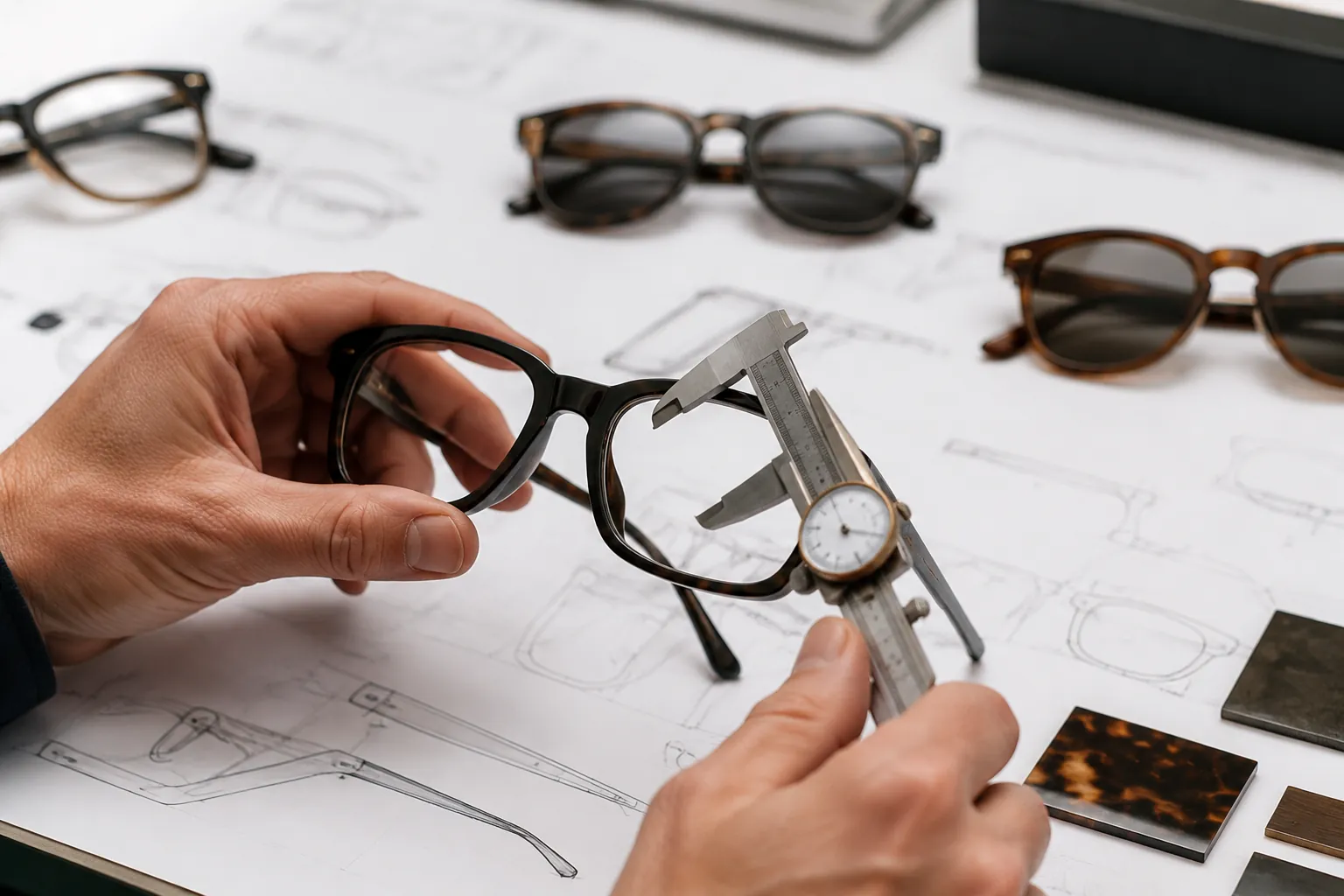
This guide is for optical buyers, sunglass brands, importers, and distributors sourcing prescription-compatible sun frames. The aim is simple: prevent lens popping, glazing problems, frame twist, optical distortion, cracked fronts, weak decoration, and styles that photograph well but fail at the optician's bench. Use it as a specification checklist before drawings, tooling, samples, or bulk production are approved.
Start with the optical use case, not the sketch
An RX-ready sunglass frame is not a plano sunglass with demo lenses. It must hold edged prescription lenses securely, keep the lens in the intended position, and allow an optician or glazing lab to mount lenses without excessive heat, force, or rework.
Start with the prescription use case. A low-power lifestyle sunglass, a progressive-friendly optical sun frame, and a wrapped sport frame are not the same product. If the sales channel is optical retail, define the intended RX range and lens type before approving the shape. Do not sell a light-RX style as broadly prescription-ready.
Before tooling, confirm the target prescription range, lens type, fitting height needs, compliance market, distribution channel, and packaging level. These decisions affect front curve, bridge design, nose pad position, lens groove, hinge choice, temple geometry, and inspection gauges.
Practical rule: if finished samples cannot accept edged test lenses repeatedly without stress whitening, front twist, rim cracking, rim gaps, or lens movement, do not approve the model as RX-ready.
Frame geometry specs that decide RX compatibility
RX compatibility starts with measurable geometry. A useful technical drawing should show more than lens width, bridge, and temple length. Ask for eye size, distance between lenses (DBL), B dimension, effective diameter (ED), front width, pantoscopic angle, face form angle, bridge height, pad position, groove section, rim thickness, and intended lens base curve.
Oversized sunglass lenses increase lens blank size, edge thickness, weight, decentration, and distortion risk. A large fashion frame may work as a plano sunglass and still be a poor RX candidate for higher minus prescriptions or progressives. For progressive lenses, confirm the minimum fitting height required by the lens design and the retailer's fitting rules before approving the B dimension.
- Eye size: smaller and moderate eye sizes are usually easier to glaze in RX than oversized sun shapes. Treat large eye sizes as low-RX or plano-first styles unless lab testing proves otherwise.
- Bridge/DBL: specify by target market and fit profile. Poor bridge fit shifts optical centers and can drive wearer complaints.
- Effective diameter: ask the supplier or lab to calculate ED. It affects lens blank diameter, lens availability, edging yield, and cost.
- Face form angle: low wrap is generally easier for standard RX glazing. Higher wrap needs lab confirmation and may require compensated lenses.
- Pantoscopic angle: set a target range and tolerance. Excessive fixed tilt reduces fitting flexibility, especially for progressives.
- Front symmetry: define left/right tolerance for eye shape, groove position, and front height on finished samples, not only on CAD drawings.
For handmade acetate and other manually finished frames, CAD is not enough. Cutting, tumbling, polishing, hinge installation, and heat adjustment can shift final dimensions. Request measured sample reports from finished frames, including front curve, temple spread, bridge width, and lens fit.
Base curve and wrap: where sun frames often fail
Sunglasses often use curved lenses for style, coverage, and side protection. Prescription lenses do not always tolerate the same curve. A high-base plano lens can look good in a showroom sample, then become expensive, distorted, or difficult to glaze in prescription form.
Base curve is the front surface curvature of the lens. Wrap, or face form angle, is how much the frame front turns around the face. They are related. They are not the same. Specify both the intended lens base curve and the acceptable face form range. Do not let these values be guessed from a photo or reference sample.
| Frame type | Typical base curve | Suggested face form angle | RX suitability | Buyer note |
|---|---|---|---|---|
| Classic optical sun frame | Base 2–4 | Low wrap | Best option for broad RX programs | Suitable for optical retailers that glaze locally, subject to sample testing |
| Fashion sunglass, mild wrap | Base 4–6 | Mild wrap | Often suitable for low to moderate RX | Confirm lens availability and lab willingness in target markets |
| Sport wrap sunglass | Base 6–8 | Moderate to high wrap | Limited RX unless engineered for it | May require compensated, digitally surfaced, or specialty lenses |
| Shield or one-piece lens | Often high curve | Varies by design | Usually not standard RX-ready | Consider an RX insert clip or a separate optical frame model |
If the program includes progressives, higher powers, or local glazing by many independent optical shops, keep wrap conservative unless the lens lab has validated the design. Wrapped RX lenses can require compensation for optical effects caused by lens tilt and wrap. That raises lens cost and limits the number of labs willing to process the frame.
Lens groove and rim retention: small specs, big returns
The lens groove is one of the most common failure points in RX-ready sun frames. If the groove is too shallow, the lens may move or pop out. If it is too tight, the lens can chip or the frame can distort during mounting. If it is inconsistent, one color or production batch may glaze well while another fails.
Plano sunglass lenses are often thin and consistent. Prescription lenses are not. Edge thickness can increase with minus powers, larger eye sizes, lower-index lens materials, and certain curves. The groove must retain the lens without forcing the optician to overheat, over-stretch, or permanently deform the frame.
For acetate and plastic fronts, specify groove depth and width on the drawing and verify them on finished samples. Common working ranges are often around 0.6–0.8 mm for groove depth and around 0.55–0.75 mm for groove width, but these are only starting points. The correct section depends on material, rim thickness, bevel design, lens thickness, lens curve, and whether the frame is full-rim, semi-rimless, or metal. Set tolerances with the supplier. Then prove them with physical glazing tests.
- Make first functional samples in the intended production material, not a substitute with different stiffness or memory.
- Edge and mount test lenses that represent the target lens thickness, curve, and bevel design.
- Mount and remove lenses through repeated cycles to check groove wear, rim recovery, screw stability, and frame memory.
- Heat-adjust the bridge, end pieces, and temples using procedures similar to an optical shop.
- Inspect lens seating, rim gaps, stress whitening, screw loosening, front twist, color-layer cracking, and any visible lens movement.
If a groove issue appears during inspection, the root cause is usually upstream: milling path, mold design, rim thickness, material choice, polishing loss, or dimensional control. Sorting finished goods may block some bad units. It does not fix the specification.
Material behavior: what works and what needs caution
Material choice affects lens retention, adjustment, screw strength, decoration, comfort, and landed cost. The lowest unit price can become expensive if opticians reject the frame or distributors receive returns.
| Material | RX-ready strengths | Risks to control | Practical specification notes |
|---|---|---|---|
| Acetate | Good adjustability, premium feel, stable rim when cut and polished correctly | Polishing variation, labor variation, possible warpage after heating | Specify rim thickness at stress areas; inspect groove depth after polishing, not before |
| TR90/nylon | Lightweight, flexible, useful for active styles | Flexible fronts can release lenses if groove and rim section are weak | Confirm retention by push testing and repeated glazing; avoid overly thin rims on larger eye sizes |
| PC injection | Low cost and commonly used for plano sunglasses | Less friendly for adjustment and RX glazing; stress cracking risk depends on design and processing | Do not claim broad RX compatibility unless actual edging, mounting, and adjustment tests pass |
| Metal | Adjustable pads, slim profile, screw-rim options, good fitting flexibility when well made | Plating defects, solder weakness, rim closure inaccuracy, screw loosening | Check rim gap, screw engagement, solder points, pad arm symmetry, corrosion resistance, and restricted-substance requirements |
| Mixed material | Can combine acetate fronts, metal temples, adjustable pads, or special trims | More QC points, color-matching issues, joint-strength risks | Control hinge joint strength, plating compatibility, trim attachment, and material movement after heating |
Acetate and well-engineered TR90 are common choices for prescription-ready sunglasses. Metal frames can also perform well when rim wire, screws, soldering, pad arms, and plating are controlled. PC can suit plano sunglasses and some limited applications, but be careful with RX claims unless the exact production design has passed glazing and adjustment trials.
Decoration must not weaken the optical structure
Brand decoration is often approved for appearance only. That is risky. Logos, plates, rivets, lamination, printing, and laser engraving can affect RX performance. They should not weaken the lens rim, interfere with heating, block temple adjustment, or create stress points near the groove.
Common decoration options include pad printing, silk-screen printing, laser engraving, hot stamping, metal logo plates, injected metal badges, temple wire-core logos, and lens logos. Each method carries process risk. Pad printing needs adhesion checks after handling and cleaning exposure. Metal plates add drilling, adhesive, pinning, or insert-molding steps. Laser engraving is clean, but it can create visible marks or local stress if placed too close to thin sections.
- Keep logos away from the lens groove: do not drill, pin, or engrave near the groove unless the rim section has been engineered and tested.
- Test adhesion: use tape pull, rub, sweat simulation, and cleaning-wipe checks on the final production color and finish.
- Control metal parts: inspect plating finish, burrs, sharp edges, corrosion resistance, attachment strength, and restricted-substance compliance.
- Approve final colors: a black prototype does not prove that translucent, crystal, tortoise, laminated, painted, or plated versions will behave the same.
For RX-ready frames, decoration approval should follow glazing tests. A frame that passes without a badge or rivet may fail after decoration is added to a thin or flexible area.
Sample approval, QC, MOQ and lead-time logic
A good-looking sample is not enough for an RX-ready program. Approve samples through repeatable bench tests with written pass criteria. Agree dimensional tolerances for the specific material and manufacturing method. Common inspection points include eye size, bridge, B dimension, temple length, front width, temple spread, face form angle, pantoscopic angle, front twist, groove depth, groove width, and left/right symmetry.
For LumiShades projects, simple samples using existing molds or standard materials are typically quoted at 7–10 days. New molds, custom acetate sheets, special metal parts, complex decoration, or multiple colorways can extend sampling to about 15–25 days. Bulk production is typically planned at 25–35 days after sample approval and deposit, depending on material availability, order size, color count, lens tinting, packaging, testing, and inspection requirements.
MOQ can start at 50 pairs per design for validation or small buyer programs. Pricing usually improves at 300, 1,000, and 5,000+ pairs because setup, color preparation, tooling time, decoration jigs, QC labor, and packaging procurement are spread across more units. Tie any quoted low unit price to the exact material, lens type, decoration, packaging, compliance requirements, and order quantity. RX-ready acetate, metal construction, polarized lenses, custom logos, and premium cases normally cost more than basic plano injection sunglasses.
- Glazing test: mount lenses in the target thickness and curve range; inspect seating, rim gaps, chipping, stress marks, and front distortion.
- Lens retention: apply controlled pressure from the front and back; lenses should not pop out or shift in the groove.
- Hinge test: open and close temples repeatedly; check screw backing-out, hinge play, alignment, and temple drop.
- Heat adjustment: adjust end pieces, bridge area, pad arms where applicable, and temples as an optical shop would.
- Appearance QC: inspect polishing waves, injection marks, color consistency, logo placement, lens tint uniformity, coating defects, and plating defects.
- AQL: define critical, major, and minor defects before production. Write the AQL level into the purchase order or inspection plan.
Compliance files and the PO appendix buyers should send
Compliance does not make a weak frame RX-ready, but it belongs in the buying specification. Depending on the market and product type, relevant documentation may include CE EN ISO 12312-1, ANSI Z80.3, AS/NZS 1067, REACH, FDA registration, ISO 9001, and BSCI. Confirm which documents apply to the specific product, shipment, and destination market.
Clarify what is being assessed: the plano sunglass supplied by the factory, the frame material, the lens, the coating, the packaging, or the finished prescription sunglass after local glazing. If an optician replaces the lenses, the final RX product may depend on the lab's lens material, tint, coating, impact requirements, and local regulations. This matters for polarized lenses, gradient tints, sun filter categories, driving use, children's products, and performance claims.
A strong purchase order should include an optical appendix with target RX use, lens type, eye size, bridge, temple length, B dimension, ED, front width, base curve, face form angle, pantoscopic angle, groove depth and width, material, color codes, decoration method, compliance market, packaging, AQL level, inspection tolerances, and sample test requirements. For a new model, start with a validation quantity before committing to a large run. Approve the design after optical shops or labs confirm real glazing performance. It is cheaper than handling returns after launch.
Have a custom sunglasses project in mind?
Send us your styles, target market and quantities and we will return a detailed quote with MOQ, lead time and a sample plan.
Get a QuoteWhy source this from Wenzhou with LumiShades
Wenzhou in Zhejiang Province is widely regarded as China’s eyewear manufacturing capital, producing a large share of the world’s sunglasses. That concentration matters to buyers: a deep local supply chain for acetate sheet, hinges, lens blanks, plating and packaging means shorter component lead times, easier color and material matching, and a workforce with decades of eyewear-specific skill. LumiShades has manufactured in this ecosystem since 2009, and our vertical integration — in-house injection molding, acetate cutting, CNC milling, lens tinting, decoration and quality control — means no part of your order is quietly subcontracted to a workshop you cannot audit.
For international buyers, that vertical control translates into accountability. When a single factory owns every step, defects are traced and fixed at source rather than bounced between vendors, and your specifications survive intact from first sample to bulk. We back this with 15+ years of experience, shipments to 60+ countries, more than 5 million pairs produced per year and a 98.5% on-time delivery rate. Our certifications — CE EN ISO 12312-1, FDA registration, ANSI Z80.3, AS/NZS 1067, REACH, ISO 9001 and BSCI audit — mean the compliance documentation your market requires already exists. Explore our manufacturing capabilities and quality control process to see how this works in practice.
Frequently asked questions
Can any sunglass frame be made prescription-ready? No. High-wrap, oversized, shield, very thin-rim, or weak plastic designs may not accept prescription lenses safely. Before calling a frame RX-ready, confirm the intended RX range, lens type, base curve, wrap, groove depth, rim strength, material behavior, and physical glazing results. If the frame cannot hold test lenses securely after insertion, removal, heat adjustment, and retention testing, sell it as plano or limited-RX only.
What base curve should we specify for RX-ready sunglasses? For broad RX compatibility, start with a conservative optical sun design, commonly around base 2–4 with low wrap. Base 4–6 can work for many low to moderate prescriptions if the lab confirms lens availability and glazing performance. Base 6–8 and higher-wrap designs should be treated as limited RX unless a qualified lens lab validates the frame and lens combination. Always specify both lens base curve and face form angle; they are different measurements.
What groove depth is typical for RX-ready plastic or acetate sun frames? Many acetate and plastic projects use groove depths around 0.6–0.8 mm and groove widths around 0.55–0.75 mm, but these are starting points, not universal rules. The correct values depend on material, rim thickness, bevel shape, lens thickness, eye size, curve, and manufacturing process. Put the groove section on the drawing, measure it on finished samples after polishing or molding, and confirm it by mounting representative test lenses.
Is acetate better than TR90 for prescription sunglass frames? Acetate is often easier for opticians to adjust and can provide a stable full-rim structure when the groove and rim thickness are controlled. TR90 is lighter and more flexible, which can be useful for active styles, but the front must be engineered so the lens does not release under pressure or after repeated glazing. Neither material is automatically RX-ready. Approve the material only after lens retention, heat-adjustment, hinge, and dimensional tests on finished samples.
What should buyers test before approving bulk production? Test the frame as an optician or lab will use it. Mount and remove representative lenses, check lens seating and retention, inspect for stress whitening or cracking, heat-adjust the frame, measure finished dimensions, check front twist and symmetry, cycle the hinges, test decoration adhesion, inspect lens tint or coating quality, and confirm packaging protection. Approve final color and decoration samples, not only plain prototypes, because material color, lamination, plating, or badges can change performance.
What MOQ and lead time should buyers expect from LumiShades? For LumiShades projects, MOQ can start at 50 pairs per design for validation or small programs. Simple samples using existing molds or standard materials are typically quoted at 7–10 days. More complex custom samples may take about 15–25 days. Bulk production is typically planned at 25–35 days after approval and deposit, depending on materials, colors, decoration, testing, packaging, and order mix. Pricing should be confirmed against the final specification and quantity; it normally improves at 300, 1,000, and 5,000+ pairs.
Which certifications and compliance documents can be used for these sunglasses programs? Applicable documents may include CE EN ISO 12312-1, ANSI Z80.3, AS/NZS 1067, REACH, FDA registration, ISO 9001, and BSCI, depending on product type and destination market. Buyers should ask what each document covers: the finished plano sunglass, the lens, the frame material, the factory system, or social compliance. Do not make UV, polarized, driving, impact, blue-light, medical, or children's-use claims unless the exact product and claim have been tested and documented for the target market.
Ready to start?
Explore our aviator sunglasses or request a quote — our sales team replies within 12 hours.
Request a Quote