
Memory Metal Sunglasses: Best Uses and Limits
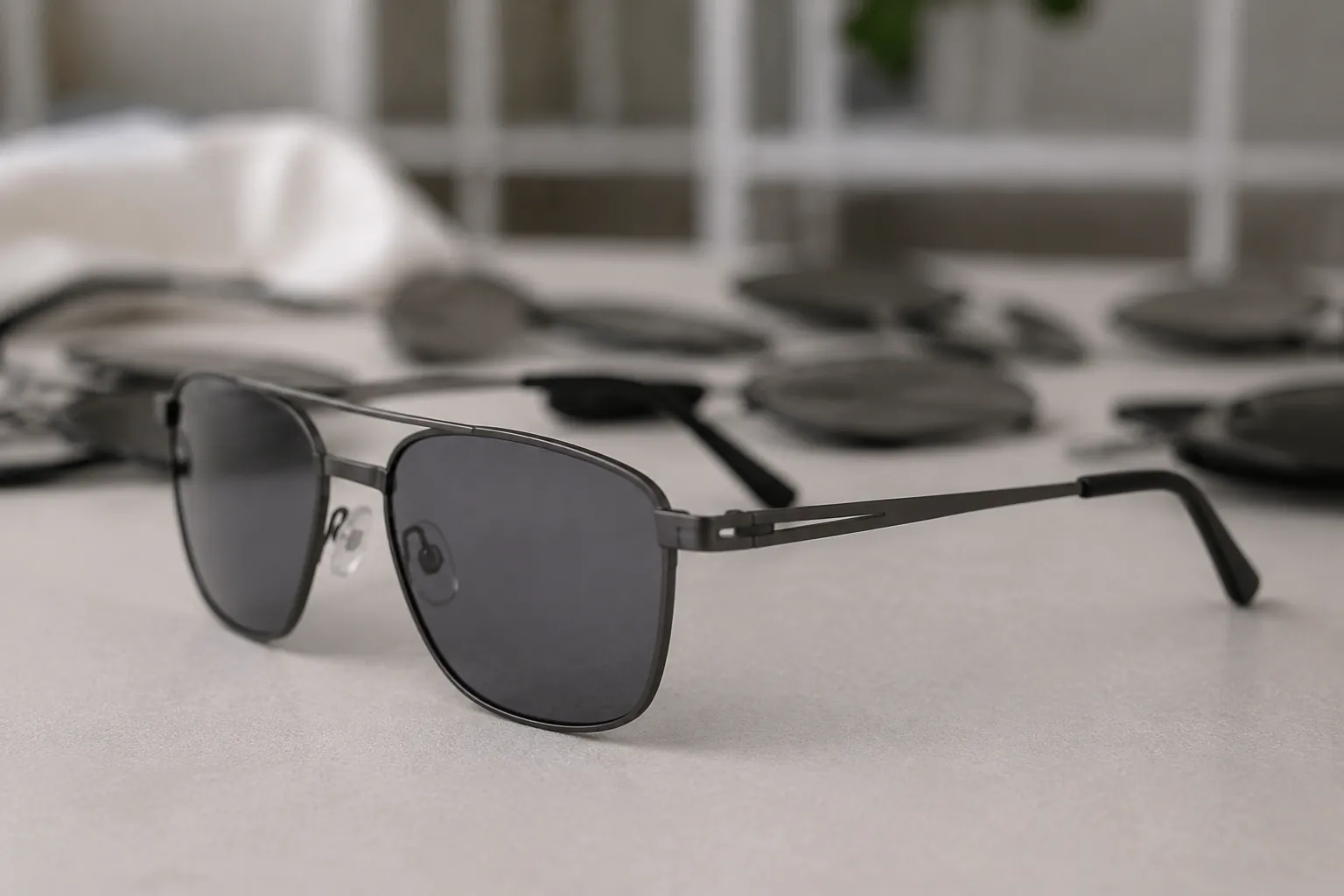
This guide is for brand owners, importers, distributors, and retail buyers assessing memory metal for sunglass frames. The real question is not whether the material sounds advanced. It is whether the frame design, sales channel, compliance requirements, and after-sales model justify using it. In the right product, memory metal can improve bend recovery and reduce deformation from routine handling. In the wrong one, it adds cost, finish risk, styling limits, and service headaches. This article stays practical: where memory metal tends to work, how factories should control it, which specifications to lock before sampling, and what compliance documents matter by market.
Start With the Use Case, Not the Material Name
Buyers often ask for memory metal because they want a frame that flexes and returns close to its original shape after bending. That is a reasonable goal. It is not a sufficient reason to use the material.
Memory metal makes the most sense when that flex matters in daily use and in the sales story. In practice, it is strongest in lightweight metal sunglasses with thin temples, slim bridge structures, and a clear technical look. It can also suit programs where frames are handled often, packed tightly, or sold on durability.
It is less convincing in collections built around thick rims, bold temple volume, heavy color expression, or oversized fashion shapes. In those cases, acetate or other constructions usually do the design job better. The frame has to look right first.
Before approving development, ask four direct questions:
- Will the end user notice and value bend recovery in normal use?
- Does the design still look commercially strong with thinner, more technical proportions?
- Can the retail channel support a more demanding manufacturing and QC process?
- What is the plan if the frame later needs adjustment, repair, or cosmetic touch-up?
If those answers are vague, stop there. The material may be wrong for the SKU even if the sample feels good in hand.
What Memory Metal Means in Eyewear Manufacturing
In eyewear, memory metal usually means nickel-titanium based alloy components used in temples, bridge sections, or other lightweight metal parts where elastic recovery matters. In plain terms, the part can deflect more than many conventional metal parts and recover with less permanent deformation.
That does not make the frame damage-proof. Performance depends on the alloy, part geometry, heat treatment, joint design, and finishing process. Get any of those wrong and the frame can still fail through weak joining, unstable hinges, poor lens fit, or finish breakdown.
On the factory side, buyers should expect control in these areas:
- Incoming material checks for alloy specification, diameter, and surface condition before forming.
- Consistent forming so left and right temples recover evenly after bending.
- Careful welding or joining control to limit heat impact near critical sections.
- Assembly checks for hinge action, symmetry, lens retention, and front alignment after finishing.
- Finish inspection after repeated opening, closing, and flexing so cosmetic defects are caught under realistic handling conditions.
The point is simple. Memory metal is not a shortcut to durability. It is a material that needs tighter process control than standard metal parts if the buyer expects repeatable performance.
The Real Trade-Offs: Flexibility, Style, and Repair
Memory metal has a real advantage. In thin temples and bridge sections, it can recover better than many conventional metal constructions after twisting or outward spreading. That can reduce deformation complaints in channels where frames are handled roughly.
The trade-off is also real. Styling freedom, decoration options, and after-sales repairability are often more limited.
| Factor | Memory Metal | Stainless Steel | Acetate |
|---|---|---|---|
| Typical best use | Thin technical frames, travel, youth, sport-casual | General metal eyewear, balanced cost/performance | Fashion-forward and color-led collections |
| Flex recovery | Generally high in suitable thin sections | Moderate | Low to moderate |
| Shape freedom | More limited for thick, bold silhouettes | Moderate | High |
| Color expression | Mainly plating, paint, or coated finish | Plating or paint based | Strong, with layered, crystal, and laminated effects |
| Repairability | Often more difficult depending on construction | Generally easier | Generally easier if hardware is standard |
| Relative cost | Usually higher than standard metal constructions | Moderate | Moderate to high depending on material and build |
Two weak points matter most. First, the styling range is narrower. Memory metal works best in lightweight aviators, rectangles, rimless concepts, and semi-rimless designs. It is far less effective where the collection depends on thick temples, bevel-heavy rims, or strong translucent color stories.
Second, after-sales repair is less forgiving. Optical shops and repair counters are usually more comfortable adjusting standard metal and acetate. Memory metal parts can be harder to rework cleanly if the frame has been scratched, overheated, or distorted near the joint area. That may be acceptable in some value-driven channels. In premium retail, it can become a service problem.
Where Buyers Get Burned
Most failures are not dramatic. They are sourcing errors that turn into returns, early cosmetic wear, inconsistent fit, or weak sell-through.
The first mistake is choosing the wrong silhouette. If the design needs wide flat temples, deep rims, or strong sculptural volume, the material is fighting the intended look.
The second is confusing flex with full durability. A frame may recover well from outward temple bending and still fail through plating wear, loose screws, poor lens retention, weak pad arms, or nose pad hardware fatigue. Sunglasses face sweat, skin oils, sunscreen, heat, and rough storage. Those factors matter just as much as bend recovery.
The third mistake is placing decoration in the wrong area. Rigid logo plates on high-flex temple zones can become cosmetic or mechanical failure points. Pad printing on high-contact areas may wear fast. Laser engraving is often lower risk on stable metal surfaces, but placement still matters. Do not put branding on a section that is constantly stressed.
The fourth is mixing up factory credentials with product compliance. For sunglasses, the finished product still needs to meet the applicable market standard: CE EN ISO 12312-1 for Europe, ANSI Z80.3 for the US, and AS/NZS 1067 for Australia and New Zealand. Chemical compliance such as REACH may also apply depending on market and materials. FDA registration may appear in US supplier screening, but it does not replace finished-product compliance testing for sunglasses. The same goes for ISO 9001 and BSCI. Useful for supplier evaluation. Not a substitute for product test reports.
Cost, MOQ, and When the Numbers Work
Memory metal needs a stronger business case than straightforward stainless-steel or injected constructions. The user may notice the flexibility right away. That does not settle the sourcing decision.
The numbers still have to work after packaging, testing, freight, and after-sales risk are included.
MOQ depends on the supplier, the construction, and how much customization is involved. Very small runs can help with sampling, pilot programs, or customer approval. They are a poor basis for judging real production economics because setup, decoration, and inspection costs are spread across too few units.
A practical volume view looks like this:
- Low-volume trial orders: suitable for validation, but usually inefficient on a per-unit basis.
- Mid-volume orders: the first reliable point for comparing materials, build options, and margin structure.
- Higher-volume recurring orders: better for negotiating stable specifications, packaging, and finishing cost.
- Longer-run repeat programs: strongest when the style is proven and reorder risk is low.
Be careful with aggressive price claims unless the exact specification is already clear. Construction complexity, lens material, polarization, decoration method, packaging, and required compliance testing all affect final cost. The right comparison is not memory metal versus the cheapest quote. It is memory metal versus expected return rate, perceived product value, and the abuse level in the target channel.
Lead Time, Sampling, and Tolerance Control
Lead time is usually manageable if the brief is complete before sampling starts. The larger risk is not the nominal production calendar. It is revision churn caused by missing specifications.
The delay pattern is common. The buyer approves the frame shape before confirming lens category, lens color, logo position, or packaging level. The sample comes back mechanically acceptable but commercially wrong. Branding then gets moved onto a higher-flex area. Compliance documents are requested after bulk approval instead of before it. That is how a simple project turns into a long one.
Tolerance control matters with lightweight flexible frames because small inconsistencies show up fast. Buyers do not need to overload a purchase order with unnecessary detail, but they do need measurable acceptance points. Typical checkpoints include front width consistency, lens retention without rattle, symmetrical temple opening, hinge function, and stable alignment after repeated opening and closing.
The cleanest method is to lock the specification pack early: frame dimensions, lens material, lens category, color, logo method, packaging standard, and target market. For memory metal, add bend-recovery expectations and cosmetic checks after flexing to the sample approval record. Put it in writing.
How to Spec a Memory Metal Sunglass Properly
If the goal is fewer surprises, the purchase brief has to read like a technical document, not a mood board. On flexible lightweight frames, cosmetic and mechanical issues often interact. Vague wording creates disputes.
At minimum, include the following:
- Core sizing: lens width, bridge, temple length, front width, and intended fit profile.
- Construction map: which parts are memory metal and which parts are stainless steel, acetate, TR, or other materials.
- Lens specification: category, tint, gradient or solid, polarized or non-polarized, and any mirror or hard-coat requirement.
- Target market compliance: CE EN ISO 12312-1, ANSI Z80.3, AS/NZS 1067, REACH, and the exact test documents your customer requires.
- Decoration method and exact location: laser engraving, pad print, screen print, hot foil, or metal logo plate.
- Finish acceptance after flexing: define what is acceptable for coating stability, logo appearance, and visible surface damage.
- Packaging standard: polybag, pouch, hard case, barcode labeling, carton marking, and transit protection requirements.
Decoration needs extra care. Laser engraving is often the lowest-risk branding method on suitable metal surfaces because it does not add a separate rigid part. Pad printing is flexible and economical but should stay off high-contact wear areas. Metal logo plates can look premium, but they should sit on stable sections, not on parts designed to bend repeatedly.
Short version: memory metal rewards exact specifications and exposes vague ones.
The Buying Decision
Use memory metal where flexibility is visible, useful, and commercially defensible. Thin metal sunglasses for travel, youth, active-casual, and durability-led programs are the clearest fit. If the product story depends on reduced deformation from routine handling, the material can make sense.
Do not force it into programs that depend on bold acetate styling, easy local repair, or strict cost-down targets. In those cases, standard metal or acetate often gives better styling freedom, easier service, and a simpler sourcing path.
The most disciplined first step is a controlled order matched to the intended channel. Validate three things before scaling: mechanical behavior, finish and logo durability, and whether the flexibility story actually helps sell the product. If the frame performs and the market responds, expand the program on a stable specification. If not, the lesson stays contained before the cost of a full rollout.
That is the right way to buy memory metal sunglasses: not because the material sounds advanced, but because the use case, construction, compliance path, and commercial logic line up.
Have a custom sunglasses project in mind?
Send us your styles, target market and quantities and we will return a detailed quote with MOQ, lead time and a sample plan.
Get a QuoteWhy source this from Wenzhou with LumiShades
Wenzhou in Zhejiang Province is widely regarded as China’s eyewear manufacturing capital, producing a large share of the world’s sunglasses. That concentration matters to buyers: a deep local supply chain for acetate sheet, hinges, lens blanks, plating and packaging means shorter component lead times, easier color and material matching, and a workforce with decades of eyewear-specific skill. LumiShades has manufactured in this ecosystem since 2009, and our vertical integration — in-house injection molding, acetate cutting, CNC milling, lens tinting, decoration and quality control — means no part of your order is quietly subcontracted to a workshop you cannot audit.
For international buyers, that vertical control translates into accountability. When a single factory owns every step, defects are traced and fixed at source rather than bounced between vendors, and your specifications survive intact from first sample to bulk. We back this with 15+ years of experience, shipments to 60+ countries, more than 5 million pairs produced per year and a 98.5% on-time delivery rate. Our certifications — CE EN ISO 12312-1, FDA registration, ANSI Z80.3, AS/NZS 1067, REACH, ISO 9001 and BSCI audit — mean the compliance documentation your market requires already exists. Explore our manufacturing capabilities and quality control process to see how this works in practice.
Frequently asked questions
Is memory metal a good choice for premium fashion sunglasses? Usually only when the design is lightweight and metal-led. If the collection depends on thick rims, bold color depth, bevel details, or oversized fashion shapes, acetate is usually the stronger choice. Review the design intent first, then ask the supplier which components would actually be memory metal and whether that construction supports the intended look without hurting serviceability.
Can memory metal frames be repaired easily after sale? Not always. Basic fitting adjustments may be possible, but repair difficulty depends on the alloy section, joint design, hinge construction, and surface finish. Service-heavy retailers should ask the supplier for written adjustment guidance, spare-part availability, and any known limits on reheating, re-bending, or refinishing. If local optical shops will handle after-sales service, confirm early that the construction is realistic for that channel.
What compliance documents should I ask for on memory metal sunglasses? Ask for documents based on the destination market, and keep product compliance separate from factory credentials. For Europe, request evidence aligned with CE EN ISO 12312-1. For the US, request testing or documentation aligned with ANSI Z80.3. For Australia and New Zealand, request evidence aligned with AS/NZS 1067. Where chemical restrictions apply, ask for REACH-related documentation as relevant to the materials used. If a supplier cites FDA registration, treat that only as a supplier-screening item, not proof that the sunglasses themselves meet market requirements. ISO 9001 and BSCI can support factory evaluation, but they do not replace finished-product test reports.
At what order quantity does memory metal start to make commercial sense? There is no universal threshold because MOQ, tooling, decoration, lens specification, and packaging all affect the economics. In general, very small orders are useful for validation but poor for judging real unit cost. Ask for pricing at more than one quantity break, compare the same specification across materials, and judge the result against expected return risk, target margin, and retail positioning rather than against a single low quote.
How should I place logos on a flexible frame? Keep rigid decorations away from high-flex areas. Ask the supplier to mark which temple and bridge zones are designed to bend, then place branding on stable surfaces whenever possible. Laser engraving is often the safest option on suitable metal sections because it does not add a separate rigid component. Pad printing can work, but it should stay off heavy-contact wear areas. If a metal logo plate is required, confirm that it will be attached to a section that is not expected to flex repeatedly and ask to see a sample checked after repeated opening, closing, and handling.
Ready to start?
Explore our cat-eye sunglasses or request a quote — our sales team replies within 12 hours.
Request a Quote