
Memory Metal vs Stainless Temples for Custom Sunglasses
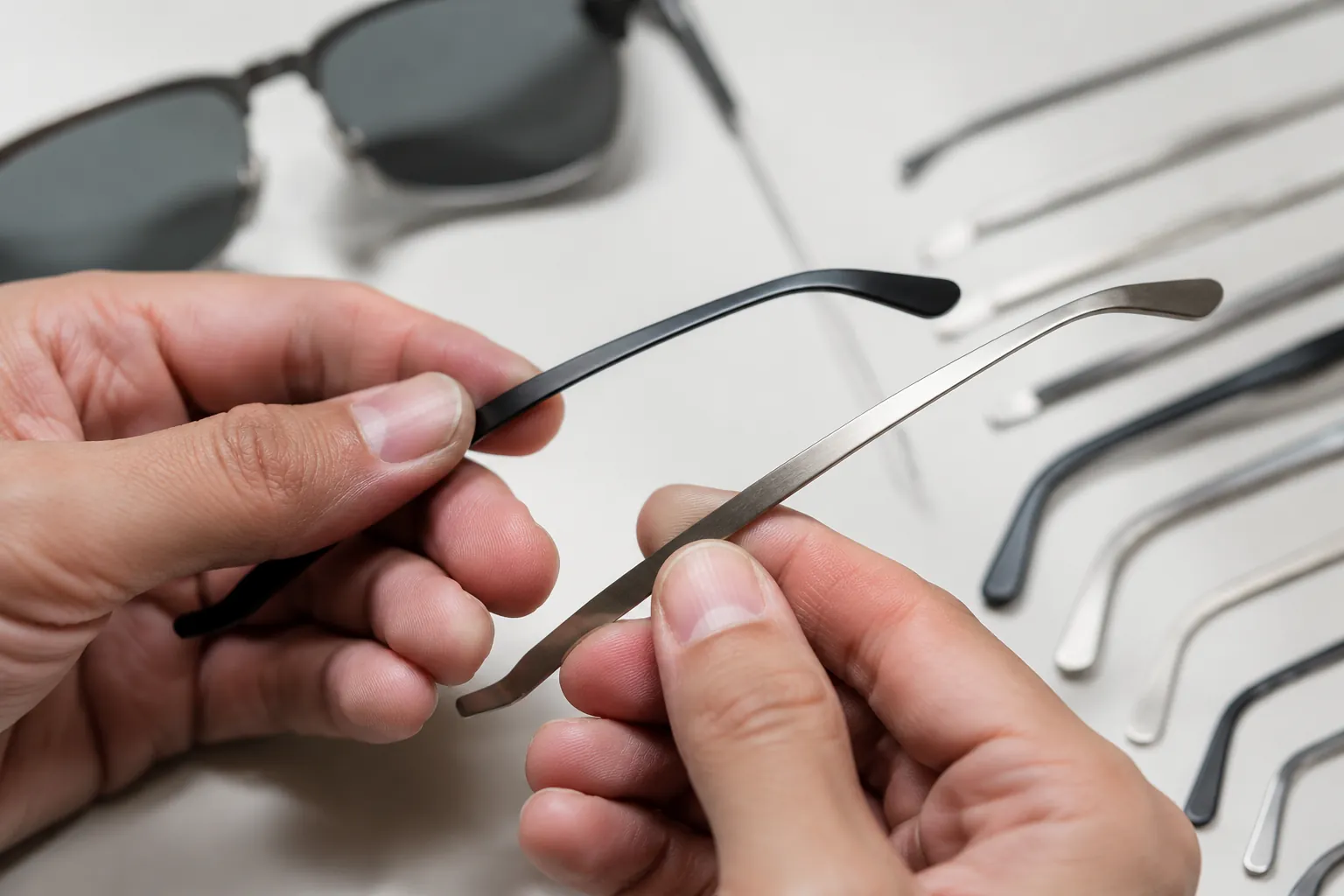
This guide is for brand owners, importers, distributors, and retailers buying custom sunglasses in volume. The key sourcing question is not which metal sounds better. It is which temple material fits your target ex-factory cost, finish requirement, use case, test plan, and return-risk profile. Memory metal and stainless steel solve different production problems. Choose wrong, and the issue shows up later as finish rejects, temple deformation, logo inconsistency, rework, or margin loss.
Start with the buying decision, not the material pitch
Buyers often get pushed into a metal choice too early. A supplier bends a memory metal temple, it springs back, and the whole conversation drifts away from the product brief. That demo proves very little. Material choice should come after the commercial and technical brief is set.
Use a simple sequence. Define the target retail band. Set the ex-factory cost ceiling. Confirm the finish and branding method. Clarify the wear conditions. Decide what complaint risk is acceptable in your market. Then choose the temple material.
If the brief calls for a sharp fashion sunglass with stable cosmetic approval and straightforward laser branding, stainless steel is usually easier to control. If the brief requires visible flex recovery and better tolerance for repeated try-ons, memory metal may fit better.
- Choose memory metal when elastic recovery, repeated opening tolerance, and comfort across a wider range of head widths are part of the brief.
- Choose stainless steel when shape precision, finish repeatability, lower material cost, and broader branding options matter more than spring-back behavior.
- Be careful at entry price points. If the customer is unlikely to notice or value flex recovery, the extra cost may not improve sell-through or reduce returns enough to justify it.
- Match the material to the selling story. If your packaging, PDP, and retail presentation do not explain the flex benefit, the premium may not pay back.
For many private-label sunglass programs, stainless steel stays the default. It is more predictable in forming, finishing, and cosmetic approval. Memory metal makes sense only when the design, user profile, and sales channel actually benefit from recovery properties.
What each material actually does in wear
Memory metal temples are chosen for elastic recovery. In wear, that means the temple can usually flex outward and return closer to its original shape than a standard stainless steel temple under similar handling. That can reduce permanent spread during repeated try-ons or day-to-day use. It matters in high-traffic retail, travel retail, uniform programs, and styles handled heavily before purchase.
Stainless steel behaves differently. It is often chosen because it holds crisp lines, flatter sections, and controlled side profiles. It does not recover from overload the same way memory metal does, but it usually gives a cleaner look on fashion-led designs. On slim rectangular shapes, geometric styles, or side-profile-driven sunglasses, stainless steel is often the practical choice.
Do not confuse comfort with material marketing. Comfort comes from the whole system: temple width, end-tip material, bend radius, hinge tension, front weight, and lens weight all affect fit. A memory metal temple with poor hinge setup can still pinch or sit unevenly. A stainless steel temple with balanced geometry and the right tip angle can feel better in use.
In QC terms, opening force, left-right symmetry, and end-tip consistency may matter more than the base metal. That is the point. Memory metal can reduce some deformation complaints. Stainless steel can reduce some cosmetic complaints linked to profile definition and finish consistency. Those are different sourcing risks.
Head-to-head: performance, finish, cost, and production impact
| Factor | Memory Metal Temples | Stainless Steel Temples |
|---|---|---|
| Flex recovery | Higher elastic recovery; better return after outward bending within the material's working range | Lower elastic recovery; more likely to retain a bend after overload |
| Fit tolerance | Can be more forgiving across variable head widths when hinge setup and temple geometry are correct | More dependent on exact geometry, bend setting, and tip adjustment |
| Profile sharpness | Usually less suitable for very crisp, flat fashion profiles | Usually better for clean lines, flat sections, and controlled side shape |
| Surface finishing | Process control is often tighter, especially where coating durability after flexing matters | Generally broader process compatibility for plating, brushing, paint, and polish |
| Decoration methods | Possible, but cosmetic approval may be less forgiving depending on finish and stress zone | Usually better suited to laser engraving, pad printing, stamped details, and attached logo plates |
| Raw material and process cost | Usually higher than stainless steel on comparable constructions | Usually lower and easier to manage within cost-sensitive programs |
| Bulk repeatability | More process discipline may be required in forming, joining, and cosmetic control | Generally more predictable for repeat production runs |
| Best fit by price tier | Often used where resilience is part of the product story | Used across a wide range of commercial and premium programs depending on finish package |
For most buyers, stainless steel leaves more room on finish, decoration, and margin control. Memory metal earns its cost only when resilience is part of the actual specification. Not a sample-room trick.
Where buyers get burned in development and bulk production
A common mistake with memory metal is assuming it will behave like standard plated metal in every downstream process. It may not. Forming sequence, joining details, heat exposure, and surface treatment all need validation for the actual construction. If those steps are loose, you can end up with inconsistent spring feel, coating problems after flexing, color variation, or cosmetic rejects near the hinge and logo area.
A common mistake with stainless steel is assuming it can take abuse because it feels solid in hand. Thin stainless steel temples can still take a permanent set if the frame is sat on, overextended, or forced repeatedly over wide displays. The risk rises on slim temple sections with little structural margin.
Many return cases are not clean breakages. They are skewed closure, one-side spread, uneven temple angle, or a frame that no longer sits level. Buyers should push on those failure modes during sampling and pre-production approval.
- Memory metal risk: added material and process cost without a clear retail benefit.
- Memory metal risk: finish failure if plating, paint, or clear-coat performance is not checked after flex testing.
- Memory metal risk: variation in spring feel if forming or heat-related process control is inconsistent.
- Stainless steel risk: permanent bend under force, especially on slim fashion temples.
- Stainless steel risk: edge discomfort or sharpness complaints if polishing and end finishing are not controlled.
- Shared risk: hinge misalignment and screw loosening if assembly torque and straightness control are weak.
Ask suppliers to separate cosmetic defects from structural defects in sample evaluation and production reports. That distinction matters. A temple that survives a bend check but fails cosmetic approval is still a sourcing failure.
Finish and branding often decide the material
Many sunglass projects are won or lost in side view. In those cases, the real question is not which metal is stronger. It is which one can deliver the required cosmetic result at an acceptable yield. Stainless steel is usually easier for brushed finishes, polished metallic looks, painted temple colors, laser engraving, pad printing, and attached logo plate integration. It also tends to hold defined edges and cleaner branding zones more consistently in bulk.
Memory metal can still be decorated, but the process window may be narrower depending on the alloy, coating system, and decoration location. If the brief calls for a tightly controlled gold tone, mirror polish, multi-step finish package, or sharply seated branded insert, stainless steel is usually the lower-risk option. With memory metal, expect stricter sample approval and closer validation of finish performance after flexing.
The branding method changes the risk as well. Laser engraving is generally stable on stainless steel when surface flatness and finish are controlled. Pad printing is flexible but still needs adhesion and abrasion checks on the actual finish. Stamped or attached logo plates can look strong, but they add placement tolerance and assembly risk.
For side logos, ask for measurable approval points: logo position tolerance, edge alignment, approved color reference, and scratch standard. Keep it specific. Process ownership matters here. If polishing, decoration, and QC are handled consistently, repeat orders are easier to control.
How price tiers, MOQ, and lead time sort the options
There is no universal market price for temple material. Lens type, front material, hinge construction, packaging, branding method, and test requirements all move the final cost. The useful pattern is comparative: stainless steel is usually easier to use in cost-sensitive programs because it leaves more budget for lenses, packaging, compliance work, and finish upgrades.
Memory metal is easier to justify when the product story clearly depends on comfort, resilience, or recovery from handling. If that benefit is not obvious to the customer, the premium can be wasted.
MOQ changes the buying logic too. At low volumes, setup cost, sampling overhead, and finishing minimums can make specialty material choices less efficient. At higher volumes, the cost picture often improves, but memory metal still usually stays above stainless steel on a like-for-like construction because the material and process demands differ.
Lead time follows the same pattern. A repeat stainless steel style may move through development and production with fewer open questions than a memory metal style that needs extra validation for flex recovery, finish durability, and decoration stability. Actual timing depends on tooling status, finish package, test requirements, and approval speed. Ask for a stage-by-stage timeline covering sample development, pre-production approval, mass production, and any required testing for the destination market.
A blunt buying rule helps here: if the customer will not see, feel, or understand the benefit quickly, do not pay a material premium for it.
QC checkpoints, test logic, and a buyer checklist
Memory metal projects need tighter confirmation at sample stage. Do not approve from one display sample. Ask for multiple pieces from the same sample run and check consistency across them. The point is not whether the temple can flex once. The point is whether the part still looks right, feels right, and aligns correctly after repeated handling, and whether the coating and branding survive that movement.
For memory metal, buyers should review:
- Open-and-close feel across several sample pieces, not one selected sample.
- Outward bend recovery after repeated manual flexing based on an agreed internal check method.
- Coating adhesion and color consistency after flex testing and any tape-check or abrasion checks used in your approval process.
- Hinge alignment, left-right symmetry, and closure balance after handling.
- Logo appearance after flexing if the decoration sits in a stress zone.
For stainless steel, focus more on straightness, end finishing, screw stability, profile consistency, and plating or paint uniformity. Cosmetic detail matters here because stainless steel is often chosen for a cleaner visual result. Ask the factory what straightness and symmetry standard they use, how they assess visible scratches, and how rework pieces are separated from approved pieces.
In both cases, lens compliance must match the destination market and the exact product configuration. Relevant standards and requirements may include CE EN ISO 12312-1, ANSI Z80.3, AS/NZS 1067, REACH, and FDA registration where applicable. These are not interchangeable labels. They relate to market access, restricted substances, labeling, and performance requirements. ISO 9001 and BSCI can indicate management-system and social-compliance frameworks, but they do not replace product-level testing for the exact sunglass model, lens specification, and labeling you are ordering.
Before locking production, use this checklist:
- Pick memory metal if your brief requires flex recovery, repeated-use resilience, and a durability story the customer can understand.
- Pick stainless steel if your brief prioritizes sharper styling, broader finish options, lower cost, and easier bulk repeatability.
- Approve abuse samples, not only showroom samples.
- Approve decoration by process: laser engraving, pad printing, plated logo plate, or insert construction, not only by artwork file.
- Match compliance to destination market and confirm reports or declarations for the exact SKU, lens, and labeling setup.
- Price at the intended volume break so the material decision reflects the actual order plan.
Most buyers do not need the most advanced temple material. They need the one that protects margin, holds finish, meets the right compliance requirements, and survives retail handling without expensive surprises in bulk production.
Have a custom sunglasses project in mind?
Send us your styles, target market and quantities and we will return a detailed quote with MOQ, lead time and a sample plan.
Get a QuoteWhy source this from Wenzhou with LumiShades
Wenzhou in Zhejiang Province is widely regarded as China’s eyewear manufacturing capital, producing a large share of the world’s sunglasses. That concentration matters to buyers: a deep local supply chain for acetate sheet, hinges, lens blanks, plating and packaging means shorter component lead times, easier color and material matching, and a workforce with decades of eyewear-specific skill. LumiShades has manufactured in this ecosystem since 2009, and our vertical integration — in-house injection molding, acetate cutting, CNC milling, lens tinting, decoration and quality control — means no part of your order is quietly subcontracted to a workshop you cannot audit.
For international buyers, that vertical control translates into accountability. When a single factory owns every step, defects are traced and fixed at source rather than bounced between vendors, and your specifications survive intact from first sample to bulk. We back this with 15+ years of experience, shipments to 60+ countries, more than 5 million pairs produced per year and a 98.5% on-time delivery rate. Our certifications — CE EN ISO 12312-1, FDA registration, ANSI Z80.3, AS/NZS 1067, REACH, ISO 9001 and BSCI audit — mean the compliance documentation your market requires already exists. Explore our manufacturing capabilities and quality control process to see how this works in practice.
Frequently asked questions
Is memory metal always better for durability? No. Memory metal is known for elastic recovery, especially when the temple is flexed outward within its working range, but that does not make the whole frame automatically more durable. Overall durability still depends on hinge construction, temple section thickness, joining quality, coating performance, and total frame design. Ask for sample pieces that can be handled repeatedly, then check recovery, hinge stability, finish condition, and alignment afterward. If the product will be sold on a durability claim, document the approval method in writing before bulk production.
Which option is usually better for low-MOQ custom runs? Usually stainless steel. At lower MOQs, buyers often need simpler costing, easier finish control, and more flexible branding options, and stainless steel generally supports that better. Memory metal can still work at low volume, but it makes more sense when the brief specifically requires flex recovery and the target selling price can absorb the added cost and process control. Before approving either option, ask the supplier to quote both materials on the same design and finish package so you can compare the real difference, not a broad estimate.
Can both temple types meet export compliance requirements? Yes, if the full product is built and tested correctly for the destination market. The temple material alone does not determine compliance. Buyers should confirm the exact requirements that apply to the finished sunglasses, then request supporting documentation for the actual model, lens configuration, and labeling being ordered. Depending on market and product scope, that may include CE EN ISO 12312-1, ANSI Z80.3, AS/NZS 1067, REACH, and FDA registration where relevant. ISO 9001 and BSCI are useful supplier checks, but they are not substitutes for product-specific compliance evidence.
Does memory metal slow down production? Not automatically, but it can add approval and control points. If the factory already runs memory metal styles, the schedule impact may be small. If the style uses a new finish, a new decoration method, or a construction that places stress near the branded area, expect more validation before production release. Ask for a timeline that separates sample making, finish approval, pre-production approval, production, and any required testing, then make sure flex recovery, coating condition, and alignment are part of the approval criteria.
Which material gives more branding flexibility on the temple? Stainless steel usually does. It is generally more forgiving for laser engraving, pad printing, brushed or polished finishes, painted colors, and attached metal logo plates. Memory metal can also be branded, but cosmetic tolerances may be tighter and the branded area should be reviewed carefully if it sits near a flex zone. To reduce risk, approve branding by actual process sample, not digital artwork alone, and confirm position standard, finish reference, and post-handling appearance before bulk production.
Ready to start?
Explore our round sunglasses or request a quote — our sales team replies within 12 hours.
Request a Quote