
When to Use Metal Core Temples in Plastic Frames
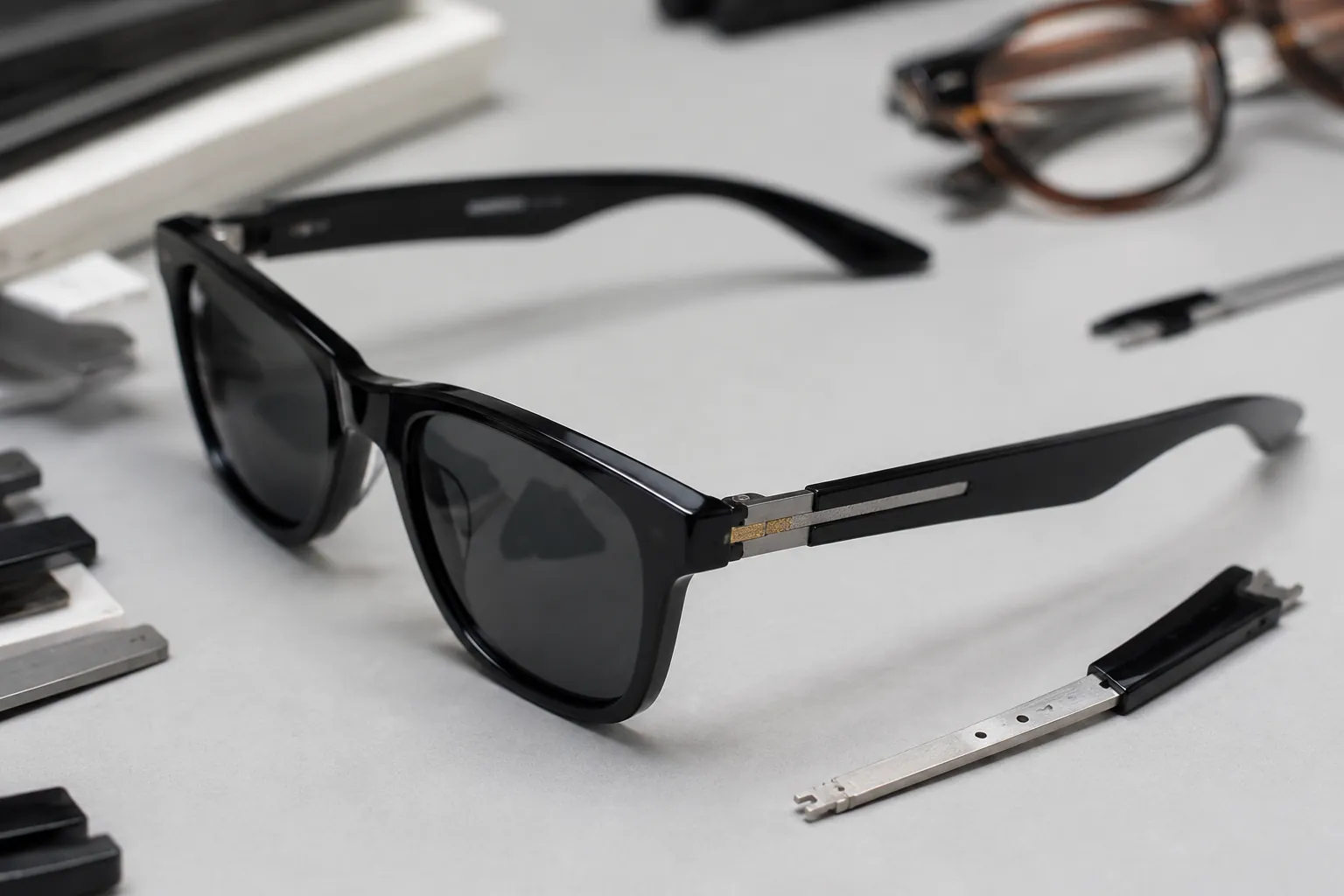
This guide is for brand owners, importers, and retail buyers deciding whether to add wire-core or metal-reinforced temples to plastic sunglasses. The upside is practical: easier fit adjustment, better shape control in slim temples, and a denser hand feel that can support a more premium price point. The tradeoffs are practical too: tighter process control, more inspection, and possible effects on tooling, finishing, and sampling. This is a structural decision, not a trim choice. Make it at drawing stage, before sample approval, because temple thickness, hinge construction, surface finish, and decoration layout all interact with the core design.
Start With the Buying Decision, Not the Feature
Metal core temples are not automatically better. They solve specific mechanical and commercial problems. If the frame needs retail fit adjustment, uses a long or slim temple profile, or sits in the mid-range or premium tier where first-touch feel matters, a core is worth considering. If the frame is a low-cost promotional sunglass with thick molded temples, it often is not.
For buyers, the decision usually comes down to four questions:
- Will the end customer or store staff need to adjust the temple for fit after sale?
- Is the frame sold at a price point where weight balance and hand feel affect perceived value?
- Is the temple section slim enough that plain plastic may twist, spread, or lose symmetry in normal handling?
- Can the target FOB price absorb extra material, labor, and QC without hurting margin?
If the answer is yes to most of these, the factory should quote a reinforced option from the start. If not, a plain temple may be the better sourcing choice.
Decide early. Acetate and injection follow different build routes. In acetate, the wire core is usually inserted into a routed channel and covered before final finishing. In injection, the reinforcement may be placed as an insert during molding, which affects mold design and process stability. Once samples are approved without that construction in mind, later changes can mean new inserts, revised section thickness, or another sampling round.
As a working rule, make this call before finalizing temple width, tip shape, logo plate position, and hinge size. Those are common conflict points in development.
What the Metal Core Actually Changes
Buyers often talk about wire-core temples as if they are mainly decorative. In production, their main job is mechanical.
- Fit adjustment: A reinforced temple allows more controlled bending during fitting, especially in the ear-bend area. This matters most in channels where in-store adjustment is part of the service model.
- Shape retention: Slim plastic temples are more likely to open outward, drift out of symmetry, or change shape after heat exposure or repeated use. A core can reduce that risk if the temple geometry is sound.
- Premium hand feel: A core can make the temple feel denser and less hollow in hand. On acetate, buyers usually notice this right away when comparing samples side by side.
- Decoration support: Lower flex can help maintain more stable conditions for some logo applications and hardware zones, though the benefit depends on decoration method and wall thickness.
There are limits. A metal core will not fix poor hinge quality, bad hinge placement, brittle resin, or a temple design that is simply too thin for the intended use. It also does not replace compliance work. The finished sunglass still has to meet the relevant market standard, such as CE EN ISO 12312-1, ANSI Z80.3, or AS/NZS 1067, depending on where it will be sold.
Material choice matters. Acetate is associated with higher polish depth and a more premium finish, but because it is cut, milled, routed, and polished, core placement and cover thickness need tight control. Injection plastics such as PC, TR90-family materials, or other molded plastics can be efficient at volume, but they are less forgiving if the insert shifts or if the surrounding wall thickness is too thin.
Construction Options and Tradeoffs
Not all reinforced temples are built the same way. Construction changes comfort, scrap risk, tooling complexity, and how much variation the factory can tolerate.
| Construction | Typical Use | Process Detail | Main Benefit | Main Risk | Cost Effect |
|---|---|---|---|---|---|
| Plain plastic temple, no core | Promotional frames, basic injection styles | Single-material molding or cutting, simplest polishing and assembly | Lowest cost and fastest production flow | Less adjustable; slim temples can warp or spread | Base cost |
| Wire-core acetate temple | Fashion acetate, optical-inspired sunglasses | Channel routing, wire insertion, closing, polishing, and finishing | Better fit tuning and premium feel | Core visibility, off-center routing, exposure after polishing | Higher than plain temple due to added process steps |
| Metal-reinforced injection temple | Longer or slimmer molded plastic temples | Insert positioning in mold, controlled overmolding, post-mold inspection | Better stiffness and shape control | Insert shift, sink marks, print-through, mold complexity | Higher than plain temple; effect depends on MOQ and mold design |
| Large insert or plate-supported temple | Statement frames with logo plate or heavy hardware | Heavier insert plus extra assembly points for plate or trim | Stable decoration zone and stronger hand feel | Rear-heavy balance, hinge stress, screw loosening | Highest increase among these options |
In acetate, factories usually target a minimum cover layer over the wire so polishing does not break through. The exact margin depends on temple color, transparency, and finishing method, so buyers should ask how the factory controls route depth and final wall thickness, especially on crystal, milky, or pale colors.
In injection, the key issue is insert consistency. If the metal insert moves during molding, the result can be visible asymmetry, uneven stiffness from left to right, or surface read-through after heat exposure.
Decoration affects the decision too. A laser logo on the outer temple is less demanding than a recessed metal plate, because a plate needs both wall thickness and stable support. If the core, plate recess, and hinge-rivet zone all compete for space in the same narrow temple, the design usually needs revision. Not optimistic tolerancing.
Where Buyers Usually See the Payoff
The comfort benefit is not softness. It is controlled fit. On acetate sunglasses with wire-core temples, the factory or retailer can make small adjustments so pressure is more even behind the ears and the frame sits more consistently across different head widths. That matters most on styles sold through optical, boutique, or department-store channels where fitting is part of the customer experience.
Shape retention matters most in three cases:
- Long temples with a slim mid-section
- Temples with a narrow cross-section at their weakest point
- Designs with pronounced curvature, strong taper, or heavy hardware near the hinge
These profiles may look fine in renderings and early samples but lose symmetry in handling, transport, or heat exposure. A plain temple can pass initial inspection and still drift after repeated opening cycles.
Perceived value matters too. If two acetate frames are otherwise similar, the reinforced version often feels steadier at the hinge and more deliberate in hand. For many mid-range collections, that difference can support better retail presentation and price positioning.
It does not matter equally on every frame. Chunky molded sunglasses with thick straight temples may already have enough section strength. On those frames, reinforcement may add cost without adding a clear user benefit. The same applies to giveaway styles, price-driven programs, and children's low-price ranges where post-sale adjustment is not part of the selling model.
Cost, MOQ, and Lead-Time Logic
Adding a metal core is not usually a major cost driver by itself, but it is rarely neutral in sourcing terms. There is more material, more handling, and at least one extra control point.
For B2B buyers, the better question is how that cost behaves across volume. On low-volume programs, reinforced construction usually has a larger percentage effect because setup, insert handling, and inspection are spread across fewer units. As order volume rises, the added cost is easier to absorb, especially when the base frame price is already improving with scale.
As a practical rule of thumb:
- Low-volume orders: expect the reinforced option to feel relatively expensive because setup and inspection are underused
- Mid-volume orders: cost becomes easier to justify on mid-range styles where fit and hand feel matter
- Higher-volume orders: the premium is often commercially acceptable if the product position supports it
Lead time can shift too. Standard samples and bulk windows may still be achievable, but only if the temple drawing is locked early. If the buyer changes thickness, logo placement, or bend profile after sample review, the core path often has to change as well. In practice, that can add time for revised parts, new approval samples, or changes to tooling inserts and routing fixtures.
At pre-production stage, buyers should ask the factory to confirm:
- Left-right temple weight consistency within the factory's control standard
- Visual symmetry when opened to the specified angle
- No obvious show-through under strong light where the design does not intend it
- Stable bend response in the ear area after repeated adjustment
If the target is the lowest possible landed cost, skip the core unless there is a clear commercial reason to keep it.
Failure Modes That Cause Most Complaints
Most problems do not come from the idea of a metal core. They come from execution.
Core show-through: This is most common on transparent, crystal smoke, champagne, pale tea, and other light colors. Sometimes it is intentional. Often it is not. Buyers should review polished samples in daylight and under strong bench light, not only in studio photography.
Off-center routing in acetate: If the routed channel is not centered, the temple may polish unevenly or look visually crooked. Even if hinge alignment passes, one sidewall can appear thinner than the other.
Sink or print-through in injection: When reinforcement sits too close to the surface, it can telegraph through after molding or after temperature change in transport. The risk is higher on slim temples and glossy finishes.
Exposed metal after polishing: If the cover layer over the wire is too thin, final polishing can break through to the core. When this happens, scrap can rise fast because the issue is usually systematic.
Weight imbalance: Adding a heavy insert, metal logo plate, and large hinge into one temple can shift weight rearward. The frame may feel tail-heavy and put more stress on the hinge screws.
Poor adjustment response: If the wire or insert specification is wrong, the temple may spring back too much or hold bends inconsistently. That creates fitting problems in store and raises complaint risk after sale.
QC should match these risks. Useful inspection includes left-right comparison, hinge cycling, bend testing where applicable, and light inspection before packing. For higher-risk colors or slim temples, buyers should consider approving a golden sample specifically for core visibility and final polish depth, not just shape and color.
How to Spec It So the Factory Can Build It Right
Buyers get better results when they specify the temple as a functional part, not just a silhouette. A good RFQ or tech pack should tell the factory what the temple must do, not only what it should look like.
- State the frame material clearly: acetate or injection plastic. The construction route changes completely.
- Define the adjustment requirement: full temple flexibility, ear-bend adjustment only, or mostly rigid with minimal tuning.
- Call out color and opacity: transparent, crystal, milky, striped, tortoise, or solid. This directly affects visibility risk and cover strategy.
- Fix decoration positions early: laser engraving, pad printing, hot stamp, embedded logo plate, and rivet details all compete for wall thickness.
- Specify the hinge package: standard hinge, spring hinge, decorative hinge, or custom plate. Hinge size changes how much support the temple root needs.
- Request pre-production checks: left-right symmetry, weight balance, adjustment response, and strong-light visual review.
Factories with in-house injection molding, acetate cutting, CNC milling, decoration, assembly, and QC are often better positioned to control this type of temple construction because insert handling, routing, polishing, logo application, and final inspection stay within one system instead of being split across subcontractors.
For regulated markets, teams should also separate structural design from compliance. The metal core itself is not the certification target. The finished sunglass still needs to be evaluated against the applicable market standard, and chemical compliance requirements such as REACH may also apply depending on material and destination market. Factory-side systems such as ISO 9001 and BSCI can support process control and audit requirements, but they do not replace product testing. If the program enters the US market through channels that require it, buyers should also confirm whether FDA registration is relevant to the supplier setup and product category.
A Practical Rule for Deciding Yes or No
Use a metal core temple when the frame is acetate or slim plastic, the customer will notice hand feel, and fit adjustment has commercial value. Skip it when the frame is thick, price-driven, and unlikely to be adjusted after sale.
A simple working rule:
- Say yes for acetate fashion sunglasses, optical-inspired sun frames, and mid-range collections where staff fitting or repeat wear matters.
- Probably yes for slim injection temples that need extra shape control or decoration support.
- Probably no for promotional frames, low-price beach styles, and chunky thick-temple molded sunglasses.
- Hard no if the target price leaves no room for extra handling or if temple geometry is still changing late in development.
Most sourcing mistakes here are timing mistakes. Buyers approve the appearance first, then ask for a core after the sample feels too light, too soft, or too unstable. At that point, the change is no longer small. It often means revising the temple section, reviewing hinge compatibility, and rechecking decoration placement. Decide early. Quote early. Inspect polished temples under bright light before bulk approval.
Have a custom sunglasses project in mind?
Send us your styles, target market and quantities and we will return a detailed quote with MOQ, lead time and a sample plan.
Get a QuoteWhy source this from Wenzhou with LumiShades
Wenzhou in Zhejiang Province is widely regarded as China’s eyewear manufacturing capital, producing a large share of the world’s sunglasses. That concentration matters to buyers: a deep local supply chain for acetate sheet, hinges, lens blanks, plating and packaging means shorter component lead times, easier color and material matching, and a workforce with decades of eyewear-specific skill. LumiShades has manufactured in this ecosystem since 2009, and our vertical integration — in-house injection molding, acetate cutting, CNC milling, lens tinting, decoration and quality control — means no part of your order is quietly subcontracted to a workshop you cannot audit.
For international buyers, that vertical control translates into accountability. When a single factory owns every step, defects are traced and fixed at source rather than bounced between vendors, and your specifications survive intact from first sample to bulk. We back this with 15+ years of experience, shipments to 60+ countries, more than 5 million pairs produced per year and a 98.5% on-time delivery rate. Our certifications — CE EN ISO 12312-1, FDA registration, ANSI Z80.3, AS/NZS 1067, REACH, ISO 9001 and BSCI audit — mean the compliance documentation your market requires already exists. Explore our manufacturing capabilities and quality control process to see how this works in practice.
Frequently asked questions
How much does a metal core temple usually add to cost? There is no universal surcharge across all factories and constructions. The added cost depends on frame material, temple design, volume, finishing method, and whether the reinforcement changes tooling or only adds process steps. The right buying question is not 'What is the standard upcharge?' but 'What does this construction add at my exact MOQ, with my finish, and does it require tooling change?' Ask the supplier to quote plain temple and reinforced temple versions side by side, with sampling cost, tooling impact, and bulk unit price separated.
Are wire-core temples only for acetate sunglasses? No. They are most common in acetate because acetate temples are often adjusted at retail and because the material supports a premium finish where hand feel matters. But metal reinforcement is also used in molded plastic temples when extra stiffness, shape control, or hardware support is needed. The right choice depends on temple geometry, sales channel, and whether post-sale adjustment is part of the product plan.
Will a metal core make the sunglasses heavier? Usually yes, but what matters is balance, not just total weight. A small increase may be acceptable if it improves fit adjustment or perceived quality. Problems usually show up when reinforcement is combined with other heavy components in the same area, such as large logo plates or oversized hinges. Ask the factory for sample weight by pair and for comments on front-to-temple balance, not just gross weight.
Can metal cores be used in transparent or light-colored temples? Yes, but the visibility risk is higher. In clear or pale colors, the issue is not only whether the core can be seen, but whether it looks intentional and stays consistent from left to right after polishing. Buyers should approve real polished samples under daylight and strong direct light, and they should state in writing whether visible core lines are acceptable as part of the design or unacceptable as a defect.
Does adding a metal core affect compliance testing? Indirectly, yes. The metal core is part of the finished product build, so any structural change should be treated as a reason to recheck the final sunglass against the target market requirements. Depending on the sales market, that may include CE EN ISO 12312-1, ANSI Z80.3, or AS/NZS 1067. Chemical compliance such as REACH may also remain relevant depending on material and destination. For buyers, the practical step is simple: when the temple construction changes, confirm with the supplier and your compliance team whether existing test reports still apply or whether fresh testing is needed.
Ready to start?
Explore our sport wrap sunglasses or request a quote — our sales team replies within 12 hours.
Request a Quote