
Rubber-Coated Frames: Best Uses, Risks, and Specs
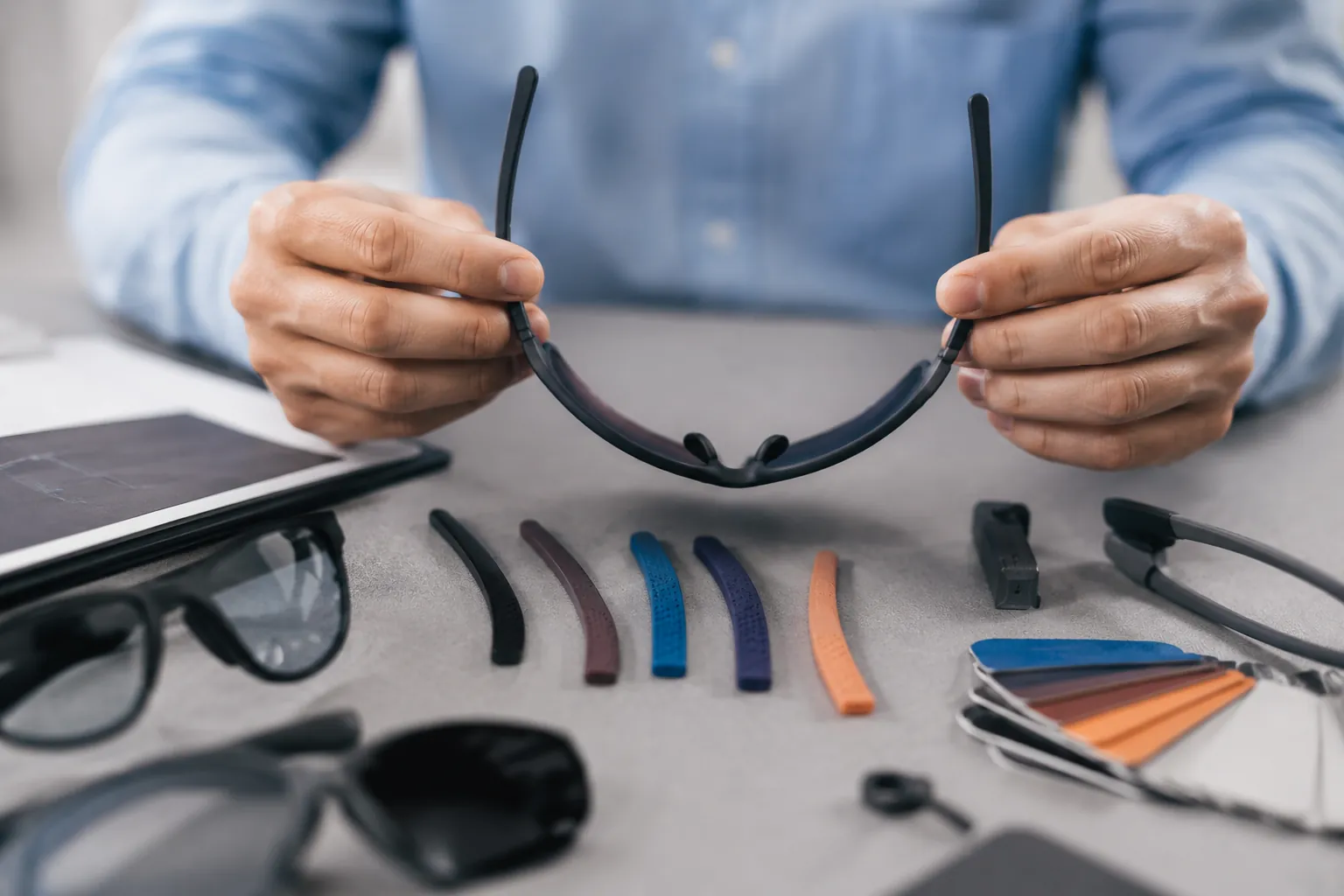
This guide is for brand owners, importers, distributors, and retailers buying custom sunglasses in volume. Rubber-coated frames can improve grip, hand feel, and perceived value. They also add a coating layer that can scuff, peel, print off, or turn tacky if the material system, application, cure, or packing is weak. That is the real issue. A finish that feels good on an approval sample may not look good after production, packing, transit, storage, store handling, and customer use. This guide explains where rubberized finishes make sense, where they add avoidable risk, and what buyers should define before approving samples or placing bulk orders.
Start with the sales channel, not the finish
Buyers often ask for a rubberized frame because it feels more premium than a plain glossy injection frame. Fair enough. But feel alone is not a buying case.
Start with channel fit. Where will the product be sold? How much handling will it take? How long may it sit before sale? How much cosmetic change can the buyer accept?
For sport programs, a rubberized finish can serve a real purpose. A light soft-touch or medium-grip coating on temple contact zones or nose-contact areas may reduce slip when the wearer is sweating. That matters on wrap styles, shield shapes, and active frames used for cycling, running, golf, or outdoor events. In retail, the finish is usually about hand feel and shelf impression. It can make a mid-price frame feel less generic, especially in dark colors. In promotional programs, the logic is weaker. Units may sit in cartons, pass through several warehouses, and get handled roughly in fulfillment. Those conditions raise the risk of rub marks, oil pickup, blocking, or tackiness if the finish is not robust.
Channel fit usually comes down to three commercial rules:
- Sport: suitable if the finish supports grip and the program includes sweat, sunscreen, and abrasion checks.
- Retail: workable on selected SKUs where hand feel supports margin, but not automatically right for every colorway or every store program.
- Promo: higher risk unless storage time is short, packing is controlled, and the buyer accepts tighter QC and a higher chance of cosmetic sorting.
Rubber coating is a surface-engineering decision. Not a last-minute style tweak. Once the base material, frame geometry, decoration method, and packing format are already fixed, buyer control drops fast.
What the coating is on the production floor
In most OEM eyewear programs, a rubber-coated frame is not molded as a rubber body. It is usually a standard frame substrate with a soft-touch topcoat added after molding and surface preparation. The base may be injected PC, TR90, or another factory-standard plastic. In some fashion programs, an acetate component may also be coated in selected areas.
Buyers often confuse this with overmolding or flexible component materials such as TPE. They are not the same. They involve different tooling, cost structures, and failure modes.
The process sequence matters because each stage affects durability later:
- 1. Molding and trimming: frame fronts and temples are molded, de-gated, and cleaned up.
- 2. Surface preparation: parts are polished or lightly abraded as required, then cleaned to remove dust, polishing compound, and surface contamination.
- 3. Base inspection: scratches, sink marks, weld lines, and sharp edges are checked before coating because coating can hide some defects and make others more visible.
- 4. Coating application: the soft-touch layer is sprayed, usually in controlled light passes.
- 5. Curing: parts are dried and cured according to the coating system. Weak cure raises tackiness risk. Too much heat can affect appearance or adhesion.
- 6. Decoration and assembly: pad print, laser marking, hot foil, or logo hardware is added depending on the design.
- 7. Cosmetic and adhesion QC: inspectors check color consistency, coverage, feel, edge build-up, and basic adhesion before packing.
Coating build must be controlled. Too light, and coverage may look uneven or wear through quickly at edges. Too heavy, and corners lose definition, hinge areas build up, and rub resistance may drop. Surface preparation matters more than many buyers expect. Residue from release agent, skin oil, or polishing dust can let a frame pass visual inspection and still fail adhesion or wear checks later.
Also confirm whether coating, assembly, and QC are managed inside one factory system or split across subcontractors. Split processing is not always a problem. But every handoff adds traceability risk.
Where rubberized frames make commercial sense
The finish is worth the added process only if it delivers functional grip or clear perceived value that survives the real selling environment. Use the table below as a first filter.
| Program type | Why buyers choose rubber coating | Main risk | Typical commercial verdict |
|---|---|---|---|
| Sport sunglasses | Better grip at temples or bridge, more technical look, improved feel in active use | Sunscreen, sweat, and repeated rubbing can expose weak adhesion or poor cure | Strong fit if coating is limited to contact zones or validated on the full frame |
| Mid-price retail | Soft-touch hand feel can improve perceived value on shelf | Scuffing from try-ons, makeup or skin-oil marks, and cosmetic returns after storage | Good on selected dark-color SKUs, less attractive for broad assortments |
| Promotional giveaways | Feels better than low-cost glossy plastic and can support a basic brand upgrade | Storage, carton abrasion, and complaint risk on low-margin orders | Often marginal unless timing is short and packing is tightly controlled |
| Outdoor event merchandise | Premium feel for limited-run branded product | Short deadlines may leave little time for aging or abrasion validation | Viable if sample approval happens early and the finish spec stays simple |
The strongest use case is an active frame where the finish has a real function. Next comes a retail capsule where touch supports the price point and the buyer accepts tighter cosmetic control. The weakest use case is low-margin promo stock that may sit in uncontrolled storage for months. In that channel, a molded-color or standard painted finish is often safer.
Another useful distinction is full-frame coating versus partial application. Full-frame coating gives the biggest visual effect. It also exposes the largest area to wear. Partial coating on temple interiors, temple tips, or nose-contact zones lowers process risk and often captures most of the functional benefit. For a first program, partial application is usually the safer call.
Failure modes buyers should expect and test for
Rubber-coated frames rarely fail in one dramatic moment. More often, they decline slowly and cosmetically across enough units to create claims, sorting cost, or returns. That is why approval should include abuse checks, not just color sign-off and a hand-feel comment.
- Tackiness after storage. This can show up when the coating system is low grade, incompletely cured, or poorly matched to the substrate or packing conditions.
- Edge wear and corner loss. Temple ends, hinge shoulders, bridge edges, and frame-front corners usually wear first because they take repeated friction.
- Oil and sunscreen marking. Matte soft-touch surfaces usually show skin oil, cosmetics, and SPF residue more readily than polished PC or acetate.
- Blocking in packs. If parts are packed before full cure, adjacent surfaces or bags can leave print-off, surface impressions, or sticking marks.
- Decoration conflict. Pad printing over a soft-touch surface may wear faster than on a harder paint system. Laser marking can work, but appearance depends on coating opacity and substrate contrast. Metal logo plates can be more stable for long-life retail SKUs.
- Color variation. Light grey, white, pastel, and bright fashion colors usually reveal spray inconsistency, rub marks, and dirt pickup faster than black or dark neutrals.
Useful screening does not require complex lab work. It requires repeatable checks tied to a signed approval sample. Buyers should ask for at least the following:
- Dry rub: repeated cloth rubbing on temples, bridge, and front corners to compare visible wear.
- Wet rub: the same areas after moisture exposure to reveal weak cure or weak adhesion.
- Tape adhesion: a defined internal tape-pull or cross-hatch method on hidden and visible areas.
- Artificial sweat: especially relevant for sport or summer retail programs.
- Sunscreen contact: important because SPF products are a common real-world trigger for marking or softening.
- Carton abrasion: packed-part movement simulation to identify rub marks before bulk shipment.
Geometry matters too. A wide fashion front with broad flat temples gives more visible area to fail. A sport wrap with selective coated zones exposes less area and can hide edge wear better. In many programs, selective coating is simply the better technical answer.
How to write the spec so the factory can control it
A request for a rubber finish is too vague. The purchase specification should define substrate, coating location, target feel, decoration sequence, and acceptance criteria in terms production and QC teams can use.
At minimum, the spec should include:
- Base material: for example injected PC, TR90, or acetate component, with an approved reference sample.
- Coating coverage: full frame, frame front only, temples only, temple tips only, or bridge-contact zones only.
- Target touch: soft-touch matte, medium-grip matte, or light rubberized finish. The word rubber alone is not enough.
- Color standard: Pantone reference plus a master sample approved under consistent lighting conditions.
- Gloss level: if relevant, define the target matte appearance so one acceptable batch is not rejected against another on subjective feel alone.
- Adhesion method: state the tape test or internal cross-hatch method to be used for release.
- Wear threshold: define the acceptable visual change after the agreed rub test on hinge areas, bridge, and temple tips.
- Chemical-resistance check: include sunscreen and sweat exposure for beach, sport, and outdoor programs where relevant.
- Logo method: pad print, laser, hot foil, inlay, or metal logo plate, with exact placement approved before production.
- Packing condition: required cure time before bagging, separation method in inner cartons, and whether tissue, sleeve, or individual bag is required.
Precision matters. The buyer can define color against an approved master, require no visible peeling or transfer after the agreed adhesion method, and identify the exact zones that must still look acceptable after abrasion screening. Cosmetic standards can also be split by zone, with tighter rules for the frame-front A-surface and looser rules for temple interiors. Without those distinctions, inspectors tend to apply inconsistent judgment during bulk sorting.
Packing should not be an afterthought. Individual polybags can reduce direct rubbing, but they can also trap odor or create print-off if parts are packed too early. Dividers, tissue sleeves, or staggered placement in inner cartons may control abrasion better than simply using a thicker bag.
Cost and lead-time math buyers should use
Rubber coating adds more than a finish surcharge. It adds handling, cure time, cosmetic inspection pressure, and a higher chance of rework or sorting. The real cost is partly in yield and schedule stability, not just in quoted unit price.
| Order size | Typical starting point | Rubber-coating effect | What buyers should expect |
|---|---|---|---|
| 50 pairs | Sampling or low-MOQ trial level | Setup and color-match effort is heavy per unit | Useful for approval and market testing, but usually inefficient for production economics |
| 300 pairs | First practical small-batch run | Process cost spreads better, but QC remains relatively expensive | Reasonable for niche retail, club, or event programs |
| 1000 pairs | More stable production planning and bulk packing efficiency | Better process consistency and lower sorting cost per unit | Often a more realistic level for validating channel performance at scale |
| 5000+ pairs | Stronger line efficiency and purchasing leverage | Finish cost still applies, but overhead dilution improves | Best economics once coating performance is already proven |
Lead time depends on the factory, color, substrate, decoration method, and whether the coating system has already been validated on a similar frame. Buyers should assume coated programs will move more slowly than plain molded-color frames. Spraying, curing, inspection, and possible rework all take time. The key sourcing question is not just the quoted lead time. It is how much schedule buffer exists if appearance or adhesion issues appear during production.
Cost logic also changes by finish strategy. Full-frame coating usually costs more than selective temple or tip coating because masking, handling, inspection area, and reject exposure all rise. Dark colors are generally easier to control than pale colors because variation, edge wear, and dirt pickup are less visible. For first programs, avoid combining multiple bright colors, mixed logo methods, and several frame shapes in one purchase order. That combination drives approval and QC complexity up quickly.
For promo tenders, a few extra finish-related days can sink the program. For retail launches, the delay is manageable if the buyer leaves enough buffer between ex-factory and in-store dates.
Compliance still applies, and new chemistry can mean re-testing
Rubber coating does not replace normal sunglasses compliance obligations. The finished product still has to meet the optical, labeling, and chemical requirements that apply in the destination market and to the lens category being sold. What changes is simple: the coating adds another chemistry layer that may need review.
For finished sunglasses programs, buyers commonly review the relevance of CE EN ISO 12312-1, ANSI Z80.3, and AS/NZS 1067 depending on destination market and product positioning. For chemical control, REACH is a common reference point for EU-bound programs. FDA registration may appear in a supplier document pack for the US market, but buyers should not treat factory registration as proof that a finished sunglass SKU meets all applicable product requirements. At the management-system level, ISO 9001 and BSCI can indicate process discipline and social-compliance infrastructure, but neither proves finish durability.
The practical sourcing question is whether the same coating formulation has already been used on a similar product for the same destination market. That is not a legal shortcut. It is a useful risk screen. If the answer is no, assume more validation is needed, especially for chemical review and real-use abuse checks. A compliant lens plus a familiar frame substrate does not automatically mean the finished SKU remains compliant once a new coating chemistry is added.
The safest buying rule is selective use. Choose rubberized finishes where the user will notice a real benefit and where the sales channel can support the added surface risk. Limit the coating to partial areas when grip matters but broad exposure raises failure risk. Be cautious on low-margin promo programs, pale colors with long storage cycles, and products that will be repacked or redistributed several times before final use.
Have a custom sunglasses project in mind?
Send us your styles, target market and quantities and we will return a detailed quote with MOQ, lead time and a sample plan.
Get a QuoteWhy source this from Wenzhou with LumiShades
Wenzhou in Zhejiang Province is widely regarded as China’s eyewear manufacturing capital, producing a large share of the world’s sunglasses. That concentration matters to buyers: a deep local supply chain for acetate sheet, hinges, lens blanks, plating and packaging means shorter component lead times, easier color and material matching, and a workforce with decades of eyewear-specific skill. LumiShades has manufactured in this ecosystem since 2009, and our vertical integration — in-house injection molding, acetate cutting, CNC milling, lens tinting, decoration and quality control — means no part of your order is quietly subcontracted to a workshop you cannot audit.
For international buyers, that vertical control translates into accountability. When a single factory owns every step, defects are traced and fixed at source rather than bounced between vendors, and your specifications survive intact from first sample to bulk. We back this with 15+ years of experience, shipments to 60+ countries, more than 5 million pairs produced per year and a 98.5% on-time delivery rate. Our certifications — CE EN ISO 12312-1, FDA registration, ANSI Z80.3, AS/NZS 1067, REACH, ISO 9001 and BSCI audit — mean the compliance documentation your market requires already exists. Explore our manufacturing capabilities and quality control process to see how this works in practice.
Frequently asked questions
Is a rubber-coated frame the same as a TR90 or TPE sports frame? No. TR90 and TPE refer to base materials or component materials. A rubber-coated frame usually means a separate soft-touch coating applied over a finished substrate such as PC, TR90, or acetate. Buyers should confirm the base material, ask whether the grip comes from the substrate or a sprayed coating, and review different test risks for each construction.
Should promo buyers avoid rubber-coated sunglasses completely? Not completely, but they should treat the finish as a higher-risk choice. If the order may sit in storage for an extended period, move through several warehouses, or run on tight margin with limited QC tolerance, a molded-color or standard painted finish is usually safer. If a promo buyer still wants a rubberized feel, the practical move is to limit coating to small contact zones, keep colors dark, define packing conditions clearly, and require rub and storage checks on approval samples.
What is the safest color choice for a first rubberized program? Black or another dark neutral such as charcoal, navy, or deep olive is usually the safest starting point. Dark colors hide minor spray variation, edge wear, oil pickup, and carton rub better than white, pastel, or bright shades. For a first order, buyers should narrow the finish to one dark color, approve a master sample under consistent lighting, and avoid launching several pale or fashion colors before the coating system is proven.
Can logos be printed on top of a rubber-coated finish? Yes, but buyers should not assume every decoration method will perform the same way. Pad printing can wear faster on a soft-touch surface depending on texture and cure quality. Laser marking may work if the coating and substrate create enough contrast. Hot foil or metal logo plates may be better where long-term appearance matters. The practical step is to compare at least two decoration methods during sampling and include the final method in the approved specification and wear checks.
Will rubber coating change sample and bulk lead times? Usually yes. Coated frames add process steps such as surface preparation, spraying, curing, inspection, and possible rework. Buyers should expect more schedule sensitivity than with a plain molded-color frame, especially on new colors, new substrates, or mixed decoration programs. Ask the factory where schedule buffer exists if coating defects appear, and leave enough time between approval, ex-factory, and delivery dates for sorting or rework if needed.
Ready to start?
Explore our shield & oversized sunglasses or request a quote — our sales team replies within 12 hours.
Request a Quote