
Recycled vs Virgin PC Frames: How Buyers Verify Claims
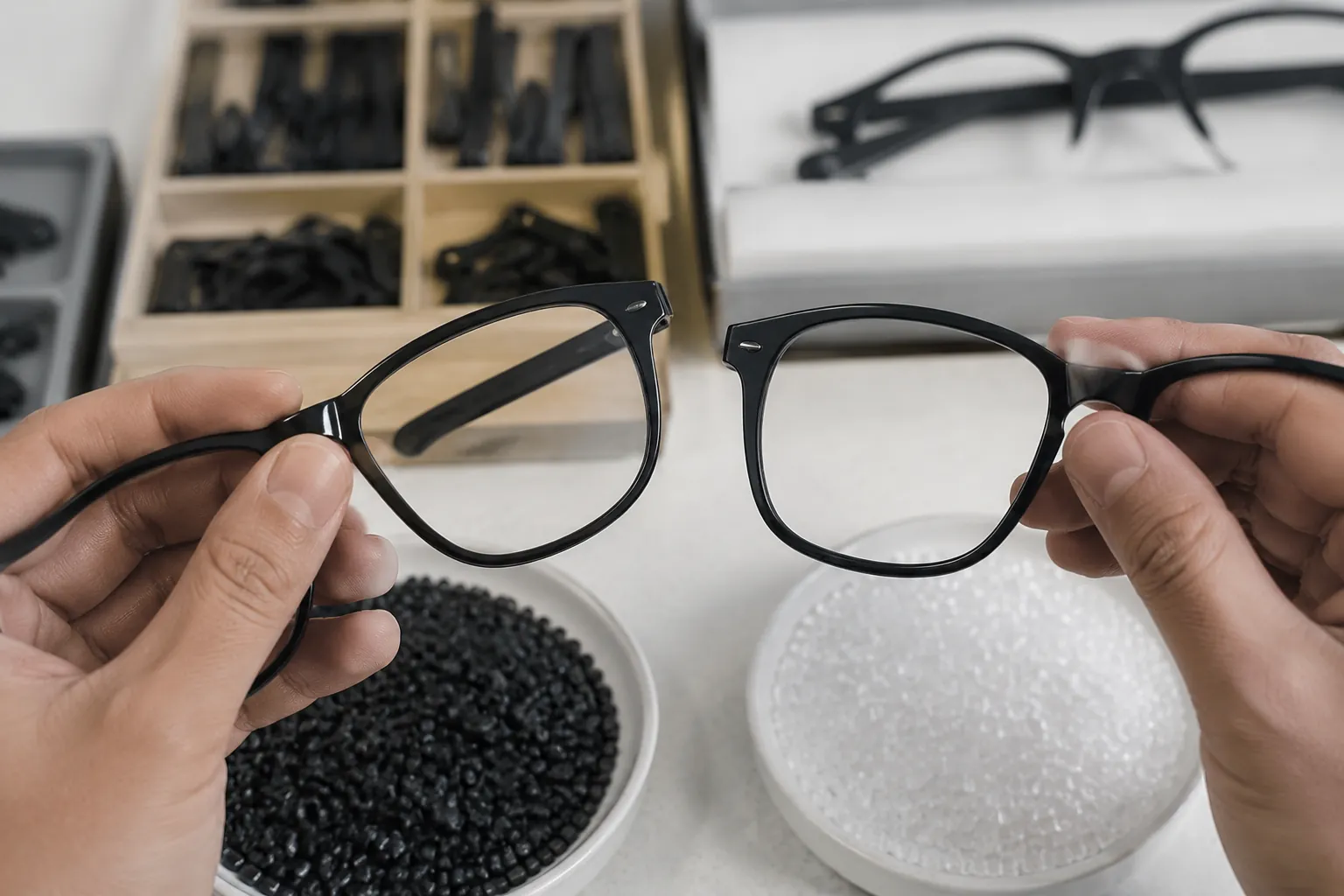
This guide is for brand owners, importers, distributors, and retail buyers sourcing custom polycarbonate sunglasses. The key question is not whether a factory can mold recycled PC. Many can. The real question is whether the supplier can keep appearance, fit, lens retention, hinge function, and documentation consistent from approved sample to bulk production. That is what matters before you release a PO.
Start with the right buying question
Most recycled-versus-virgin discussions stop at the sustainability claim. That is not enough for a commercial eyewear program. A buyer needs to verify three things at the same time: material consistency, finished-frame performance, and claim documentation. If one of those fails, the order gets expensive fast, even if the unit price looked good at quote stage.
Virgin PC usually gives molders a more predictable processing window. Drying behavior, melt flow, color response, and shrinkage are often more stable from lot to lot. Recycled PC can work well too, but results depend much more on the source stream, the blend ratio, and process discipline during drying and molding. That means resin handling, machine settings, and inspection standards need to be controlled. Tightly.
For sunglasses frames, start from the product brief, not the claim. Virgin PC is usually the safer choice for high-gloss fashion fronts, transparent looks, light colors, and styles with strict cosmetic requirements. Recycled PC is often easier to run in dark opaque colors, matte finishes, sport shapes, promotional lines, and value programs where slight visual variation may be acceptable if function and appearance still meet the agreed standard.
Ask the supplier to define the target in writing. For example: "Frame front and temples in recycled-content PC blend, matte black, Pantone reference attached, cosmetic standard agreed under fixed lighting, complete sunglasses to be produced to approved sample." Specific language prevents vague arguments later.
Where recycled PC usually fails first
Polycarbonate is durable in use but demanding in production. It is moisture-sensitive. Poor drying can cause splay, haze, silver streaks, or other visible defects. Recycled material adds another variable because the feedstock history is less uniform than virgin resin. Problems often show up first in cosmetics. Then dimensions and mechanical performance start to drift.
- Color consistency: Base-tone variation shows more clearly in white, crystal, smoke, champagne, clear grey, and pastel shades. A color can pass approval on paper and still shift visibly from lot to lot on a glossy surface.
- Surface finish: Recycled PC is more likely to show flow lines, gate blush, haze, fine specks, or uneven gloss if source control and process settings are loose.
- Dimensional stability: Small shrinkage changes can affect front shape, bridge opening, lens groove condition, and temple straightness. Parts may look acceptable at first glance but still create lens-fitting or assembly problems.
- Mechanical performance at stress points: A frame may feel fine in a quick hand check yet still be less reliable around hinge pockets, screw bosses, logo insert areas, or snap-fit lens zones if the material has been degraded by prior heat history or poor handling.
- Decoration adhesion: Pad print, spray coating, hot foil, and bonded logos can become less stable when surface condition varies or mold-release control is weak.
Also ask what the supplier means by recycled PC. Purchased recycled resin, internal regrind, and blends of the two are not the same. If the factory cannot define the source and intended use clearly, do not approve a recycled-content claim.
What to ask for before sampling
A serious supplier should answer material questions precisely. Ask for the proposed recycled-content percentage, whether the source is post-industrial or post-consumer, whether the claim applies to the whole frame or only selected parts, and whether the same formula has already been run on a similar product type. Similar geometry matters. A thick matte wrap and a thin glossy cat-eye do not process the same way, even if both are PC.
Before sampling, build the checkpoints into the request:
- Request comparative samples when risk is high: one in virgin PC and one in the proposed recycled-content PC, using the same tool and a similar color target where practical.
- Lock visual standards early: define the color reference, gloss or matte level, texture, and acceptable cosmetic defects before pre-production.
- Request a dimensional report: ask the supplier to report the key measurements that affect fit and assembly, including front width, lens size, bridge, temple length, frame weight, lens groove condition, and hinge alignment.
- Ask what QC checks in line: for example sink marks, flow lines, black specks, gate marks, parting-line mismatch, temple warp, print adhesion, and lens fit.
- Define the decoration method: pad print, laser engraving, hot foil, spray coating, rubber coating, hydro dip, or bonded logo plate. Each has a different risk profile on PC substrates.
- Confirm intended market compliance for the finished sunglasses: not just the frame material, but the complete assembled product with the actual lens specification and labeling.
If a supplier says recycled PC is the same as virgin PC, treat that as a warning. It may be fit for purpose. It is not interchangeable by default.
Side by side: cost, finish, and risk
| Factor | Virgin PC Frames | Recycled PC Frames |
|---|---|---|
| Material consistency | Usually more stable lot to lot with a narrower processing variation | Depends on source control, blend ratio, drying discipline, and traceability |
| Best use case | Glossy fashion frames, light colors, transparent looks, thin-wall designs | Dark solids, matte finishes, sport wraps, value lines, promo programs |
| Typical cosmetic risk | Lower risk of haze, splay, fine specks, and flow marks | Higher risk unless drying and molding conditions are tightly controlled |
| Dimensional behavior | More predictable shrinkage and lens-fit consistency | More variation can appear around hinge areas, groove fit, and temple straightness |
| Decoration performance | Generally more stable for pad print, spray, and bonded logos | Needs adhesion and abrasion verification on the actual finished part |
| Claim requirement | No recycled-content substantiation needed | Buyer should request a written declaration and lot traceability |
| Commercial effect | Safer for premium cosmetic targets and first production runs | Supports sustainability positioning if reject rate and documentation stay controlled |
Do not assume recycled PC is cheaper. Often it is not. Stable recycled feedstock may cost as much as virgin resin, and any material saving can disappear through added setup time, more color adjustment, stricter inspection, or higher rejection if the visual standard is tight.
MOQ, price breaks, and lead times vary by supplier, tooling status, lens specification, decoration count, packaging, and inspection requirements. Ask for pricing against the exact construction being quoted. Then compare virgin-PC and recycled-PC versions on the same specification. That is the only useful comparison.
How to verify the recycled-content claim
This is where many projects go weak. The buyer asks for recycled content. The factory says yes. The order moves forward on an email statement alone. That is not enough if your retailer, compliance team, or marketing department later asks for proof.
At minimum, request a written material declaration stating:
- the target recycled-content percentage;
- whether the source is post-industrial or post-consumer;
- whether the percentage applies to the whole frame or only to specific parts;
- the allowed variance, if the supplier uses one;
- the resin supplier name or resin lot reference tied to production records.
Then verify traceability at the factory. Broad sustainability language is not enough. Practical controls are what matter:
- Is recycled resin stored separately from virgin resin with clear lot identification?
- Are blending, drying, and hopper-loading instructions documented by lot or batch?
- Is internal regrind used in addition to purchased recycled content, and if so, under what written limit?
- Can the factory connect a production batch of frames to the resin lot used?
- Are nonconforming parts segregated so they do not re-enter claimed material without control?
Keep compliance topics separate. REACH covers chemical restrictions. CE EN ISO 12312-1, ANSI Z80.3, and AS/NZS 1067 cover sunglass performance. FDA registration does not verify recycled content. ISO 9001 and BSCI may support confidence in management systems or social compliance, but they do not prove a recycled-content percentage.
Compliance and testing: verify the finished sunglasses
For sunglasses, the real legal and commercial risk sits in the finished product. A frame material declaration does not prove that the assembled sunglasses comply with the target-market standard. If you are buying finished sunglasses, ask which standard the production model is intended to meet and whether the lens category, UV performance, markings, and user information match your destination market.
Common documents buyers may request include CE EN ISO 12312-1, ANSI Z80.3, AS/NZS 1067, REACH, and, where relevant to the product category and market route being used, FDA registration. At the factory-system level, suppliers may also hold ISO 9001 and BSCI. The point is simple: choosing recycled instead of virgin PC does not reduce the need to validate the complete sunglasses.
Sample-stage and pre-production checks should reflect production stress, not just desk review. Ask for:
- Lens retention check on the actual production lens shape and thickness, especially on wrap styles.
- Hinge function review on assembled samples, since material variation often shows first around hinge pockets and screw-holding areas.
- Temple symmetry and opening width after the sample has rested, not only immediately after assembly.
- Cosmetic inspection under fixed lighting conditions with the viewing method agreed in advance.
- Color comparison against the approved standard on both front and temples, because molded parts can shift differently.
- Decoration adhesion and rub check after handling and packing simulation, not only when fresh off the line.
If the frame uses mirrored, polarized, or high-wrap lenses, make sure the approved sample includes that actual lens combination. Assembly stress changes when the final lens is fitted. That is often where a marginal frame starts to show distortion, whitening, or fit inconsistency.
Lead times, MOQ, and production planning
Material choice affects production planning more than many buyers expect. With virgin PC, the first molding trial often stabilizes faster because the process window is more predictable. With recycled PC, the factory may need more adjustment to drying and molding conditions before cosmetics and dimensions settle.
PC is moisture-sensitive, so drying discipline matters. A lot. If drying control is poor, surface defects can appear quickly. In a disciplined plant, that is manageable. Still, buyers should ask exactly how resin is identified, dried, staged for production, and recorded by lot or batch.
Use the supplier timeline as the base, then add approval discipline. If you are testing a recycled-content PC formula for the first time, budget another review loop, especially for glossy or light-color frames. In practice, that means allowing time for comparative samples, revised color matching, and pre-production approval instead of forcing a mass run on a marginal sample.
Small MOQs can help with market testing, but they do not prove bulk stability. A short run may come from one resin lot, one machine setup, and one operator team. If your real target is larger-scale production, ask for pre-production confirmation using the same resin source, color system, and decoration method intended for shipment. That is where lot-to-lot drift starts to show.
Approval checklist before you release the PO
Use this checklist before production starts. Tight approvals cost less than post-shipment disputes.
- Define the material in writing: virgin PC or recycled-content PC, with the exact target claim and source type if applicable.
- Match material to finish: confirm whether the frame is gloss, matte, textured, transparent, translucent, or dark opaque. Recycled PC is not equally suitable for every finish.
- Request comparative samples where risk is high: virgin versus recycled on the same tool, especially for clear, white, pastel, or polished-gloss projects.
- Lock cosmetic standards: define acceptance for haze, specks, flow lines, gate blush, parting-line mismatch, and color variation under fixed inspection conditions.
- Review critical dimensions and fit: front shape, temple alignment, groove condition, hinge position, lens fit, and overall wearing balance.
- Confirm the document pack: recycled-content declaration, REACH status, intended finished-product compliance documents, and any market-specific test reports you require.
- Approve decoration after stress review: pad print, laser, hot foil, spray, or bonded logo should be checked after handling and packing simulation, not only immediately after decoration.
- Set hold points: sample approval, color approval, pre-production approval, and final QC or AQL release criteria before shipment.
Short version: if you want recycled PC, buy it with tighter controls. Not looser ones.
Have a custom sunglasses project in mind?
Send us your styles, target market and quantities and we will return a detailed quote with MOQ, lead time and a sample plan.
Get a QuoteWhy source this from Wenzhou with LumiShades
Wenzhou in Zhejiang Province is widely regarded as China’s eyewear manufacturing capital, producing a large share of the world’s sunglasses. That concentration matters to buyers: a deep local supply chain for acetate sheet, hinges, lens blanks, plating and packaging means shorter component lead times, easier color and material matching, and a workforce with decades of eyewear-specific skill. LumiShades has manufactured in this ecosystem since 2009, and our vertical integration — in-house injection molding, acetate cutting, CNC milling, lens tinting, decoration and quality control — means no part of your order is quietly subcontracted to a workshop you cannot audit.
For international buyers, that vertical control translates into accountability. When a single factory owns every step, defects are traced and fixed at source rather than bounced between vendors, and your specifications survive intact from first sample to bulk. We back this with 15+ years of experience, shipments to 60+ countries, more than 5 million pairs produced per year and a 98.5% on-time delivery rate. Our certifications — CE EN ISO 12312-1, FDA registration, ANSI Z80.3, AS/NZS 1067, REACH, ISO 9001 and BSCI audit — mean the compliance documentation your market requires already exists. Explore our manufacturing capabilities and quality control process to see how this works in practice.
Frequently asked questions
Is recycled PC always cheaper than virgin PC for sunglasses frames? No. Do not assume recycled PC will reduce your unit cost. Ask the supplier to quote virgin-PC and recycled-PC versions on the same frame, lens, decoration, packaging, and inspection standard. Then compare not only ex-factory price, but also likely reject risk, color-matching effort, extra sample rounds, and documentation requirements. That gives you a usable commercial comparison.
What frame styles are safer to run in recycled PC? Start with lower-risk constructions: dark opaque colors, matte finishes, and less cosmetically sensitive sport or value-line shapes. Use more caution on clear, white, pastel, transparent, high-gloss, or thin-section fashion styles. If your program falls into one of those higher-risk categories, request side-by-side samples in virgin and recycled-content PC before approving bulk.
What proof should I request for a recycled-content claim? Request a written material declaration that states the recycled-content percentage, whether it is post-industrial or post-consumer, whether it applies to the full frame or selected parts, and the resin lot or batch reference linked to production records. Then ask how the factory separates virgin resin, purchased recycled resin, and any internal regrind. If the claim cannot be tied to batch records, treat it as unverified.
Do recycled PC frames affect sunglass compliance? They can affect consistency, assembly behavior, and cosmetic outcome, but compliance still has to be verified on the finished sunglasses. Ask which target standard applies to your market: CE EN ISO 12312-1, ANSI Z80.3, or AS/NZS 1067. Also confirm REACH where relevant, and check that the tested or approved model matches your actual lens specification, markings, and final construction.
Can I test recycled PC with a small MOQ first? Yes, but treat a small run as a screening step, not as proof of production stability. Use the trial to review finish, fit, lens retention, decoration performance, and documentation quality. If bulk production will be materially larger, require a pre-production approval using the actual resin source, color system, and decoration method planned for shipment so you can judge whether the approved sample is likely to hold at scale.
Ready to start?
Explore our sport wrap sunglasses or request a quote — our sales team replies within 12 hours.
Request a Quote