
TAC vs PC Polarized Lenses: What Buyers Must Specify
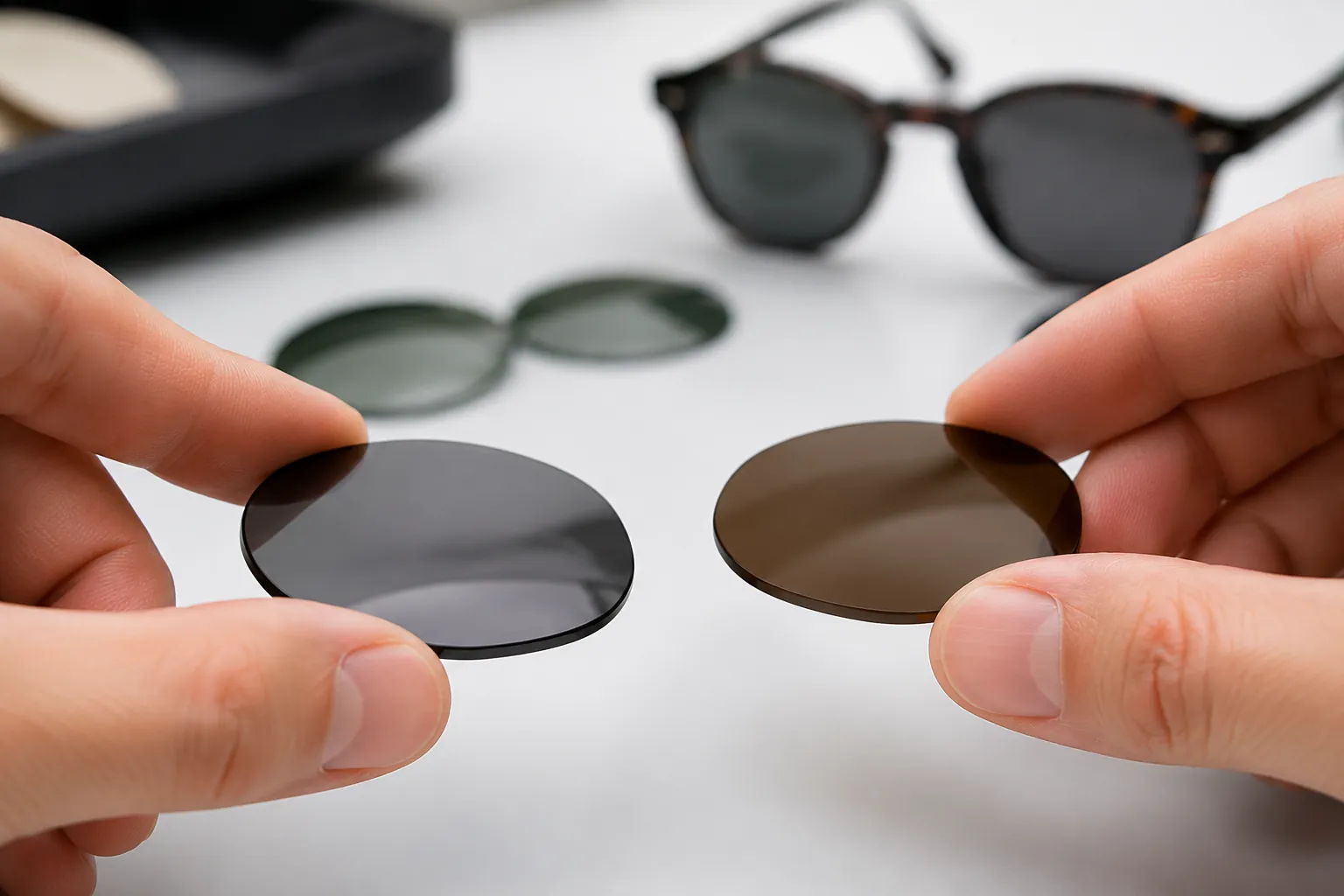
This guide is for brand owners, importers, distributors, and retailers buying custom polarized sunglasses in volume. The wrong lens choice rarely appears at quotation stage. It appears later as scratch claims, distortion complaints, edge failure, assembly breakage, compliance gaps, or margin loss through returns. The real question is not which acronym sounds better. It is which lens construction fits the frame, sales channel, use case, compliance burden, and return-risk tolerance. This article compares TAC and PC by construction, failure modes, application fit, specification language, cost logic, production controls, and document management so buyers can brief suppliers clearly and compare offers on equal terms.
Start with the buying decision, not the acronym
Many buyers ask for polarized lenses as if that were a complete lens specification. It is not. Polarization only describes the glare-reducing filter. It does not define substrate, lens build, thickness, optical control, coating level, edge strength, or assembly tolerance.
In custom sunglass sourcing, the more useful comparison is usually TAC polarized versus polycarbonate (PC) polarized.
TAC is a market term for a laminated polarized lens made from multiple layers. Depending on the supplier, those layers may include protective films, carrier layers, the polarizing film, adhesive interfaces, tint layers, and hard-coat layers. Construction varies by factory and by price level. Two TAC quotes may describe different products even when both are called polarized TAC lenses.
PC polarized uses a polycarbonate substrate combined with a polarized layer or film through a supplier-specific process. The process matters. Optical quality, internal stress, impact behavior, edge performance, and coating durability depend on the total build, not just the word polycarbonate.
Before comparing quotations, buyers should define five decisions:
- Complaint risk: scratches, delamination, distortion, edge cracking, whitening, coating marks, or assembly damage.
- Use case: fashion, driving, fishing, kids, sports, outdoor retail, chain-store private label, promotional, or e-commerce.
- Frame stress: full-rim or semi-rimless, low base or high wrap, shallow groove or deep retention, decorative cutouts, drilled parts, or snap-fit tension.
- Commercial target: ex-factory price, landed cost, target margin, and acceptable return exposure.
- Compliance burden: reports, declarations, test records, and traceability required for the destination market.
Skip that framework and you will compare non-equivalent offers. One supplier may quote a thin TAC lens with a basic hard coat and loose tint control. Another may quote a thicker PC lens with better coating, stricter optical inspection, and stronger packaging protection. Both are called polarized. They are not the same sourcing proposition.
The practical rule is simple: specify the performance and the build you need, then ask suppliers to quote against that brief. If you ask only for polarized sunglasses, the supplier will fill in the blanks with its own baseline. That makes the quotation hard to compare and harder to defend after claims begin.
How TAC and PC differ in lens construction
The biggest buying mistake is treating TAC and PC as if they differ in one property only. They differ in structure, and structure drives processing behavior.
A typical TAC polarized lens is laminated. It contains multiple bonded layers, and every adhesive interface is a potential control point. If lamination pressure, curing, film quality, or edge finishing is weak, the lens may pass initial inspection and still fail later in transport, assembly, or consumer use.
A typical PC polarized lens uses polycarbonate as the main substrate. That generally improves impact resistance, but does not guarantee better optics, better scratch resistance, or better consistency. Polycarbonate can show stress, birefringence, or coating sensitivity if molding and finishing are not controlled.
Buyers should ask suppliers to state the following, in plain language, before approving the build:
- Whether the lens is laminated or substrate-based
- Nominal lens thickness and tolerance
- Base curve and whether the lens is plano, semi-finished, or molded to shape
- How the polarized layer is integrated
- Hard-coat type and claimed abrasion level
- Whether anti-reflective, mirror, hydrophobic, or oleophobic layers are included
- Whether the frame design requires drilling, grooving, aggressive edging, or strong curvature
That information matters because lens problems often start at the interfaces. In TAC, interfaces include bonded layers. In PC, interfaces include the substrate and its coatings, plus any polarized layer integration. If the supplier cannot describe the stack-up or process logic, the buyer does not yet know what is being purchased.
TAC vs PC in production and field use
At a practical level, TAC is often chosen for cost-sensitive polarized programs where appearance, low weight, and price control matter most. PC is often chosen where impact resistance, rough handling, and wider assembly tolerance matter more. The differences appear in edging, coating, assembly, transport, and after-sale use.
| Factor | TAC Polarized | PC Polarized | Buyer Implication |
|---|---|---|---|
| Construction | Multi-layer laminated lens with adhesive interfaces | PC substrate combined with polarized layer through supplier-specific process | TAC needs close review of lamination quality; PC needs close review of stress control and coating quality |
| Impact behavior | Generally lower than PC | Generally higher than TAC | PC is often the safer starting point for kids, sport, driving, and rough-use products |
| Optical control | Can be very good when lamination flatness is stable | Can be very good when molding and stress control are stable | Request distortion inspection results and approved counter-samples, not only a polarization claim |
| Scratch behavior | Depends heavily on hard coat and handling discipline | Also depends heavily on hard coat; raw PC is relatively soft | Neither type is scratch-proof; specify coating expectation and test method |
| Edge finishing | Can be more sensitive to poor cutting, beveling, drilling, or groove pressure | Often more tolerant in assembly | Wrapped frames, semi-rimless frames, and tight grooves need closer review with TAC |
| Heat and moisture sensitivity | Lamination quality can be affected by weak bonding or poor curing | Usually less exposed to lamination-separation risk, but still coating-sensitive | TAC needs stronger process validation and storage review |
| Appearance in sampling | Often attractive for fashion sampling at controlled cost | Can also sample well, but price may be higher | Do not approve on sample appearance alone |
| Typical commercial fit | Often used in value to mid-price fashion polarized programs | Often used where durability risk and complaint cost are higher | Match lens choice to sales channel expectations, not to sample-room first impressions |
Two points matter. First, impact resistance is not scratch resistance. PC is tough, but surface durability still depends on hard-coat quality, cure stability, and packaging protection. Second, a good approval sample does not prove production consistency. TAC may look excellent in a sample set and still become a complaint source if lamination, curing, or edge finishing varies in bulk.
As a rule, stronger wrap, deeper base curve, tighter lens retention, or more aggressive assembly pressure often make PC easier to process reliably. Flatter fashion shapes with lower abuse expectations often keep TAC commercially attractive.
Failure modes that drive returns and margin loss
Most lens problems appear after shipment, not during quotation. Buyers should review likely failure modes before locking the construction. This is where TAC and PC differ most in commercial risk.
- Delamination: Mainly a laminated-lens risk. In TAC builds, weak bonding, poor curing, heat, moisture, edge stress, or poor storage can cause lifting or separation.
- Warp, wave, or ripple: These appear as visual distortion. In TAC, they may come from lamination flatness or uneven pressure. In PC, they may come from molding stress, stress release, or uneven finishing.
- Scratch complaints: Both TAC and PC depend heavily on hard-coat performance, handling discipline, cleaning method, and packing protection.
- Stress whitening or cracking: Often appears near notches, drilled areas, sharp edge transitions, or tight retention points. PC usually handles this stress better than laminated TAC constructions.
- Coating haze or abrasion marks: Can appear after wiping, transport rubbing, or poor curing.
- Polarization inconsistency: If the polarized layer is not aligned consistently, glare reduction and visual comfort can vary from lens to lens.
- Color drift between lots: Without a retained approved standard, repeat orders may not match the original tint, mirror density, or appearance.
- Assembly breakout: Lens chips, edge bursts, or retention marks may occur during insertion if groove design and lens tolerance are not matched.
Buyers should also ask where each problem starts:
- Lens production or lamination
- Tinting, mirror, or coating application
- Curing or drying control
- Edging and bevel control
- Frame assembly pressure
- Final cleaning, bagging, and carton protection
- Storage and shipping conditions
That process view matters. Many complaints are not caused by the substrate alone. A lens may pass inspection before edging and still fail later because the groove fit is too tight, the lens edge is overworked, the coating is under-cured, or the pouch allows rubbing in transit.
Look at the whole system: lens construction + frame design + assembly method + packaging + shipping conditions. Anything less is guesswork.
Which lens fits which sales channel
There is no universal winner. The better choice depends on how the product will be sold, handled, and returned.
TAC polarized often fits fashion programs, tourist retail, gift retail, promotional upgrades, online fashion drops, and private-label collections where price sensitivity is high and the product is not intended for heavy abuse. It usually works best where the frame is full-rim, the lens shape is simple, and appearance at controlled cost is the priority.
PC polarized is often the safer choice for sports-influenced products, kids' ranges, driving-focused styles, outdoor retail, marine use, cycling, fishing, and channels where breakage claims are expensive. If the sunglasses are likely to be dropped, flexed, loosely stored, or used in active conditions, PC should be evaluated first.
The following channel-fit table helps buyers start from commercial reality instead of material preference.
| Sales Channel / Use Case | Typical Risk Profile | Better Starting Lens | Reason |
|---|---|---|---|
| Fashion private label | Price pressure, moderate wear | TAC | Usually supports polarized appearance at lower cost if frame stress is low |
| Outdoor retail | Higher abuse, stronger return expectations | PC | Impact and assembly tolerance usually matter more than lowest unit cost |
| Kids' sunglasses | Drops, bending, rough handling | PC | Generally safer from an impact and breakage standpoint |
| Driving-focused collection | Optical comfort and repeat use | PC or premium TAC, case by case | Optics, tint stability, and frame fit should be reviewed together |
| Promotional upgrade | Tight budget, lower long-term use expectation | TAC | Often the more practical polarized option for controlled spend |
| Sport wrap frame | High curve, higher assembly stress | PC | Usually more tolerant in wrapped and tensioned designs |
| Tourist gift shop | Fast-turning value product | TAC | Commercial fit is often cost-led if compliance and appearance are covered |
| Chain-store compliance-heavy program | Low return tolerance, formal QA review | Sample both | Decision should follow test data, pilot results, and packaging validation |
A simple rule helps:
- If price pressure is the main driver, start with TAC.
- If abuse resistance is the main driver, start with PC.
- If the account has strict quality scorecards, low tolerance for returns, or formal compliance review, sample and test both before locking production.
Do not separate lens choice from frame design. A wrapped sport frame, a shallow groove, or a design with higher assembly stress can push the decision toward PC. A flatter acetate fashion frame may leave TAC as the more efficient option.
What the spec sheet must include
Weak RFQs produce weak quotes. If the buyer does not define the lens clearly, the supplier will quote to its own baseline. Then the price comparison is not meaningful.
A usable spec sheet for polarized sunglasses should include, at minimum, the following items:
- Lens construction: TAC polarized or PC polarized.
- Nominal lens thickness: state target thickness and any tolerance needed for the frame design.
- Lens category and visible light transmission target: state intended sun-lens category and approved VLT range.
- Base curve: such as 4-base, 6-base, or 8-base.
- Lens geometry: flat fashion shape, moderate curve, wrapped sport shape, drilled, grooved, or insert application.
- Hard-coat requirement: ask what coating is used and how consistency is checked.
- Additional coatings: mirror, anti-reflective, hydrophobic, oleophobic, or anti-smudge if required.
- Polarization orientation: require standard alignment and the supplier's inspection method.
- Tint standard: approve a master sample and define acceptable lot-to-lot variation.
- Edge condition: full-rim, semi-rimless, rimless, drilled, or nylon-groove use.
- Logo and decoration method: screen print, pad print, laser marking, hot stamping, foil, embedded logo, or lens engraving where relevant.
- Cleaning and packaging contact control: define protective bag, film, pouch, separator, tissue, and anti-rub requirement.
- Compliance file required: specify the standards, declarations, and reports needed for the destination market.
- Inspection standard: define AQL, cosmetic criteria, and the viewing conditions for lens defects.
Also ask how the supplier checks lenses during production. A useful answer should include real control points such as:
- Incoming raw material inspection
- Film or tint batch verification
- Coating application and curing control
- Visual inspection for bubbles, pits, haze, scratches, rainbow marks, and edge defects
- Polarization alignment check
- VLT verification by batch
- Assembly-fit inspection after edging
- Final pack-out inspection before carton sealing
If a supplier cannot explain those checkpoints clearly, the quotation may still look good on price. It is weaker on repeatability and claim control.
Buyer checklist: questions to ask before approving TAC or PC
Use this list in sampling and pre-production meetings. It forces suppliers to move from general claims to verifiable details.
- What is the exact lens build? Ask for a plain-language description, not only a material label.
- What is the nominal thickness and tolerance? Confirm fit against the target frame groove or mounting method.
- What is the base curve? High-wrap geometry changes stress behavior and optical control.
- How is the polarized layer integrated? The process affects consistency and failure risk.
- What hard coat is used? Ask how abrasion performance is validated.
- What defects are screened in production? Request actual inspection checkpoints.
- How is polarization direction checked? Misalignment creates field complaints.
- What packaging prevents rub marks? Lens protection is part of quality, not an afterthought.
- Has this exact build been used in similar frame stress conditions? Prior experience reduces risk.
- Which reports apply to this exact build? Reports must match the construction being sold.
- Can the supplier provide retained approval samples by lot? This matters for repeat order color control.
- What changes trigger re-approval? Material, coating, tint, geometry, or assembly changes should not be treated as minor.
This checklist is simple, but it prevents the most common sourcing error: approving a polarized sample without understanding the process limits behind it.
Cost, MOQ, lead time, and sampling logic
Lens choice affects cost, but not by itself. Frame material, hinge construction, decoration method, coating level, packaging, and testing can change total program cost as much as the lens substrate. Buyers who focus only on lens material often miss the real commercial picture.
In many supply situations, TAC is the more economical route for polarized fashion programs, while PC costs more because substrate and processing demands differ. The exact gap depends on supplier capability, lens geometry, thickness, coating package, and order scale.
Do not ask only, "Which lens is cheaper?" Ask three better questions:
- What is the ex-factory difference between TAC and PC for the same frame and finish?
- Does the sales channel justify the added durability margin of PC?
- Which cost is worse: a higher unit price now or a higher return rate later?
| Order Stage | Typical Quantity | Buyer Goal | Typical Timing |
|---|---|---|---|
| Sampling | Prototype quantity as agreed with supplier | Compare TAC vs PC, tint, logo position, fit, optics, and pack-out protection | Depends on tooling, materials, and decoration method |
| Pilot bulk | Small initial order | Test channel acceptance, assembly yield, and complaint risk | Depends on material readiness and production capacity |
| Core run | Scaled production quantity | Lock master sample, color tolerance, packaging spec, and compliance file | Depends on order mix and production schedule |
| Volume repeat | Repeat production | Improve consistency, reduce avoidable variance, and manage cost by stable booking | Depends on material planning and season |
Decoration method should also be part of the cost review. A one-color pad print may cost less than a metal insert, injected logo part, or engraved lens detail. Packaging can also move the cost more than expected if anti-rub protection, microfiber pouches, custom cases, or retail boxes are required.
The best commercial comparison is direct: sample both TAC and PC in the same frame, with the same tint family, similar finish level, and the same packaging standard. That isolates the true difference in cost and risk.
Compliance, testing, and document control
For overseas buyers, the lens must do more than look acceptable. It must align with the applicable standards and with the exact construction being sold. Common references in sunglass sourcing include EN ISO 12312-1, ANSI Z80.3, AS/NZS 1067, and chemical-control frameworks such as REACH. Some U.S. buyers also ask suppliers about FDA registration for vendor paperwork, but administrative registration is not the same as product-level compliance evidence.
The main point is direct: do not ask only whether a factory has a report on file. Ask whether the exact lens build you are buying is covered. If material, tint, transmittance category, geometry, mirror treatment, or construction changes, the old file may no longer be enough.
Good document control should include:
- Approval of the final lens build, not only the frame style
- A retained golden sample for color and appearance reference
- Linking reports and declarations to that approved build
- Reviewing the file again if lens material, geometry, category, or coating changes
- Lot traceability for repeat orders where possible
Factory credentials such as ISO 9001 and BSCI may indicate management discipline, but they do not replace product-specific verification. Treat management-system credentials and product-performance evidence as separate issues.
Buyers should also define who owns the compliance file internally: product management, sourcing, QA, or regulatory. If nobody owns the document package, gaps usually appear at shipment approval or after a marketplace audit.
A practical workflow for first orders and repeat programs
If you are sourcing polarized sunglasses for a new program, or moving an existing style to a new supplier, use a workflow that forces objective comparison and document control.
- Define the sales channel clearly: fashion, sport, kids, driving, outdoor, private label, distributor, or chain retail.
- Review frame stress: full-rim or semi-rimless, base curve, groove tension, drill points, and likely abuse level.
- Select candidate constructions: evaluate TAC and PC if the use case does not already make the choice obvious.
- Sample both in the same frame: use the same tint family, same logo method, and as close a specification match as practical.
- Compare more than appearance: review distortion, scratch sensitivity, edge quality, fit in frame, coating marks, and packaging protection.
- Review supplier process capability: ask which operations are controlled directly and how defects are screened.
- Lock the specification sheet: material, thickness, category, base curve, decoration, packaging, inspection rules, and compliance documents.
- Run a pilot order: use the first production as a process check, not only a sell-through test.
- Track complaints by failure mode: separate scratch, distortion, breakage, delamination, color mismatch, and cosmetic issues.
- Scale only after evidence: move to repeat volume after the construction proves stable in production and in market use.
Nothing complex is required. Strong buyers do not choose between TAC and PC based on shorthand labels. They define the use environment, test the actual build, verify the documents, and scale only when the supplier can repeat the result.
Have a custom sunglasses project in mind?
Send us your styles, target market and quantities and we will return a detailed quote with MOQ, lead time and a sample plan.
Get a QuoteWhy source this from Wenzhou with LumiShades
Wenzhou in Zhejiang Province is widely regarded as China’s eyewear manufacturing capital, producing a large share of the world’s sunglasses. That concentration matters to buyers: a deep local supply chain for acetate sheet, hinges, lens blanks, plating and packaging means shorter component lead times, easier color and material matching, and a workforce with decades of eyewear-specific skill. LumiShades has manufactured in this ecosystem since 2009, and our vertical integration — in-house injection molding, acetate cutting, CNC milling, lens tinting, decoration and quality control — means no part of your order is quietly subcontracted to a workshop you cannot audit.
For international buyers, that vertical control translates into accountability. When a single factory owns every step, defects are traced and fixed at source rather than bounced between vendors, and your specifications survive intact from first sample to bulk. We back this with 15+ years of experience, shipments to 60+ countries, more than 5 million pairs produced per year and a 98.5% on-time delivery rate. Our certifications — CE EN ISO 12312-1, FDA registration, ANSI Z80.3, AS/NZS 1067, REACH, ISO 9001 and BSCI audit — mean the compliance documentation your market requires already exists. Explore our manufacturing capabilities and quality control process to see how this works in practice.
Frequently asked questions
Is TAC always cheaper than PC for polarized sunglasses? No. TAC is often less expensive in fashion-oriented polarized programs, but not in every case. The right comparison uses the same frame, tint family, coating level, and packaging standard. Ask each supplier for a side-by-side quote that changes only the lens construction. Then compare not just unit price, but also likely return risk, breakage exposure, and channel quality requirements.
Which lens type is better for sports or kids' sunglasses? Usually PC. Sports and kids' styles face more drops, flexing, and rough handling, and PC generally offers better impact resistance and assembly tolerance. That does not mean every PC lens is better than every TAC lens. Coating quality, optical control, frame design, and edge finishing still matter. But if durability risk is high, PC is usually the safer starting point.
Are TAC lenses more likely to delaminate? They can be, because TAC is usually a laminated construction with bonded layers. Delamination risk depends on the quality of the films, adhesives, curing, edge finishing, and storage conditions. A well-made TAC lens may perform well in the right frame and channel, but buyers should treat lamination quality as a specific control point and not assume all TAC builds perform the same.
Does PC automatically have better scratch resistance than TAC? No. PC usually has better impact resistance, not automatic scratch resistance. Raw polycarbonate is relatively soft, so scratch performance depends heavily on hard-coat quality and curing. TAC scratch behavior also depends on surface treatment and handling. If scratch complaints matter, ask for the coating specification, inspection method, and packaging protection, regardless of lens type.
Can I switch from TAC to PC after sampling without updating documents? No. A material change can affect optical behavior, transmittance, performance, and the compliance file linked to the approved build. If you switch substrate or lens construction, review the master sample, specification sheet, and applicable test records again. Treat it as a controlled change, not a minor substitution.
What is the biggest RFQ mistake buyers make with polarized sunglasses? Requesting polarized lenses without defining the full lens build. Buyers often omit thickness, base curve, coating level, VLT range, edge condition, packaging protection, and compliance requirements. That allows each supplier to quote a different baseline. The result is a low-clarity quotation comparison and higher complaint risk after production.
Ready to start?
Explore our square sunglasses or request a quote — our sales team replies within 12 hours.
Request a Quote