
Polarized Lens QC for Custom Sunglasses Orders
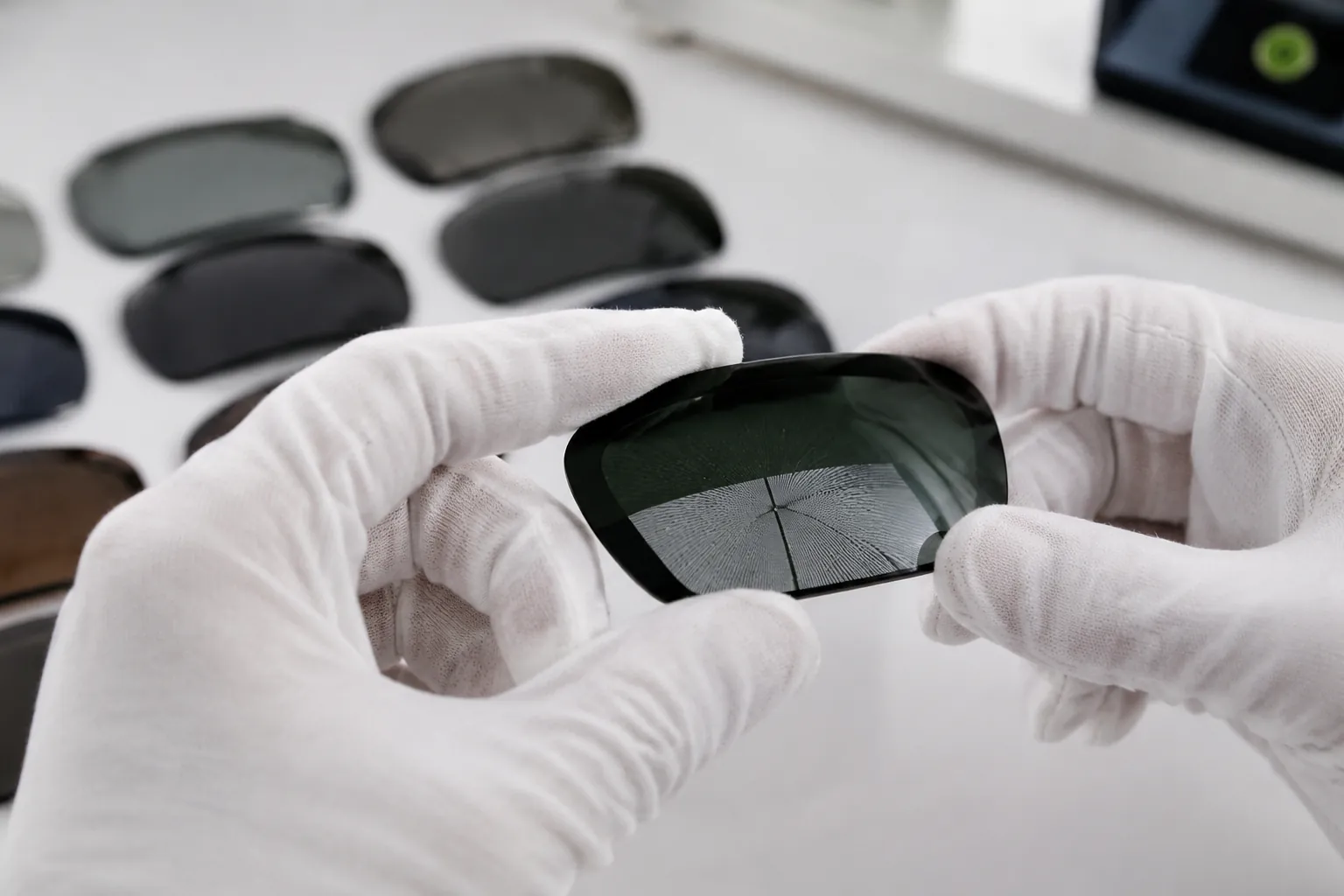
This guide is for importers, private-label brands, distributors, and retail buyers approving polarized sunglasses before bulk production. It explains what to specify, what to test, and what to reject: lens material, axis alignment, haze, tint consistency, frame stress, decoration quality, packaging claims, MOQ decisions, and shipment approval. Use it as a pre-production and inspection framework when sourcing from Wenzhou or any volume eyewear factory.
Start With a Written Polarized Lens Specification
Do not write only "polarized lens" on a purchase order. That is not a specification. It only says the lens includes a polarizing film or structure intended to reduce glare from one direction. It does not define lens material, visible light transmission, filter category, axis angle, color tolerance, haze, coating stack, base curve, impact performance, or the claims allowed on packaging.
Approve a written lens specification before sample making. The production team needs measurable targets for lens material, tint, cutting direction, mounting pressure, and final inspection. A gray TAC polarized lens for driving-style sunglasses is not the same product as a brown polarized lens for fishing or water use, even if both look convincing on a demonstration card.
A usable specification should include lens material, lens color, visible light transmission range, filter category, polarizing axis, allowed axis deviation, left-right pair tolerance, haze expectation, coating requirements, base curve, frame fit, target compliance market, and packaging claims. Example: gray TAC polarized lens, category 3, VLT range confirmed by the agreed test method, vertical polarizing axis in worn position, axis deviation within plus or minus 3 degrees per lens, left-right pair difference within 2 degrees, no visible bubbles, no film wrinkles, no edge delamination, and no obvious rainbow distortion in normal wear position.
Do not approve bulk from a photo or short sales video. Photos hide haze. Videos hide axis rotation. Both can miss lens stress, color drift, and frame pressure. A small trial order can help because it shows whether lens cutting, mounting, color control, and decoration are stable before the order becomes expensive to sort, rework, or replace.
Choose Lens Material Before the Test Plan
Polarized sunglasses can use TAC, PC, nylon, CR-39, or other lens structures. The test plan should match the material and the selling claim. TAC is common for affordable fashion and promotional polarized sunglasses because it is light and cost-effective. PC is often selected for sport or youth styles because of its toughness, but it can show stress patterns if the frame groove, lens curve, or assembly pressure is wrong. Nylon is common in higher-performance curved sport frames because it can support good optical performance in wrap designs, but it needs tighter processing control. CR-39 is often used for optical-style sunglass lenses, but it is heavier than many plastic alternatives.
| Lens Material | Typical Use | Process Risk | QC Focus |
|---|---|---|---|
| TAC polarized | Fashion, retail, promotional programs | Film wrinkles, edge delamination, tint variation | Axis check, haze, color matching, edge inspection |
| PC polarized | Sport, youth, outdoor sunglasses | Rainbow stress, coating adhesion issues, mounting pressure | Stress viewing, coating check, frame groove fit |
| Nylon polarized | Premium sport, cycling, fishing, wrap frames | Base curve distortion, higher material and processing sensitivity | Optical clarity, curve consistency, VLT and axis control |
| CR-39 polarized | Optical-style sunglasses and premium retail | Heavier lens, longer processing cycle, breakage risk if mishandled | Surface quality, coating, color, thickness balance |
The material choice affects MOQ, lead time, supplier options, and inspection method. Standard TAC polarized lenses are usually easier to source than custom colors, mirror coatings, gradients, special base curves, or nylon polarized lenses. Ask the supplier to confirm material availability, sample lead time, bulk lead time, and whether third-party testing time is included. A generic lead-time promise is not quality approval. Tie production release to the approved sample, written specification, and inspection criteria.
Run Simple Buyer Checks Before Lab Testing
You do not need a full optical lab to reject obvious polarized lens problems. A procurement team can run practical checks with a polarized test card, LCD screen, known-good polarized lens, neutral light box, white inspection sheet, and the approved master sample. These checks do not replace testing against CE EN ISO 12312-1, ANSI Z80.3, AS/NZS 1067, or the supplier's QC records. They are screening checks before you approve a production direction or release shipment.
- LCD blackout check: Hold the sunglasses in front of a phone, tablet, or monitor with a bright white screen. Rotate the glasses slowly. A polarized lens should darken strongly at one angle and lighten again as it rotates away. A weak change may mean poor polarizing efficiency, wrong lens type, or wrong orientation. Screens vary, so compare against a known-good polarized sample.
- Left-right matching: Rotate both lenses against the same screen or reference lens. If one lens reaches maximum darkness at a visibly different angle from the other, the axes may not match. This often happens when lens blanks are edged without respecting the film direction.
- Glare surface check: View reflected light from water, polished tile, dashboard glass, or a windshield. In normal wearing position, vertically oriented polarized sunglass lenses should reduce horizontal glare clearly. This is a use check. It is not a substitute for measured transmission data.
- White sheet inspection: Place lenses over clean white paper under neutral light. Look for one lens being warmer, cooler, darker, cloudier, or greener than the other. Compare against the signed master sample, not memory or a catalog image.
- Mounted-frame check: Inspect lenses after assembly, not only as loose blanks. Some lenses look acceptable loose but show rainbow stress, distortion, or edge pressure once mounted in the frame.
Record results by SKU, lens batch, sample number, inspector, and inspection date. A phone video of the LCD rotation test can support the record, but it is not enough alone. Approval should also include written tolerances, a signed master sample, and the supplier's inspection report.
Treat Axis Alignment as a Key Failure Point
Polarization works because the lens blocks light in a defined orientation. For most sunglasses, the useful axis is vertical in the worn position because it reduces horizontally reflected glare from roads, water, snow, and glass. If the axis rotates too far during cutting or assembly, the product may still be polarized. It may still pass a casual card check. But glare reduction can be weaker in real use.
The main risk appears after the polarized sheet or lens blank is cut. If the operator nests the lens shape without respecting the film axis, the right and left lenses can differ. The wearer may notice uneven darkness, eye fatigue, or odd behavior when viewing screens. On dark mirror lenses, the defect may not be obvious on a table. Appearance inspection alone is not enough.
A common buyer target for mid-range and premium retail programs is plus or minus 3 degrees from the approved axis, with left-right pair difference within 2 degrees. Some low-price promotional programs may accept a wider tolerance, such as plus or minus 5 degrees, but that choice must be written into the order and reflected in inspection criteria. For fishing, driving, cycling, snow, and water-sport products, do not relax axis control casually. Glare reduction is part of the product's value.
Ask the factory to mark the polarization direction on sample lenses before cutting. Then confirm the axis after edging and again after final assembly. For volume orders, QC should check incoming lens material, cutting orientation, mounted pair alignment, and finished-goods sampling. If the supplier uses subcontractors for lens blanks, cutting, coating, or assembly, require traceability records so problems can be linked to the correct batch and process step.
Control Haze, Stress, Film Defects, and Color Drift
A lens can be genuinely polarized and still be poor to wear. Haze lowers clarity. Internal stress creates rainbow patterns. Film defects create spots, waves, and streaks. Color drift makes the pair look inconsistent and may affect filter category or VLT consistency. These are separate problems. One polarized card will not catch them all.
Haze usually appears as a milky cast, especially under side light or over white paper. It may come from lamination issues, contamination, coating defects, handling damage, or overheating during forming. Rainbow stress often appears when the mounted lens is viewed through another polarized lens. A small stress pattern may be visible in some molded plastic lenses, but strong uneven bands usually point to frame pressure, curve mismatch, or material stress.
Reject film wrinkles, bubbles, and edge delamination unless the supplier can prove they are outside the usable area and within the agreed defect standard. Edge separation is serious. Heat, storage, transport, and retail handling can make it worse. For color, approve one sealed master for each lens and coating combination: gray polarized without mirror, gray polarized with silver mirror, brown polarized, green, gradient smoke, and any fashion tint should each have its own reference.
| Defect | Buyer Check | Likely Cause | Action Before Bulk |
|---|---|---|---|
| Low polarization effect | Weak LCD blackout or weak glare reduction versus known-good sample | Poor film, wrong lens type, wrong axis, or incorrect test setup | Request replacement lens batch, axis report, and repeat check against master sample |
| Axis mismatch | Left and right lenses darken at different rotation angles | Cutting orientation error or mixed lens batches | Reset cutting marks, segregate batches, and inspect after edging |
| Haze | Milky cast over white paper or in a light box | Lamination, coating, contamination, handling, or heat damage | Reject affected batch and define measurable haze or visual acceptance limit |
| Rainbow stress | Colored bands through another polarized lens | Frame pressure, forming stress, curve mismatch, or groove design | Check frame groove, base curve, lens thickness, and assembly pressure |
| Color drift | One lens is warmer, cooler, darker, or lighter than the other | Tint batch variation, coating inconsistency, or mixed lots | Approve master color, control batch mixing, and set visual or instrumental tolerance |
Scale QC by MOQ, Order Value, and Sales Risk
Not every order needs the same inspection cost. A design sample should not carry the same QC burden as a large retail launch, but it still needs enough checking to avoid approving the wrong lens, color, or claim. Scale testing by order value, sales channel, market regulation, and the wording printed on the product or packaging.
| Order Stage | Typical Quantity | Testing Focus | Buyer Decision |
|---|---|---|---|
| Concept sample | 1-5 pcs | Polarization effect, lens color, frame fit, logo position | Approve direction or revise specification |
| MOQ trial | Supplier-dependent | Axis matching, haze, color consistency, assembly pressure | Confirm whether the process is stable enough for volume |
| Small bulk | Buyer- and supplier-dependent | Incoming lens lot, inline QC, finished pair inspection | Accept, rework, or hold shipment |
| Volume bulk | Buyer- and supplier-dependent | Batch traceability, AQL inspection, compliance files, carton sampling | Release shipment only against written criteria |
Unit price often changes with order quantity, frame material, lens type, coating, decoration, packaging, testing, and compliance documentation. Do not approve a lower price by removing checks that protect the selling claim. Sorting, rework, air freight, launch delays, retailer chargebacks, and replacement stock can cost more than the savings from a cheaper lens or looser inspection plan.
The rule is simple: if the product will be sold with a polarized claim on packaging, online listings, hangtags, or retailer product pages, verify the claim before bulk and again during final inspection. For e-commerce programs, keep photos, sample IDs, test reports, and QC records aligned. Listing claims are often reviewed after customer complaints, not only before launch.
Check Decoration and Packaging Before Mass Printing
Decoration can create quality problems even when the polarized lenses are correct. Pad printing on temples, laser engraving on metal parts, hot stamping, metal logo plates, lens logos, and printed microfiber pouches all need approval. A lens logo that is too large, too low, or printed with the wrong ink can interfere with vision or fail rub testing. A temple print may look clean on one sample but blur, shift, or lose adhesion in bulk if the fixture, ink, curing, or surface preparation is not controlled.
For custom sunglasses, approve decoration method, position tolerance, color, durability expectation, and packaging layout before bulk. Write requirements plainly: logo position tolerance for temple printing, consistent color against approved artwork, no ink bleeding, no exposed glue around metal plates, no sharp edges from logo hardware, and no decoration inside the primary viewing area unless specifically approved. For lens logos, confirm the mark does not interfere with normal wear, required markings, or retailer requirements.
Control compliance claims before packaging is printed. Polarization is not the same as UV protection, impact resistance, driving suitability, or safety eyewear certification. For Europe, CE marking for sunglasses is linked to applicable requirements including EN ISO 12312-1. For the United States, ANSI Z80.3 is commonly used for non-prescription sunglasses, and FDA registration may apply to relevant eyewear businesses and import requirements. Australia and New Zealand buyers should review AS/NZS 1067. REACH is relevant for restricted substances in frame materials, coatings, colorants, and skin-contact parts.
Use only certification and compliance references supported by current documents. Acceptable references may include CE EN ISO 12312-1, FDA registration, ANSI Z80.3, AS/NZS 1067, REACH, ISO 9001, and BSCI when the supplier has valid evidence. Do not add badges because they look good. Packaging should say only what the product and documents support: "polarized" from polarization checks, "UV400" or filter category from lens test data, and no "safety glasses" wording unless the product is designed and tested under the correct safety standard.
Build a Pre-Production Approval Pack
Before bulk starts, collect the physical samples, technical records, QC method, and artwork in one approval pack. This prevents the factory, buyer, and inspection company from judging the order against different standards.
- Approved master sample: finished sunglasses with final frame color, lens color, polarization, logo decoration, hinge, temple printing, and packaging direction.
- Lens specification: material, color, VLT range, filter category, polarizing axis tolerance, coating, mirror or non-mirror finish, base curve, and haze expectations.
- Compliance target: CE EN ISO 12312-1, ANSI Z80.3, AS/NZS 1067, REACH, FDA registration requirement, or market-specific combination.
- Decoration approval: laser engraving, pad printing, hot stamping, metal logo plate, temple print, lens logo, pouch print, and position tolerance.
- QC method: LCD test, polarized card, axis check, light-box visual check, color comparison, frame stress check, and final carton sampling.
- Traceability record: lens material lot, tint or coating batch, production date, SKU, inspector, and carton range.
- Defect list: define critical, major, and minor defects before inspection. False polarization claim, axis failure, cracked lens, sharp frame edge, wrong warning text, and unsupported compliance marking should be treated as serious defects.
- Shipment hold rule: state who can release goods if QC finds defects. Do not decide this after cartons are packed.
For a Wenzhou factory or any other volume eyewear supplier, these controls match the main production risks: lens material, color, cutting direction, frame fit, decoration, compliance wording, and final packing. They also make third-party inspection easier. The inspector can compare finished goods against the same signed sample, written specification, and defect standard used during production.
Have a custom sunglasses project in mind?
Send us your styles, target market and quantities and we will return a detailed quote with MOQ, lead time and a sample plan.
Get a QuoteWhy source this from Wenzhou with LumiShades
Wenzhou in Zhejiang Province is widely regarded as China’s eyewear manufacturing capital, producing a large share of the world’s sunglasses. That concentration matters to buyers: a deep local supply chain for acetate sheet, hinges, lens blanks, plating and packaging means shorter component lead times, easier color and material matching, and a workforce with decades of eyewear-specific skill. LumiShades has manufactured in this ecosystem since 2009, and our vertical integration — in-house injection molding, acetate cutting, CNC milling, lens tinting, decoration and quality control — means no part of your order is quietly subcontracted to a workshop you cannot audit.
For international buyers, that vertical control translates into accountability. When a single factory owns every step, defects are traced and fixed at source rather than bounced between vendors, and your specifications survive intact from first sample to bulk. We back this with 15+ years of experience, shipments to 60+ countries, more than 5 million pairs produced per year and a 98.5% on-time delivery rate. Our certifications — CE EN ISO 12312-1, FDA registration, ANSI Z80.3, AS/NZS 1067, REACH, ISO 9001 and BSCI audit — mean the compliance documentation your market requires already exists. Explore our manufacturing capabilities and quality control process to see how this works in practice.
Frequently asked questions
How can I confirm the lenses are truly polarized before approving production? Start with a quick screening check: rotate the finished sunglasses in front of an LCD screen or use a polarized test card, then compare the result with a known-good polarized sample. Both lenses should show a clear change in darkness as they rotate, and the left and right lenses should behave consistently. For bulk approval, request the supplier's QC records for polarization effect and axis alignment, keep a signed master sample, and repeat the same checks during final inspection.
What axis tolerance should I specify for polarized sunglasses? For most mid-range and premium sunglasses, specify the polarizing axis in the worn position and require each lens to be within plus or minus 3 degrees of the approved axis, with the left-right pair difference within 2 degrees. For lower-cost promotional orders, a wider tolerance such as plus or minus 5 degrees may be acceptable only if the buyer understands the performance tradeoff and writes it into the specification. For driving, fishing, cycling, snow, or water-sport products, keep the tighter tolerance because glare reduction is a functional selling point.
Can polarized sunglasses also claim UV400? Yes, but polarization and UV protection are different properties. A lens can be polarized without meeting a UV400 claim, and a UV-protective lens does not have to be polarized. Approve UV400 or filter category wording only when the supplier provides lens test data for the target market, such as documentation aligned with CE EN ISO 12312-1, ANSI Z80.3, or AS/NZS 1067 as applicable.
Should I test every pair in a large order? Usually no, unless the order, buyer, or retailer specifically requires 100% inspection. A practical plan uses incoming lens lot checks, inline QC, and final AQL sampling, with focused checks for polarization effect, axis alignment, haze, color matching, decoration, sharp edges, packaging text, and compliance markings. If a critical defect appears, such as false polarization, cracked lenses, wrong compliance wording, or unsafe sharp edges, hold the affected cartons and expand inspection before shipment release.
Will mirror coating affect polarization testing? Mirror coating can make visual inspection harder because reflections hide lens color and some surface defects, but it should not eliminate the polarization effect. Test from the wearer side where possible, rotate the finished glasses against an LCD screen or known polarized reference lens, and compare left and right lenses. Also inspect mirror coating for scratches, pinholes, color mismatch, adhesion problems, and edge defects because those issues are separate from polarization.
When should I approve packaging claims? Approve packaging claims only after the lens specification, master sample, and compliance targets are confirmed. Check that every claim on the box, pouch, hangtag, instruction sheet, and online listing is supported by evidence. "Polarized" should be supported by polarization and axis checks; "UV400" or filter category should be supported by lens test data; CE EN ISO 12312-1, ANSI Z80.3, AS/NZS 1067, REACH, FDA registration, ISO 9001, or BSCI references should appear only when current documents support them.
Ready to start?
Explore our aviator sunglasses or request a quote — our sales team replies within 12 hours.
Request a Quote