
Low-Cost Sunglass Lenses: Thickness vs Distortion
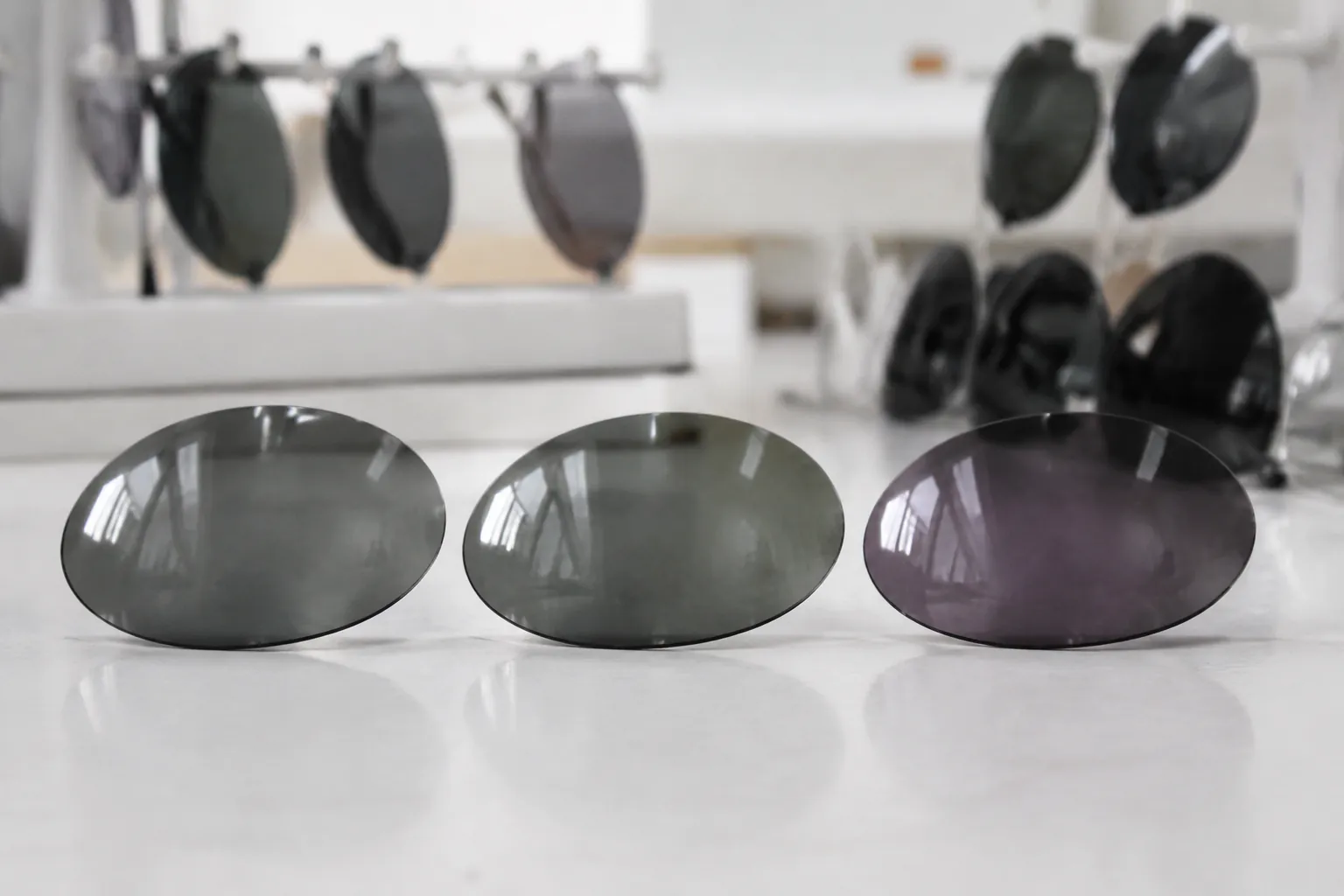
This guide is for brand owners, importers, distributors, and retail buyers developing sunglasses in volume. In low-cost FOB programs, lens complaints rarely come from one obvious defect. They usually come from several small decisions stacked together: cheaper material, thinner lenses, stronger wrap, wide tolerance, or a frame that squeezes the lens after assembly. The result can be blur, visual fatigue, peripheral swim, left-right mismatch, or a pair that passes basic compliance but still feels poor in wear. Control starts before sample approval. Define material, base curve, thickness tolerance, edging, and assembly method before the factory optimizes the build around price.
Where distortion actually starts
Low-cost sunglasses seldom fail because of one dramatic mistake. More often, discomfort comes from decisions that look acceptable one by one but create trouble once they meet in the finished pair. The main drivers are lens material, base curve, thickness tolerance, edging, and assembly pressure.
Buyers usually start with style, lens color, logo placement, packaging, and target FOB. That is normal. The risk begins when the lens brief is too loose. If the spec only says "smoke PC lens" or "black polarized lens," the factory still has to decide how to hit that result at cost. Those decisions may include wall thickness, tolerance range, mold selection, edging allowance, and how tightly the frame holds the lens.
Small dimensional changes matter. A lens that looks fine as a loose component can warp after edging and mounting. On an 8-base wrap or shield-style frame, variation that would be invisible on a flatter fashion shape can become obvious in wear.
The buyer's question should not stop at "Will it pass a lab test?" Ask the harder question: "Can the customer wear it without noticing blur, swim, pressure distortion, or mismatch between the two lenses?" Use a disciplined sequence:
- Confirm lens construction first: PC, TAC polarized, acrylic, or nylon if the product position supports it.
- Freeze base curve and eye size next. A 6-base fashion frame carries different risk than an 8-base wrapped sport style.
- Lock nominal center thickness, edge condition, and production tolerance on the specification sheet before sample sign-off.
- Review how the frame retains the lens: injection groove, hand-fit acetate bevel, screw-mount, or rimless hardware.
- Approve assembled samples after the lenses have settled in the frame, not only loose lenses or fresh post-assembly samples.
This order prevents a common sourcing error: approving appearance first, then discovering optical instability after tooling, packaging, and bulk planning are already moving.
Material choice affects return risk
Lens material sets the baseline for impact performance, optical consistency, moldability, tint response, and assembly tolerance. Two sunglasses can look the same on a table and feel very different on the face.
| Lens option | Typical thickness range in low-cost programs | Main process risk | Buyer guidance |
|---|---|---|---|
| Polycarbonate (PC) | Commonly used in fashion and promotional programs; final thickness depends on lens size, curve, and frame design | Molding stress, post-assembly warpage, peripheral distortion if the lens is too thin for the geometry | Often the best cost/performance balance for wholesale sunglasses, but only when thickness, curve, and fit pressure are controlled |
| TAC polarized | Varies by laminate structure and finished cut profile | Lamination defects, edge opening after cutting, polarization consistency issues | Good value upgrade when well controlled; inspect edge finish, bonding quality, and left-right uniformity carefully |
| Acrylic | Used in some highly price-driven styles; finished thickness depends on shape and process | Lower impact resistance than PC and less process forgiveness in budget programs | Use only when the price target is extremely tight and performance expectations are limited |
| Nylon | Application-dependent and more common in performance-oriented eyewear | Higher raw-material cost and less common in low-cost fashion volume runs | Can offer strong optical performance in sport applications, but is often outside entry-level FOB targets |
PC is the default in many custom sunglass programs. It is widely available, works with common decoration methods, and can be used for products intended for markets governed by CE EN ISO 12312-1, ANSI Z80.3, or AS/NZS 1067 when the finished product is properly designed and tested. But "PC" is not a full specification. Buyers still need to confirm whether the lens is injection molded, whether a hard coating is applied, how the tint is produced, and what thickness target the factory is using.
TAC polarized lenses can raise perceived value because polarization is easy for consumers to understand. But TAC is a laminated construction. It adds film alignment, adhesive bonding, trimming quality, and edge durability to the risk list. In a tight-cost program, those details need direct inspection.
Decoration also affects control. Common options include:
- Dip tinting for standard solid colors such as smoke, brown, or green, and for some gradient effects.
- Flash mirror coating for silver, blue, gold, or multicolor looks, which can improve shelf appeal but may increase complaint risk if adhesion or scratch resistance is weak.
- Pad printing or laser marking for logos on the lens surface.
- Transfer or hydrographic decoration on frame components, which affects appearance but does not fix lens quality issues.
If one supplier controls lens tinting, lens marking, frame processing, and final assembly in-house, root-cause work is usually easier. Still, decoration cannot rescue a lens that becomes unstable after fitting.
Thickness tolerance changes comfort
Thickness is an easy place to cut cost. It is also a fast way to create complaints. On large fashion squares, flat-top aviators, and wrapped shields, a thinner lens may lose enough rigidity to become sensitive to edging stress, insertion force, and normal frame tension.
Do not approve only a nominal thickness. The production sheet should state the target and the allowable tolerance. If the approved sample is based on a defined center thickness, the factory should confirm where that thickness is measured and what variation is acceptable in production. For oversized or high-wrap styles, buyers may also need a minimum finished condition after edging.
Practical checkpoints include:
- Ask where thickness is measured: center, edge, or finished post-edging profile.
- Check both loose lenses and assembled frames, because acceptable loose lenses can distort after mounting.
- Review multiple assembled pre-production pieces on sensitive styles, not only one approval sample.
- Be conservative on minimum thickness for larger eye sizes and stronger wraps.
Variation can enter through resin grade, molding conditions, cooling, trimming, storage, edging settings, and frame insertion method. That is why stronger factories do not rely only on loose-lens inspection. They review the finished pair after assembly.
If the supplier cannot clearly explain the thickness tolerance being controlled, the optical spec is not complete. At that point, cost and cosmetics are probably receiving more attention than wearer comfort.
Base curve and wrap increase risk
Base curve controls how much the lens wraps around the face. It also changes optical forgiveness. In low-cost programs, flatter curves are usually easier to keep visually stable. Stronger wraps can look sportier and improve coverage, but they make small manufacturing errors easier to notice.
The rule is simple: stronger wrap needs tighter process control. A thin 8-base lens with a large eye size is less forgiving than a thicker 4-base or 6-base fashion lens. Add polarization and a low FOB target, and the process window gets smaller.
Three complaints show up often on wrapped styles:
- Peripheral distortion or "swim" when the wearer looks off-center.
- Stress warpage caused by a tight groove forcing the edged lens into place.
- Visible left-right mismatch when molded geometry varies across cavities or lots.
This matters during line planning. A supplier that performs well on a flat fashion square at aggressive pricing may not deliver the same consistency on a curved shield at the same price. That is not always a supplier failure. Often, it is a geometry and tolerance issue that should have been addressed before the PO.
Plain version: a very thin lens, strong wrap, mirror polarized construction, and entry-level price create a high-risk combination.
Assembly pressure can create distortion
A lens can be acceptable before assembly and poor after assembly. This happens in injection-molded plastic frames, hand-fit acetate fronts, and metal frames with tight retention points.
The usual process is:
- Lens is molded or cut from a laminated construction.
- Lens is tinted, coated, mirrored, or logo-marked as required.
- Lens is edged to final frame geometry.
- Frame front is prepared; on some styles it is heated for insertion.
- Lens is mounted under pressure into the groove or hardware.
- Frame cools or settles, and stress redistributes through the assembly.
- Final QC checks cosmetics, alignment, and basic visual acceptability.
Hidden distortion often appears during assembly or after settling. If the groove is too tight, the bevel angle is wrong, or insertion takes too much force, the lens can develop stress that was not present as a loose part. Review assembled samples after they have remained in the frame for a defined period. Immediate checks are not enough.
Process control helps. When the same supplier controls frame production, machining, lens processing, decoration, and final assembly, it is easier to identify whether the root cause is the lens, frame groove, edging profile, or assembly method.
For QC planning, ask whether finished-pair inspection includes post-assembly warp checks, not only scratches, color, and alignment. A frame can look correct on the table and still cause visual fatigue if the lens is under tension.
Compliance is not comfort
Export-market compliance is necessary. It is not the same as wearer comfort. A sunglass can meet UV transmission and other applicable requirements while still causing complaints about blur, eye strain, or uneven optics.
Separate three topics:
- Regulatory and market-access testing: CE EN ISO 12312-1, ANSI Z80.3, AS/NZS 1067, REACH, and FDA registration where applicable to the business and market context.
- Factory systems and management: ISO 9001, BSCI, and similar management or social compliance frameworks.
- User experience: optical clarity, left-right consistency, comfort in wear, and retail return risk.
This distinction matters. A product can satisfy the compliance file and still disappoint the end user. Approval should include internal wear evaluation by the buyer's team under normal lighting and movement, not only a bench review under factory conditions.
Also confirm that the tested sample matches the bulk build. If the supplier changes lens material, curve, coating stack, or thickness after approval to reduce cost, the original test report and optical review may no longer represent production.
Model cost, MOQ, and lead-time trade-offs
Many avoidable problems start with poorly modeled cost pressure. Identify where savings are low risk and where they directly increase the chance of returns or claims.
| Decision | Typical unit-cost effect | Lead-time effect | Likely impact on returns |
|---|---|---|---|
| Reduce lens thickness aggressively | Can lower material cost | Usually little direct effect | Higher risk of flex, warpage, and optical complaints |
| Choose a flatter base curve | Often limited cost impact | Can simplify molding and fitting | Usually lowers optical risk on value-fashion styles |
| Upgrade from non-polarized PC to TAC polarized | Raises unit cost | May add process and inspection steps | Can improve perceived value if well controlled; can increase complaints if lamination quality is weak |
| Skip optical review and approve only cosmetic sample | No meaningful direct saving | May shorten development slightly | Often increases downstream claims, deductions, and rework risk |
MOQ, sampling cost, and lead time vary by supplier, tooling status, material choice, decoration, and packaging requirements. Get written confirmation. Generic market ranges are not enough.
The risk economics are consistent: an extra review round on a difficult lens-frame combination is usually cheaper than returns in market. Saving a small amount by reducing lens thickness or skipping assembled wear review is rarely a true saving after distributor claims, retailer chargebacks, customer-service labor, and replacement stock are counted.
Pre-production checklist for buyers
Before releasing a bulk PO, confirm these points in writing. Clear records reduce preventable optical complaints and make supplier accountability easier.
- Lens construction confirmed: PC, TAC polarized, acrylic, or nylon, with coating and color method defined.
- Base curve, eye size, and final lens shape frozen against the approved sample.
- Nominal center thickness and tolerance stated on the production sheet; edge condition clarified for large or wrapped styles.
- Left-right lens consistency checked on assembled samples, not only loose components.
- Frame groove, bevel, or retention method reviewed for pressure-distortion risk.
- Tint, mirror, and logo decoration approved under consistent lighting conditions.
- Applicable compliance path confirmed for the target market: CE EN ISO 12312-1, ANSI Z80.3, AS/NZS 1067, REACH, and FDA registration where relevant.
- QC criteria define optical reject conditions in addition to scratches, color variation, and cosmetic defects.
For new developments, start with the supplier's more stable lens-frame combinations. Do not force the lowest possible thickness onto a new shape before the construction is proven. Once sales feedback and return data are available, cost can be optimized with better control.
Sunglasses are not simple commodity products. Small technical choices can change user experience quickly. The bulk buyer usually pays for poor choices later.
Have a custom sunglasses project in mind?
Send us your styles, target market and quantities and we will return a detailed quote with MOQ, lead time and a sample plan.
Get a QuoteWhy source this from Wenzhou with LumiShades
Wenzhou in Zhejiang Province is widely regarded as China’s eyewear manufacturing capital, producing a large share of the world’s sunglasses. That concentration matters to buyers: a deep local supply chain for acetate sheet, hinges, lens blanks, plating and packaging means shorter component lead times, easier color and material matching, and a workforce with decades of eyewear-specific skill. LumiShades has manufactured in this ecosystem since 2009, and our vertical integration — in-house injection molding, acetate cutting, CNC milling, lens tinting, decoration and quality control — means no part of your order is quietly subcontracted to a workshop you cannot audit.
For international buyers, that vertical control translates into accountability. When a single factory owns every step, defects are traced and fixed at source rather than bounced between vendors, and your specifications survive intact from first sample to bulk. We back this with 15+ years of experience, shipments to 60+ countries, more than 5 million pairs produced per year and a 98.5% on-time delivery rate. Our certifications — CE EN ISO 12312-1, FDA registration, ANSI Z80.3, AS/NZS 1067, REACH, ISO 9001 and BSCI audit — mean the compliance documentation your market requires already exists. Explore our manufacturing capabilities and quality control process to see how this works in practice.
Frequently asked questions
How thin can we go on low-cost PC lenses before distortion becomes a problem? There is no single safe number. Acceptable thickness depends on lens size, base curve, frame groove design, and assembly pressure. Require a defined nominal thickness and tolerance on the spec sheet, then evaluate assembled samples rather than loose lenses alone. On large eye sizes and high-wrap shapes, do not approve thickness reductions without a new assembled review. Ask the factory where thickness is measured and request multiple finished samples from the intended production method.
Are polarized TAC lenses always better for wholesale sunglasses? No. TAC polarized lenses can improve glare reduction and retail appeal, but they also add lamination, trimming, and edge-durability risks. A stable non-polarized PC lens may outperform a poorly controlled TAC lens in a value program. Review edge finish, polarization consistency between left and right lenses, and the appearance of the lens after assembly into the final frame.
Why do approved samples sometimes look fine, but bulk gets return complaints? Common causes include production-tolerance drift, post-assembly stress, or a build change after sampling. A single showroom sample may not reveal cavity-to-cavity variation, lot variation, or what happens after the lens remains under frame tension. Require confirmation that bulk uses the same material, curve, coating stack, thickness target, and assembly method as the approved sample. Before mass production, review several assembled pre-production pieces and define optical reject conditions.
Which compliance documents matter most for export sunglasses? Requirements depend on the target market, but common buyer documents include CE EN ISO 12312-1, ANSI Z80.3, AS/NZS 1067, REACH, and FDA registration where relevant. Separate product compliance from factory system documents such as ISO 9001 and BSCI. Request product-specific test reports that match the final build, not generic certificates or reports based on a different lens or frame configuration.
How should we inspect optical quality during development? Inspect finished, assembled samples under normal viewing conditions, not only under factory bench lighting. Compare left and right lenses, look through the center and periphery, and move the frame while viewing straight lines or high-contrast edges to detect swim or warpage. Recheck samples after they have remained assembled for a defined period so insertion stress can appear. Record the exact construction reviewed and make sure the same build carries into bulk production.
Ready to start?
Explore our wayfarer sunglasses or request a quote — our sales team replies within 12 hours.
Request a Quote