
TAC Sunglass Lenses: Cost, Specs, and Best Uses
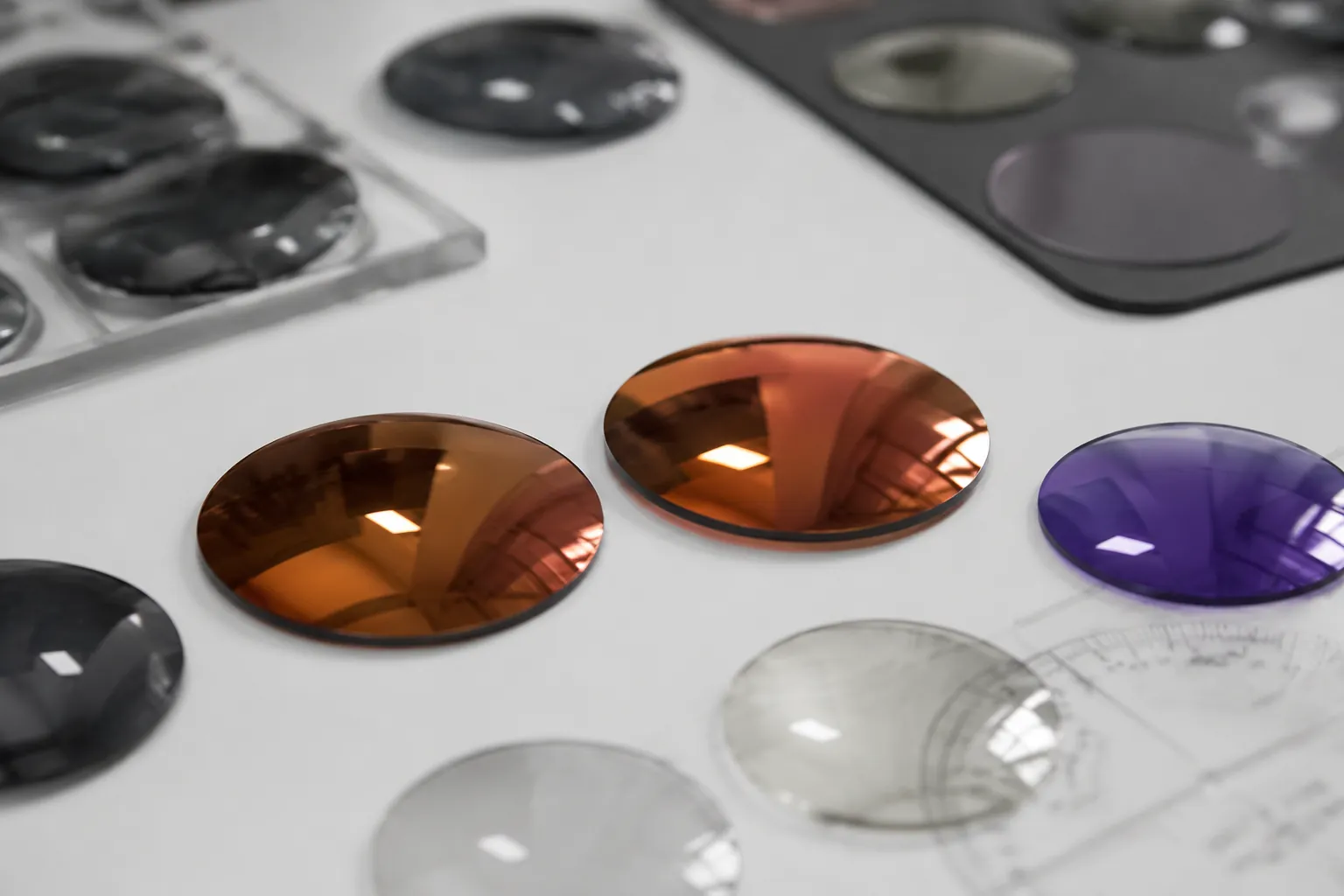
This guide is for brands, importers, distributors, and retail buyers deciding whether TAC lenses fit a sunglass program. TAC can help control weight and cost, support many tint options, and speed up sampling. But it only works well when the frame design, QC plan, compliance file, and retail promise match the material. Here is a factory-level guide to thickness, polarization, MOQ and price logic, decoration, lead times, testing points, and the retail channels where TAC is a practical choice.
The Short Decision: Where TAC Fits
TAC usually means triacetate cellulose laminated lens material. It is one of the most common choices for value and mid-market sunglasses. It is thin, light, easy to tint, widely available, and often used in polarized lens constructions. For many private label programs, TAC is a cost-efficient way to offer smoke, brown, green, gradient, mirror, and polarized options without developing an injected lens mold.
The fit is specific. TAC works well for fashion sunglasses, promotional ranges, beach retail, resort shops, travel retail, pharmacy and convenience channels, festival drops, and seasonal online collections. It is usually a poor first choice for safety-adjacent products, high-impact sports eyewear, rough-use children's sunglasses, or aggressive wrap frames where lens stress is high.
Use TAC when the customer is buying style, sun protection, and optional glare reduction at a competitive retail price. Do not use TAC when the customer expects heavy impact resistance, hard outdoor use, or premium sports optics. A sample can look clean. That is not enough. The lens also has to survive edging, assembly, shipping, shelf display, and normal consumer handling.
For B2B buyers, the decision should come before sampling. Confirm the target retail price, warranty expectation, frame design, lens category, UV claim, destination market, and packaging method. If those points fit TAC, it can be a strong material choice. If they do not, polycarbonate, nylon, or injected polarized lenses may be safer options.
Cost Position by Lens Type
TAC is popular because its cost position is usually lower than molded polycarbonate, nylon, or injected polarized lens options. Stock availability is broad. Factory processing is familiar. Non-tooled lens shapes are also easier to support in small or seasonal programs. Final cost still depends on lens color, polarization, mirror coating, curvature, cutting yield, inspection level, packaging, and order quantity.
At LumiShades, MOQs start from 50 pairs per design for custom programs. Pricing usually improves at higher quantities because setup, sample handling, logo preparation, packaging work, and QC time are spread across more units. Buyers should request quotes against the exact frame, lens type, lens color, logo method, packaging, inspection level, and Incoterms. Do not assume a fixed TAC lens price.
| Lens Option | Typical Thickness | Cost Position | Best Use | Main Buyer Risk |
|---|---|---|---|---|
| Non-polarized TAC | About 0.7-1.0 mm | Lowest | Promotional, fashion, entry retail | Weak positioning if UV, filter category, and labeling claims are unclear |
| Polarized TAC | About 0.8-1.1 mm | Low to medium | Driving, beach, resort, general retail | Poor axis control or lamination defects can cause returns |
| Polycarbonate | Often about 1.5-2.0 mm, depending on design | Medium | Sport styling, kids' ranges, stronger impact story | Higher processing cost and more tooling or mold dependence |
| Nylon | Often about 1.2-1.8 mm, depending on design | Medium to high | Performance lifestyle and higher-end optical programs | May be too costly for basic price-point ranges |
| Injected polarized lens | Design dependent | High setup, efficient at scale | Large repeat orders with stable lens geometry | Tooling cost, longer development cycle, and less flexibility after approval |
Do not choose TAC only because it is inexpensive. Choose it because the channel, retail price, warranty term, and product claim fit the material. A promo sunglass, a beach shop model, and a polarized private label frame can all use TAC. They should not share the same inspection plan or packaging standard.
Material Behavior and Design Limits
TAC sunglass lenses are laminated. A common polarized build includes TAC layers, adhesive layers, and a PVA polarizing film. This structure gives weight and cost advantages, but the lens edge is less forgiving than a thicker molded lens. If the edge is chipped, compressed, poorly cut, or held under repeated stress, failures can show up as whitening, delamination, coating lift, or small cracks near the groove.
Most TAC sunglass lenses sit around 0.7 mm to 1.1 mm, although the actual thickness should be confirmed for each approved lens. Thinner lenses reduce weight and cost. They also demand cleaner edging and better frame fit. For metal frames, check groove pressure carefully around the eyewire and screw area. For acetate or plastic frames, the lens should seat securely without force. Avoid visible lens bowing after insertion. Lens movement should stay minimal under light thumb pressure. If operators need excessive heat, bending, or pressure to seat the lens, correct the frame and lens shape before bulk production.
- Good fit: lifestyle frames, fashion aviators, wayfarer styles, round acetate frames, promotional sunglasses, and adult retail ranges with normal handling.
- Risky fit: rimless designs, very tight metal grooves, children's rough-use products, cycling wraps, safety-adjacent products, and high-base sports curves.
- Common failure points: edge chips after cutting, stress marks near screws, coating scratches during packing, and delamination from poor storage or low-grade lamination.
- Factory control point: check lens fit during trial assembly and first-line production, not only during final carton inspection.
- Storage concern: avoid high heat and humidity before assembly because laminated lenses can become more vulnerable to edge separation.
The factory rule is simple. If the frame needs force to seat the lens, TAC will create risk later. The frame should hold the lens firmly, but it should not bite into the laminate edge.
Polarization, Tint, and Optics
Polarized TAC is often the most useful version of TAC for retail. Consumers can feel the benefit. It cuts horizontally reflected glare from roads, water, snow, glass, and wet surfaces. That gives retailers a clear selling point for driving, beach, fishing, resort, and summer lifestyle ranges without moving to a higher-cost lens platform.
The purchase order must define polarization clearly. Do not write only "polarized lens." Specify polarized TAC, lens color, mirror or no mirror, target filter category, UV400 or equivalent UV claim, and any coating requirement. During production, workers can use polarized test cards or LCD screens for quick checks. Batch QC should also review axis consistency, visible distortion, delamination, bubbles, tint matching, and mirror consistency against the approved sample.
Visible light transmission must match the product claim and destination-market label. Category 3 lenses are common for bright sunlight and usually have low visible light transmission, but the exact category must come from testing or supplier documentation for the approved lens. Lighter fashion tints may fall into lower categories and need different labeling. Very dark or special-use lenses may require warnings depending on the market and standard. The claim must match the tested lens, not the catalog image.
TAC can deliver a clean retail look, glare reduction, UV protection, and wide color choice. It should not be sold as precision performance eyewear unless the full product has been designed and verified for that claim. Watch for edge distortion on highly shaped lenses, uneven gradient transitions, mirror variation between batches, and low-grade polarizing film that looks inconsistent when the wearer rotates the glasses.
Compliance Points to Lock Before PO
TAC lenses can be used in compliant sunglasses. Compliance is not automatic. Lens color, transmission category, UV blocking, polarization, frame fit, warnings, markings, packaging, and destination market all matter. If the buyer approves smoke TAC and later changes to blue mirror gradient, the compliance file may need an update. Treat each lens color and category as a controlled specification, not a late cosmetic choice.
For sunglass programs, LumiShades can work against recognized compliance frameworks such as CE EN ISO 12312-1, ANSI Z80.3, AS/NZS 1067, REACH, FDA registration, ISO 9001, and BSCI, depending on the product and destination market. The importer's key question is not only "does the factory have documents?" It is this: does this exact finished sunglass, in this lens color and category, match the documents and labeling required for my market?
| Market Need | Relevant Requirement | Buyer Action Before PO |
|---|---|---|
| European Union sunglasses | CE EN ISO 12312-1 and REACH | Confirm lens category, UV data, labeling, warning text, restricted substance control, and technical file requirements |
| United States sunglasses | FDA registration and ANSI Z80.3 | Review optical, impact, UV, drop-ball, and labeling expectations for the product type |
| Australia and New Zealand | AS/NZS 1067 | Match lens category, usage warning, UV performance, and retail labeling to the standard |
| Retail chain audits | ISO 9001, BSCI, and buyer-specific audit rules | Confirm factory documentation, inspection process, restricted-substance controls, and traceability before quotation approval |
The cleanest process is direct. Approve the exact lens, frame, logo, packaging, warning text, and destination market before bulk production starts. Changing a lens after sample approval can affect price, lead time, packaging claims, and compliance paperwork.
Lead Time, MOQ, and Production Flow
TAC is usually not the slowest part of a custom sunglass order. Frame tooling, acetate color sourcing, metal part development, decoration, packaging, compliance review, and customer approvals often create more delay. Lens changes can still stop production if the buyer approves one sample and later asks for a different tint, mirror color, polarization grade, or filter category.
For a typical LumiShades order, sample and bulk lead times should be confirmed case by case. They depend on component availability, order quantity, decoration workload, packaging complexity, testing needs, and approval speed. Small orders near the MOQ are useful for test launches, retail trials, or influencer drops. They are less price-efficient. Higher-volume orders usually make it easier to standardize materials, cartons, barcode labels, QC sampling, and reorder planning.
- Confirm frame material, lens type, lens color, polarization, filter category, UV claim, and destination market.
- Cut or source sample lenses and assemble them into the approved frame.
- Check lens fit, groove pressure, tint consistency, visible defects, polarization, and basic optical performance.
- Approve decoration such as laser engraving, pad printing, metal logo plates, hot stamping, or temple printing.
- Run bulk production through the relevant frame, lens, decoration, assembly, and QC processes.
- Pack according to the buyer's pouch, case, carton, barcode, hang tag, warning label, and retail display requirements.
The fastest orders have complete specifications and few late changes. TAC can be quick to source and process. Buyer indecision, unclear labeling claims, and last-minute packaging changes are what slow the schedule.
Decoration, Packaging, and Channel Fit
Match the lens to the sales channel before negotiating tiny cost differences. TAC can support very different products, from a simple giveaway sunglass to a polished private label polarized range. The difference sits in the frame material, logo method, hinge quality, pouch or case, lens consistency, and inspection level.
Decoration affects both positioning and risk. Pad printing is cost-effective for simple temple logos, but it should be checked for rubbing during packing and transport. Laser engraving can work well on suitable metal parts and some acetate details for a cleaner look. Metal logo plates raise perceived value but add component cost and assembly control. Hot stamping can support fashion effects. Lens stickers and retail tags must not leave adhesive marks on TAC coatings.
- Promotional buyers: prioritize UV compliance, low breakage, fast packing, simple smoke or brown lenses, and durable low-cost logo printing.
- Fashion brands: use TAC for seasonal colors, gradients, mirror effects, and quick drops where style drives purchase.
- Outdoor lifestyle retailers: consider polarized TAC for glare reduction, but avoid high-impact sports claims unless the product is tested and positioned for them.
- Distributors: standardize two or three lens colors to reduce stock complexity, compliance testing, and reorder risk.
- Online brands: photograph mirror and gradient TAC accurately because returns rise when product images overstate lens color or reflectivity.
Packaging should protect the lens, not just display the brand. Loose bulk packing can scratch coatings. Clean polybags, microfiber pouches, paper sleeves, clamshells, or hard cases should be chosen by retail price, shipping route, and inspection expectations. For TAC lenses, any package surface that rubs against the lens during vibration, transit, or carton movement can create visible complaints at receiving inspection.
Factory QC Checklist for TAC Orders
The best TAC programs are controlled at incoming lens inspection, trial assembly, line production, and final audit. Waiting until carton inspection is too late. By then, edge chips, tint mismatch, axis errors, or packing scratches may already be spread across many finished pairs.
For TAC orders, buyers should require QC checks that connect the lens to the actual frame, not only to a drawing. Lens fit, groove pressure, screw tension, temple pressure, logo position, pouch fit, and carton protection should be checked before full-line assembly and again before shipment.
- Check lens color against the approved sample under consistent light, not mixed warehouse lighting.
- Verify UV and filter category claims against the approved compliance plan.
- Inspect polarized TAC for axis consistency, delamination, bubbles, and obvious stress marks.
- Review lens edge quality after cutting, especially on sharp corners, aviator shapes, and thin rims.
- Test assembly pressure by opening and closing temples, flexing lightly, and checking for lens movement.
- Check decoration adhesion with reasonable rub handling before approving mass packing.
- Protect lenses during packing with clean bags, paper, pouch design, or case structure that does not rub the coating.
A low-cost lens is not the problem. An uncontrolled lens is the problem. TAC works when the buyer's spec sheet is clear and the factory rejects parts that do not match the approved standard.
Have a custom sunglasses project in mind?
Send us your styles, target market and quantities and we will return a detailed quote with MOQ, lead time and a sample plan.
Get a QuoteWhy source this from Wenzhou with LumiShades
Wenzhou in Zhejiang Province is widely regarded as China’s eyewear manufacturing capital, producing a large share of the world’s sunglasses. That concentration matters to buyers: a deep local supply chain for acetate sheet, hinges, lens blanks, plating and packaging means shorter component lead times, easier color and material matching, and a workforce with decades of eyewear-specific skill. LumiShades has manufactured in this ecosystem since 2009, and our vertical integration — in-house injection molding, acetate cutting, CNC milling, lens tinting, decoration and quality control — means no part of your order is quietly subcontracted to a workshop you cannot audit.
For international buyers, that vertical control translates into accountability. When a single factory owns every step, defects are traced and fixed at source rather than bounced between vendors, and your specifications survive intact from first sample to bulk. For procurement review, buyers can request process records, approved samples, quality checkpoints and project-specific compliance files before placing a bulk order. Required testing and documentation are confirmed against the destination market and product specification rather than assumed from a generic certificate list. Explore our manufacturing capabilities and quality control process to see how this works in practice.
Frequently asked questions
Is TAC good enough for polarized sunglasses? Yes. TAC is suitable for many polarized lifestyle, driving, beach, resort, and general retail sunglasses. The buyer should specify polarized TAC in the PO, approve the exact lens color and category, confirm UV and visible light transmission documentation, and require polarization checks during incoming inspection and final QC.
What MOQ should I expect for custom TAC sunglasses? At LumiShades, custom TAC sunglass programs can start from 50 pairs per design. For better pricing and smoother production, ask for tiered quotes at practical volume breaks. Confirm what changes at each level, including logo setup, packaging, inspection method, lens color availability, and reorder conditions.
Can TAC lenses pass CE or US requirements? They can, but only when the finished sunglasses meet the relevant test, documentation, and labeling requirements. For EU programs, confirm CE EN ISO 12312-1, REACH, lens category, UV performance, warning text, and technical file needs. For US programs, confirm FDA registration, ANSI Z80.3 expectations, UV performance, impact-related requirements, and retail labeling before approving bulk production.
What is the biggest quality risk with TAC lenses? The biggest risks are edge damage, lamination stress, and inconsistent polarization control. Buyers should avoid tight grooves, rough edging, excessive assembly force, poor storage, abrasive packing, and late lens changes after sample approval. Add trial assembly and incoming lens inspection to the QC plan, not only final carton inspection.
Should I choose TAC or polycarbonate for sports sunglasses? Choose TAC for lifestyle sport styling when the frame is not too curved, the lens is not under heavy stress, and the product is not sold with high-impact claims. Choose polycarbonate, nylon, or another suitable lens platform for rough-use sports positioning, children's products, high-curvature wraps, or programs where stronger impact performance is part of the product promise.
Ready to start?
Explore our aviator sunglasses or request a quote — our sales team replies within 12 hours.
Request a Quote