
Photochromic Sunglasses Sourcing & QC Guide
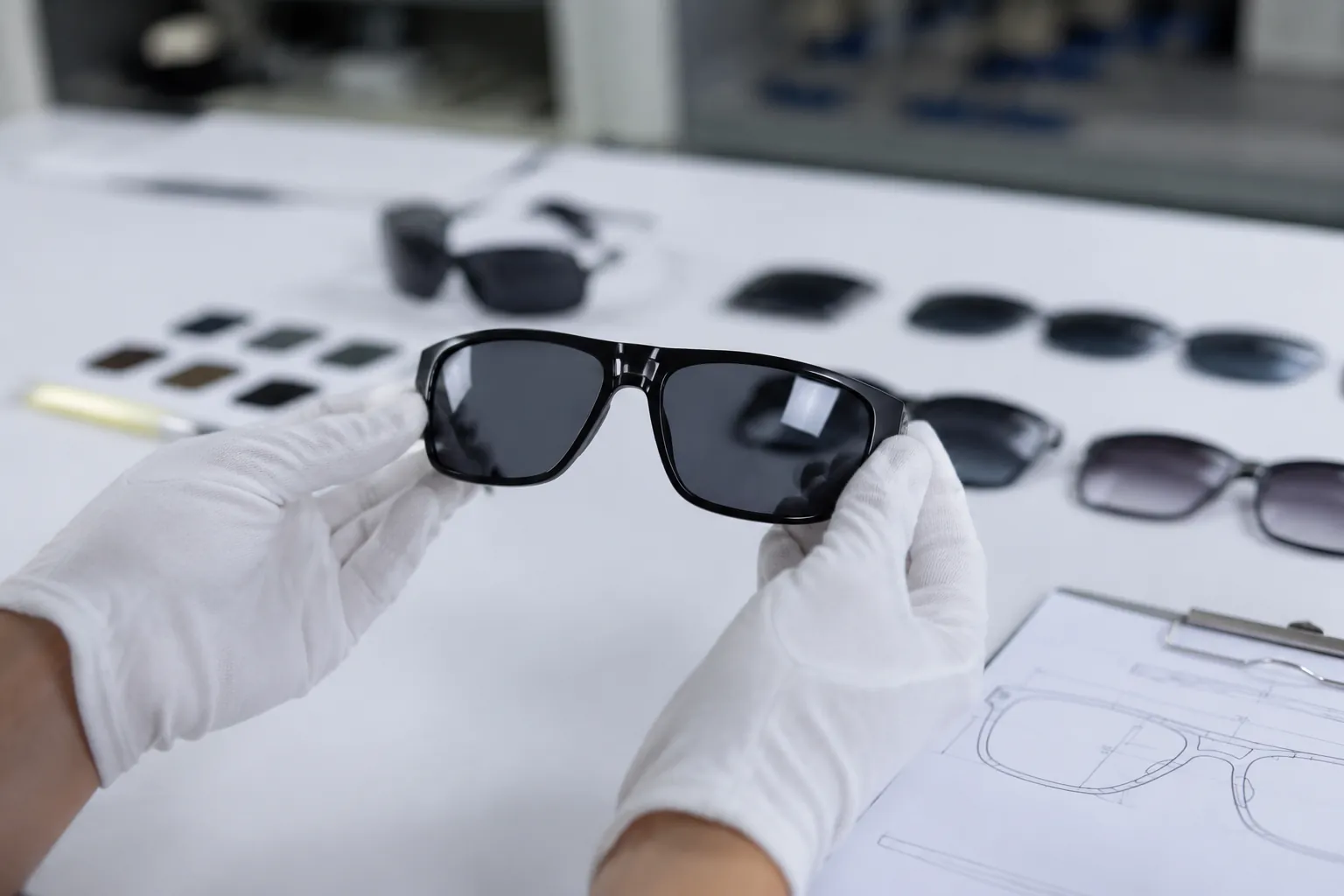
This guide is for private label brands, importers, distributors, and retail buyers sourcing photochromic sunglasses for volume orders. It explains where light-adaptive lenses make commercial sense, what to put in the spec sheet, how PC, TAC, nylon, and CR-39 lenses differ, and which QC checks should happen before shipment. The aim is simple: fewer vague samples, fewer arguments about lens darkness, and purchase orders the factory can verify and build consistently.
Start With the Commercial Use Case
Source photochromic sunglasses around a real use case, not a catalog image. The lens feature works best when the product story is clear: cycling glasses that move from shade to open road, fishing sunglasses for shifting cloud cover, running eyewear for changing daylight, kids' outdoor glasses, travel sunglasses, or retail programs where one lens benefit is easy for staff to explain.
The weak case is a fashion-only program expecting a dramatic "clear indoors, dark outdoors" change at the lowest price. Many photochromic sunglass lenses keep a visible base tint indoors. Most standard systems react mainly to UV, so activation may be limited behind car windshields, shop windows, or other UV-filtering glass. Temperature matters too. High heat can reduce final darkness. Cold sunny conditions can make the lens look darker.
Define the selling claim before sampling. A realistic claim may be "light-adaptive gray lens with visible darkening in sunlight," backed by a target visible light transmission range under defined test conditions. Avoid claims such as "clear-to-black" unless the exact production lens has test data to support them. If the retailer wants a driving-related claim, test the exact lens inside a vehicle and check the claim against market requirements before approving packaging. For sport, prioritize impact resistance, wrap stability, secure fit, and sweat exposure. For kids, prioritize low weight, hinge safety, rounded edges, and coating durability.
Blunt sourcing rule: Do not approve a photochromic sunglasses order from a render, catalog photo, or supplier video. Approve it from physical samples tested under the light, temperature, and use conditions your customers will face.
Choose the Lens Before the Frame
The lens decision affects frame groove design, screw tension, lens curve, packaging claims, and inspection method. Buyers often start with frame color, temple logo, and retail box. That is risky for photochromic sunglasses. Choose the lens material, curve, tint range, and coating stack first. Then confirm which frame material and construction can hold the lens without stress marks, warpage, or optical distortion.
| Lens option | Typical use | Key sourcing risk | QC focus |
|---|---|---|---|
| PC photochromic | Sport, kids, lightweight retail programs | Scratches if the hard coating is weak; stress whitening or distortion if mounted too tightly | Impact-related requirements, coating adhesion, curve control, lens retention |
| TAC photochromic | Value retail, promotional sunglasses, polarized options | Layer separation if edge finishing, storage, or humidity control is poor | Edge quality, polarization axis if polarized, humidity aging, delamination check |
| Nylon photochromic | Premium sport eyewear and high-wrap frames | Higher material cost; tint matching and curve stability need tighter control | Optical clarity, activated color uniformity, wrap distortion, heat aging |
| CR-39 photochromic | Optical-style fashion frames and lower-wrap designs | Heavier than PC or nylon; less suitable for aggressive sport curves | Thickness, breakage resistance appropriate to the design, abrasion resistance, transmittance range |
For many private label sunglass programs, PC is a practical starting point. It is light, more impact-resistant than many conventional plastic lens materials, and widely available in gray or brown photochromic options. Nylon is often better for premium wrap sunglasses because it can support curved sport designs with good optical performance when processed correctly, but it usually costs more. TAC can work for value lines, especially where polarization is required, but edge finishing and lamination quality must be controlled. CR-39 usually fits optical-style frames better than hard sport use.
Ask for target visible light transmission, not only a color name. Define the acceptable VLT range in the unactivated or low-UV state, the VLT range after defined UV exposure, the test temperature, and the measurement method. The final filter category and labeling must match the sunglass standard and sales market. If the buyer cannot define the target range, the factory can only match a visual sample. That is not enough.
Write a Buildable Spec Sheet
A useful specification is a control document, not a mood board. Before sampling, define the frame material, lens material, base tint, activated tint, VLT target, UV claim, dimensions, hinge type, logo process, packaging, and compliance market. This prevents disputes after lenses are ordered, packaging is printed, or production jigs are prepared.
- Lens material: state PC, TAC, nylon, or CR-39; never write only "photochromic lens."
- Lens performance: define base color, activated color, VLT range, UV400 claim if supported, and whether polarization is included.
- Frame dimensions: specify lens width, bridge, temple length, total front width, lens curve, and groove depth or lens retention method.
- Decoration: choose laser engraving, pad printing, hot stamping, metal logo plate, temple insert, or printed pouch logo, and define logo artwork size and position.
- Packaging: confirm polybag, microfiber pouch, cleaning cloth, retail box, barcode label, carton mark, hangtag, and any printed performance claim.
- Compliance market: name CE EN ISO 12312-1, ANSI Z80.3, AS/NZS 1067, REACH, or FDA registration only where relevant to the market and product.
Use measurable tolerances. Avoid loose phrases such as "good quality" or "same as sample." Define dimensional tolerances for the actual construction, because injection frames, acetate frames, metal frames, and rimless or semi-rimless designs behave differently. Logo placement tolerance should reflect the surface curve and decoration method. Judge left-right lens color against a signed master sample after the same activation exposure, not against phone photos taken under different light.
Decoration also needs process detail. Pad printing is economical for temple logos, but it needs adhesion testing, especially on curved, coated, or rubberized surfaces. Laser engraving is durable, though the mark may be subtle on some plastics. Metal logo plates look premium but require tooling, positioning jigs, and checks for glue overflow, loose parts, or uneven seating. For a small validation order, keep decoration simple. Save complex inserts or multi-color printing for proven programs.
Test First Samples Properly
Sample timing depends on what can be reused. Existing molds, existing lens recipes, available hardware, and standard packaging keep timing shorter. New molds, special hardware, new lens colors, custom coatings, or custom retail packaging add time. Do not judge the first sample round by appearance alone. It must prove the design can survive production and that the photochromic behavior is commercially acceptable.
Test samples in repeatable steps. Expose both lenses outdoors in direct sunlight for a fixed period. Record the time, location, weather, approximate temperature, and exposure duration. Bring the eyewear indoors and record fading at set intervals, such as 2, 5, and 10 minutes. Repeat in weaker sunlight if the product is for everyday use, not only sport. If the lens is promoted for vehicle use, test inside the relevant vehicle environment. No data, no claim.
Inspect the assembly, not only lens color. Open and close the temples repeatedly by hand. Check hinge noise, screw loosening, temple symmetry, nose comfort, and pressure marks near the lens groove. Look at lens edges for chips, whitening, coating lift, or delamination. For wrap frames, wear the sample and check for distortion in the side field of view. A desk inspection misses too much.
Keep two signed master samples after approval: one with the factory and one with the buyer or third-party QC team. Seal them in bags and label the date, lens recipe, frame color, logo method, packaging version, and approved claim. Do not use master samples as sales samples. Scratches, age-related fading, or untracked handling can create confusion during production inspection.
Understand MOQ, Price, and Lead Time
Photochromic lenses add cost and planning risk compared with standard tinted lenses. The final quote depends on lens material, coating stack, frame material, decoration, packaging, test documents, and whether components are available or specially sourced. A low MOQ can help with validation runs, retailer presentations, and limited drops. Better unit pricing usually needs higher volume and stable specifications.
| Order stage | Typical quantity | Main purpose | Timing logic |
|---|---|---|---|
| Sample approval | 1-10 pairs | Confirm lens behavior, fit, logo, and packaging direction | Fastest when existing molds, lenses, and standard packaging are used |
| Pilot order | 50-300 pairs/design | Validate retail response and basic QC stability | May still require bulk-style material planning if lenses or packaging are custom |
| Standard bulk | 1000+ pairs/design | Improve unit cost and stabilize material purchasing | Lead time should start only after sample, artwork, materials, and deposit are confirmed |
| Program order | 5000+ pairs/design | Plan cost, inspections, packaging, and replenishment across SKUs | Often produced in scheduled waves when several colors or SKUs are involved |
The cheapest quote is often built on vague specs. Ask whether the price includes photochromic lenses, UV performance basis, hard coating, polarization if needed, logo decoration, microfiber pouch, retail box, barcode labeling, export carton marks, and compliance documents. Also confirm which production steps are handled in-house and which are outsourced. Handoffs affect lead time, traceability, and defect responsibility.
QC Points That Catch Real Defects
Photochromic sunglasses fail in predictable ways: slow or weak activation, uneven left-right lens color, coating scratches, lens warpage, frame distortion after assembly, hinge looseness, poor logo adhesion, packaging rub marks, and incorrect compliance claims. A useful QC plan catches these defects before goods leave the factory. Not after they reach a retailer warehouse.
Incoming lens inspection should verify material, base tint, surface defects, thickness, coating quality, and activation against the approved master. During assembly, operators must control lens insertion pressure. Too much force can create stress marks, especially in PC lenses. For injection frames, molding temperature, cooling time, and front curvature matter because a warped frame can twist the lens and create optical distortion.
Final inspection should include appearance, dimensions, hinge movement, screw tightness, lens retention, logo position, packaging condition, barcode or SKU labels, and carton strength. If AQL is used, define critical defects clearly: cracked lens, sharp edge, wrong lens type, unsupported UV claim, broken hinge, missing logo, incorrect packaging, or left-right lens color outside the approved sample range. Major defects may include visible scratches, loose temples, misaligned logo, uneven frame front, or dirty packaging. Minor defects may include small cosmetic marks that do not affect safety, claims, function, or retail presentation.
Do not skip optical and claim checks. Sunglasses should be checked against the applicable market standard: CE EN ISO 12312-1 for many European programs, ANSI Z80.3 for the United States, AS/NZS 1067 for Australia and New Zealand, plus REACH chemical requirements where relevant. FDA registration may support U.S. import administration for certain eyewear suppliers, but it does not replace sunglass performance testing.
Keep Compliance Claims Narrow
Compliance language must match the product, market, and test report. Do not print every logo and standard on the packaging because it looks reassuring. Overclaiming creates legal risk and retailer review problems. For Europe, CE EN ISO 12312-1 is the key sunglasses reference. For the United States, ANSI Z80.3 is commonly requested. For Australia and New Zealand, AS/NZS 1067 applies. REACH relates to chemical safety for materials, coatings, and certain accessories sold into the EU market.
Ask the supplier for documents that match the lens material and product type you are buying. A report for a black standard lens does not automatically prove a gray photochromic lens. A report for one frame material does not automatically cover every coating, paint, or decoration system. If the retailer requires SKU-level reports, say so before sampling so the factory can plan testing cost, samples, and timing.
Use certifications accurately. CE EN ISO 12312-1, ANSI Z80.3, AS/NZS 1067, REACH, and FDA registration relate to market access, product performance, chemical requirements, or import administration depending on the market. ISO 9001 and BSCI describe management system and social compliance status. They do not prove that a specific sunglass lens blocks UV or meets a transmittance category. Keep the compliance file clean: product spec, test report, approved sample photos, purchase order, inspection report, packing list, carton marks, and packaging artwork approval.
Bulk Order Approval Checklist
Before paying a deposit for bulk production, freeze the details in the purchase order and spec sheet. Most sourcing disputes start after someone changes a lens color, logo position, pouch fabric, barcode label, or carton quantity in a chat message. If the change is real, update the written approval and confirm whether it affects price, lead time, testing, or packaging claims.
- Approved sample: one signed master sample for the buyer and one for the factory, both labeled with date and version.
- Photochromic range: base color, activated color, VLT target, test condition, and acceptable visual difference.
- Production standard: frame dimensions, lens material, groove fit, hinge type, screw color, logo method, and packaging components.
- Compliance: required standards named clearly, such as CE EN ISO 12312-1, ANSI Z80.3, AS/NZS 1067, REACH, or FDA registration where applicable.
- Timing: agreed lead time after approval and deposit, with extra time allowed for new molds, special packaging, testing, or delayed material confirmation.
- Inspection plan: incoming lens check, in-process assembly check, final AQL inspection if used, activation check, and carton verification.
- Commercial terms: MOQ, price breaks, packaging inclusions, spare parts policy, rework responsibility, and claim-document responsibility.
If this is the first photochromic line, start with one or two frame colors and one lens recipe. More variants look attractive in a catalog, but every extra color adds matching, inventory, inspection, and after-sales risk. Scale only after the first shipment proves stable. Do not pay for complexity before the market asks for it.
Have a custom sunglasses project in mind?
Send us your styles, target market and quantities and we will return a detailed quote with MOQ, lead time and a sample plan.
Get a QuoteWhy source this from Wenzhou with LumiShades
Wenzhou in Zhejiang Province is widely regarded as China’s eyewear manufacturing capital, producing a large share of the world’s sunglasses. That concentration matters to buyers: a deep local supply chain for acetate sheet, hinges, lens blanks, plating and packaging means shorter component lead times, easier color and material matching, and a workforce with decades of eyewear-specific skill. LumiShades has manufactured in this ecosystem since 2009, and our vertical integration — in-house injection molding, acetate cutting, CNC milling, lens tinting, decoration and quality control — means no part of your order is quietly subcontracted to a workshop you cannot audit.
For international buyers, that vertical control translates into accountability. When a single factory owns every step, defects are traced and fixed at source rather than bounced between vendors, and your specifications survive intact from first sample to bulk. For procurement review, buyers can request process records, approved samples, quality checkpoints and project-specific compliance files before placing a bulk order. Required testing and documentation are confirmed against the destination market and product specification rather than assumed from a generic certificate list. Explore our manufacturing capabilities and quality control process to see how this works in practice.
Frequently asked questions
Can photochromic sunglasses turn completely clear indoors? Some lenses become quite light indoors, but many retain a base tint. Before approval, ask for the indoor or low-UV VLT range, the activated VLT range, and the test condition used. Approve production against a signed physical master sample, not a supplier photo.
Are photochromic lenses suitable for driving sunglasses? Be careful. Many photochromic lenses activate mainly by UV, and vehicle windshields block much of that UV. Test the exact production lens inside the target vehicle environment before making any driving-related claim, and confirm the claim against the applicable market standard and retailer requirements.
What is a practical MOQ for a private label test order? A small pilot order can validate fit, lens behavior, packaging, and retail response, but it may not deliver the best unit price. Ask the supplier to quote clear price breaks, confirm whether photochromic lenses and packaging are included, and state whether the pilot uses the same materials as bulk production.
Which lens material is best for photochromic sunglasses? There is no single best material. PC is practical for lightweight and impact-sensitive programs, nylon often suits premium sport wraps, TAC can suit value polarized lines when lamination is controlled, and CR-39 is better for optical-style fashion frames with lower curves. Choose based on use case, curve, weight, claim, and target price.
Which compliance documents should I request? Request documents for your sales market and exact product type: CE EN ISO 12312-1 for many European programs, ANSI Z80.3 for the United States, AS/NZS 1067 for Australia and New Zealand, REACH where chemical compliance is required, and FDA registration where relevant to U.S. import handling. Match reports to the actual lens material, tint, coating, and frame specification.
How long should I allow from sample to bulk shipment? Lead time depends on mold status, lens availability, packaging, testing, and approval speed. Ask the supplier to separate sample time, artwork approval time, material preparation, production time, inspection time, and shipping time. Do not start the bulk lead-time clock until the master sample, packaging artwork, compliance requirements, deposit, and materials are confirmed.
What defect is most common with photochromic sunglasses? Uneven left-right lens color after activation is common. Control it with a signed master sample, incoming lens checks, identical UV exposure during inspection, defined acceptance limits, and rejection rules for visible mismatch, coating defects, or unsupported lens claims.
Ready to start?
Explore our wayfarer sunglasses or request a quote — our sales team replies within 12 hours.
Request a Quote