
TAC Polarized Lenses: OEM Sunglasses Buyer Guide
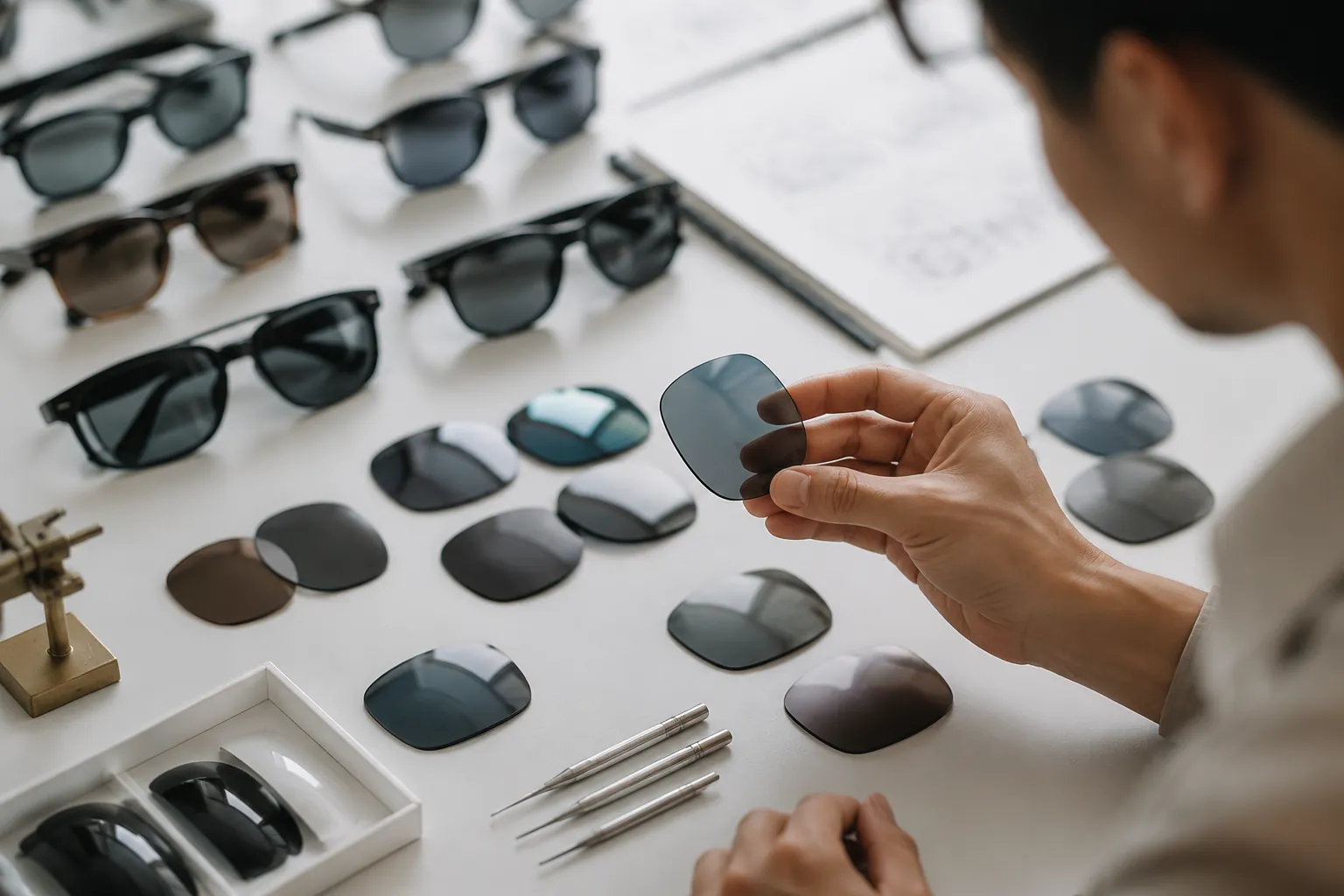
This guide is for brands, importers, distributors, and retail buyers planning custom sunglasses with TAC polarized lenses. It explains what TAC polarized lenses are, where they work well, where they do not, and which specifications must be fixed before sampling and bulk production. Use it to reduce common risks: weak polarization, lens cracking, tint drift, poor frame fit, scratched mirror coatings, wrong labeling, and compliance delays.
Where TAC Polarized Lenses Fit in an OEM Program
TAC usually means triacetate cellulose. In sunglasses, a TAC polarized lens is typically a laminated sheet: TAC outer layers, adhesive layers, and a polarizing film in the middle. The film reduces reflected glare. The TAC layers protect the film and give the lens a surface that can be tinted, coated, cut, edged, and fitted into sunglass frames.
For many lifestyle and fashion sunglasses programs, TAC polarized lenses are a practical choice. They are light, cost-effective compared with many premium lens materials, and available in many colors. They are commonly used with acetate, TR90, PC, metal, and mixed-material frames when the lens curve, groove design, and assembly pressure are controlled.
Common finished lens thicknesses include about 0.74 mm, 1.0 mm, and 1.1 mm. Around 1.0 mm is widely used for general fashion and retail sunglasses. Still, thickness is not a guess. It must match the frame groove, lens shape, and durability target.
For general sunwear, many buyers target filter category 3 lenses. The final category must be confirmed by visible light transmittance testing under the applicable destination standard. Under common sunglass standards, category 3 lenses are typically in the 8% to 18% visible light transmittance range. Do not assign the category by appearance. A dark lens or mirror coating still needs measurement.
TAC has limits. It is not the right material for every product. It is generally less impact-resistant than polycarbonate and can be sensitive to high frame stress, poor edge finishing, excessive assembly heat, and aggressive wrap designs. Tight eyewire grooves, drilled rimless styles, sharp lens corners, and mismatched base curves can cause stress whitening, edge cracks, or delamination.
TAC is usually reliable for lifestyle, beachwear, driving-oriented, resort retail, and private-label sunwear when the frame and lens are engineered together. At LumiShades, TAC polarized lenses are used in OEM programs where buyers need clear development control, repeatable production, and multiple options for frame material, lens color, logo decoration, and packaging. MOQ starts at 50 pairs per design, subject to frame, lens, logo, and packaging requirements. Samples usually take 7–10 days after specifications, artwork, and materials are confirmed. Bulk production typically runs 25–35 days after approved samples, confirmed packaging, final production files, and agreed payment terms.
TAC vs PC vs Nylon: The Buyer Trade-Off
Do not choose lens material by price alone. The wrong lens can create warranty claims, poor wearer experience, or product claims the item cannot support. Match the material to the use case, compliance target, frame design, cost target, and required test performance.
| Lens option | Typical use | Practical strengths | Limitations | Best buyer fit |
|---|---|---|---|---|
| TAC polarized | Lifestyle, fashion, beach, resort, driving-oriented retail sunglasses | Good glare reduction, light weight, broad tint and mirror options, competitive cost | Lower impact resistance than PC; sensitive to high frame stress, sharp edges, excessive heat, and poor fit | OEM sunglasses where visual comfort, polarization, and price balance matter |
| Polycarbonate polarized | Sports, kids, active-use styles, semi-rimless designs, some drilled designs | Higher impact resistance, strong durability, suitable for more demanding frame structures | Usually higher cost than basic TAC; optical distortion, coating adhesion, and stress marks still require control | Performance-oriented brands or buyers with higher durability requirements |
| Nylon polarized | Premium sport, fishing, cycling, outdoor eyewear | Good optical quality potential, heat resistance, flexibility, premium positioning | Higher material cost, often more demanding processing, and may require more controlled tooling and QC | Technical outdoor brands and higher retail price points |
| Non-polarized TAC or AC | Promotional, event, novelty, low-cost fashion sunglasses | Lower cost, simple tinting, fast development | No glare reduction from polarization, weaker product story, lower perceived value | Price-first programs where polarization is not required |
For many importers, TAC polarized lenses sit in the commercial middle. They support real polarized sunglasses, offer many color and coating options, and work for small to mid-size OEM runs. But the purchase order must be specific. "Polarized lens" is not enough.
Cost Drivers: Why TAC Lens Prices Vary
One TAC polarized lens is not the same as another. Cost and reliability can change based on polarizing film grade, lens thickness, base curve, tint process, coating package, cutting tolerance, inspection level, packing protection, and expected rejection allowance. If a supplier quotes only "TAC polarized," the quote may not match another supplier's offer.
For complete custom sunglasses at LumiShades, MOQ starts from 50 pairs per design when the product fits available development conditions. Unit pricing normally improves at higher quantities because material purchasing, color setup, logo setup, packing labor, and inspection time are spread across more units. Exact pricing must be quoted against the confirmed frame material, lens type, decoration, packaging, compliance needs, and order structure.
TAC polarized lenses usually cost more than basic non-polarized tinted lenses. That added cost often makes sense for retail sunwear, where glare reduction, UV claims, wearer comfort, and perceived value matter.
- Polarizing film grade: Better-controlled film helps improve glare reduction consistency, color stability, and defect rate. Buyers should require a defined polarization check in QC instead of relying on a claim.
- Thickness: 0.74 mm can reduce weight and cost but may be less forgiving during assembly. Around 1.0 mm is common for many fashion frames. Thicker options may require groove adjustment and fit testing.
- Base curve: 2-base to 4-base lenses are easier for many fashion shapes. 6-base and 8-base wrap styles require better forming control and lower assembly stress.
- Coatings: UV protection must be verified for the target market. Mirror coating, hard coating, hydrophobic coating, oleophobic coating, and back-side anti-reflective coating add cost and increase inspection needs.
- Color control: Smoke, brown, G15-style green, gradient, flash mirror, and multi-layer mirror colors should be approved with physical master samples. Color names and photos are not reliable production standards.
- Cutting tolerance: A practical target is often within ±0.10 mm to ±0.20 mm, depending on frame type and groove design. Oversized lenses can create stress. Undersized lenses can rattle or fall out.
- Packing protection: Mirror lenses and soft coatings need stronger protection, such as individual polybags, microfiber pouches, separator cards, protective film where suitable, or case packing.
Before comparing quotes, ask each supplier to confirm the lens stack, thickness, base curve, UV claim, coating package, test standard, inspection level, packing method, and approval sample process. Compare the same product against the same requirement. Anything else is guesswork.
Specifications to Freeze Before Sampling
The sample stage is where ambiguity should end. If the approved sample is vague, bulk production will be vague too. A good lens specification does not need to be complex, but it must be complete enough for purchasing, production, and QC teams to follow the same target.
- Lens material and structure: State TAC polarized, target thickness, and whether the lens is sheet-cut, formed, or made from prepared blanks.
- Base curve: Confirm the required curve, such as 2-base, 4-base, 6-base, or 8-base. Do not assume the factory will choose the same curve as your reference sample.
- UV protection: Confirm UV400 or the required UV transmittance under the applicable destination standard. The claim should be supported by testing or supplier documentation for the actual lens specification.
- Polarization: Define the inspection method, such as a polarization tester, crossed-lens check, or LCD screen check. For production, checks should be made during in-process inspection and final QC.
- Lens category: Confirm the filter category for the target market. Category 3 is common for general sunglasses, but the category must be based on measured visible light transmittance.
- Visible light transmittance: Agree a range for each lens color. A dark smoke lens, light brown gradient lens, and blue mirror lens should not share one loose requirement.
- Color master: Approve a physical sample. Keep one retained sample with the buyer and one with the factory production or QC team.
- Coating requirements: State mirror, hard coating, hydrophobic coating, anti-scratch coating, back-side AR, or no extra coating. For mirror lenses, define color, acceptable pinholes, edge defects, rub marks, and scratch limits.
- Frame fit: Confirm groove width, lens edge thickness, lens retention, and whether lenses can be removed and reinserted without cracking or visible stress marks.
Many lens complaints are not caused by TAC material alone. They come from frame groove depth, wrong base curve, sharp lens edges, excessive eyewire pressure, poor heating control during assembly, or rushed handling. Develop the frame and lens together. Problems are easier to catch before bulk production than after shipment.
Production Flow and QC Points That Catch Defects
A typical TAC polarized sunglasses program includes lens sheet or blank selection, tint or coating confirmation, lens cutting, edge finishing, frame preparation, logo decoration, lens insertion, cleaning, final inspection, and packing. Each step has a failure point. Check it before goods reach export cartons.
Incoming lens inspection should check scratches, bubbles, stains, delamination, haze, color variation, uneven polarization, and sheet warpage. During cutting, the factory should confirm the polarization axis before nesting the lens shapes. Wrong orientation can reduce performance and may cause the left and right lenses to behave differently.
For many frame types, lens shape tolerance should be controlled within the agreed range, often around ±0.10 mm to ±0.20 mm depending on the design. Nose-side corners and temporal edges need extra attention because stress often concentrates there.
Edge finishing matters. A rough edge, sharp corner, or uneven bevel can become the start of a crack when the lens is pressed into the groove. For acetate and TR90 frames, controlled heating may be used during assembly. Too much heat can distort the lens, affect coating appearance, or weaken the lamination. Assembly workers should avoid twisting the lens and should reject frames where the groove is visibly too tight.
- Incoming check: Inspect lens sheets or blanks for scratches, bubbles, stains, delamination, haze, warpage, and color inconsistency.
- Orientation check: Confirm the polarization axis before cutting and after assembly.
- Dimensional check: Verify lens shape against approved drawings or a master lens, especially on wrap frames.
- Stress check: Look for edge whitening, waves, pressure marks, cracks, or signs of delamination after insertion.
- Optical check: Inspect for distortion, haze, left-right color mismatch, uneven tint, and uneven mirror coating.
- Cosmetic check: Define acceptable limits for dust points, coating specks, pad-print marks, fingerprints, glue marks, and hairline scratches.
- Packing check: Make sure lenses cannot rub against metal logos, hinges, nose pads, another pair, pouch hardware, or carton dividers during transport.
Decoration adds risk. Pad printing, laser engraving, hot stamping, metal logo plates, and temple badges all affect handling and packing. A metal logo plate may look premium, but it can scratch a mirror lens if the sunglasses are packed without a pouch or separator. Review decoration, lens assembly, and packing protection together during sample approval.
Compliance: What to Ask For by Market
Polarized does not mean compliant. Polarization describes glare reduction. It does not replace UV testing, optical testing, labeling review, chemical compliance, or claim control.
Confirm the applicable requirements before mass production. Changing lens category, user information, packaging text, or product claims after production can delay shipment.
| Market or requirement | Relevant document or standard | What the buyer should confirm |
|---|---|---|
| European Union | CE, EN ISO 12312-1, REACH | Lens category, UV protection, visible transmittance, CE marking, user information, and restricted substances in frame, lens, coating, ink, pouch, and packaging where applicable |
| United States | FDA registration context, ANSI Z80.3 | General sunglass performance, applicable impact-related requirements, labeling, and accuracy of product claims |
| Australia and New Zealand | AS/NZS 1067 | Lens category, UV and visible transmittance, warning statements, and suitability for driving where applicable |
| Factory management and social audit | ISO 9001, BSCI | Quality management and social compliance status; these support sourcing confidence but do not replace product-level testing |
LumiShades can provide certification and compliance documentation related to CE EN ISO 12312-1, ANSI Z80.3, AS/NZS 1067, REACH, FDA registration, ISO 9001, and BSCI where applicable to the order and destination market. Buyers should request current documents and confirm whether they apply to the same lens material, lens color, frame material, coating, and product category being ordered.
Also review packaging, hangtags, online listings, product pages, and marketplace copy. A product can pass sunglass testing and still create a claim issue if the sales copy says "safety eyewear," "industrial protection," "night driving," "impact proof," or "for all sports" without the required product design and test evidence.
Samples, MOQ, Price Breaks, and Lead-Time Logic
Plan the OEM timeline backwards from the required delivery date. For LumiShades, sample production is typically 7–10 days after lens color, frame material, logo method, packaging direction, and required files are confirmed. Bulk production is usually 25–35 days after sample approval, final artwork, packaging approval, payment terms, and any required compliance testing plan are settled. These are planning ranges. Confirm timing against the actual order.
MOQ and lead time depend on how much is custom. A 50-pair order using an existing frame, standard TAC polarized smoke lens, and simple temple logo can usually move faster than a program with custom mirror coating, multiple logo processes, branded pouch, barcode stickers, retail carton, and market-specific warning text.
Larger orders may improve unit economics, but they also require tighter control. Color drift, coating defects, and packing damage repeat at scale. Retained samples, incoming material checks, and packing inspections become more important, not less.
The biggest schedule risks are late lens color changes, unclear logo files, unapproved packaging, missing compliance requirements, and coating changes after sample approval. Mirror lenses are especially sensitive because buyers often try to approve them from photos. Photos are unreliable. Camera settings, light angle, screen brightness, and background color can change how a mirror lens appears. Use a physical master sample under natural light and indoor light.
For approval control, keep three signed samples when possible: one for the buyer, one for production, and one for QC. Mark the version clearly. If the product is matte black TR90 with 1.0 mm grey TAC polarized category 3 lenses and a silver pad-printed temple logo, write that exact specification on the approval record. For repeat orders, confirm whether the factory should match the original approved sample or the last bulk shipment. Lenses, coatings, and frame finishes can drift slightly between batches.
Buyer Checklist Before Placing the Purchase Order
Before issuing a purchase order for TAC polarized custom sunglasses, use a checklist that covers product, compliance, decoration, production, and packing. Small assumptions become expensive claims.
- Frame: Confirm material, color, surface finish, hinge type, size, fit, base curve, and groove design.
- Lens: Confirm TAC polarized, thickness, base curve, color, coating, UV requirement, lens category, and visible light transmittance range.
- Fit tolerance: Confirm cutting tolerance, edge finish, lens retention, and acceptable stress marks after assembly.
- Compliance: Confirm CE EN ISO 12312-1, ANSI Z80.3, AS/NZS 1067, REACH, or FDA registration-related needs according to the sales market.
- Decoration: Confirm logo method such as laser engraving, pad printing, hot stamping, metal logo plate, or temple badge, including position, color, size, and abrasion expectations.
- Packaging: Confirm polybag, pouch, case, cleaning cloth, barcode, hangtag, warning text, carton quantity, separator protection, and drop protection if required.
- QC: Confirm inspection level, AQL if used, polarization check, cosmetic defect limits, lens fit check, optical check, coating check, and carton inspection.
- Commercials: Confirm MOQ, quantity-based pricing, sample cost, tooling or setup cost if any, payment terms, and shipping method.
- Timeline: Confirm sample and bulk timing only after specifications, artwork, packaging, and compliance requirements are complete.
TAC polarized lenses are a sensible choice for many custom sunglasses programs. They are not universal. They are not all equal. Buyers who define lens structure, frame fit, compliance target, decoration method, QC checks, packing protection, and approval samples get a more predictable result than buyers who only ask for "polarized sunglasses" and chase the lowest quote.
Have a custom sunglasses project in mind?
Send us your styles, target market and quantities and we will return a detailed quote with MOQ, lead time and a sample plan.
Get a QuoteWhy source this from Wenzhou with LumiShades
Wenzhou in Zhejiang Province is widely regarded as China’s eyewear manufacturing capital, producing a large share of the world’s sunglasses. That concentration matters to buyers: a deep local supply chain for acetate sheet, hinges, lens blanks, plating and packaging means shorter component lead times, easier color and material matching, and a workforce with decades of eyewear-specific skill. LumiShades has manufactured in this ecosystem since 2009, and our vertical integration — in-house injection molding, acetate cutting, CNC milling, lens tinting, decoration and quality control — means no part of your order is quietly subcontracted to a workshop you cannot audit.
For international buyers, that vertical control translates into accountability. When a single factory owns every step, defects are traced and fixed at source rather than bounced between vendors, and your specifications survive intact from first sample to bulk. We back this with 15+ years of experience, shipments to 60+ countries, more than 5 million pairs produced per year and a 98.5% on-time delivery rate. Our certifications — CE EN ISO 12312-1, FDA registration, ANSI Z80.3, AS/NZS 1067, REACH, ISO 9001 and BSCI audit — mean the compliance documentation your market requires already exists. Explore our manufacturing capabilities and quality control process to see how this works in practice.
Frequently asked questions
Is TAC polarized good enough for retail sunglasses? Yes, for many lifestyle, fashion, beach, resort, and general retail sunglasses programs. Confirm UV protection, visible light transmittance, lens category, polarization performance, and frame fit before bulk production. For high-impact sports, drilled rimless designs, children's active-use eyewear, or safety-adjacent claims, ask whether polycarbonate or nylon is more suitable and confirm the required test standard.
What MOQ should I expect for custom TAC polarized sunglasses? At LumiShades, MOQ starts at 50 pairs per design when the frame, lens, logo, and packaging requirements fit the order setup. Higher quantities normally improve unit pricing because setup and inspection costs are spread across more pairs. Confirm MOQ by SKU, frame color, lens color, logo method, and packaging type, not only by total order quantity.
What thickness is common for TAC polarized sunglasses lenses? Many fashion and retail sunglasses use around 1.0 mm TAC polarized lenses. Thinner options, such as about 0.74 mm, may reduce weight and cost but can be less forgiving during assembly. Thicker options may feel more solid but can require a wider or deeper frame groove. Always approve lens thickness together with the frame drawing or physical fit sample.
How do I verify that the lenses are really polarized? Use a polarization tester, crossed-lens check, or LCD screen check as a practical production check. For OEM orders, require the factory to check polarization before cutting and again after assembly. Also confirm left and right lens orientation. Wrong orientation can reduce glare reduction or create inconsistent performance between the two lenses.
Which compliance documents matter for polarized sunglasses? For the EU, ask about CE, EN ISO 12312-1, and REACH. For the United States, ask about FDA registration context and ANSI Z80.3. For Australia and New Zealand, ask about AS/NZS 1067. For factory-level sourcing review, ISO 9001 and BSCI may be relevant. Always confirm that the documents apply to the actual product configuration, including lens material, lens color, coating, frame material, and destination market.
Can TAC polarized lenses have mirror coating? Yes. Confirm the base lens tint, mirror color, coating type, acceptable pinholes, scratch limits, edge defects, and packing protection before sampling. Do not approve mirror color from photos alone. Use a physical master sample and review it under natural light and indoor light.
What is the normal OEM lead time? For LumiShades, samples usually take 7–10 days after specifications, artwork, materials, and packaging direction are confirmed. Bulk production normally takes 25–35 days after sample approval, final logo files, packaging approval, payment terms, and compliance requirements are complete. Custom mirror colors, new packaging, special testing, or late artwork changes can extend the schedule.
Ready to start?
Explore our round sunglasses or request a quote — our sales team replies within 12 hours.
Request a Quote