
Mirror Coatings for Sunglasses: Buyer Specs
This guide is for brands, importers, distributors, and retailers buying custom sunglasses in volume. Mirror coatings can cause problems if the spec is vague. Color drift, weak adhesion, packaging damage, and repeat-order mismatches all show up fast. Define the base lens, mirror color, approval standard, and durability requirements in writing. Do that, and you reduce rework, returns, and order disputes. Skip it, and even a good-looking sample can become a costly production miss.
What a mirror coating does
A mirror coating is a thin reflective layer on the front side of a sunglass lens. It lowers visible light transmission and creates the reflective look buyers expect. In production, the mirror is usually a vacuum-deposited metal or metal-oxide layer with a protective topcoat.
Do not treat it as one simple finish. The factory is controlling several variables at once: the base lens tint, the coating thickness, the reflectance level, and the adhesion system. They matter separately. A blue mirror on a smoke lens and a silver mirror on a brown lens can look similar in a catalog and still behave differently in production.
For B2B buying, the key point is this: mirror appearance depends on both the base lens and the coating process. A stronger mirror can hide small tint variation. It can also hide defects you would rather catch early. So approval should never rely on one indoor photo. Check the sample under daylight or a daylight-equivalent light source, with the final frame color and final lens base in place.
Material matters too. Polycarbonate is common in sport and mass retail because it resists impact, but it can be more sensitive to surface prep and coating stress than CR-39 or some nylon lenses. Trivex is stable and light, but coating performance still depends on cleaning, curing, and handling. On wrapped frames, the curvature changes the deposition angle. The same recipe may not look the same on a flat lens and an 8-base lens.
Mirror coating should be treated as a controlled process. Not decoration. The more the factory controls tinting, coating settings, and final inspection in one workflow, the easier it is to keep color and finish consistent from sample to bulk. That matters again on reorder.
The specs to put in writing
Do not ask for only "silver mirror" or "blue mirror." That is too loose. Put the spec in the purchase order, the tech pack, and the approved sample record. Cover appearance, performance, and process controls.
At minimum, specify:
- Base lens material and color, such as polycarbonate smoke, TAC gray, CR-39 brown, or a gradient base tint.
- Target lens darkness, ideally with a visible light transmission target and tolerance if the supplier can measure it.
- Mirror color family, such as silver, gold, blue, red, green, or flash mirror.
- Target visual intensity, such as light flash, medium mirror, or heavy reflective finish.
- Allowed color tolerance, for example match against one approved master sample under daylight-equivalent lighting, or a measured color tolerance if the supplier has agreed method and equipment.
- Left/right lens matching requirement, especially on mirrored polarized lenses or premium fashion styles.
- Front-side only or both sides coated, if applicable to the design.
- Adhesion, scratch, and salt-sweat expectations tied to your agreed test method.
- Compliance target: CE EN ISO 12312-1, ANSI Z80.3, AS/NZS 1067, REACH, FDA registration, ISO 9001, or BSCI, as relevant to the market and supply chain.
Ask for a physical master sample, a retained production sample, and a written sign-off record with the date and version number. A photo is not enough. Photos change with light source, camera white balance, viewing angle, and screen calibration. They do not lock color reliably.
If you are approving a seasonal line, label each mirror SKU separately. "Blue mirror" is too broad. One supplier may run a bright cobalt finish, another a darker steel-blue finish. That difference becomes a repeat-order problem if the spec is vague.
For higher-volume programs, ask how the factory controls coating thickness, curing temperature, chamber loading, and post-coating handling. A supplier that can explain those points clearly is usually easier to manage at scale.
Color, reflectivity, and sell-through
Mirror color affects how a product sells on shelf, in marketplace listings, and during wholesale line reviews. Customers react to appearance first. Optics come second. Sometimes much later.
Silver usually reads as sporty and broad-appeal. Gold reads warmer and often pairs well with brown or amber bases. Blue and green are more fashion-led and can work well in youth or trend-driven assortments, but they also carry more approval risk because buyers expect a very specific shade.
Do not confuse mirror reflectivity with the underlying lens category. A lens can look highly mirrored and still have workable visible light transmission if the base tint is lighter. The opposite is true as well: a darker base with a lighter mirror may still feel too dark for some markets. If you are building an assortment, keep the use case clear. Fashion, everyday wear, and sport should not share the same mirror spec unless the base tint and transmission target also align.
From a sell-through perspective, the wrong mirror tone can create dead stock because it photographs differently from the listing image. This is a common e-commerce problem. The buyer expects a glossy silver flash and gets a dull gray finish. Or expects bright blue and gets muted steel-blue. Even if the lens is compliant, the product can still come back because it does not match the visual promise.
If your market is price-sensitive, let the mirror support the price point. Do not ask it to carry the whole product. A lighter flash mirror can work for promotional programs. Premium fashion or sport programs usually need a more stable finish and tighter color repeatability. Better repeatability means fewer returns and fewer complaints. Simple.
Adhesion drives warranty cost
Mirror failures usually show up as edge peel, patchy wear, micro-flaking, or local haze after cleaning. That is an adhesion problem, not a color problem. In production, adhesion depends on surface preparation, deposition chemistry, curing, and handling after coating. If one step is weak, the lens may pass at shipment and fail later in a hot warehouse, a vehicle interior, or a retail display.
Ask exactly how the factory checks adhesion. The method varies, but the principle does not: the coating must survive normal cleaning, sweat, humidity, and daily handling. A useful supplier answer should mention at least one of these: cross-hatch adhesion testing, tape pull, rub resistance, wet-cloth cleaning cycles, or accelerated heat and humidity checks. Ask for the pass/fail criteria. Ask whether they are written into the inspection standard. If the supplier cannot describe a repeatable check in plain language, that is a warning sign.
The weak points are usually predictable. Lens edges are common failure zones because the coating can thin out there. Gradient lenses can be more vulnerable at the transition zone because the surface finish changes. Drilled mounts, decoration holes, metal logo plates, and heavy temple decorations can also increase handling damage if the process flow is not planned correctly.
If the frame uses screw-mounted ornaments or thick metal appliqués near the lens edge, tell the factory before sampling starts. Extra handling steps raise the risk of scratches or coating marks unless the work sequence is locked down.
For premium programs, ask for durability checks if the product will ship through hot or humid climates. Heat, humidity, salt exposure, and repeated cleaning can reveal problems that a quick bench inspection will miss. The best factories can explain how they protect the lens after coating, how long they allow for cure or stabilization, and whether lenses are packed immediately or held before final QC.
A simple comparison of mirror options
Use the mirror style that fits the channel, not just the sample card. The table below is a practical buying view, not a style guide.
| Mirror type | Typical buyer use | Strengths | Risks | Spec priority |
|---|---|---|---|---|
| Silver mirror | Sport, mass retail, daily wear | High reflection, broad appeal, hides minor base-tint variation | Can look generic; thin coatings may show scratches and edge wear | Adhesion, scratch resistance, edge durability |
| Gold mirror | Fashion, premium casual, lifestyle | Warm look, pairs well with brown or amber bases, strong shelf presence | Shade can drift toward yellow, bronze, or rose-gold across batches | Color consistency under daylight and batch repeatability |
| Blue/green mirror | Fashion, youth, seasonal assortments | Strong visual impact, useful for merchandising and content creation | Higher approval risk; small shifts in hue are obvious on reorders | Master sample control and tight visual matching |
| Flash mirror | Promo, price-driven, entry-level programs | Lower cost, bright shelf effect, easier to sell in promotional volume | Can look uneven if coating thickness varies or cure is inconsistent | Thickness uniformity and process stability |
If you need aggressive pricing, mirror finish is one place factories may try to save on process time, topcoat quality, or inspection time. That only works if your customer accepts a lighter flash, slightly lower wear life, and a wider visual tolerance. On volume programs, a modest upgrade in coating control is often cheaper than a high return rate. Especially in channels where appearance drives reviews.
What LumiShades can do in production
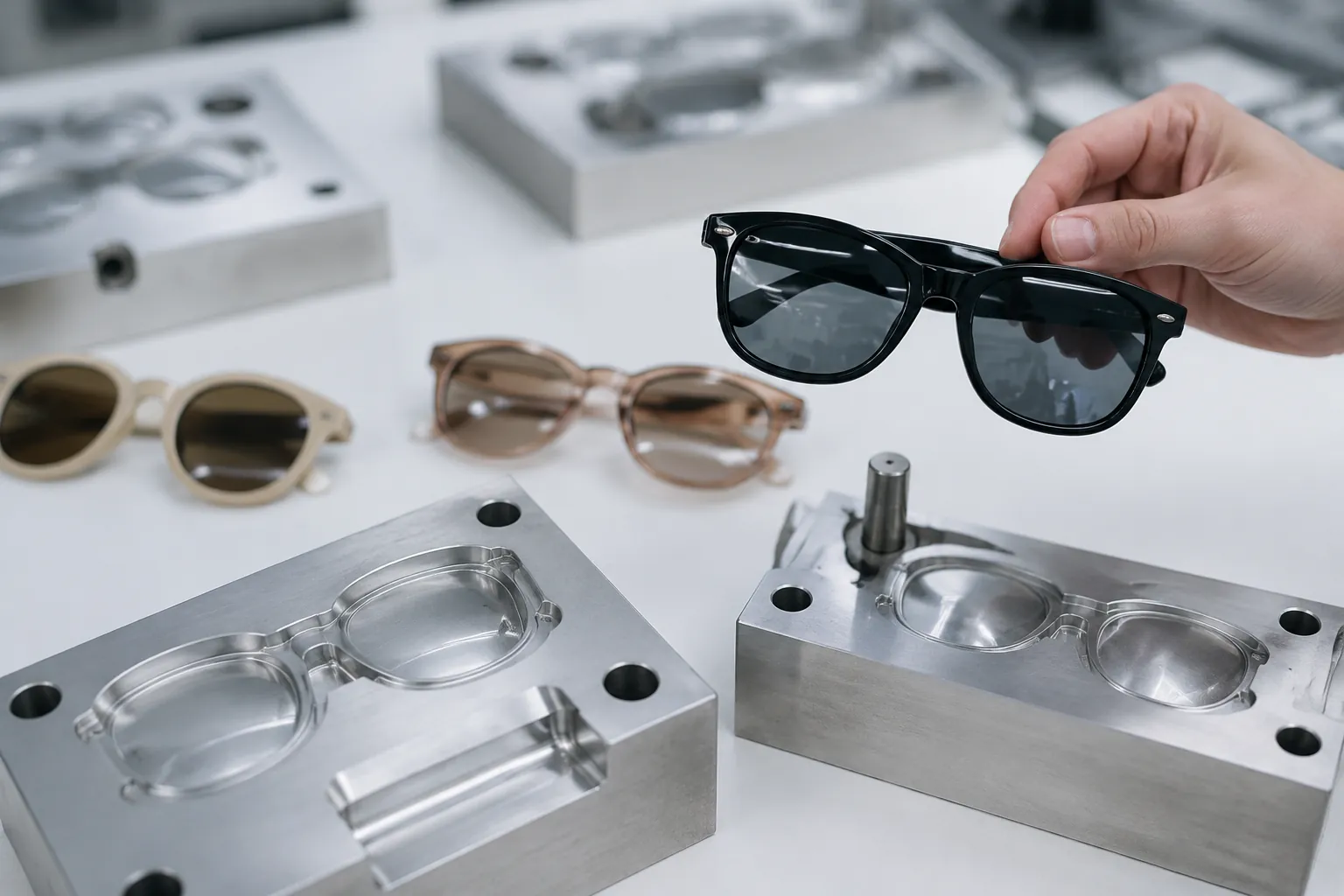
LumiShades runs injection molding, acetate cutting, CNC milling, lens tinting, decoration, and QC in-house. For mirror-coated sunglasses, that matters because the lens base, decoration position, and inspection point can be controlled in one workflow instead of being split across suppliers. Fewer handoffs usually mean fewer damaged lenses, fewer mix-ups between versions, and less color drift between pre-production and mass production.
The ordering point is simple. A lower minimum order quantity helps you test a new style, but you still need a clear spec and an approved sample before bulk production. Sample lead time and bulk lead time depend on the lens type, decoration, coating complexity, and the testing or documentation needed for the destination market. A simple mirror tint on a standard frame is typically faster than mirrored polarized lenses, custom gradient tint, or styles with multiple decoration steps.
Lead time also depends on sequence. If the style uses pad print, hot stamp, laser logo, or metal trim near the lens, the factory may need extra trial runs because decoration can affect lens handling and final inspection. The more complex the product, the more important it is to freeze the sequence before mass production. Mirror finishes are sensitive to extra handling. Marks show up fast.
If you are buying mirror-coated models for multiple markets, ask for compliance support at the quote stage. LumiShades works with CE EN ISO 12312-1, FDA registration, ANSI Z80.3, AS/NZS 1067, REACH, ISO 9001, and BSCI. That does not remove your market-specific responsibility, but it reduces the risk that a finished style becomes unusable because the testing or paperwork path was missed early.
How to avoid repeat-order problems
Most repeat-order failures come from vague specs. The first order passes because everyone is focused. The second order fails because the factory treats the sample as a loose visual reference instead of a locked standard. Prevent that early.
- Approve one master sample with the final frame color, lens base, mirror finish, and decoration together.
- Write the mirror color name, base tint, and target appearance into the purchase order, not just in email.
- Specify whether the sample or the first production lot is the reference for future runs.
- Ask for an inspection plan and define cosmetic reject points before mass production.
- Confirm packaging, because lens rubbing, nested stacking, or loose insert cards can damage weak coatings.
- Keep retained samples from every approved batch by season and customer account.
For repeat programs, define a re-order check at the factory. A pre-production photo helps, but a wet sample check is better because some mirror differences show up when the lens is wiped or exposed to moisture. If the style is being rerun after a long gap, compare it against the original retained sample under the same light source before bulk production starts. Light sources change. Operators change. Small drift gets expensive if nobody checks against the original target.
Packaging deserves more attention than it usually gets. If the mirror coating is thin or the topcoat is soft, a good lens can still pick up marks from inner bags, cardboard dust, or friction inside the carton. Tell the factory whether you need lens films, sleeve bags, insert separators, or individually wrapped pairs. Better pack-out is often cheaper than replacing a damaged shipment.
Buyer checklist before you order
Use this checklist on every mirror-coated sunglass program. It is basic, but it saves money.
- State the base lens tint, lens material, and mirror color in writing.
- Approve physical samples under daylight or a daylight-equivalent light source, not warm office lighting.
- Confirm the target market: EU, US, Australia/New Zealand, or mixed.
- Ask how adhesion is tested and what the fail criteria are.
- Check whether the mirror finish stays stable on straight and wrapped lenses.
- Confirm order quantity expectations, sample timing, and bulk lead time before you build the launch calendar.
- Get the factory to note any decoration near the lens edge that could affect coating durability.
- Ask whether packaging prevents lens-to-lens rubbing and surface abrasion in transit.
One blunt rule: if the supplier cannot explain why a mirror lens peeled, scratched, or shifted color on a past lot, do not assume the next lot will be fine. Mirror coating is process control. The factories that treat it that way protect your margin on repeat orders.
Have a custom sunglasses project in mind?
Send us your styles, target market and quantities and we will return a detailed quote with MOQ, lead time and a sample plan.
Get a QuoteWhy source this from Wenzhou with LumiShades
Wenzhou in Zhejiang Province is widely regarded as China’s eyewear manufacturing capital, producing a large share of the world’s sunglasses. That concentration matters to buyers: a deep local supply chain for acetate sheet, hinges, lens blanks, plating and packaging means shorter component lead times, easier color and material matching, and a workforce with decades of eyewear-specific skill. LumiShades has manufactured in this ecosystem since 2009, and our vertical integration — in-house injection molding, acetate cutting, CNC milling, lens tinting, decoration and quality control — means no part of your order is quietly subcontracted to a workshop you cannot audit.
For international buyers, that vertical control translates into accountability. When a single factory owns every step, defects are traced and fixed at source rather than bounced between vendors, and your specifications survive intact from first sample to bulk. We back this with 15+ years of experience, shipments to 60+ countries, more than 5 million pairs produced per year and a 98.5% on-time delivery rate. Our certifications — CE EN ISO 12312-1, FDA registration, ANSI Z80.3, AS/NZS 1067, REACH, ISO 9001 and BSCI audit — mean the compliance documentation your market requires already exists. Explore our manufacturing capabilities and quality control process to see how this works in practice.
Frequently asked questions
What should I specify for mirror coating if I only care about color consistency? Specify the base lens tint, lens material, mirror color family, and target visual intensity, then approve a physical master sample under daylight or a daylight-equivalent light source. If possible, add a visible light transmission target and tolerance so the supplier knows what consistent means in measurable terms. For repeat orders, keep the approved sample and reference it in the purchase order.
Does a stronger mirror always mean better UV protection? No. Mirror reflectivity affects appearance and visible light transmission, but UV protection depends on the lens material, lens design, and compliance testing. A mirrored lens can still fail a compliance target if the overall product is not built and tested for the market standard you need. Ask the supplier for the specific compliance route for CE EN ISO 12312-1, ANSI Z80.3, or AS/NZS 1067 as relevant.
What is the most common mirror coating failure in volume orders? Poor adhesion is one of the most common problems. It usually appears as edge peel, micro-flaking, patchy wear, or local haze after cleaning, heat exposure, humidity, or shipping stress. To reduce the risk, ask the factory what adhesion test it uses, what the pass/fail criteria are, and how it protects the lens after coating and before packing.
Can I mix mirror colors in one order with a low MOQ? Yes, if the factory can separate the versions clearly and your spec is written by SKU. At a low MOQ, color splits are easier when each variant has its own code, master sample, and packaging instruction. Make sure the quote reflects any added setup or handling so the price and lead time stay realistic.
How fast can mirror-coated samples be made? Sample timing depends on the lens type, coating complexity, decoration, and any compliance or documentation needs. A simple mirror tint on a standard frame is usually faster than a wrapped lens, mirrored polarized lens, or a style with multiple decoration steps. Ask the supplier for a written sample schedule tied to the exact style instead of relying on a general promise.
Which compliance documents matter for export sunglasses? The exact set depends on your market, but common references include CE EN ISO 12312-1, FDA registration, ANSI Z80.3, AS/NZS 1067, REACH, ISO 9001, and BSCI. Use only the standards that apply to your destination market and buyer requirements, and confirm early whether the factory can support the needed tests and paperwork.
Ready to start?
Explore our square sunglasses or request a quote — our sales team replies within 12 hours.
Request a Quote