
Mirror Coating Sunglasses: Specs for Repeat Orders
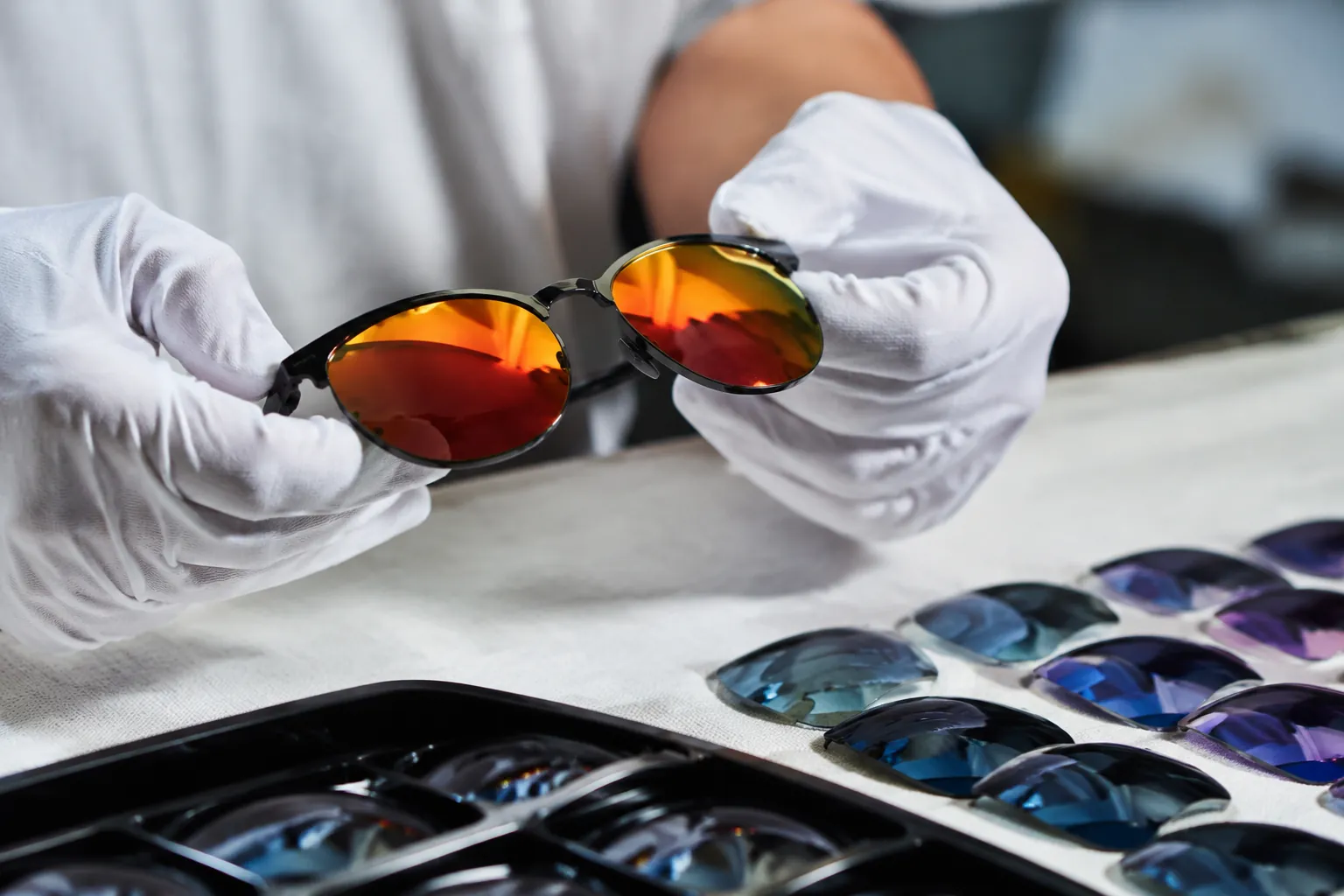
This guide is for brands, importers, distributors, and retail buyers ordering mirrored sunglasses in bulk. It focuses on controls you can verify: lens stack, base tint, coating route, tolerances, compliance documents, QC checks, and repeat-order records. The goal is simple. Make the approved sample repeatable.
Start With a Measurable Mirror Target
"Blue mirror" is not a production specification. One factory may read it as cyan. Another may make a deep royal blue. The same mirror layer can also look different over grey, brown, green, or clear base lenses. Buyers do not see the mirror layer by itself. They see the full optical system: lens material, base tint, mirror coating, frame color, lighting, and viewing angle.
A useful specification defines the lens stack. Example: PC lens, 2.0 mm nominal center thickness, smoke grey base, category 3, target VLT 10–14%, front blue mirror, inner hard coat if required, UV400, matched to approved golden sample LS-BM-042. Now sampling, production, and QC have a target. Not a guess.
Mirror coatings are semi-reflective, so the base tint still affects the final look. Silver over grey usually appears cooler and more neutral. Silver over brown looks warmer. Red or orange mirror over smoke may shift between front view and angled view. That is normal optical behavior, but it still needs written acceptance criteria.
For many sunglass programs, buyers should specify a target VLT range, not only a lens category. A practical tolerance may read: VLT must remain within the approved range, or within agreed percentage-point limits, provided the lens still meets the required category and destination standard. If lens darkness matters at retail, do not rely on category wording alone.
For repeat orders, use three controls: a sealed physical golden sample, a written lens recipe or production reference, and controlled inspection photos. Photos help communication, but camera exposure, phone processing, and monitor settings can change mirror appearance. Treat the approved lens as a controlled component. Not a style note.
Materials and Coating Routes Change the Look
Most mirrored sunglass lenses follow a similar route: lens forming, base tinting or material selection, cleaning, mirror coating, curing or stabilization if required, edging or CNC milling, assembly, and QC. Small changes at any step can affect color, VLT, surface quality, or adhesion.
- PC lenses: Common for injected fashion, sport-inspired, and promotional sunglasses. PC is lightweight and impact resistant. Surface preparation matters because molding residue or handling contamination can reduce coating adhesion.
- TAC polarized lenses: Built from laminated polarizing film layers. They need checks for polarization axis, delamination, bubbles, waviness, and heat sensitivity. A mirror coating can make laminate defects easier to see.
- Nylon lenses: Often used for higher-performance sport or premium frames. Nylon can offer good optical clarity and stable stress behavior, but material cost and process control are usually higher than for basic fashion lenses.
- Acrylic lenses: Used in some low-cost promotional programs. They may work for certain cosmetic applications, but buyers should confirm that the material fits the required impact, optical, and durability expectations.
Mirror layers are often applied by vacuum coating or related physical vapor deposition processes. Coating thickness, coating uniformity, base tint, and lens curvature all influence reflected color and transmitted light. A lens can look fine at first glance and still fail the order if VLT is outside the specified range or adhesion fails the agreed test.
LumiShades has in-house injection molding, lens tinting, CNC milling, decoration, assembly, and QC in Wenzhou. Keeping these steps close together shortens the feedback loop when a tint, fit, or assembly issue appears. It does not replace a detailed specification. It makes the specification easier to check.
Spec Sheet Fields Buyers Should Not Skip
A mirrored sunglass order needs more than frame color, logo size, and "UV400 blue mirror." The specification should be clear enough for a different production team to repeat the order months later. If the reorder depends on memory, the system is weak.
| Spec field | What to define | Recommended tolerance or evidence |
|---|---|---|
| Lens material | PC, TAC polarized, nylon, acrylic, or other approved material | Material grade or supplier reference recorded in the production file where available |
| Base tint | Grey, brown, green, smoke, gradient, clear base, or custom tint depth | Visual match to approved base or finished-lens sample; VLT measured at the agreed stage |
| Lens category / VLT | Required category and target visible light transmission range | Measured VLT must remain within the agreed range and comply with the destination standard |
| Mirror color | Silver, blue, green, gold, red, pink, purple, or custom match | Golden sample match under agreed light source at front view and angled view |
| Coating face | Front mirror only; inner hard coat, anti-scratch, or other inner treatment if required | Confirmed in sample approval record and pre-shipment inspection |
| Polarization | Non-polarized or polarized; polarization axis if relevant to the product | Axis checked on sampled units; no visible delamination, bubbles, or film defects beyond agreed limits |
| Frame fit | Full-rim, semi-rimless, rimless, shield, drilled lens, or other construction | No edge lift, cracking, pressure marks, or abnormal lens stress after assembly |
| Compliance target | CE EN ISO 12312-1, ANSI Z80.3, AS/NZS 1067, REACH, FDA registration, or other market requirement as applicable | Current reports, declarations, registrations, or supporting documents matched to the destination market and product scope |
Put acceptance language directly in the PO or tech pack. Example: "Production lenses must match approved sample LS-BM-042 under agreed inspection light at front and approximately 45° viewing angles; category 3 VLT target 10–14%; no visible pinholes at 30 cm normal viewing distance; no coating removal after the agreed tape adhesion test on sampled units." Plain language prevents arguments. It defines whether an issue is a defect, a tolerance question, or a requested change.
Control Light, Angle, and Sample Aging
Mirror color is angle-sensitive. A lens may look blue at front view, violet at 45 degrees, and nearly black under weak indoor light. Many buyer-supplier disputes start with uncontrolled photos. Both sides may be honest. They are just comparing under different conditions.
Set viewing rules before mass production. Use a D65 light box or another agreed inspection condition. Compare production lenses against the sealed golden sample at the same angle and distance. A practical method is front view at 0°, angled view at about 45°, and normal viewing distance of 30–50 cm. Do not give final approval under mixed warehouse light, unknown office LED light, or phone photos taken near a window. Use those only as informal references.
For remote approvals, request three images: front view on a neutral background, angled view at about 45°, and side-by-side photo with the golden sample. Ask the supplier to lock exposure and white balance where possible. No filters. No automatic color enhancement. Photos can screen obvious problems, but if the mirror finish is a key selling feature, approve a physical sample before bulk production.
Sample time at LumiShades is usually 7–10 days when an existing frame mold, standard materials, and simple decoration are used. New mold work, custom lens colors, special polarized lens requirements, complex logo work, or custom packaging can add time.
LumiShades MOQ starts at 50 pairs per design for many configurations. Pricing normally improves at higher quantities such as 300 pairs, 1,000 pairs, and 5,000+ pairs because setup, material purchasing, coating runs, inspection, and packing are spread over more units. Final pricing depends on the approved specification, lens material, decoration method, packaging, compliance requirements, and delivery terms.
Adhesion, Wear, and Packaging Failures
Mirror coating complaints often appear as peeling, edge lift, spotting, haze, pinholes, color bands, or scratches. These flaws are more visible on mirrored lenses than on many non-mirrored lenses. Some problems start in production. Others come from assembly pressure, packing contact, transport vibration, or poor care instructions.
- Insufficient cleaning before coating: Dust, oil, silicone, release agent, or fingerprints can reduce coating bond. Peeling may appear in patches or near lens edges.
- Weak process control: If coating, curing, or stabilization parameters are not controlled, lenses may pass a quick cosmetic check but fail after heat, humidity, rubbing, or normal handling.
- Frame stress: Tight rim grooves, drilled holes, shield-lens curvature, or aggressive lens insertion can create edge cracks, stress marks, or coating lift.
- Poor packing contact: Lenses can rub against hang tags, hard case interiors, nose pads, accessories, or unprotected parts during carton vibration.
- Wrong care instructions: Alcohol wipes, strong solvents, abrasive cloths, and dried saltwater can shorten coating life. Care cards should specify mild soap, clean water, and a clean microfiber cloth unless another method has been validated.
Basic QC should include visual inspection, VLT and UV checks, adhesion sampling, agreed rub checks, and heat or humidity checks for higher-risk retail programs. For example, a buyer may require sampled lenses to show no visible coating removal after a defined tape pull, no obvious haze after a defined heat hold, and no lens-to-packaging contact after a carton handling check. Define the method, sample size, and pass/fail criteria before production.
Compliance still matters. A mirror finish does not replace sunglass performance testing. European programs commonly require CE compliance using EN ISO 12312-1. U.S. programs commonly reference ANSI Z80.3, and FDA registration may be relevant for import handling. Australia and New Zealand programs may require AS/NZS 1067. REACH restrictions may apply to frames, coatings, inks, nose pads, cases, and packaging components depending on the product and market.
Decoration and Frame Choices Add Lens Risk
Buyers often separate lens coating from frame decoration. In production, they interact. A decorated frame may need extra handling, heat, solvents, pressure, or cleaning. Any of these can raise risk for mirrored lenses if the sequence is wrong.
| Customization method | Typical use | Lens-related risk | Control point |
|---|---|---|---|
| Pad printing | Temple logos, small brand marks, promotional graphics | Ink solvents, fingerprints, or handling marks if frames are assembled too soon | Allow ink to cure before lens insertion and packing |
| Hot stamping | Metallic logos on temples or cases | Heat and pressure can deform nearby plastic parts if settings are wrong | Stamp before lens assembly where possible and verify part shape afterward |
| Laser marking | Metal parts, subtle temple branding, selected lens marks only when approved | Incorrect settings can create residue, heat marks, or stress | Test on the actual material and clean residue before assembly |
| Metal plaques or rivets | Fashion frames and private-label retail lines | Extra assembly pressure can twist the front frame or affect lens seating | Check lens gap, seating, and stress after hardware installation |
| Premium case and insert packaging | Retail, resort, outdoor, and gift programs | Hard surfaces can rub mirror lenses during transport | Use lens bags, protective films, microfiber barriers, or revised inserts where needed |
Full-rim injected frames are usually the most forgiving because the lens edge is better protected. Semi-rimless, rimless, shield, and drilled-lens designs need closer review because the coating edge is more exposed and assembly stress is easier to see. If a mirrored shield lens is deeply curved, approve assembled samples and check for stress marks after 24–48 hours. Do not judge only the first assembled piece.
Reorder Consistency Needs Records
Repeat consistency does not come from writing "same as last order" on the PO. A proper reorder package should include the previous PO number, approved sample code, lens material, base tint reference, mirror coating reference, VLT target, packaging method, decoration method, compliance target, and inspection notes from the last shipment.
Ask the factory to retain production records. Useful records include lens material batch or supplier reference, tint parameters, coating reference or batch, QC readings, assembly notes, packaging configuration, and retained shipment samples. If your brand uses a signature mirror color, keep two golden samples: one with the buyer and one sealed at the factory.
Protect golden samples from light, heat, abrasion, and frequent handling. Replace or re-confirm them periodically because lenses can age or become scratched. If the buyer and factory samples no longer match, approve a new reference before the next production run.
For important reorders, approve a pre-production sample before mass production. It adds time. It can also prevent a shipment of "almost right" sunglasses. LumiShades bulk lead time is typically 25–35 days after order confirmation and sample approval for many standard projects. Large quantities, polarized lenses, custom packaging, metal trims, new compliance testing, or peak-season scheduling can extend this timeline.
Practical rule: If the mirror coating is part of the product identity, manage it like a controlled color standard. It needs a physical sample, written tolerance, retained records, and sign-off for each production run.
Pre-Shipment QC Checklist for Mirror Lenses
A useful QC report for mirrored sunglasses should do more than show beauty photos. It should prove four things: production matches the approved sample, lens performance is within range, compliance documents support the destination market, and packing protects the mirror surface.
- Confirm sample match: Compare production lenses with the golden sample under the agreed light, distance, and viewing angles.
- Measure lens performance: Verify UV protection and VLT or lens category against the order requirement and applicable standard.
- Inspect coating surface: Check for pinholes, scratches, cloudy areas, color bands, edge lift, uneven reflection, and contamination.
- Test adhesion on sampled units: Use the agreed tape, rub, or other approved method and record pass/fail clearly, with photos of tested lenses where practical.
- Check assembled fit: Confirm lenses are seated correctly and not under excessive stress, especially for rimless, semi-rimless, drilled, and shield styles.
- Review decoration quality: Check logo position, color, curing, scratches, hot-stamp transfer, laser marks, hardware alignment, and contamination near the lenses.
- Review compliance documents: Match reports and declarations to the target market, such as CE EN ISO 12312-1, ANSI Z80.3, AS/NZS 1067, REACH, and FDA registration where applicable.
- Check packing contact: Confirm lenses do not rub against tags, accessories, case interiors, printed inserts, or hard surfaces during normal carton handling.
LumiShades works under ISO 9001 and BSCI systems and performs in-house QC across lens tinting, decoration, assembly, and packing. Supplier QC still needs buyer-defined criteria. Put acceptance rules in the PO and tech pack. If a mirror lens is rejected, the written specification decides whether the issue is a defect, an agreed tolerance question, or a preference change.
Have a custom sunglasses project in mind?
Send us your styles, target market and quantities and we will return a detailed quote with MOQ, lead time and a sample plan.
Get a QuoteWhy source this from Wenzhou with LumiShades
Wenzhou in Zhejiang Province is widely regarded as China’s eyewear manufacturing capital, producing a large share of the world’s sunglasses. That concentration matters to buyers: a deep local supply chain for acetate sheet, hinges, lens blanks, plating and packaging means shorter component lead times, easier color and material matching, and a workforce with decades of eyewear-specific skill. LumiShades has manufactured in this ecosystem since 2009, and our vertical integration — in-house injection molding, acetate cutting, CNC milling, lens tinting, decoration and quality control — means no part of your order is quietly subcontracted to a workshop you cannot audit.
For international buyers, that vertical control translates into accountability. When a single factory owns every step, defects are traced and fixed at source rather than bounced between vendors, and your specifications survive intact from first sample to bulk. We back this with 15+ years of experience, shipments to 60+ countries, more than 5 million pairs produced per year and a 98.5% on-time delivery rate. Our certifications — CE EN ISO 12312-1, FDA registration, ANSI Z80.3, AS/NZS 1067, REACH, ISO 9001 and BSCI audit — mean the compliance documentation your market requires already exists. Explore our manufacturing capabilities and quality control process to see how this works in practice.
Frequently asked questions
Can I approve mirror color from photos only? For a first order, avoid photo-only approval if the mirror color affects retail value. Use photos to screen obvious issues, then approve a physical sample. If remote review is unavoidable, require side-by-side photos with the golden sample, fixed lighting, locked exposure and white balance where possible, front view, and approximately 45° angled view.
What is the minimum order for custom mirrored sunglasses? LumiShades MOQ starts at 50 pairs per design for many configurations. Confirm whether that MOQ applies to your exact frame, lens material, mirror color, logo method, packaging, and compliance requirements. Pricing normally improves at higher quantities such as 300, 1,000, and 5,000+ pairs because setup and inspection costs are spread across more units.
What VLT tolerance should I specify for mirrored sunglasses? Specify both the required lens category and the numeric VLT range. For example: "Category 3, target VLT 10–14%." If you allow a production tolerance, state it clearly and make sure the result still meets the destination standard. Ask the supplier to record VLT readings from pre-production and pre-shipment samples.
Do mirrored lenses still need UV and sunglass compliance testing? Yes. Mirror coating is an appearance and light-reflection feature. It does not replace sunglass performance requirements. State the destination market in the PO and request relevant support, such as CE EN ISO 12312-1 for Europe, ANSI Z80.3 for the U.S. where applicable, AS/NZS 1067 for Australia/New Zealand, REACH documentation for restricted substances, and FDA registration where relevant to import handling.
Why did my reorder mirror color look slightly different? Common causes include changed base tint, different lens material batch, coating thickness variation, different inspection lighting, sample aging, different lens curvature, or missing production records. For reorders, provide the previous PO number, approved sample code, VLT target, lens material, tint reference, coating reference, and packing method. Approve a pre-production sample if the color is commercially important.
Are polarized mirror lenses harder to control? Yes. They require the normal mirror checks plus polarization-axis verification, laminate inspection, delamination checks, bubble checks, and heat-sensitivity review. Ask for physical samples and include polarization requirements in the tech pack. If the frame has a strong curve, also check visual distortion and lens stress after assembly.
How long should I allow for samples and bulk production? For many standard projects using existing molds, sample time is usually 7–10 days. Bulk production is typically 25–35 days after order confirmation and sample approval. Add time for new molds, custom mirror colors, polarized lenses, premium packaging, metal trims, compliance testing, peak-season capacity, and freight scheduling.
Ready to start?
Explore our rimless sunglasses or request a quote — our sales team replies within 12 hours.
Request a Quote