
OEM Mirror Sunglass Lenses: Color, QC, Cost
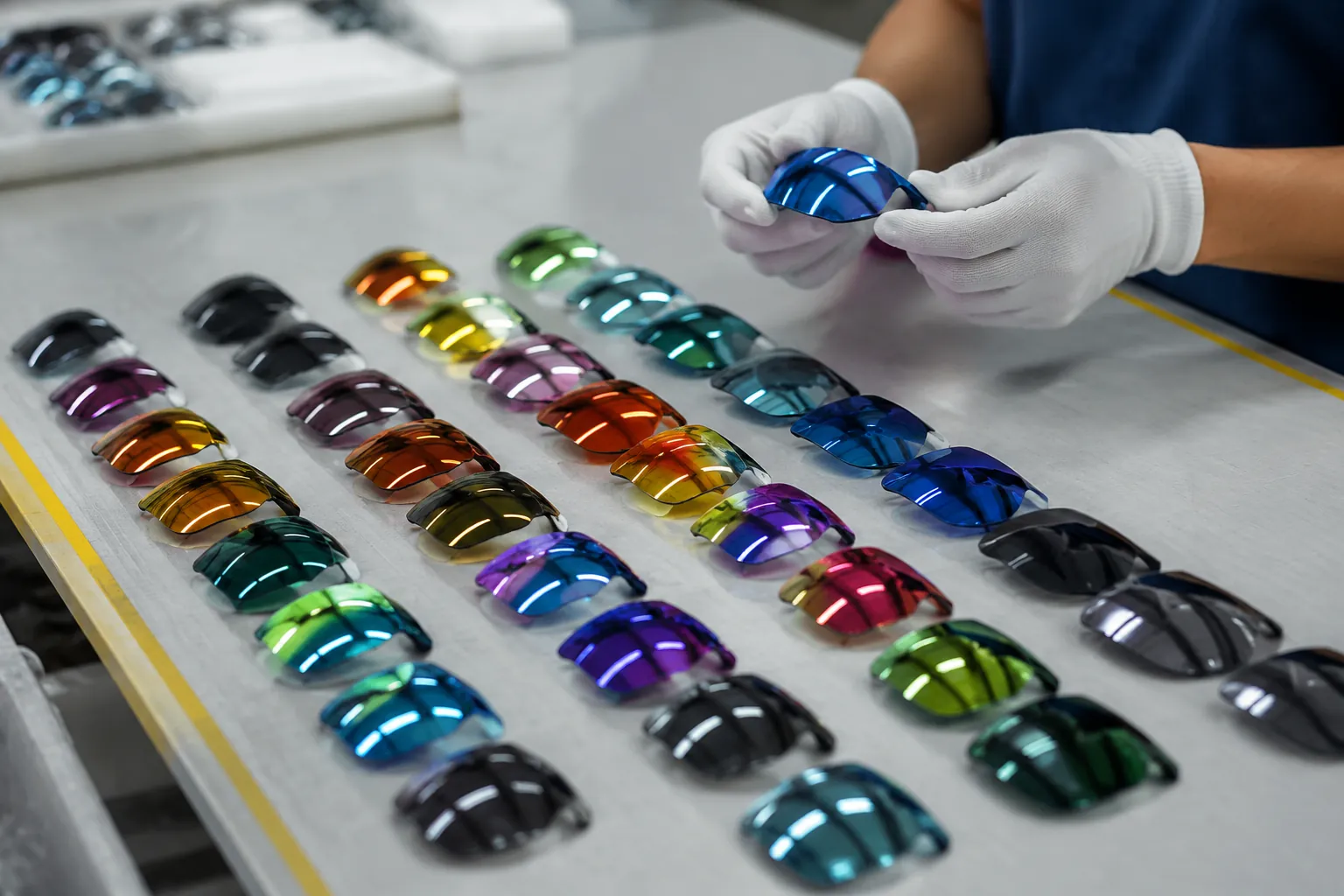
This guide is for brands, importers, distributors, and retailers buying mirror coated sunglasses in OEM volumes. It explains how to specify mirror colors, choose lens materials, check coating quality, review samples, and understand why unit price changes by quantity. Use it before approving samples. A mirror lens can look strong in a photo and still fail in production because of poor color repeatability, weak adhesion, wrong visible light transmission, incorrect polarization axis, or inaccurate category marking.
Start With the Lens Stack, Not the Color Name
Mirror lens buying often starts with a vague request: silver mirror, blue mirror, rainbow mirror, or red mirror. That is not a specification. It will not give you repeatable production.
A mirror sunglass lens is a stack. It includes the base lens material, lens shape, base tint, UV protection, mirror coating, optional hard coating, and sometimes back-side anti-reflective coating. Change one layer and the final color can change. Darkness, optical feel, and wearer comfort can change too.
For OEM sunglasses, common lens materials include PC, TAC, nylon, and CR-39. PC is widely used for injection sunglasses because it is light, impact resistant, and cost efficient. TAC is common for polarized lenses because the polarizing film is laminated into the lens structure. Nylon is often chosen for curved sport frames and wrap designs where flexibility and optical performance matter. CR-39 is valued for optical clarity, but it is heavier than PC and is usually not the first choice for low-cost injection sunglass programs.
The mirror effect sits over the tinted base. A blue mirror over gray looks colder than blue over brown. Gold over green can turn olive. Red over smoke may look almost black indoors. For production, specify both the outside reflected color and the wearer-side tint or transmission target. If the target is Category 3, visible light transmission is typically 8% to 18% under sunglass category systems. Category 2 is typically above 18% and up to 43%. The coating supplier and factory need this target before the first sample.
At LumiShades in Wenzhou, lens tinting and mirror lens sourcing should be part of the same sample approval flow as frame production, decoration, assembly, and QC. Lens color is not approved in isolation. The finished sunglasses must fit the frame, meet the intended lens category, and match the signed master sample under agreed inspection conditions.
Specify Mirror Color So the Sample Can Be Judged
Do not approve mirror lenses from a phone photo alone. Camera exposure, white balance, screen settings, and viewing angle can make a weak coating look vivid. They can also make a correct coating look wrong.
A useful mirror lens specification combines three things: a physical reference, a written color direction, and a lens category or VLT target. If no reference exists, ask for two or three lens chips before building finished sunglasses. It saves time later.
- Reflected color: silver, blue, green, gold, rose gold, red, purple, rainbow, ice blue, or gradient mirror. If the color matters, provide a physical sample or approved lens chip.
- Base tint: gray, brown, green, smoke, amber, yellow, rose, or another fashion tint. The base tint affects both the outside mirror color and the wearer-side view.
- Lens category or VLT: for example Category 2, Category 3, or a target such as 12% to 15% VLT if the buyer has a defined requirement.
- UV requirement: normally UV400 for sunglasses, with test coverage matched to the destination market standard.
- Polarization: yes or no. Polarized mirror lenses need checks for axis direction, delamination, and stress marks after assembly.
- Back surface: tint only, clear, or back-side anti-reflective coating. Back-side AR can improve comfort, but it adds cost and handling sensitivity.
- Fit dimensions: lens curve, center thickness, edge thickness, groove fit, screw hole, or rimless drilling requirement.
For bulk approval, define an acceptable color range. In practical OEM production, visual approval is often done against a signed master sample under daylight-like lighting and neutral indoor white light. If measured color control is required, request a spectrophotometer or another agreed measurement method. Confirm the measurement geometry first. Mirror surfaces are angle-sensitive.
A practical visual tolerance is simple: no obvious left-right mismatch at normal viewing distance, no color shift outside the approved master range, and no cloudy, thin, peeling, or stained coating zones on the front surface.
Material and Mirror Options: Know the Trade-Offs
Color choice affects price, reject risk, and wearer experience. Silver is usually easier to control because small hue shifts are less visible. Blue and green mirrors are common, but they still depend heavily on base tint. Rose gold, red, purple, rainbow, and gradient mirrors are more sensitive. Small coating thickness changes can show.
Gradient mirrors add another problem. The fade line must sit at a consistent height across both lenses. If it does not, the finished sunglasses look cheap.
| Option | Typical use | Production risk | Buyer note |
|---|---|---|---|
| PC lens + silver mirror | Fashion, promotional, and driving-style sunglasses | Low | Usually the safest entry choice for small OEM runs. Good impact resistance and stable cost compared with more complex lens builds. |
| TAC polarized + blue/green mirror | Beach, fishing, outdoor, and sport collections | Medium | Check polarization axis, lens category, wearer-side color, and delamination risk after assembly. |
| Nylon lens + performance mirror | Wrap frames, sport shields, and flexible designs | Medium to high | Useful for curved shapes, but lens sourcing, base curve, and tooling compatibility must be confirmed early. |
| Gold or rose gold mirror | Metal frames and acetate fashion styles | Medium to high | Can shift toward orange, copper, pale yellow, or pink depending on base tint and coating. A physical master sample is important. |
| Red, purple, rainbow mirror | Statement styles and seasonal ranges | High | Higher visual variation and reject risk. Allow an extra sample round if exact color is important. |
| Gradient mirror | Fashion and lifestyle collections | High | Confirm fade height, top darkness, bottom clarity, and left-right alignment before bulk. |
If you are buying around 50 pairs per design, choose standard mirror colors unless the lens effect is the main selling point. At higher quantities, the factory has more room to sort lenses, stabilize process cost, and reduce setup and inspection cost per unit. The exact price improvement depends on the frame, lens material, coating, logo method, packaging, testing, and order split by color.
Durability Checks to Request Before Bulk
Mirror coatings are thin. Do not call them scratch-proof. The realistic goal is controlled resistance to normal handling, cleaning, assembly, and packaging.
Many visible defects happen after coating. Edging can damage the lens edge. A tight frame groove can scrape the mirror layer. Screw pressure can stress the lens. A dirty cloth can scratch the surface. Loose packing inside a polybag can mark both lenses before the goods even ship.
A practical QC plan includes incoming lens inspection, comparison with the approved master sample, coating surface inspection before assembly, assembly-line handling checks, and final inspection after cleaning and packaging. Define critical, major, and minor defects before the order starts. Coating peel, wrong lens category, severe scratches in the central vision area, wrong logo, sharp edges, lens cracking, and loose lenses should be treated as critical or major defects depending on the buyer's AQL plan and market requirements.
- Adhesion check: use a tape pull or crosshatch-style test on test pieces where applicable. The mirror layer should not lift under normal tape removal or handling.
- Rub check: rub with a clean microfiber cloth using a defined number of cycles and consistent pressure. This helps identify weak top surfaces and cleaning sensitivity.
- Visual scratch inspection: inspect under fixed white light at consistent angles. Apply stricter standards to the central vision area than to the outer edge.
- Edge chipping check: important for rimless, semi-rimless, shield, and tight-groove frames. Poor edging can start cracks or coating lift.
- Polarized lens check: confirm axis direction, visual uniformity, no delamination, and no rainbow stress marks after assembly.
For higher retail price points, ask whether a compatible hard coating is available for the selected lens and mirror system. It can improve resistance to normal cleaning, but it still does not make the lens scratch-proof. Packaging matters too. A microfiber pouch, paper sleeve, lens film, or hard case can reduce transit scratches. For retail products, include cleaning instructions that warn against dry wiping when dust, sand, or salt is on the lens surface.
Compliance: Match the Lens to the Market
Mirror coating changes visible light transmission. That can change the lens category and the label. Do not assume the same frame with a different mirror color remains in the same category.
A dark smoke lens with a heavy silver mirror may transmit much less light than a brown lens with a light gold mirror. If category marking appears on packaging, product information, or user instructions, it must match the tested lens.
For overseas B2B orders, specify the destination market before sampling. Relevant standards, registrations, and systems that may apply to LumiShades eyewear orders include CE EN ISO 12312-1, FDA registration, ANSI Z80.3, AS/NZS 1067, REACH, ISO 9001, and BSCI. Use the terms correctly. Product standards are not factory management systems. A registration is not a product test report.
For the EU, sunglasses are commonly assessed under EN ISO 12312-1 in connection with CE requirements. For the United States, ANSI Z80.3 is commonly requested for non-prescription sunglasses, and FDA registration may be relevant for eyewear import and device establishment requirements. For Australia and New Zealand, AS/NZS 1067 applies. REACH matters for restricted substances in frame materials, coatings, paints, nose pads, temple tips, and decoration components. ISO 9001 relates to quality management systems. BSCI relates to social compliance auditing.
Ask for test reports that match the lens type you are buying. A report for black Category 3 PC lenses does not automatically prove a new rainbow mirror TAC polarized lens. If an order includes several lens colors, group them by material, tint, coating risk, and VLT target. Then decide which combinations need testing. This controls lab cost without pretending all colors are identical.
Cost Drivers: Why a Mirror Lens Quote Changes
The frame style is only one part of the quote. Mirror lenses can change price through material, coating complexity, polarization, testing, wastage, decoration, packaging, and quantity.
LumiShades supports MOQ from 50 pairs per design. Pricing usually improves at higher quantities such as 300, 1000, and 5000+ pairs. Still, any unit price must be tied to a complete specification. Do not compare prices unless lens material, coating, logo, packaging, testing, and freight assumptions are the same.
| Cost driver | Lower-cost choice | Higher-cost choice | Why it changes price |
|---|---|---|---|
| Lens material | Standard PC | TAC polarized, nylon, CR-39 | Material cost, cutting loss, optical quality, and supplier availability differ. |
| Mirror color | Silver or simple blue | Rose gold, red, rainbow, gradient | Complex colors require tighter coating control and may create higher reject rates. |
| Polarization | Non-polarized tinted lens | Polarized TAC mirror lens | Adds film structure, axis control, delamination checks, and extra inspection. |
| Testing | Existing valid report where applicable | New lens color/category test | Lab fees and sample time must be built into the project schedule. |
| Decoration | Simple pad print or laser logo | Metal logo plate, multi-color print, custom temple hardware | More labor, fixtures, reject risk, and sample rounds. |
| Quantity | 50 pairs per design | 300, 1000, 5000+ pairs | Setup, sorting, coating loss, packaging labor, and inspection cost are spread over more units. |
Decoration is often underestimated. Laser engraving, pad printing, hot stamping, metal logo plates, and custom temple inserts can all change the sample path. A low-cost lens paired with a difficult logo plate may not stay low cost.
For RFQs, ask for a quote that separates frame, lens, logo, packaging, testing, and freight assumptions. This makes later changes easier to price and reduces disputes before production.
Sample Approval Flow That Prevents Bulk Problems
A mirror lens sample should answer production questions. It should not just look good in one photo.
Typical samples may take 7 to 10 days when the material, coating, and decoration are standard and available. If a new lens color, custom logo hardware, tooling change, or compliance test is required, allow more time. Bulk production is commonly planned at 25 to 35 days after sample approval, deposit, and confirmation of components, packaging, and documents. The final schedule still depends on the actual specification and order quantity.
Use this approval sequence:
- Freeze the frame: confirm material, size, hinge, temple length, bridge fit, logo position, and lens shape first. Lens color approval is weaker if the frame may still change.
- Approve lens chips or reference lenses: compare reflected color, base tint, and darkness before finished assembly.
- Build full samples: check fit, lens tension, screw pressure, edge marks, coating scratches, wearer-side view, and left-right color match.
- Confirm market and category: decide whether CE EN ISO 12312-1, ANSI Z80.3, AS/NZS 1067, REACH, or FDA-related documentation is required.
- Sign master samples: keep one at the factory and one with the buyer. This becomes the visual and construction reference for bulk inspection.
- Set inspection rules: define AQL level, critical defects, acceptable minor marks, packaging checks, barcode checks, labeling, and carton marking rules.
Do not approve bulk from a render. Mirror lenses are physical products with angle-dependent color. Renders are useful for sales decks and retail previews, but they are not production control tools.
If remote approval is unavoidable, require fixed-light photos from the front, 45 degrees, and wearer-side views. Show both left and right lenses together. Then confirm with a physical master sample as soon as possible.
RFQ Template for Mirror Sunglass Lenses
A complete RFQ gives you a more reliable quote. Missing lens details often create a low first price followed by corrections later. That wastes time. It also creates avoidable arguments before production starts.
Buyers can copy this format:
Frame: model photo or drawing, material, size, color, hinge type, logo method, and packaging. Lens: PC, TAC polarized, nylon, or CR-39; base tint; mirror color; lens category or VLT target; UV400 requirement; coating durability expectation; destination market standard. Quantity: 50, 300, 1000, or 5000+ pairs per design and color. Approval: lens chip, full sample, signed master sample, sample deadline, test report needs, and inspection level. Shipment: destination country, carton marking, barcode, retail packaging, and required documents.
If color is critical, ship a reference lens to Wenzhou and allow at least one controlled sample round. If timing matters more than exact color, say so and choose a standard mirror option.
A supplier can optimize for color accuracy, low price, fast delivery, or low MOQ. Not all four at once. There will be trade-offs.
For mirror lenses, repeatability starts with a written specification, a signed master sample, and a QC checklist that treats the lens as a controlled component rather than a decoration. The strongest RFQs include the market standard, lens category or VLT target, reference color, acceptable tolerance, packaging method, and inspection rules before the first sample is made.
Have a custom sunglasses project in mind?
Send us your styles, target market and quantities and we will return a detailed quote with MOQ, lead time and a sample plan.
Get a QuoteWhy source this from Wenzhou with LumiShades
Wenzhou in Zhejiang Province is widely regarded as China’s eyewear manufacturing capital, producing a large share of the world’s sunglasses. That concentration matters to buyers: a deep local supply chain for acetate sheet, hinges, lens blanks, plating and packaging means shorter component lead times, easier color and material matching, and a workforce with decades of eyewear-specific skill. LumiShades has manufactured in this ecosystem since 2009, and our vertical integration — in-house injection molding, acetate cutting, CNC milling, lens tinting, decoration and quality control — means no part of your order is quietly subcontracted to a workshop you cannot audit.
For international buyers, that vertical control translates into accountability. When a single factory owns every step, defects are traced and fixed at source rather than bounced between vendors, and your specifications survive intact from first sample to bulk. We back this with 15+ years of experience, shipments to 60+ countries, more than 5 million pairs produced per year and a 98.5% on-time delivery rate. Our certifications — CE EN ISO 12312-1, FDA registration, ANSI Z80.3, AS/NZS 1067, REACH, ISO 9001 and BSCI audit — mean the compliance documentation your market requires already exists. Explore our manufacturing capabilities and quality control process to see how this works in practice.
Frequently asked questions
Can I order different mirror colors at the 50-pair MOQ? Yes. LumiShades can support 50 pairs per design, but standard mirror colors are safer at that level unless the lens color is the main selling point. For each color, confirm the base tint, mirror color, VLT or category target, and whether one shared test report is acceptable. If you split one style into many lens colors, expect higher sampling, sorting, and possible testing cost per color.
Are mirror coated lenses scratch-proof? No. Mirror coated lenses should only be described as scratch-resistant if the selected lens system includes a suitable hard coating and passes agreed handling checks. They can still scratch from sand, dust, keys, rough cloths, or dry wiping. For retail orders, request a rub check, define scratch acceptance rules for the central vision area, and use protective packaging such as a pouch, sleeve, or case.
Will a blue mirror lens and silver mirror lens use the same test report? Not automatically. Different mirror coatings and base tints can change visible light transmission, lens category, and wearer-side color. Before relying on an existing report, compare the lens material, base tint, coating type, VLT/category, polarization, and destination market standard. If the new color falls outside the tested specification, plan for additional testing.
How long should I allow for mirror lens samples and bulk production? For standard available materials and colors, sample production is commonly around 7 to 10 days. Add time for custom mirror colors, lens chips, logo hardware, tooling changes, or lab testing. Bulk production is commonly planned at 25 to 35 days after sample approval, deposit, and confirmation of packaging and documents. Confirm the final lead time against the order quantity and specification.
What certifications can be referenced for LumiShades eyewear orders? Relevant standards, registrations, and systems include CE EN ISO 12312-1, ANSI Z80.3, AS/NZS 1067, REACH, FDA registration, ISO 9001, and BSCI. Use them correctly. EN ISO 12312-1, ANSI Z80.3, and AS/NZS 1067 are product standards. REACH relates to chemical restrictions. FDA registration is not a product performance test. ISO 9001 is a quality management system. BSCI is a social compliance audit system.
What is the best way to approve mirror lens color remotely? Use physical samples whenever possible. If remote review is unavoidable, ask for photos and video under fixed lighting from front, 45-degree, side, and wearer-side angles, with both left and right lenses shown together. Also request the lens category or VLT result if category marking matters. Treat remote review as provisional. The signed physical master sample should be the final production reference.
Ready to start?
Explore our wayfarer sunglasses or request a quote — our sales team replies within 12 hours.
Request a Quote