
Polarized vs Non-Polarized Sunglasses for Buyers
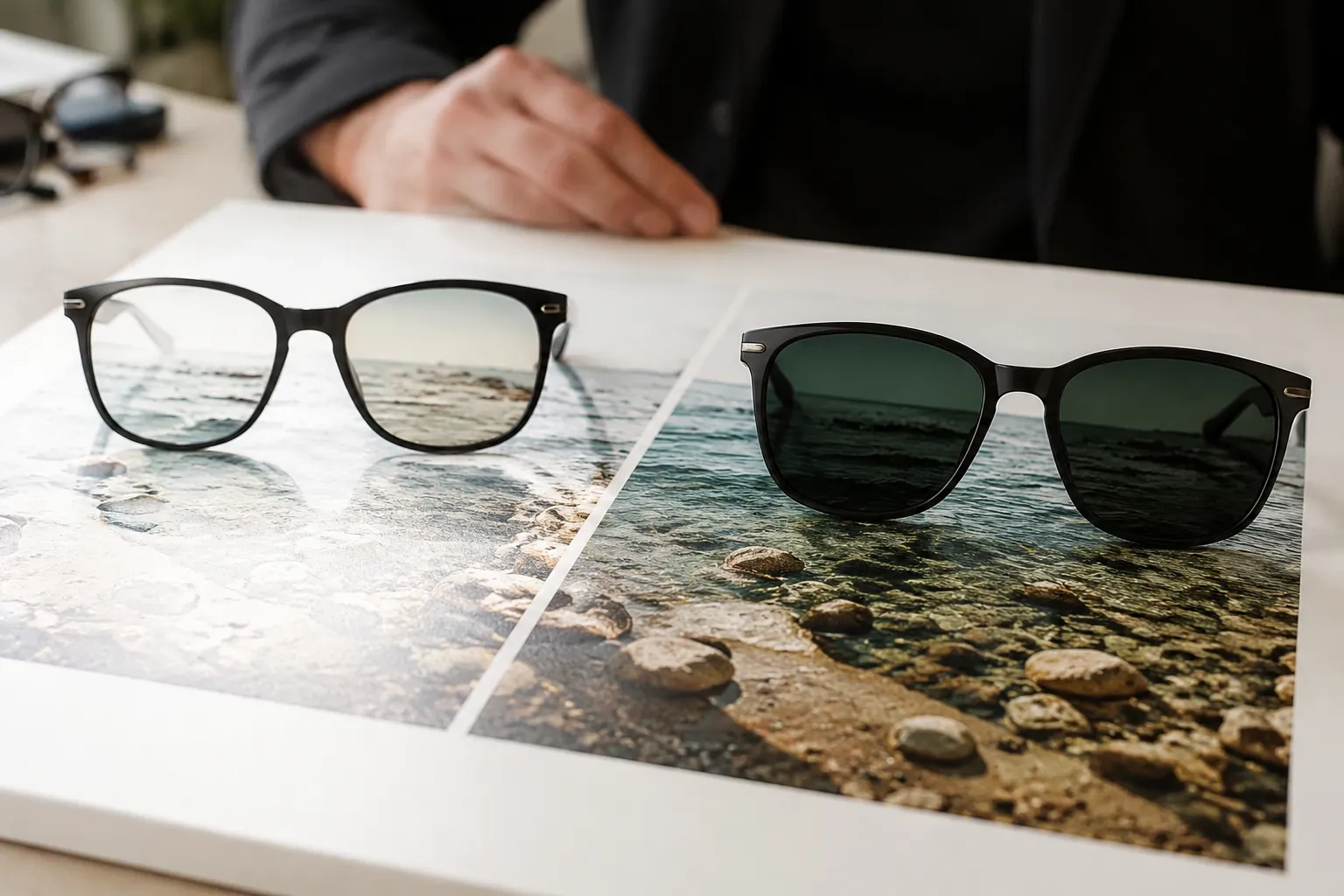
If you buy sunglasses for a brand, import business, retail chain, or distribution channel, polarized vs non-polarized is not a style debate. It is a channel, price, and sell-through decision. The right mix depends on where the product sits: travel, outdoor, fashion, promo, or low-ticket retail. This guide explains how each lens type behaves in production, how buyers usually position it, what to confirm in compliance, and how LumiShades can build both types on the same frame platform.
The buying decision starts with channel
Polarized and non-polarized sunglasses solve different buying problems. The channel usually decides which one fits. Polarized lenses use a filter that reduces reflected glare from water, roads, glass, snow, and wet pavement. Non-polarized lenses still reduce visible brightness and can provide UV protection, but they do not cut glare in the same way. That difference affects value, price tolerance, and the customer story.
For B2B buyers, the better question is not "Which is better?" It is "Which lens type matches this channel and price point?" Outdoor and travel channels often support a higher ticket because the glare-reduction benefit is easy to explain. Fashion, impulse retail, promo, and entry-price mass retail usually move more non-polarized units. The price is lower. The decision is faster. Sometimes that is enough.
At LumiShades, both versions can be built on the same frame platform. That makes it easier to compare one silhouette across two price points without changing the whole line. Frame fit stays consistent. Only the lens spec changes. That helps with assortment testing and inventory planning.
The practical rule is simple. Match the lens type to the job. If the buyer wants a product that looks good and blocks sun, non-polarized is often enough. If the buyer wants a product that reduces glare on water, road, or snow, polarized is usually the better fit. Start with the channel. Then set the frame, finish, and price tier.
Where polarized lenses add value
Polarized sunglasses are strongest where glare is part of the use case. Fishing, boating, driving, golf, skiing, beach retail, and outdoor travel are common examples. Customers can often see the difference quickly. Reflected light drops. Contrast can feel clearer. That makes the product easier to explain.
That visible function is why polarized product often supports a higher wholesale and retail price than a similar non-polarized style. The value is not just that it looks premium. It performs a specific task. Buyers can understand that. Sellers can explain it.
Polarized SKUs work best as hero items, upsell tiers, or focused category entries. Retailers do well with them where staff can explain the use case. Distributors fit them into sports, travel, marine, or premium casual eyewear. Brands use them to separate an entry line from a higher-positioned functional line without changing the frame family.
Production control matters. Polarized lenses require the polarizing layer and its orientation to be correct. They should be checked for haze, scratches, edge condition, and optical consistency. If a lens is cut or mounted under stress, distortion can appear. So polarization is both a sales feature and a process-control item. It has to be right.
Why non-polarized sunglasses still win
Non-polarized sunglasses win on simplicity, price, and range. Many buyers want a frame that looks good, reduces sunlight, and moves quickly at retail. They do not need glare cancellation. The purchase is for fashion, daily wear, event giveaways, or low-cost distribution. In those cases, lens function is secondary to shape, color, and price.
Non-polarized product also gives buyers more room in the cost stack. If the target retail price has to stay aggressive, a standard UV-protective lens leaves more room for frame material, finish, decoration, packaging, and channel margin. That matters in supermarkets, convenience stores, pharmacies, souvenir shops, and fast-moving online listings.
Sourcing is often easier too. The spec is simpler. There is less lens confusion, fewer functional claims, and fewer reasons for a buyer to reject a sample. If the program uses one frame in multiple colors, a standard non-polarized lens is usually the cleanest way to keep purchasing simple and inventory lean.
They are also flexible in presentation. A non-polarized lens can take gray, brown, and mirror-backed fashion tints without a performance-first sales story. For volume programs, that matters. Buyers want low friction, predictable reordering, and a product that looks strong in photos and on shelf without needing a demo.
Price, MOQ, and lead time
Lens choice changes cost, but it does not usually change the whole sourcing structure. Frame complexity, decoration method, lens material, tint strength, and packaging all affect the final number. For custom sunglasses programs, MOQ starts at 50 pairs per design. That is useful for sampling a new concept or testing a channel. Pricing improves at 300, 1000, and 5000+ pairs, and the exact unit cost depends on the final frame, lens, decoration, and packaging spec. Polarized lenses usually cost more than comparable non-polarized lenses because they need extra materials and tighter process control.
| Option | Typical buyer fit | Cost pressure | Sell-through logic | Lead time |
|---|---|---|---|---|
| Non-polarized UV400 | Fashion, promo, entry retail, general e-commerce | Lowest | Best when style and shelf price drive the sale | Samples 7-10 days; bulk 25-35 days |
| Polarized basic sports/casual | Outdoor, travel, driving, mid-market retail | Moderate | Best when glare reduction is easy to demonstrate | Samples 7-10 days; bulk 25-35 days |
| Polarized with higher-end frame finish | Premium retail, branded DTC, gifting with function | Higher | Best when perceived value supports a larger ticket | Samples 7-10 days; bulk 25-35 days |
The sample clock matters. It is the fastest way to validate fit, tint, and function. In a clean program, a buyer can review samples in about 7-10 days, then approve bulk once the lens color, logo decoration, and packaging are locked. Bulk production is typically 25-35 days after approval, assuming the spec is stable and the artwork is confirmed early. Late changes slow everything down.
Higher volume usually improves unit economics. At 50 pairs, the buyer pays for flexibility. At 300 pairs, production runs more efficiently and waste may fall. At 1000 pairs, custom carton, insert, and decoration costs spread across more units. At 5000+ pairs, raw-material purchasing and packing efficiency can improve further. The pattern is consistent, even if the exact breakpoints vary by spec.
What changes in production and QC
Polarized and non-polarized lenses do not go through the exact same process. A non-polarized lens is usually simpler to tint, polish, and inspect. A polarized lens needs the polarizing layer to be correct, then checked carefully for haze, scratches, edge chipping, and optical consistency. If the orientation is wrong or the lens is mounted under stress, the finished product can show visible issues.
In practical manufacturing terms, lens specs need tight control. Typical checks include lens thickness tolerance, fit in the groove, coating uniformity, and surface clarity. If the frame groove is too tight or the lens cut is off, stress marks or edge lift can appear after assembly. In custom eyewear, small errors often explain why a sample passes but bulk creates rejects. Good process control catches those issues early.
LumiShades handles injection molding, acetate cutting, CNC milling, lens tinting, decoration, and QC in-house. That matters because frame geometry and lens fit can be matched under one roof instead of being handed off between vendors. It also tightens defect control. If temple angle, lens groove depth, or bridge dimension creates stress, the issue can be corrected earlier. For polarized models, that control is especially useful because lens cutting, insertion pressure, and final inspection all affect performance.
Decoration still matters in the lens decision. Laser engraving, pad printing, foil logo plates, metal inlays, and temple branding can all work with either lens type. The right choice depends on price tier and channel. A premium polarized style often works best with restrained branding and a tighter finish package. A fashion-led non-polarized style can carry bolder color and more visible marketing because the buyer is buying style and accessibility as much as function.
Compliance, claims, and export discipline
Do not overclaim lens performance. Separate marketing language from compliance language. For Europe, eyewear should align with CE EN ISO 12312-1. For the U.S. market, relevant references include FDA registration and ANSI Z80.3. For Australia and New Zealand, AS/NZS 1067 applies. REACH matters for restricted substances, while ISO 9001 and BSCI speak to quality management and social compliance rather than optical performance.
Polarization is a feature, not a certification. A lens can only be called polarized if it actually is polarized. The product still needs the right UV protection, labeling discipline, and testing for the market being entered. Non-polarized product is not less compliant by default. It just serves a different use case. Problems start when packaging or listings imply driving safety, anti-glare performance, or premium optical benefits that the actual spec does not support.
For overseas buyers, the biggest practical risk is a vague spec sheet. A supplier may make a polarized sample, then switch to a non-polarized bulk spec if the purchase order does not explicitly lock it down. That is how disputes start. The safest approach is to freeze the lens type in the tech pack and order confirmation. State the lens material, tint, polarization requirement, UV claim, any coating, and the target standard before production starts.
As a rule, the claims should match the product. If the lens is mirrored, say mirrored. If it is polarized, say polarized. If the target is fashion retail, keep the language centered on style and sun protection. If the target is driving or outdoor use, make sure the functional claim is supported by the lens build and the compliance documents that ship with the order.
How to choose the right SKU mix
A practical assortment usually does not choose one side only. It splits by channel and price tier. If the channel is broad, start with a core non-polarized line and a smaller polarized line for functional categories. That keeps inventory risk lower while still giving you a higher-ticket option. It also lets you test which channel responds to the feature instead of guessing.
- Use non-polarized for fashion-led frames, event giveaways, and price-sensitive retail.
- Use polarized for outdoor, travel, driving, and premium casual lines.
- Keep the frame family the same where possible so tooling, fit, and packaging stay stable.
- Limit lens colors at first; too many tints slow purchasing and complicate QC.
- Test sell-through by channel before scaling the higher-cost polarized variant.
If you are launching with a 50-pair MOQ, keep the first order simple. One frame. One or two lens colors. One decoration method. One clear channel use case. Once the top seller is clear, move to 300 or 1000 pairs to improve unit cost and stabilize supply. At that point, the main margin gain usually comes from buying efficiency, lower waste, and fewer small-batch setup costs.
A common assortment structure is 70/30 or 80/20 by volume, depending on channel maturity. The non-polarized line carries breadth and price accessibility. The polarized line carries higher average order value and stronger functional storytelling. That balance usually works better than forcing a polarized build into every style, especially when the buyer needs a clear retail ladder.
Buyer checklist before ordering
Before you approve production, make sure the lens specification and the commercial specification match. A low-cost lens on the wrong frame is still a bad buy. A strong frame with unclear lens claims is also a bad buy. Ask these questions before signing off so the supplier can quote accurately and the factory can hold the spec during production.
- Is the lens polarized or non-polarized, and is that written into the PO and tech pack?
- Which market standard applies: CE EN ISO 12312-1, ANSI Z80.3, or AS/NZS 1067?
- What is the target retail or wholesale price, and does the lens type support it?
- What decoration method will hold up at the planned volume and packaging style?
- What are the acceptable tolerances for fit, lens insertion, and cosmetic finish?
- What is the sample approval window, and what is frozen before bulk starts?
- What is the reorder plan at 300, 1000, or 5000+ pairs?
If the answers are vague, the project will drift. If they are clear, the factory can quote correctly, buy the right materials, and hold the spec through production. That matters most when the difference between a strong program and a discounted one comes down to landed cost, lead time, and how clearly the product fits the channel.
Have a custom sunglasses project in mind?
Send us your styles, target market and quantities and we will return a detailed quote with MOQ, lead time and a sample plan.
Get a QuoteWhy source this from Wenzhou with LumiShades
Wenzhou in Zhejiang Province is widely regarded as China’s eyewear manufacturing capital, producing a large share of the world’s sunglasses. That concentration matters to buyers: a deep local supply chain for acetate sheet, hinges, lens blanks, plating and packaging means shorter component lead times, easier color and material matching, and a workforce with decades of eyewear-specific skill. LumiShades has manufactured in this ecosystem since 2009, and our vertical integration — in-house injection molding, acetate cutting, CNC milling, lens tinting, decoration and quality control — means no part of your order is quietly subcontracted to a workshop you cannot audit.
For international buyers, that vertical control translates into accountability. When a single factory owns every step, defects are traced and fixed at source rather than bounced between vendors, and your specifications survive intact from first sample to bulk. We back this with 15+ years of experience, shipments to 60+ countries, more than 5 million pairs produced per year and a 98.5% on-time delivery rate. Our certifications — CE EN ISO 12312-1, FDA registration, ANSI Z80.3, AS/NZS 1067, REACH, ISO 9001 and BSCI audit — mean the compliance documentation your market requires already exists. Explore our manufacturing capabilities and quality control process to see how this works in practice.
Frequently asked questions
Which lens type usually has the higher wholesale price? Polarized lenses usually cost more than comparable non-polarized lenses because they require the polarizing layer and tighter process control. The exact price gap depends on the frame, lens material, tint, decoration, packaging, and order volume. Ask the supplier to separate frame cost, lens cost, and decoration cost so you can see where the premium comes from.
What sells faster in fashion retail? Non-polarized sunglasses usually sell faster in pure fashion retail because the price is lower and the customer is buying shape, color, and style first. They are easier to merchandise when the product does not need a performance explanation. If the channel is price-sensitive, a simpler lens spec usually helps sell-through.
Is polarized always better for driving SKUs? No. Polarized lenses are often easier to position for driving because they reduce reflected glare, but the product still has to fit your market, price point, and compliance requirements. If you market a driving benefit, make sure the lens specification, labeling, and documents support that claim and that the PO clearly states the lens type.
Can I mix polarized and non-polarized in one frame series? Yes, and that is often the best structure. Keep the frame family stable, then change only the lens specification and price tier so you can test one silhouette across multiple channels without retooling the whole line. That also makes it easier to compare sell-through and reorder behavior.
What MOQ should I plan for a custom order? A practical starting point is 50 pairs per design if you are testing a concept or validating a channel. From there, many buyers scale to 300 or 1000 pairs once the winner is clear. Higher volumes usually improve unit economics because setup, waste, and packing costs spread across more units, but the exact break depends on the final specification.
How long do samples and bulk production take? A typical sample window is 7-10 days, and bulk production is usually 25-35 days after approval if the specification is frozen and artwork is confirmed. Lead time can extend if the buyer changes lens tint, logo placement, packaging, or compliance requirements after sampling. The best way to protect the schedule is to lock the tech pack before bulk starts.
Ready to start?
Explore our aviator sunglasses or request a quote — our sales team replies within 12 hours.
Request a Quote