
Polarized vs Non-Polarized Sunglasses: Buyer Guide
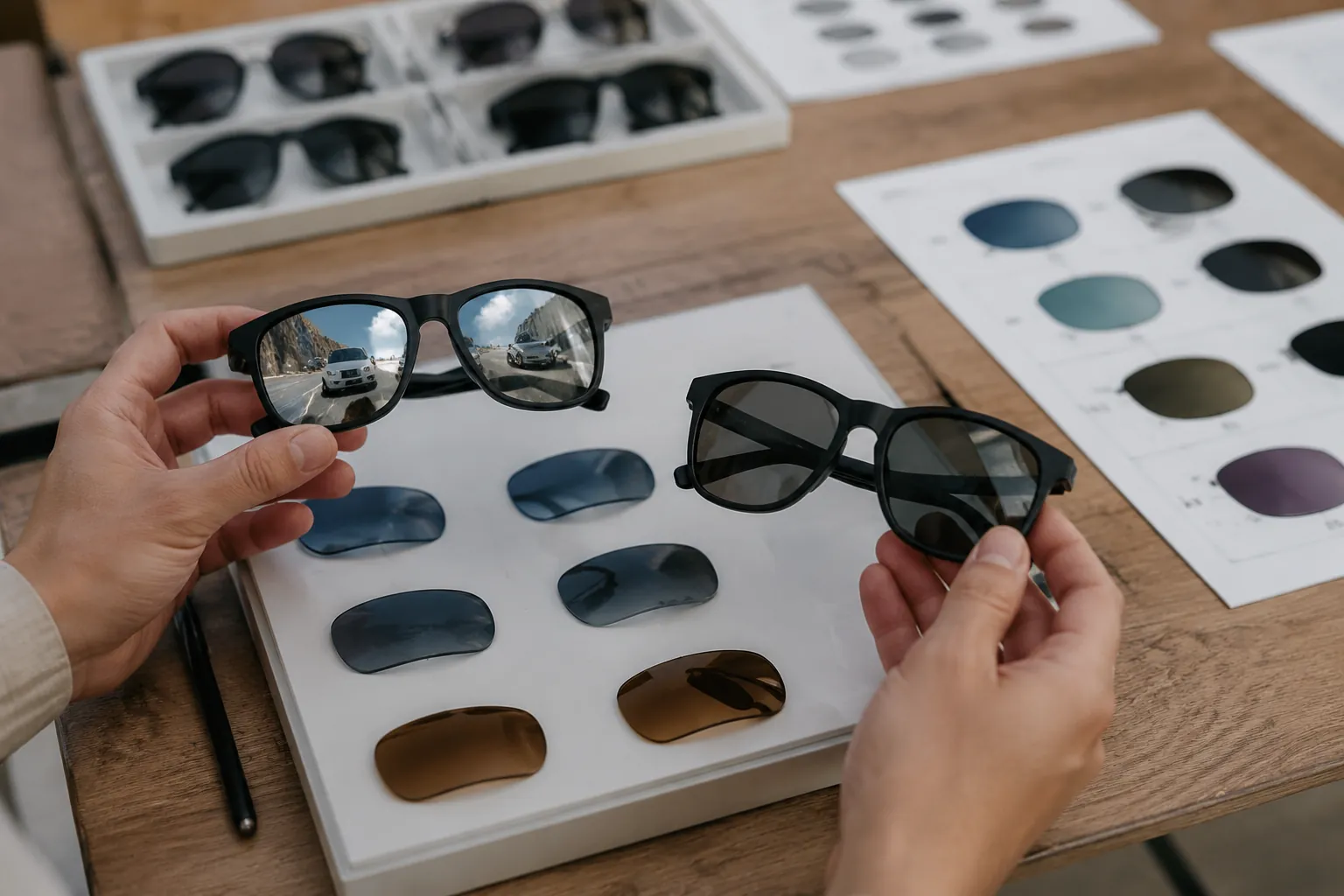
For brands, importers, distributors, and retailers, the polarized vs non-polarized decision is not about which lens is better in the abstract. It is about the channel, the target retail price, and the margin left after lens cost, decoration, freight, duty, testing, and returns. This guide covers the trade-offs in sourcing terms, with production detail, tolerance checks, and compliance points that matter in export markets.
Start With Channel, Not Lens Type
Most sourcing mistakes start with the lens. That is backwards. First decide where the product will sell, who will buy it, and what the shelf price can carry.
Polarization adds value in glare-heavy use cases. It also adds cost, tighter QC, and another feature to explain. If the channel is price-led, that extra cost often does not come back.
For mass-market fashion frames, convenience-store programs, seasonal promotions, and low-ticket private label lines, non-polarized usually wins. The retail price is too tight for a lens premium. For driving, fishing, boating, golf, outdoor travel, and premium retail capsules, polarized usually makes sense. The customer can see the benefit fast.
At LumiShades, the first questions are simple: what is the channel, what is the target retail price, and what claim set is expected? A $6.99 promo style has a very different lens budget than a $24.99 driving style. If the product sits on a wall display and the buyer has five seconds, shape, color, and perceived value may matter more than polarization. If the product is sold on function, polarization earns its place.
Use three buckets: price-first, function-first, or mixed. Price-first programs usually stay non-polarized. Function-first programs usually justify polarized lenses. Mixed programs should use both, but only where the feature changes conversion or supports a higher ticket.
What Polarization Actually Changes
Polarized lenses use a filtering layer that reduces reflected glare from flat surfaces such as water, roads, pavement, snow, and car hoods. That is the feature. Nothing more, nothing less.
Polarization does not automatically make a lens darker. It does not make the sunglasses higher quality by itself. Tint density, base curve, UV performance, surface flatness, and optical consistency still matter. Always.
In production, polarization usually means a laminated lens structure or a polarized film built into the lens stack. That adds material cost and more ways for a lens to fail: uneven transmission, bubbles, visible banding, delamination at the edge, or left-right mismatch. On lower-grade lines, these defects show up quickly in incoming QC.
Non-polarized lenses are simpler to spec and easier to quote. They suit fashion-driven programs where the buyer wants a clean UV story without extra explanation. They also give more flexibility on tint families, because the focus is on color, appearance, and sell-through rather than glare reduction.
From a buyer standpoint, the key difference is this: a polarized lens must prove its value in use, while a non-polarized lens must prove it is clean, consistent, and on-brand. A cheap-looking non-polarized lens can still get returned if the optics are hazy, the tint is blotchy, or the base curve looks uneven.
Buyer rule: pay for polarization only when the channel can turn it into either a higher conversion rate or a higher ticket. If the feature does not move sell-through, it becomes dead cost.
Cost and Margin Logic by Volume
LumiShades quotes start at MOQ 50 pairs per design, with pricing improving at 300, 1000, and 5000+ pairs. At small runs, setup, decoration, and packaging drive the price. At larger runs, lens spec and component standardization matter more. A polarized build usually costs more than a comparable non-polarized build because the lens stack is more expensive and QC is stricter.
The right question is not "How much does polarization cost?" It is "What does that feature do to gross margin?" In many programs, the incremental lens cost is only a few tenths of a dollar. The pressure comes from freight, duty, packaging, labelling, testing, and distributor markup. A $0.20 to $0.60 lens increase can be fine in a $15 to $30 retail program. In a sub-$10 program, it can wipe out the margin cushion.
At 50 pairs per design, buyers often treat polarization as a testable feature because the MOQ is low enough to validate demand. At 300 pairs, SKU mix starts to matter. At 1000+ pairs, the cost gap becomes more important than the feature story on paper, especially if wholesalers want a fixed landed-cost target.
| Program type | Lens choice | Typical buyer logic | Margin pressure |
|---|---|---|---|
| Promo / seasonal value line | Non-polarized | Keep unit cost low, minimize explanation, maximize sell-through speed | Low |
| Driving / outdoor retail | Polarized | Feature is obvious, supports higher ticket, and reduces consumer hesitation | Medium |
| Fashion-private-label midrange | Mixed | Use polarized on hero colors and non-polarized on volume colorways | Medium |
| Premium functional line | Polarized | Function drives purchase and the feature helps justify price positioning | Lower if positioned correctly |
Do not make every style polarized. That narrows the price ladder and creates inventory imbalance. Reserve polarization for the styles with the clearest use case. Let the rest carry the assortment through lower cost and more color flexibility.
Material Behavior, Tolerances, and Decoration
Lens choice never sits alone. It interacts with frame material, geometry, and decoration. In acetate programs, polarized lenses can look especially clean because the frame has more visual mass, but the lens edge fit still needs control. In injected acetate or TR90-style light frames, alignment and optical clarity matter more because the platform looks more technical. In metal frames, spring-hinge tension and lens retention tolerance become easier for the customer to notice.
A practical lens tolerance target for many wholesale eyewear programs is about ±0.2 mm on lens cut, with consistent left-right centering and no visible wobble in the rim. For base curve, the higher the curve, the more important it is to confirm that the polarized film does not introduce edge distortion. Ask for the same tolerance standard on both lens types. Do not accept a looser spec for non-polarized just because it is cheaper.
Decoration also affects unit cost and lead time. Laser engraving is clean and durable, but it needs a suitable surface and usually works best on temples or lens corners with limited branding space. Pad printing is flexible and low-cost, but it can wear faster if the ink system or cure process is poor. Metal logo plates add perceived value but increase component count and assembly time. Hot stamping can work for small logo hits, but it is less forgiving on textured acetate or high-curvature surfaces.
In quoting, decoration can move price more than the difference between polarized and non-polarized in a simple frame. A lens change is not expensive compared with a metal badge, a custom hinge pin, or a two-color temple print. Lock decoration early and compare complete landed cost, not just lens cost.
Lead Time, Samples, and QC Reality
LumiShades samples in 7-10 days and bulk production in 25-35 days, depending on frame material, finish complexity, and decoration. Those timeframes work for both polarized and non-polarized programs, but polarized styles need more discipline in sample approval. Buyers notice clarity, reflection control, and color consistency immediately.
A realistic production flow is: material preparation, frame forming or molding, lens tinting or sourcing, polarization integration if needed, frame/lens assembly, decoration, final cleaning, and inspection. If the frame is acetate, cutting and polishing can add time. If it is injection-molded TR90 or similar material, the mold cycle is faster but the surface finish and hinge fit must be controlled more carefully. If it is metal, plating consistency and temple alignment become key checkpoints.
Do not rely on a desk test alone. Polarized samples should be checked outdoors, ideally against a car windshield, pavement, or water-like reflective surface, so the buyer can see the glare reduction in real conditions. Inspect for color shift, left-right mismatch, edge distortion, coating defects, and visible banding. For non-polarized samples, still verify tint consistency, lens centering, and surface flatness. A low-cost lens that looks cloudy in daylight will create returns. It will not save margin.
When approving samples, ask for the exact production-standard build: same frame finish, same lens tint, same decoration method, same packaging, and same compliance labels. Buyers often approve a "close enough" sample and later discover that the mass run uses a different lens supplier or print process. That creates avoidable disputes and slows repeat orders.
Compliance: Match the Claim to the Market
Compliance is not optional, and it is not the place to improvise claims. LumiShades holds certifications and registrations relevant to export eyewear: CE EN ISO 12312-1, FDA registration, ANSI Z80.3, AS/NZS 1067, REACH, ISO 9001, and BSCI. Use the standard that matches the destination market and the product claim.
Polarized lenses do not replace UV, safety, or substance-compliance requirements. They are a feature, not a certification. If you sell into the EU, the compliance file still needs to align with CE EN ISO 12312-1. For the US, FDA registration and the correct product classification matter, and the spec should not overstate impact resistance or medical benefits. For Australia and New Zealand, AS/NZS 1067 is the relevant benchmark. REACH applies to restricted substances and matters for both polarized and non-polarized products.
Watch how claims are written on packaging, hangtags, and online listings. "Polarized," "UV400," "Category 3," and "impact-resistant" are not interchangeable claims. Each one should be backed by the actual construction and test package. Tie each claim to the right document rather than assuming a generic eyewear file covers everything.
A simple compliance workflow works best: confirm target market first, assign the correct standard, request test reports against the exact SKU build, and then lock artwork. That sequence prevents a common failure mode where the art is printed before the test file is ready. Once packaging is printed, changing a claim gets expensive fast.
Which SKUs Should Be Polarized
Not every style deserves the upgrade. The strongest polarized SKUs are the ones where glare reduction is visible, easy to demonstrate, and easy to explain in one sentence. Those products usually convert better and create fewer "this lens feels odd" complaints.
The best candidates are usually:
- Driving sunglasses: road glare is a direct pain point, and the benefit is easy to show during a retail conversation.
- Fishing and boating styles: water reflection makes polarization highly demonstrable.
- Outdoor sports and travel sets: buyers accept a higher price when the use case is specific and functional.
- Premium retail capsules: polarization supports a more serious product story without overcomplicating the assortment.
Non-polarized is usually the better choice for color-led fashion collections, impulse retail, promotional programs, and low-price multipacks. In those channels, the buyer cares more about silhouette, mirror tint, acetate color, and display impact than about glare control.
If you are launching a new line, a practical structure is one polarized hero SKU and two to four non-polarized companions. That gives the buyer a clear value ladder, keeps inventory broader, and prevents the range from being priced as if every style must perform like a functional sports product.
How To Spec the Order Without Wasting Money
Good sourcing starts with a tight spec sheet. Do not write "polarized if possible." That creates confusion later and usually leads to a price dispute. Specify lens type, tint, target visible light transmission, frame material, decoration method, packaging, and test standard from the start.
- State clearly whether the lens is polarized or non-polarized on the PO and tech pack.
- Define the target channel and retail band before confirming the build.
- Ask for sample approval against the exact colorway and finish, not a generic lens sample.
- Lock decoration early: laser engraving, pad printing, hot stamping, or metal logo plate all change unit cost and lead time.
- Confirm MOQ sensitivity; at 50 pairs/design, a polarized test run may be fine, but at 1000+ pairs the margin math matters much more.
- Request packing details up front, including pouch, microfiber, insert card, carton count, and label format.
For many buyers, the smartest move is to request both lens options on the same frame. That lets you test market response without changing the core tooling. The frame stays constant. Only the lens spec changes. It is a cleaner A/B test for sell-through and gives a more honest read on whether the market is paying for the feature or just reacting to the styling.
Think in landed-cost bands, not ex-factory quotes. A small lens premium can be absorbed or destroyed by packaging upgrades, freight swings, or duty changes. If your target retail is fixed, build the PO backward from the margin you need to protect, then decide whether the lens feature belongs in the SKU.
Practical Decision Matrix
If the channel is price-first, use non-polarized unless a retailer specifically requests otherwise. If the channel is use-case-first, polarized is usually worth the extra spend. If the channel is mixed, build a line plan with both and limit polarized to the SKUs that can carry it.
| Question | If yes | If no |
|---|---|---|
| Does glare reduction help the buyer choose? | Use polarized | Non-polarized may be enough |
| Can the retail price absorb the lens premium? | Polarized can hold margin | Keep the build simpler |
| Is the product for driving, water, or outdoor use? | Polarized adds real value | Fashion lens may be better |
| Is this a test order of 50-300 pairs? | Try a small polarized run if the channel supports it | Start non-polarized and validate demand first |
The short version: polarized is not automatically premium, and non-polarized is not automatically cheap. The right lens fits the channel, protects margin, and matches the claim file. Source that way, and you buy fewer wrong SKUs, reduce returns, and reorder the styles that actually move.
Have a custom sunglasses project in mind?
Send us your styles, target market and quantities and we will return a detailed quote with MOQ, lead time and a sample plan.
Get a QuoteWhy source this from Wenzhou with LumiShades
Wenzhou in Zhejiang Province is widely regarded as China’s eyewear manufacturing capital, producing a large share of the world’s sunglasses. That concentration matters to buyers: a deep local supply chain for acetate sheet, hinges, lens blanks, plating and packaging means shorter component lead times, easier color and material matching, and a workforce with decades of eyewear-specific skill. LumiShades has manufactured in this ecosystem since 2009, and our vertical integration — in-house injection molding, acetate cutting, CNC milling, lens tinting, decoration and quality control — means no part of your order is quietly subcontracted to a workshop you cannot audit.
For international buyers, that vertical control translates into accountability. When a single factory owns every step, defects are traced and fixed at source rather than bounced between vendors, and your specifications survive intact from first sample to bulk. We back this with 15+ years of experience, shipments to 60+ countries, more than 5 million pairs produced per year and a 98.5% on-time delivery rate. Our certifications — CE EN ISO 12312-1, FDA registration, ANSI Z80.3, AS/NZS 1067, REACH, ISO 9001 and BSCI audit — mean the compliance documentation your market requires already exists. Explore our manufacturing capabilities and quality control process to see how this works in practice.
Frequently asked questions
Is polarized always better for sunglasses sales? No. It works best only when glare reduction matters to the buyer and the channel can support the added cost. For fashion and low-price programs, non-polarized often sells better because the SKU stays simpler, cheaper, and easier to explain.
What is the MOQ at LumiShades for polarized or non-polarized styles? MOQ is 50 pairs per design. That is low enough for market tests, but the unit price improves at 300, 1000, and 5000+ pairs.
How long do samples and bulk production take? Samples take 7-10 days. Bulk production takes 25-35 days, depending on frame material, decoration, and order complexity.
Which compliance documents matter for export eyewear? Use the standard that matches the destination market and claim: CE EN ISO 12312-1 for the EU, FDA registration and ANSI Z80.3 for the US, AS/NZS 1067 for Australia and New Zealand, and REACH for substance restrictions.
Should I mix polarized and non-polarized SKUs in one line? Yes, often that is the best structure. Put polarization on the hero functional SKUs and keep fashion or promo colors non-polarized so you do not compress margin across the whole range.
Ready to start?
Explore our cat-eye sunglasses or request a quote — our sales team replies within 12 hours.
Request a Quote