
Polarized vs Non-Polarized Sunglasses by Channel
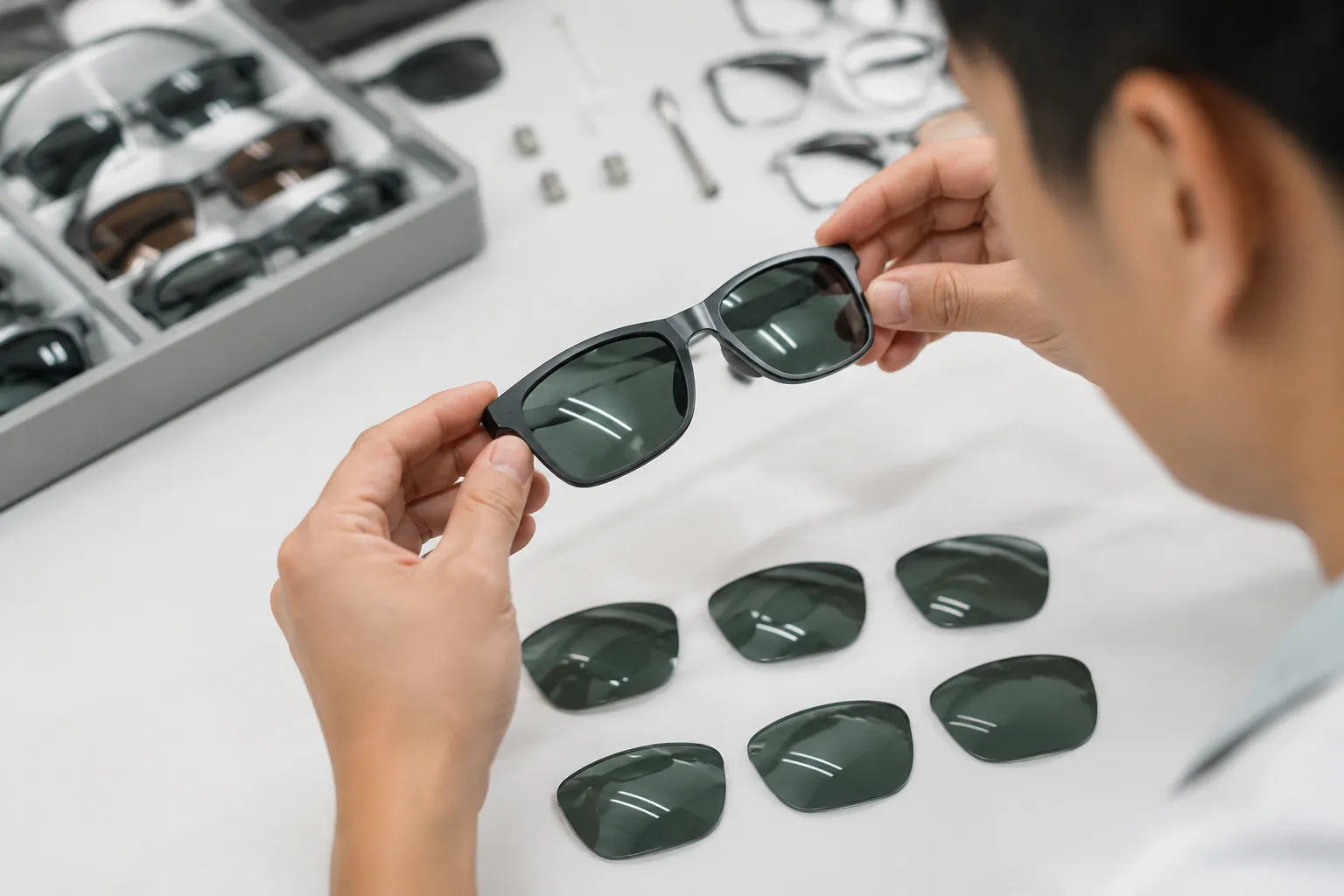
If you buy sunglasses for retail, promo, travel, or sports, lens type is not just a style choice. It changes price, perceived value, screen visibility, performance expectations, and how quickly a program moves through sourcing and compliance. This guide shows which lens type fits each sales channel, what it does to cost, and where buyers most often get tripped up.
Start With the Channel, Not the Lens
Most buying mistakes start with the wrong question. Buyers ask, "Should these be polarized?" The better question is, "What channel am I selling into, what will the end user actually do, and what unit economics can that channel support?"
Polarized lenses reduce reflected glare from horizontal surfaces. That matters on water, wet roads, snow, glass, sand, and bright pavement. Non-polarized lenses still cut brightness, but they do not suppress reflected glare in the same way. Same frame. Different job.
For B2B programs, lens type should be chosen alongside target retail price, packaging, decoration method, and compliance scope. A low-cost promotional item and a higher-price retail SKU do not need the same lens spec. A travel-retail buyer may want one clear benefit. A fashion buyer may care more about color, tint, and shelf appeal. A sports buyer may need glare reduction for a specific use, not as a default.
At LumiShades, tinting, coating, assembly, and QC are handled in-house. That reduces handoffs and makes it easier to match lens type with frame material, decoration, and order quantity. That matters on small custom runs and on larger orders where every spec change affects cost.
Pick the lens that supports the channel math. Not the one that sounds best in a slide deck.
What Polarized Lenses Actually Do
A polarized lens contains a directional filter that reduces horizontally reflected light. The result is less glare from flat or shiny surfaces. Drivers notice it on wet pavement. Boaters notice it on water. Ski and snow users notice it on reflective snowfields.
There is a trade-off. Polarization can make some LCDs, instrument clusters, ATMs, phones, tablets, and dashboard displays harder to read. Depending on the angle and display type, the screen may look dimmer, patterned, or partly obscured. Buyers often discover this late. The lens works fine in sunlight. Then the screen problem shows up.
Polarized lenses are also more demanding in production. The film, lamination, and orientation control must stay consistent across the batch. If the filter angle shifts, the lens may pass a quick check and still trigger complaints in the field. Treat polarization as a controlled spec. It is not just a label.
Use it where the benefit can be said in one sentence: less glare while driving, boating, fishing, or moving through bright reflective environments. If the channel cannot explain that clearly, the extra cost becomes friction.
Where Non-Polarized Wins
Non-polarized lenses are the workhorse option. They reduce brightness, support a wide range of tint colors, and keep unit cost lower. In promotional programs, that is usually enough. The buyer wants volume, clean packaging, and a product that hits the cost target without creating avoidable complaints.
Non-polarized also fits fashion-led retail. In that channel, frame shape, temple profile, finish, and brand story usually drive the sale. The lens contributes to the look, but it is not always expected to make a performance claim. Consistent tint and clean appearance matter more than glare reduction.
It is also the safer choice for screen-heavy use. Trade shows, commuting, travel accessories, office-adjacent wear, and urban lifestyle programs often involve frequent phone and dashboard viewing. Non-polarized avoids the support call that starts with, "My screen looks weird." That is a real problem. It is a common one.
Cost adds up fast. On a large order, even a small per-pair delta affects landed cost, freight, duties, and distributor margin. If the target margin is thin, paying extra for polarization across every SKU can weaken the program economics.
Non-polarized also gives more room for fashion tints and coating combinations. Mirror effect, smoke, amber, green, gradient, and color tints are easier to merchandise when the product is positioned first as a style item.
Channel Match: Which Lens Type Fits Where
| Sales channel | Better fit | Why buyers choose it | What to watch |
|---|---|---|---|
| Retail fashion | Non-polarized or mixed | Lower cost, stronger color flexibility, easier merchandising across frame shapes and finishes | Keep tint density consistent; do not oversell glare control if the SKU is mainly aesthetic |
| Travel retail | Polarized | Clear consumer benefit for driving, beach, outdoor, and vacation use | Expect questions about screen readability, lens darkness, and packaging claims |
| Promotional programs | Non-polarized | Lower landed cost, simpler quoting, easier large-volume fulfillment | Focus on decoration area, pack-in presentation, and on-time delivery rather than premium optical claims |
| Sports / outdoor | Polarized for glare-heavy use | Water, snow, fishing, boating, and driving can benefit from reduced reflected light | Some sports, timing displays, and cockpit-style environments are better served by non-polarized lenses |
This is the short version: retail fashion cares about style and cost, travel retail cares about an obvious functional story, promo cares about price and consistency, and sports cares about the environment. The same lens type does not win everywhere.
A practical rule: if the purchase driver is "looks good," start non-polarized. If the driver is "reduces glare where I use it," start polarized. If the assortment has both kinds of buyers, split the line on purpose. Do not force one spec to do every job.
Cost, MOQ, and Lead-Time Logic
Lens type affects the bill of materials, but it is not the only price driver. Frame material, hinge selection, lens color, coating stack, decoration method, packaging, and order quantity all affect the final number. At LumiShades, MOQ starts at 50 pairs per design. Pricing usually improves at larger volumes such as 300, 1000, and 5000+ pairs, with exact pricing depending on specification, decoration, and packaging.
Why does price improve with volume? Setup, color matching, QC sampling, and packaging prep are fixed costs until enough units absorb them. A basic non-polarized promo style in a standard frame color is usually the simplest path to a low landed cost. Add polarization, mirror coating, complex temple decoration, or premium packaging, and the math changes quickly.
Lead time matters just as much as unit price. Sample production is typically 7-10 days. Bulk production is usually 25-35 days after sample approval and artwork sign-off. That schedule assumes the buyer is not changing core specs late in the process. If lens type changes after color approval, the job often needs a new sample check because tint, fit, and visual appearance can shift even if the frame tooling stays the same.
For buyers comparing polarized and non-polarized options, the trade-off is simple:
- Non-polarized: lower unit cost, easier screen use, more flexible tint design, and a better fit for mass promo or fashion basics.
- Polarized: higher perceived value, stronger retail story, and better performance in glare-heavy outdoor environments.
- Mixed assortment: use polarized only on higher-ticket SKUs and keep entry SKUs non-polarized to protect margin and simplify quoting.
One common mistake is forcing polarization into every style because it sounds premium. That can create a price ceiling the channel cannot support. Use the feature where buyers will pay for it.
Material Behavior and Decoration Choices
Lens choice should be reviewed with frame material and decoration method. Different frame materials respond differently to heat, pressure, and finishing, and that affects appearance and reject rate. Injection-molded frames usually allow efficient throughput and stable color matching. Acetate feels more premium, but it can require tighter control on cutting, polishing, and alignment. Metal frames can look refined, but hinge and temple fit need more attention.
Decoration changes the job too. Laser engraving gives a precise, permanent mark and works well when the buyer wants a restrained premium look. Pad printing is flexible for logos and short runs, but ink adhesion, line sharpness, and abrasion resistance need checking. Metal logo plates add perceived value, but they also add labor, adhesive control, and inspection time. If the piece ships as a gift item or travel-retail product, packaging finish and print placement can matter almost as much as the frame.
For lenses, tint tolerance and visual consistency are critical. The batch should hold a consistent shade so adjacent pairs do not look off on a display wall. Minor variation is normal in mass production, but buyers should define acceptable ranges for tint density, surface quality, and lens alignment before production starts. If the program includes mirrored or gradient lenses, inspection should also cover reflection uniformity and edge consistency because those flaws stand out more than on a plain smoke lens.
Polarized lenses need more inspection points because the filter layer and orientation control add complexity. Non-polarized lenses are simpler, but they still need checks for haze, optical distortion, and scratch resistance. A low-cost lens that looks fine in a carton can still become a complaint under retail lighting.
Compliance Is Not Optional
Lens choice does not replace compliance. It sits on top of it. For overseas B2B buyers, the real issue is whether the finished product meets the target market standard and whether the paperwork matches the shipment. Confirm compliance before tooling, not after the first sample.
LumiShades holds certifications and registrations including CE EN ISO 12312-1, FDA registration, ANSI Z80.3, AS/NZS 1067, REACH, ISO 9001, and BSCI. Different channels and destinations ask for different proof. A European buyer may need CE-related documentation and REACH support. A U.S. importer may need FDA registration details and product claims that match market expectations. Australia and New Zealand may require AS/NZS 1067 documentation. If the order goes through a retail chain, the buyer may also request test reports.
Polarized and non-polarized lenses both need the same discipline on UV protection, optical quality, labeling accuracy, and claim control. If the spec sheet says UV400, the sample must support that claim. If the program is sold as category-grade eyewear, the standards language, hangtag copy, carton marking, and barcode setup need to match. Generic copy is a common failure point because customs, distributors, and retail QA teams often ask for exactly what was claimed.
Lock the target market standard before tint approval or decoration sign-off. It is much cheaper to revise a spec sheet than to rework a shipment.
How LumiShades Runs the Job
For a buyer, the factory process matters as much as the lens choice. A controlled process reduces back-and-forth and lowers the risk of a first-inspection reject. Start with the channel, the price target, and the compliance scope. Do not start with the frame image alone.
- Confirm channel, target retail price, and required certifications.
- Choose frame material and lens type together so the product is engineered as one system.
- Approve tint, logo method, packaging, and print copy.
- Produce samples, typically in 7-10 days, for fit, lens clarity, and decoration review.
- Check visual points such as tint consistency, logo placement, and surface finish under bright light.
- Release bulk production, usually 25-35 days after approval.
- Inspect final goods for color drift, scratch rate, assembly alignment, and packaging accuracy.
LumiShades handles injection molding, acetate cutting, CNC milling, lens tinting, decoration, and QC in-house. That gives more control over frame-lens fit and over decoration choices like laser engraving, pad printing, and metal logo plates. It also helps when the buyer wants a mixed line: polarized for one SKU, non-polarized for another, same frame family, same packaging, different channel.
That setup is useful for distributors and retailers running tiered assortments. Keep the entry SKU accessible, use non-polarized lenses for the core line, and still offer a higher-value polarized version without reworking the whole program.
Buyer Decision Checklist
Use this before you approve a spec sheet. It keeps the discussion tied to the channel and the economics, not personal preference.
- Is the product mainly for retail, promo, travel, or sports?
- Will the user need clear screen visibility or dashboard readability?
- Is the buyer willing to pay more for glare reduction?
- Do you need CE EN ISO 12312-1, FDA registration, ANSI Z80.3, AS/NZS 1067, REACH, ISO 9001, or BSCI support?
- What is the target MOQ, and where does the price need to land at 300, 1000, or 5000+ pairs?
- Will lens type affect packaging claims, print copy, barcode setup, or shelf messaging?
If you cannot answer those six points, you are not ready to lock the lens type. Ask them first, then quote.
For many importers, the best setup is simple: non-polarized for the lowest-price core line, polarized for higher-ticket travel and outdoor SKUs, and strict QC on both. That keeps the assortment clear, easier to sell, and easier to replenish.
Have a custom sunglasses project in mind?
Send us your styles, target market and quantities and we will return a detailed quote with MOQ, lead time and a sample plan.
Get a QuoteWhy source this from Wenzhou with LumiShades
Wenzhou in Zhejiang Province is widely regarded as China’s eyewear manufacturing capital, producing a large share of the world’s sunglasses. That concentration matters to buyers: a deep local supply chain for acetate sheet, hinges, lens blanks, plating and packaging means shorter component lead times, easier color and material matching, and a workforce with decades of eyewear-specific skill. LumiShades has manufactured in this ecosystem since 2009, and our vertical integration — in-house injection molding, acetate cutting, CNC milling, lens tinting, decoration and quality control — means no part of your order is quietly subcontracted to a workshop you cannot audit.
For international buyers, that vertical control translates into accountability. When a single factory owns every step, defects are traced and fixed at source rather than bounced between vendors, and your specifications survive intact from first sample to bulk. We back this with 15+ years of experience, shipments to 60+ countries, more than 5 million pairs produced per year and a 98.5% on-time delivery rate. Our certifications — CE EN ISO 12312-1, FDA registration, ANSI Z80.3, AS/NZS 1067, REACH, ISO 9001 and BSCI audit — mean the compliance documentation your market requires already exists. Explore our manufacturing capabilities and quality control process to see how this works in practice.
Frequently asked questions
Should a promo sunglasses program use polarized lenses? Usually not. Promo buyers are typically focused on unit cost, volume, and presentation. Non-polarized lenses keep landed cost lower and avoid paying for a feature the end user may not value. They also simplify quoting when the order has to hit a fixed campaign budget or a low pack-in cost.
When is polarized worth the extra cost? Use it when the product is sold for driving, boating, fishing, snow, or travel and the buyer can explain the benefit clearly. Polarized lenses make sense when glare reduction is a real usage benefit, not just a premium label. They work best in channels where the performance story supports a higher price.
Do polarized lenses cause complaints about phone screens? They can. Some LCD and dashboard screens can look dim, striped, or partly blacked out at certain angles. If the user is likely to check screens often, non-polarized may be the safer choice. Test the lens against the actual devices or displays used by the target customer.
What MOQ should I expect for custom sunglasses? At LumiShades, MOQ starts at 50 pairs per design. Pricing usually improves at higher volumes such as 300, 1000, and 5000+ pairs, but the exact number depends on frame material, lens type, decoration method, and packaging spec. Share the target market, design, and compliance level to get an accurate quote.
How fast can samples and bulk orders move? Samples typically take 7-10 days. Bulk production is usually 25-35 days after sample approval and artwork sign-off. Late changes to lens type, tint, or logo placement usually add time because the order needs another verification step.
Which compliance documents should I ask for? Match the target market and the claims on the product. Common documentation includes CE EN ISO 12312-1, FDA registration, ANSI Z80.3, AS/NZS 1067, REACH, ISO 9001, and BSCI, depending on destination and buyer requirements. Ask for the documents that support the market you are selling into, not a generic certificate list.
Ready to start?
Explore our cat-eye sunglasses or request a quote — our sales team replies within 12 hours.
Request a Quote