
Sunglass Lens Distortion, Clarity, and Flatness
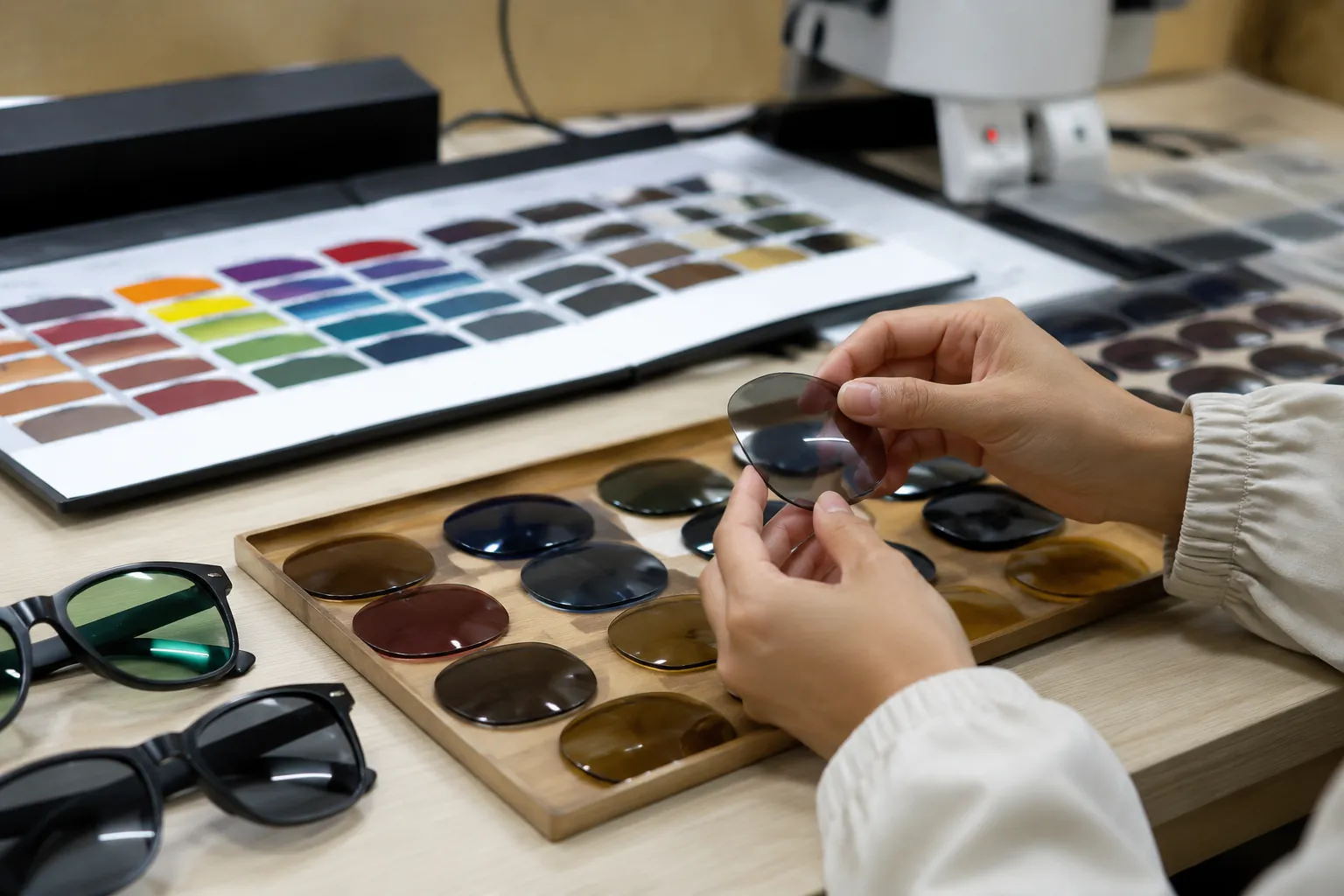
If you source sunglasses for retail, distribution, or private label, lens defects are not just cosmetic. Distortion, haze, scratches, coating flaws, and lens warpage can trigger complaints, failed inspections, and returns. This guide focuses on three buyer-critical checks—distortion, clarity, and flatness—and shows how to inspect them, document them, and turn them into a workable supplier specification before shipment.
1) Start with the failure modes buyers actually see
Three lens issues drive a large share of buyer complaints in non-prescription sunglasses: distortion, clarity loss, and flatness error. They are related, but they are not the same defect.
Distortion is an optical problem the wearer can see. Straight lines may look bent, wavy, or unstable as the sunglasses move relative to the eye. Buyers usually notice it first against shelf edges, window frames, tiles, or a printed grid. Distortion can come from lens surface error, uneven curvature, stress from molding or edging, or a mismatch between the lens and the frame.
Clarity is the visual cleanliness of the lens. A lens can have the right tint category and still fail if it shows haze, fine scratches, inclusions, bubbles, coating marks, or uneven tint. Those defects may come from raw material, molding, surface finishing, tinting, coating, handling, or packaging. The cause varies. The complaint does not.
Flatness is a geometry issue. A warped or twisted lens may not seat correctly in the frame, and the frame may then force the lens under stress. That stress can create visible distortion, whitening at the edge, poor retention, or cracking over time. Flatness matters more on large lenses, tight grooves, and frame fronts that already carry stress.
There is a simple rule here: if the defect is visible to the buyer, it will be visible to the market. Retail staff may catch it on display. Consumers may feel it on first wear. QC teams may reject it before it ships. Lens quality needs a defined standard, not a casual opinion.
2) Use a simple test stack, not one vague inspection
Do not rely on a single "looks fine" judgment. Use a short inspection stack that covers surface quality, visual performance, fit, and stability. Each check catches a different failure mode.
- Visual inspection under controlled white light. Inspect both lens surfaces under consistent neutral white light. Look for haze, scratches, pits, inclusions, bubbles, coating marks, edge chips, and visible tint irregularity. Check at more than one angle. Some defects show only at low reflection angles.
- Straight-line distortion test. Hold the lens or finished sunglasses in front of a printed grid, ruled chart, or other high-contrast straight-line target. Move the lens slowly. Watch whether the lines stay stable or appear to bend, ripple, or swim. This is a fast screen for visible distortion.
- Flatness and fit check. Place the lens on a known flat reference surface to screen for rocking or obvious bowing. Then check fit in the intended frame. The lens should seat properly without excessive force, edge lift, visible stress whitening, or frame deformation.
- Pair-match check. Compare left and right lenses for tint consistency, appearance, and visible optical behavior. A mismatch between the two lenses often causes complaints even when each lens alone looks acceptable.
- Post-conditioning sample review. After any internal conditioning or handling process used by the factory, re-check sample units for warpage, loose fit, coating marks, or appearance change. The point is not a specific stress routine. The point is confirming that the lenses still match the approved sample after normal production exposure.
Buyers should avoid vague wording such as "perfect lens" or "good clarity." Define the inspection method, lighting, viewing distance, reference sample, and pass/fail examples. That makes the requirement enforceable during sampling, inline QC, and pre-shipment inspection.
Short version: if a lens only passes a quick hand-wipe check, it has not been inspected well enough for volume production.
3) What to test for optical clarity
Clarity starts with material quality and ends with handling discipline. The same visible defect can have different root causes, so buyer inspection should focus on what can be observed consistently.
Common lens materials behave differently. Polycarbonate is widely used because it is lightweight and impact resistant, but poor process control can leave molding stress, flow marks, or coating sensitivity. CR-39 is known for good optical properties in many applications, but product suitability depends on the design and use case. Whatever the material, approval should be based on the finished lens in the finished product, not on material assumptions alone.
- Surface haze: A cloudy or milky appearance that reduces visual cleanliness. Possible causes include poor surface finishing, contamination, coating defects, or handling damage.
- Inclusions: Visible foreign matter or internal imperfections such as black specks, bubbles, or embedded particles.
- Tint non-uniformity: Uneven density, bands, edge darkening, spots, or patchiness in the color.
- Coating issues: Patchiness, rainbowing, uneven mirror appearance, or visible marks from incomplete or inconsistent coating application.
- Micro-scratches: Fine abrasion caused during cleaning, stacking, transport, or assembly.
For a buyer spec, clarity should be checked the same way every time. A practical method is to inspect under front light for surface defects, under backlight for inclusions or haze, and through a high-contrast printed target for visual cleanliness. If the lens looks cloudy, scratched, or non-uniform under the agreed inspection conditions, it should not be accepted just because the tint color is correct.
Decorative operations also matter. Printing, hot stamping, laser marking, and mirror finishing near the lens area can create residue, local haze, or visible marks if the process is poorly controlled. The approved reference sample should include the final decoration, final tint, and final surface condition—not just the base lens.
4) Flatness: the hidden spec behind fit and warp complaints
Flatness matters because a lens must fit the frame without excessive mechanical stress. If the lens is warped, twisted, or edged incorrectly, the frame may force it into shape during insertion. That affects both appearance and durability.
Typical flatness-related failure points include:
- After molding: Uneven cooling or residual stress can leave the lens with bow or twist.
- After cutting or edging: Incorrect geometry, bevel mismatch, or uneven edge finishing can affect how the lens seats.
- During tinting or coating: A thermal or handling process may alter shape or reveal pre-existing stress.
- During assembly: A tight rim, poor groove compatibility, or forced insertion can distort the lens and the frame together.
Buyers should be careful about asking for a numerical flatness tolerance unless the method, reference surface, and frame design are also defined. A lens for a flatter fashion front is not evaluated the same way as a deeply curved wrap style. In many projects, the better requirement is functional: the lens must seat correctly in the approved frame, without visible stress, edge gap, rocking, creaking, whitening, or frame distortion.
Frame geometry is part of the lens-quality discussion. A lens that looks acceptable on its own may fail once mounted. That is why lens approval should include an assembled sample review, not just loose lenses. If insertion requires excessive force, if the frame bows, or if whitening appears around corners or notches, treat it as a production setup problem, not normal variation.
Any decoration or hardware close to the lens channel can also affect fit and local stress. Even if the lens itself is fine, nearby dimensional changes can change assembly behavior enough to create field complaints later.
5) A comparison buyers can actually use
This table separates acceptable variation from likely rejection. Use it during sample approval and pre-shipment review, and compare the approved master sample against bulk under the same lighting.
| Issue | What you see | Likely cause | Buyer action |
|---|---|---|---|
| Image swim / straight-line bend | Lines wobble when the head moves | Optical distortion, poor curvature control, lens-frame mismatch | Reject sample; test against a grid and on-face; review lens geometry and frame fit |
| Haze or fogginess | Lens looks cloudy under white light | Surface contamination, poor finishing, coating defect, handling damage | Check under backlight; require rework or rejection; inspect surface protection and process control |
| Warp / rocking on flat surface | Lens does not sit flat or rocks on one corner | Material stress, uneven cooling, edging error, shape change after processing | Check assembled fit; review molding, edging, and post-process handling |
| Tint blotches | Uneven darkness or visible bands | Inconsistent tinting or contamination | Compare against approved master sample; hold batch for review and segregation |
| Stress whitening after assembly | White marks at edges or corners after insertion | Lens forced into frame; poor edge finish; frame tolerance too tight | Stop production; correct lens edge and frame-fit conditions before continuing |
A useful habit: compare development sample, pre-production sample, and bulk units against the same approved reference. If the supplier changes lens material source, coating route, tint process, or frame tooling, require renewed approval.
6) Ask for the right tests in the right compliance lane
Optical clarity and flatness do not replace compliance testing, and compliance testing does not replace batch inspection. You need both.
For market access and product testing, the relevant references commonly include CE EN ISO 12312-1 for many CE-market sunglasses, ANSI Z80.3 for the U.S. market, and AS/NZS 1067 for Australia and New Zealand. REACH is relevant for chemical restrictions in the EU supply chain. FDA registration may be part of the U.S. regulatory picture depending on product classification and selling context. ISO 9001 and BSCI can be useful indicators of management systems and social compliance, but neither one proves that a particular batch of sunglasses is optically acceptable.
Do not treat a certificate file as proof that current production is good. What matters is whether the supplier can connect the order to the correct test scope: lens material, tint category, mirror or decorative finish, polarization if applicable, frame type, and destination market.
A workable buy-spec should state:
- Lens material and color or tint description
- Approved reference sample number and approval date
- Inspection lighting and viewing method for visual defects
- Distortion screening method, such as a printed grid or straight-line target
- Assembled fit standard, including no visible stress whitening or forced insertion
- Packaging method to prevent scratching and abrasion
- Applicable compliance target and required test report set
This level of detail is basic. It is also what prevents disputes from turning into opinion fights.
7) How to write a workable spec with your supplier
A good supplier spec does not need to be long. It needs to be specific enough that sampling, production, and pre-shipment inspection all use the same pass/fail standard.
Start with the approved reference. Identify the exact golden sample by code, date, photos, and revision status. If the sunglasses include mirror coating, gradient tint, logo decoration, or special packaging, the approved sample must include those final features.
Define the inspection method. State the lighting condition, viewing distance, background or target used for distortion screening, and whether inspection is on loose lenses, assembled sunglasses, or both.
Write functional acceptance language. For example: no visible haze, scratch, inclusion, or tint blotch under agreed inspection conditions; no visible distortion when checked against the approved straight-line target; left and right lenses must match in tint and appearance; lens must seat in the approved frame without visible whitening, edge gap, or excessive insertion force.
Include packaging controls. Many acceptable lenses are damaged after final QC. Specify protective films, individual bags, separators, or other packaging details needed to prevent lens-to-lens or lens-to-hardware contact.
Ask for evidence before shipment. Request pre-shipment photos or video taken under the same inspection setup used for approval, plus identification of the sampled cartons or production lots. If a third-party inspection is used, make sure the checklist includes lens optics and assembled fit, not only count and labeling.
Control changes. Require notice and re-approval if the supplier changes lens material source, coating process, tint route, frame tooling, or decoration process. Small changes can alter optical appearance enough to matter at retail.
8) The bottom line for retail acceptance
Buyers do not usually face returns because a sunglass spec was too detailed. They face returns because key lens requirements were left undefined. Distortion, clarity, and flatness are practical screening points that catch many defects consumers notice first.
Use a real approval process. Inspect under controlled light. Check distortion against a straight-line target. Review loose-lens condition and assembled fit. Match bulk to the approved reference sample. Confirm the supplier's compliance documents for the destination market, but also verify batch quality with actual inspection evidence.
The goal is not perfection. The goal is a clear acceptance standard the factory can hold and the buyer can enforce.
Have a custom sunglasses project in mind?
Send us your styles, target market and quantities and we will return a detailed quote with MOQ, lead time and a sample plan.
Get a QuoteWhy source this from Wenzhou with LumiShades
Wenzhou in Zhejiang Province is widely regarded as China’s eyewear manufacturing capital, producing a large share of the world’s sunglasses. That concentration matters to buyers: a deep local supply chain for acetate sheet, hinges, lens blanks, plating and packaging means shorter component lead times, easier color and material matching, and a workforce with decades of eyewear-specific skill. LumiShades has manufactured in this ecosystem since 2009, and our vertical integration — in-house injection molding, acetate cutting, CNC milling, lens tinting, decoration and quality control — means no part of your order is quietly subcontracted to a workshop you cannot audit.
For international buyers, that vertical control translates into accountability. When a single factory owns every step, defects are traced and fixed at source rather than bounced between vendors, and your specifications survive intact from first sample to bulk. We back this with 15+ years of experience, shipments to 60+ countries, more than 5 million pairs produced per year and a 98.5% on-time delivery rate. Our certifications — CE EN ISO 12312-1, FDA registration, ANSI Z80.3, AS/NZS 1067, REACH, ISO 9001 and BSCI audit — mean the compliance documentation your market requires already exists. Explore our manufacturing capabilities and quality control process to see how this works in practice.
Frequently asked questions
What is the quickest way to spot lens distortion in a sample? Use a straight-line screening test. Hold the loose lens or finished sunglasses in front of a printed grid, ruled chart, window frame, or other high-contrast straight line. Move the lens slowly side to side and up and down. If the line bends, ripples, or swims, flag the sample for rejection or closer review against the approved reference. Check both lenses, and check them in the frame if the product is already assembled.
How do I tell haze from normal tint darkness? Tint reduces light transmission. Haze reduces visual cleanliness. To separate them, inspect the lens under neutral white light and then look through it at a high-contrast printed target. A dark but acceptable tint should still look clean and sharp. A hazy lens will look cloudy, milky, foggy, or washed out, and edges of text or lines will look less crisp. Check both front light and backlight, because haze and coating defects may show more clearly in one condition than the other.
Which compliance standards should I ask for on custom sunglasses? Ask for the standard that matches the destination market and product type. Common references are CE EN ISO 12312-1 for many CE-market sunglasses, ANSI Z80.3 for the U.S., and AS/NZS 1067 for Australia and New Zealand. Also review REACH compliance where EU chemical restrictions apply. FDA registration may be relevant in the U.S. context, but it is not a substitute for product-specific testing. If a supplier shows ISO 9001 or BSCI, treat those as system indicators only, not proof that the shipped batch meets optical or regulatory requirements.
What should I approve before bulk production starts? Approve the exact golden sample, the final lens color or tint appearance, the finished decoration, the assembled frame fit, the packaging method, and the inspection standard. Document the lighting condition, the visual defect criteria, the distortion screening target, and the pair-match requirement for left and right lenses. If the supplier changes lens material source, tint process, coating route, frame tooling, or decoration method after approval, require a new sample review before bulk shipment proceeds.
Ready to start?
Explore our aviator sunglasses or request a quote — our sales team replies within 12 hours.
Request a Quote