
How to Choose Lens Base Curve for Sunglasses
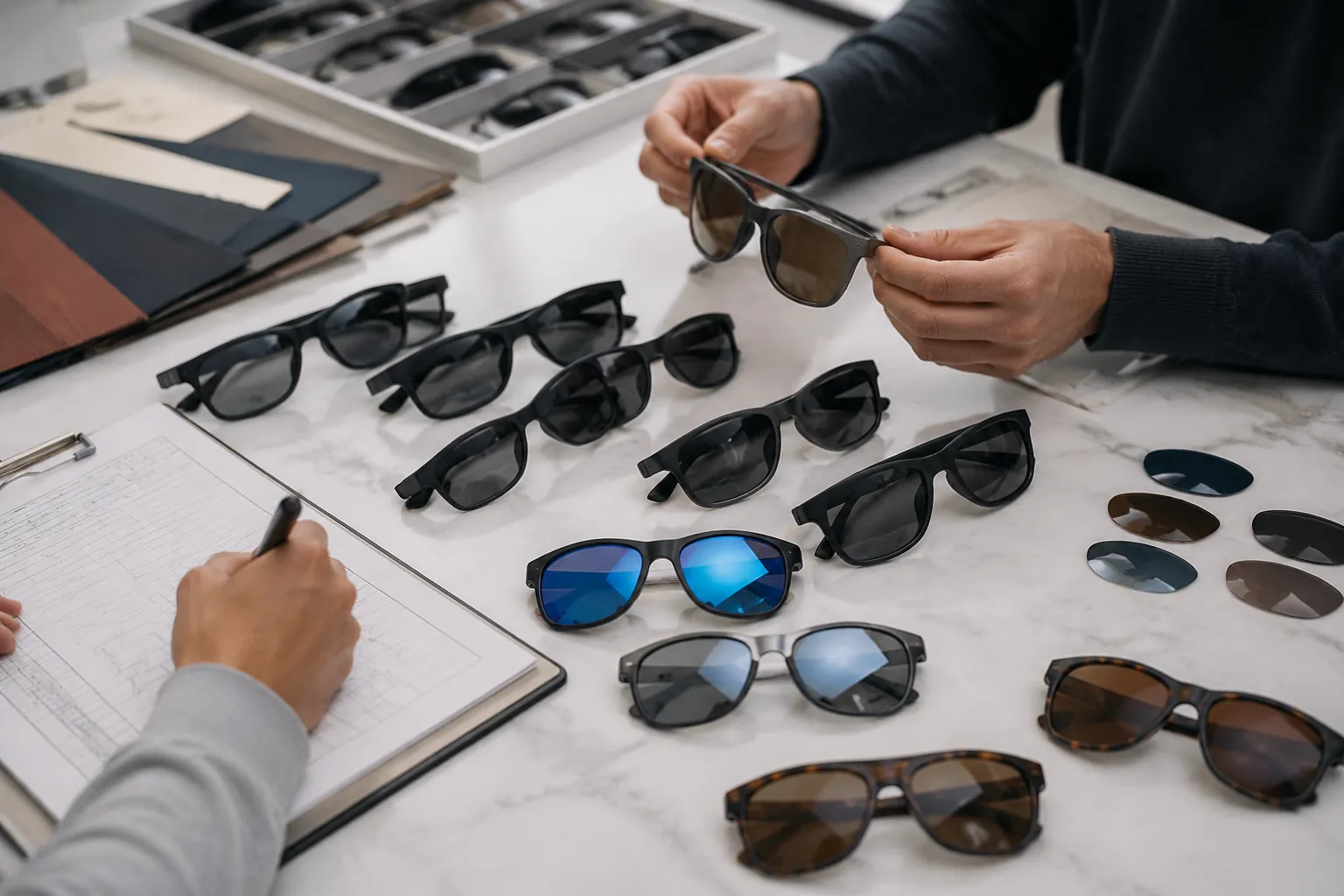
Base curve looks small on paper. It is not small in production. It changes how a sunglass wears, how it reads on shelf, how it fits the frame, and how much rework you absorb during sampling and mass production. If you buy for fashion, sport, or promotional channels, the wrong curve can make a frame look flat, wrap too hard, create edge glare, or miss the fit target. This guide explains how to choose the curve that fits the channel, frame shape, material, and price point.
What base curve changes
Base curve is the curvature of the front surface of the lens. Lower numbers are flatter. Higher numbers wrap more around the face. That single number affects four buyer priorities: front-view appearance, side coverage, wearer comfort, and how easily the lens fits the frame without stress.
Most private label sunglass programs use 2, 4, 6, and 8 base lenses. A 2 base lens reads almost flat. A 4 base lens adds a light wrap and works across many styles. A 6 base lens starts to look more performance-driven. An 8 base lens is strongly wrapped and is usually used in sport or outdoor styles. These curves are not interchangeable. Frame front angle, lens cut, groove depth, bevel position, and temple spread all have to match the chosen geometry.
Curve also changes the optical and fit experience. As wrap increases, the outer edges move closer to the face. That makes decentration, distortion control, and left-right symmetry more important. If the curve is too strong for the frame, wearers may notice peripheral distortion, cheek contact, or nose pressure even if the sample looked fine on a flat tray.
The rule is simple. More wrap means tighter tolerances. On flat fashion styles, a small front-angle mismatch may never be noticed. On a stronger wrap style, the same mismatch can show up as lens lift, uneven brow line, visible twist, or stress at the temple area. Lock the base curve early. Do it before tint, logo placement, and compliance sign-off.
In sourcing terms, base curve is not a decorative detail. It is a core spec item that affects tooling, assembly yield, final comfort, and channel fit. Buyers should treat it like lens diameter or UV requirement: define it before samples go out, not after the first round comes back.
Base curve quick comparison table
| Base curve | Front look | Coverage | Comfort / forgiveness | Typical channel | Buyer risk if misused |
|---|---|---|---|---|---|
| 2 base | Flat, clean, minimal wrap | Low to moderate | High forgiveness, broad face tolerance | Fashion, promotional, optical-adjacent | Too flat for sport looks; weak side coverage |
| 4 base | Light wrap, balanced profile | Moderate | Good all-round comfort | Fashion, retail, corporate gifting | Can look generic if the frame expects more curve |
| 6 base | Noticeable wrap, more technical | Moderate to high | Less forgiving; needs better geometry control | Sport, outdoor, active lifestyle | Fit issues if frame front is too flat |
| 8 base | Strong wrap, performance look | High | Least forgiving; tight QC needed | Cycling, running, skiing, tactical-inspired | Distortion, cheek touch, groove stress, assembly rejects |
Use this table as a starting point only. The final choice should still be confirmed against frame front angle, lens width, bridge size, temple flare, and the target wearer profile.
Pick the curve by channel first
The fastest way to choose a curve is to start with the channel, then refine by frame shape and target wearer. That prevents you from sampling a product that looks correct in CAD but misses the commercial use case.
| Channel | Typical base curve | Typical use case | Why it works | Main risk if wrong |
|---|---|---|---|---|
| Fashion / retail / optical-adjacent | 2 to 4 base | Acetate classics, metal fashion, lifestyle collections | Cleaner front view, easier styling, broader face-shape tolerance | Too much wrap can look aggressive or make the frame feel narrow |
| Sport / performance / outdoor | 6 to 8 base | Cycling, running, fishing, skiing, tactical-inspired styles | More coverage, less side light, stronger technical identity | Flat lenses reduce coverage and weaken the intended performance look |
| Promotional / corporate giveaway | 2 to 4 base | Event gifts, festival packs, branded giveaways, seasonal campaigns | Lower fit risk, easier to wear across mixed audiences, simpler QC | Over-wrapped lenses raise rejection risk and can look too specialized |
| Kids / youth lifestyle | 2 to 4 base | Retail promotions, school events, family bundles | Broader comfort and easier fitting across smaller facial dimensions | High wrap can pinch temples or create asymmetry |
| Luxury fashion / statement pieces | 2 to 4 base, sometimes custom wrap | Runway-inspired silhouettes, oversized frames, editorial drops | Supports design-led front view and premium styling | Too much curve can distort the design language and complicate lens visibility |
For promotional programs, flatter is usually safer unless the frame is clearly athletic. A giveaway buyer wants broad wearability, low complaint rates, and minimal sample churn. For a cycling, fishing, or running promotion, the answer changes. Six or 8 base can make sense because the user expects coverage and the style cue matters as much as the lens color.
One useful sourcing shortcut: if the product is sold as fashion first, stay at 2 or 4 base unless the frame silhouette truly needs wrap. If it is sold as activity first, do not force a flat lens just to reduce tooling complexity. The market sees the difference fast.
Another practical check: if the product page will lead with close-up hero images, a flatter curve is easier to photograph cleanly. If the product page leads with performance claims, a more wrapped lens strengthens the visual message and reduces buyer confusion.
How curve changes shelf appearance
Retail buyers often miss this part. Base curve changes how a frame reads from normal shopping distance. That is the distance that matters on a shelf, in a display case, or in a product photo grid. A 2 base lens reflects more like a flat window and usually gives a calmer look. A 6 or 8 base lens catches light differently and makes the front feel wrapped, more assertive, and more technical.
That visual shift affects merchandising. Fashion accounts often prefer flatter lenses because they pair more easily with apparel and accessories. Sport accounts usually want visible wrap because it signals function. If you are building a small range, keep the frame family consistent and change the curve only when the channel changes. That keeps line planning cleaner. It also prevents the range from looking mixed up.
Lens finish changes the effect too. Dark smoke and mirror coatings exaggerate curvature because they reflect more sharply across the front surface. Solid tint in a mid-density brown or gray can soften the curve visually. Gradient tints can reduce the visual impact of a slight wrap if the top is darker and the lower edge reads lighter.
Check samples under both daylight and retail lighting. A lens that looks balanced on a bench can look more aggressive under downlights, especially with glossy frames or mirrored finishes. Look for uneven brow lines, visible twist, and any gap between lens and frame groove at normal viewing distance. If one side catches noticeably more reflection than the other, review the assembly or lens cut even if the part is still within drawing tolerance.
For ecommerce, also check how the lens curve behaves in photos shot at 50 to 100 cm. Curved lenses can reflect the camera, light boxes, and ceiling fixtures more aggressively than flat lenses. If your imagery depends on clean face visibility, sample the lens finish and curve together before approving the hero shot.
Comfort, fit, and edge glare
Comfort is not only about temple length and nose pads. Curve changes where the lens sits relative to the face and how much surface area reaches the cheeks and temples. A stronger wrap gives more coverage, but it also reduces forgiveness for wider faces, higher cheekbones, or deeper-set eyes.
Put bluntly: if the curve is too strong for the frame geometry, wearers feel it quickly. Common complaints are cheek touch, temple pressure, the lens sitting too close to the lashes, and edge reflections in peripheral view. Those complaints often show up in wear testing or after the first few wears, not during the first bench review.
In production, fit is driven by the frame front angle, lens width, bridge design, temple spread, and pantoscopic angle. If the frame is 6 base or 8 base, the frame geometry needs to support the wrap. It should not force the lens to compensate. A mismatch in lens seating can create visible asymmetry on a tighter wrap style.
- 2 base: easiest for broad comfort, least wrap, least side protection
- 4 base: middle ground, usually safest for mixed face shapes and mass promotion
- 6 base: better coverage, needs tighter control of frame width and temple angle
- 8 base: performance feel, least forgiving on geometry, most sensitive to QC drift
For fit checks, request samples to be worn on at least two head sizes: one narrower and one average or wider. If possible, also test on a higher cheekbone profile. A product that only fits one face type may still be acceptable in a niche sport channel. It is risky for retail or promotional programs. A basic fit check should confirm no cheek touch, no lash contact, no obvious lens lift at the outer edge, and no pressure point at the temple after several minutes of wear.
Do not rely on static headform fit alone. Headforms can confirm shape alignment, but they do not reveal pressure complaints, edge glare, or how the temple opens under real movement. A short wear test is often enough to expose a curve mismatch before mass production starts.
What changes in manufacturing and QC
At the factory level, base curve affects lens tooling, frame groove geometry, tint behavior, and final assembly. If the supplier handles injection molding, acetate cutting, CNC milling, lens tinting, decoration, and QC in one workflow, curve choice can be managed before the order is split across vendors. That matters. Every handoff adds tolerance drift.
Material matters too. Injection-molded frames generally allow repeatable groove cutting, but the lens edge angle still needs to match the chosen curve. Acetate can look forgiving, yet still create stress if the lens is forced into a shallow or deep groove. On a curved lens, edge polish and bevel accuracy matter more because any chip or rough bevel is more visible at the wrap line.
Agree tolerances before sampling. Ask for the supplier's standard dimensional tolerances on the drawing and confirm how left-right symmetry will be checked. For assembly, ask for lens seating consistency, even brow alignment, and no visible gap at the groove. If the frame uses a higher wrap, the factory should also confirm that the lens does not spring out under normal handling. Tension increases as curvature increases.
Decoration needs to be planned around lens shape. Laser engraving can work well for small, precise marks on coated lenses if the artwork is positioned correctly. Pad printing is better when color is needed, but it can look distorted if placed too close to a heavily curved edge. Hot stamping and metal logo plates are usually handled on the frame. If the lens itself carries branding, the printable area gets smaller as the curve increases. On an 8 base lens, keep artwork simple, centered, and away from the outer wrap zone.
QC should include more than a visual check. A good factory review will confirm lens retention, symmetry, tint consistency between pairs, logo position, scratch-free coating, and no stress whitening at the groove. For polarized or coated lenses, also check optical continuity and surface defects under angled light. On curved products, a minor distortion that passes on a flat view can become obvious once the lens is mounted.
Recommended QC checkpoints for curved sunglasses:
- Verify left/right lens match against the approved drawing
- Check groove engagement around the full perimeter
- Inspect brow line height from a front view
- Confirm no spring-back or lens pop-out after handling
- Review coating uniformity under oblique light
- Measure symmetry at both ends of the temple opening
Keep tooling and sampling under control
Do not treat base curve as a last-minute cosmetic choice. It changes the drawing, the sampling sequence, and sometimes the tooling itself. Before sampling, confirm the lens curve, lens size, frame front angle, temple spread, tint, coating, and decoration location. If one of those changes after sample approval, expect another round of samples or partial revalidation.
Use a clean workflow:
- Choose the channel and target wearer first.
- Set the base curve family: 2, 4, 6, or 8.
- Match frame front angle and lens shape to the curve.
- Approve tint, coating, and decoration on the same sample.
- Check fit on real faces, not just a flat tray.
- Freeze the sample before moving to mass production.
Timing depends on how complete the spec is. If the curve, artwork, and material are already locked, samples are usually faster than if the style still needs design changes. If the curve changes after the first sample, allow time for re-cutting the lens shape, rechecking assembly, and updating QC reference photos. Bulk production usually starts after sample approval, but stronger wrapping, mirror coatings, or multi-step decoration can extend the schedule.
MOQ and price also move with complexity, but not in a fixed, universal way. A small order can still be viable if the spec is simple and the tooling already exists. More complex curves, tighter fit requirements, mirror coatings, and heavier branding usually increase setup and QC effort. The curve itself is not always the biggest cost driver. It can still add enough sampling and inspection work to matter.
The real saving is freezing the spec early. One late curve change can consume the same time as an entirely new style sample because the lens shape, groove fit, and decoration alignment all have to be checked again.
If you are developing a multi-SKU range, keep one shared frame family and vary only what the channel needs. That approach reduces new tooling, shortens the revision loop, and makes the sample set easier to compare side by side.
Compliance follows the use case
Curve alone does not determine compliance, but it affects how the lens package is built and how the product is described. A sport-style 8 base lens may need closer review for coverage, field of view, and visual distortion than a flat promotional lens. A flatter fashion lens may be easier to place in a general sunglasses category, but it should not be sold with performance claims it cannot support.
For overseas programs, request only the certifications and test references that fit the final product and market. Common examples include CE EN ISO 12312-1, ANSI Z80.3, AS/NZS 1067, FDA registration, REACH, ISO 9001, and BSCI, as applicable to the supplier, product, and destination market. Do not accept vague paperwork or generic certificates that do not match the final lens, frame, and coating combination.
The key is consistency. Do not let a fashion design be sold as a sport spec, or the reverse. If the product is sold as protective eyewear in a stricter channel, the lens construction, tint density, and documentation need to match that claim. Keep the product description honest and tie the test reports to the exact SKU. That reduces customs questions, retailer pushback, and post-shipment disputes.
If the product is going into a marketplace or retail program with strict item-level review, confirm that the sample, test report, and mass production spec all match. A base curve mismatch between approved sample and bulk shipment is a common source of avoidable rejection.
Buyer note: the most common mistake is not picking the wrong curve. It is mixing a strong-wrap lens with a frame designed for a flat fashion shape. That creates fit problems, stress at the groove, and QC headaches through assembly.
Buyer checklist before you place the order
Use this before PO issuance. It takes a few minutes and can save a week of sampling churn.
- Confirm the channel: fashion, sport, or promotional.
- Pick the base curve range, not just the lens tint.
- Check whether the frame front angle supports that curve.
- Confirm groove depth and lens retention method for the material.
- Test fit on at least two face widths and one higher-cheek profile if possible.
- Review decoration placement on the actual lens or frame surface.
- Ask for compliance documents tied to the final product spec.
- Freeze the sample before bulk order and keep a signed reference sample.
- Verify lens and frame symmetry under both daylight and indoor lighting.
- Confirm whether the chosen coating or mirror finish changes the visual wrap effect.
If you are splitting one style across channels, consider two lens options rather than forcing one curve to do everything. A flatter version can work for retail. A stronger wrap can work for outdoor promotion or sport. Same family, different buyer logic. That usually sells better than a compromise that satisfies neither channel.
For buyers working with an integrated factory, the value is coordination. The factory can match curve choice to molding, acetate cutting, CNC finishing, tinting, and logo decoration in one workflow. That reduces rework, but it does not remove the need for buyer discipline. It simply makes the process less fragile when the specification is clear from the start.
If you are negotiating with multiple suppliers, ask each one to quote against the same curve, drawing, and tolerance set. Otherwise, you will compare different products that only look similar on paper.
Have a custom sunglasses project in mind?
Send us your styles, target market and quantities and we will return a detailed quote with MOQ, lead time and a sample plan.
Get a QuoteWhy source this from Wenzhou with LumiShades
Wenzhou in Zhejiang Province is widely regarded as China’s eyewear manufacturing capital, producing a large share of the world’s sunglasses. That concentration matters to buyers: a deep local supply chain for acetate sheet, hinges, lens blanks, plating and packaging means shorter component lead times, easier color and material matching, and a workforce with decades of eyewear-specific skill. LumiShades has manufactured in this ecosystem since 2009, and our vertical integration — in-house injection molding, acetate cutting, CNC milling, lens tinting, decoration and quality control — means no part of your order is quietly subcontracted to a workshop you cannot audit.
For international buyers, that vertical control translates into accountability. When a single factory owns every step, defects are traced and fixed at source rather than bounced between vendors, and your specifications survive intact from first sample to bulk. We back this with 15+ years of experience, shipments to 60+ countries, more than 5 million pairs produced per year and a 98.5% on-time delivery rate. Our certifications — CE EN ISO 12312-1, FDA registration, ANSI Z80.3, AS/NZS 1067, REACH, ISO 9001 and BSCI audit — mean the compliance documentation your market requires already exists. Explore our manufacturing capabilities and quality control process to see how this works in practice.
Frequently asked questions
What base curve is best for promotional sunglasses? For most promotional sunglasses, 2 base or 4 base is the safest choice. It gives broad wearability, lower complaint risk, and easier assembly. Use 6 base or 8 base only if the promotion is clearly sport-led and the frame is designed for wrap.
Can I use the same frame with different base curves? Sometimes, but not always. Small changes may be possible if the frame front angle, groove geometry, and lens shape allow it. In many cases, a 2 base or 4 base lens will not fit or wear correctly in a frame designed for 6 base or 8 base. Confirm with sample testing before reusing the frame.
Does a higher base curve always mean better sunglasses? No. Higher base curve means more wrap and coverage, but also tighter tolerances and less forgiveness. It is better for sport and outdoor use, not automatically better for fashion or promotional programs. The right curve depends on channel, fit, and the frame design.
What should I request from the factory before confirming? Request the exact base curve, lens shape drawing, tint specification, coating and decoration placement, fit references, and the applicable compliance documents for the final SKU. For certification, ask only for the documents that match your market and product, such as CE EN ISO 12312-1, ANSI Z80.3, AS/NZS 1067, FDA registration, REACH, ISO 9001, or BSCI as applicable.
How do I know if the curve is causing fit problems? Look for cheek touch, lash contact, temple pressure, lens lift at the outer edge, and uneven brow alignment. Test on at least two face widths and one higher-cheek profile if possible. If the fit is acceptable on the bench but uncomfortable on real faces, the curve may be too strong for the frame geometry.
Ready to start?
Explore our sport wrap sunglasses or request a quote — our sales team replies within 12 hours.
Request a Quote