
How Lens Clarity Drives Sunglasses Sell-Through
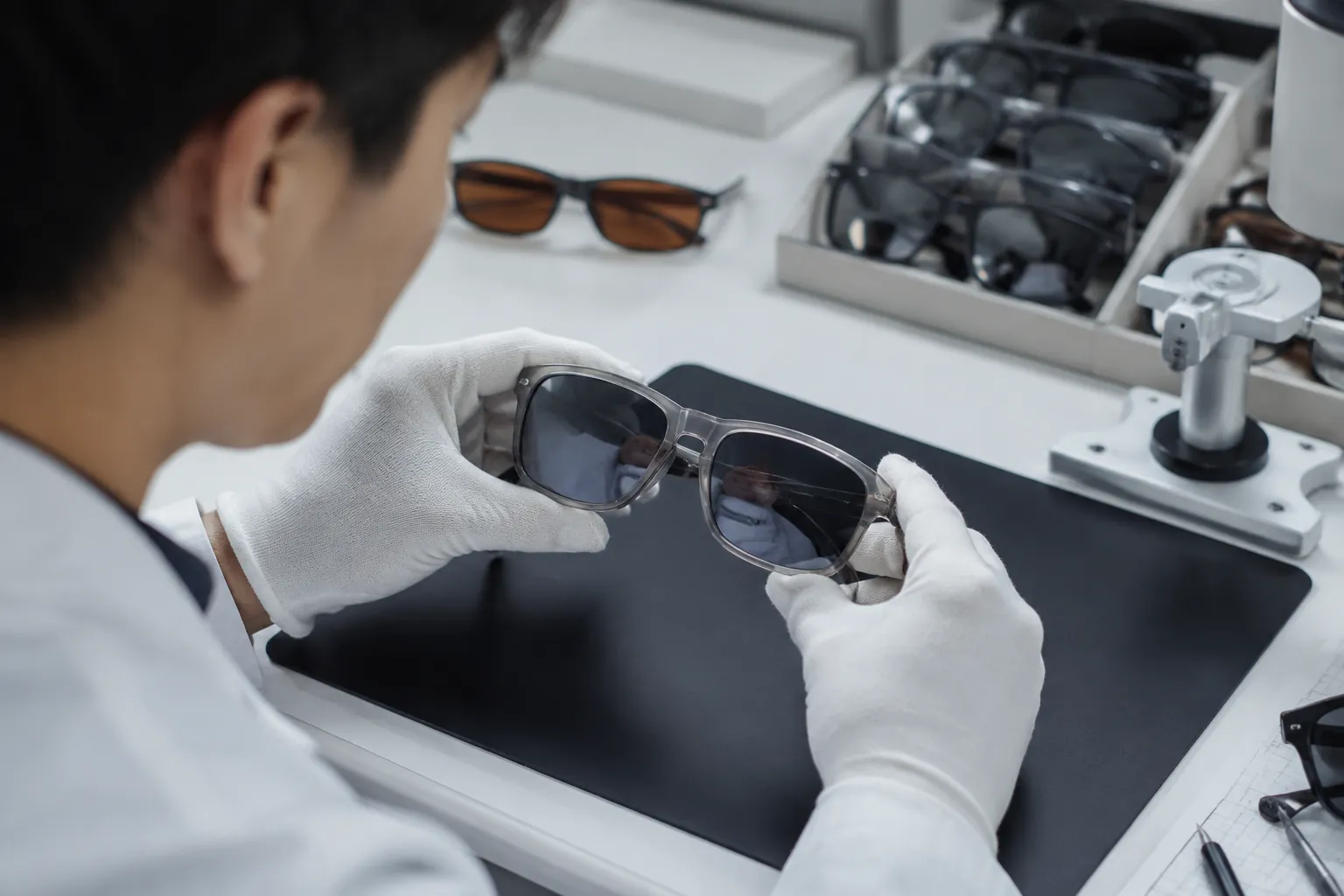
For retail, promo, or private label sunglasses, lens quality is not a minor detail. It affects wear time, complaints, returns, and reorders. A pair can look good on the peg and still fail once a customer puts it on. The frame gets the attention first. The lens decides whether the product feels wearable. This article covers the lens factors that influence sell-through, what to specify in your RFQ, and how manufacturers reduce risk through process control and inspection.
Why lens clarity affects sell-through
Buyers often focus on frame shape, color, logo placement, and unit price. That is incomplete. In store, the customer usually tries a pair on for only a few seconds. In that short window, the lens has to feel visually calm. If the view feels warped, cloudy, too dark, or oddly tinted, the pair goes back on the peg.
That first reaction matters because customers do not split a product into separate frame and lens judgments. They see one thing: a sunglass that feels right or wrong. A solid frame will not save a pair if the lens causes discomfort or distraction.
Three outcomes usually move first: try-on comfort, return rate, and repeat purchase intent. The same rule applies in promotional programs. Even at a low price, a branded sunglass with haze, tint mismatch, or scratches gets worn less and kept less often. Brand exposure drops with it.
The main visual triggers are distortion, tint uniformity, and surface finish. If straight lines bend at the edge, the lens looks milky under store lights, or scratches show on first handling, customers read the product as cheap within seconds. They may not describe the flaw correctly. They still reject it.
At scale, even a small defect rate gets expensive fast. Returns, replacements, and buyer complaints can erase any savings from a weak lens spec.
What buyers should measure, not guess
For sunglasses, "looks clear" is not a specification. Buyers need measurable standards so the factory knows what passes and what fails. A capable supplier should be able to discuss these points directly.
- Optical distortion: Straight lines should not bend noticeably through the center or edge of the lens. Distortion is easier to spot on larger lenses and stronger wrap styles.
- Visible haze: The lens should not appear milky, cloudy, greasy, or scratched under normal daylight or retail lighting.
- Color consistency: Left and right lenses should match in tint density and hue. A visible mismatch makes the pair look off-spec.
- Surface defects: Check for scratches, sink marks, flow lines, dust inclusion, polishing haze, and coating speckle.
- UV and safety compliance: Clarity is not protection. The lens still needs to meet the relevant UV and safety standard for the target market.
In the RFQ, ask for the exact lens material and process route. Common options include PC, TAC, nylon, and CR-39-style optical resin. Each behaves differently. PC is lightweight and impact-resistant, but weak molding control can leave internal stress or subtle birefringence that buyers read as distortion. TAC often gives strong clarity and is widely used in polarized lenses, but it is less impact-robust than PC. CR-39-style resin is often comfortable to view through, but it is usually not the first choice when low weight and impact resistance lead the spec.
Ask for practical acceptance criteria. A useful baseline is tint variation within one half-step of the approved master sample, visible left-right match under neutral light, and no visible distortion at arm's-length viewing. If the supplier cannot define internal criteria, the approval process is loose.
Process control matters here. Lens inconsistency is usually not random. It comes from unstable production.
The three failure modes that hurt retail performance
Most weak sell-through traces back to the same three issues. They sound minor. They are not.
- Distortion at the edge: This often appears when lens curvature and frame geometry do not match, or when polishing is uneven. Customers notice it fast when they look sideways, especially in oversized fashion shapes or high-wrap sport styles.
- Tint mismatch: One lens darker than the other, or one lens slightly greener than the other, makes the product look off-spec immediately. Bright retail lighting makes small differences obvious.
- Surface haze or scratches: These defects can come from molding, polishing, handling, or packing. Under store lights they often look worse than they did in the warehouse.
Promotional sunglasses are especially exposed because the order is usually driven by price and volume. The frame can be simple. The lens still has to be clean, consistent, and wearable. A logo on a flawed lens does not fix the problem.
One rule holds across channels: if the lens looks cheap, the whole sunglass looks cheap. Consumers rarely separate the two.
There is also a quieter retail effect. Store staff stop recommending a style once they hear repeated complaints about visual comfort. Sell-through slips even if the planogram looked right on day one.
Lens material comparison for B2B buyers
Not every lens material fits every channel. The right choice depends on price point, impact expectations, and the visual experience you want on shelf. The table below is a practical buyer view, not a lab summary.
| Lens material | Clarity and distortion control | Durability | Typical use | Buyer note |
|---|---|---|---|---|
| PC | Good when molded and finished correctly; can show stress or subtle distortion if process control is weak | High impact resistance, lightweight | Mass retail, sports styles, promo programs | Best when you need toughness, low weight, and acceptable cost |
| TAC | Very good visual comfort, especially in polarized styles; strong low-glare appearance | Moderate | Retail fashion, polarized programs, better-looking promo eyewear | Popular for clarity-sensitive buyers and styles where perceived quality matters |
| CR-39-style resin | Good clarity and stable viewing; comfortable for prolonged wear | Moderate | Higher-comfort fashion or lifestyle products | Watch weight, impact requirements, and target price |
| Glass | Excellent clarity and stable optics | Heavier and lower impact safety versus plastic options | Niche premium use | Less common for mainstream sunglasses because of weight and handling risk |
For most B2B sunglasses programs, TAC or quality PC is the practical choice. TAC is often preferred when buyers want a more premium visual feel, especially for polarized styles. PC is often the better fit when impact resistance, lower weight, or lower cost matters more.
Keep the end customer in view. If the product needs to survive active handling, shipping, and high-volume distribution, PC is usually the safer route. If the product needs to feel more refined at close range, TAC often wins on optics. If the buyer wants a middle ground, the sample stage becomes critical because the same tint can look better or worse depending on base material and coating.
How manufacturing changes what the customer sees
Lens quality is built into the process. It is not added at final inspection.
For injection-molded lenses, key variables include melt temperature, mold polish, mold venting, packing pressure, cooling time, and demolding control. If the mold surface is rough or the cycle is rushed, the result can be haze, flow marks, sink, or residual stress. That stress may not stand out in the warehouse. Under strong light, it often does.
A lens can be within shape tolerance and still feel wrong in use. Uneven shrinkage across the curve, for example, can create subtle optical issues that dimensional checks alone will miss. That is why shape inspection does not protect sell-through by itself.
For tinted lenses, the bath, coating, or dyeing step has to be controlled for time, temperature, concentration, and drying conditions. If that process drifts, left and right lenses can separate in density or hue. Batch variation is another common failure. Buyers approve one sample, then reject the production lot because the tint shifted darker or picked up a green cast.
Decoration can also affect lens appearance indirectly. Pad printing, laser engraving, hot stamping, and metal logo plates are common, but the handling around those steps matters. If repeated wiping, fixture contact, or poor packing protection touches the lens surface, scratches follow.
QC should include visual inspection under controlled light, left-right lens comparison, frame-to-lens fit checks after assembly, and random checks from the live production lot. Not just the pilot sample. If a factory says the goods were checked, ask how many pieces per lot, under what lighting, and which defects trigger rejection. Short answers are a warning sign.
How optical clarity affects returns and repeat orders
A customer may like the style and still reject the product once they look through it. That is the problem. In sunglasses, comfort drives staying power.
Retail buyers should watch three downstream effects:
- Returns: Poor clarity often shows up as "uncomfortable," "headache," or "too dark" complaints even when the frame fits correctly.
- Review damage: Customers call out bad lenses quickly, and poor reviews can drag down a style for a long time.
- Reorder hesitation: Once store staff hear enough complaints, they stop pushing the style and reorder plans weaken.
Promotional buyers see a related problem. The product is usually a brand touchpoint, not a profit driver. If the lens is too hazy, too dark, or easy to scratch, the promotional value drops fast. People keep what feels usable. They discard what feels cheap.
For sunglasses, the real test is not the approved sample on a desk. It is how the lens looks after handling, transport, and a few minutes in strong light.
That is why production-like samples matter. A hand sample may be polished, cleaned, and selected from the best-looking unit. Bulk production will not match that unless the process is stable.
For retail chains, one more metric matters: sell-through velocity against return rate. A style that sells fast but comes back often is not a win. Lens clarity is one of the simplest places to protect that balance.
What to put in your RFQ and sample approval
If you want consistent optical quality, write the request clearly. Do not expect the factory to infer standards from a reference photo.
- State the lens material, tint color, and whether the lens is polarized or non-polarized.
- Request the target standard for the market: CE EN ISO 12312-1, ANSI Z80.3, AS/NZS 1067, or the relevant local requirement.
- Ask for REACH compliance for the materials used in the finished product and any coatings or decoration components.
- Define acceptable tint variation between lenses and between lots, ideally against a master sample and a neutral light source.
- Require approval against a production-like sample, not only a polished display sample.
- Ask how lenses are protected from scratches in packing, inner bagging, master cartons, and carton loading.
- Specify inspection method, sample size, and acceptance criteria, including AQL level if your purchasing team uses one.
For custom runs, the cost logic is simple: MOQ starts at 50 pairs per design, pricing usually improves at 300, 1000, and 5000+ pairs, and final volume pricing depends on the exact spec. Samples usually take 7-10 days. Bulk lead time is typically 25-35 days, depending on decoration method and material combination. Lens approval needs to happen before production is locked.
Those quantity breaks reflect setup and handling costs. At 50 pairs, manual work weighs heavily. At 300 pairs, decoration, tinting, and inspection labor spread across more units. At 1000+ pairs, line setup, tooling use, and packing efficiency improve. At 5000+ pairs, buyers often have more room to tighten the lens spec because the unit cost effect of better process control is smaller.
If you are buying for multiple regions, confirm the compliance set at the start. One lens spec does not automatically fit every market.
A practical buyer checklist before you place the PO
Use this checklist before you release production. It prevents arguments later and gives the factory a clear target.
- Approved lens color, darkness level, and finish are documented.
- Left and right lenses match under store-like lighting, not just in daylight.
- Surface finish is clean, with no haze, visible scratches, or polishing residue.
- Frame and lens fit are checked after final assembly, including around the rim and groove.
- Packaging protects the lenses from rub marks during transit and carton vibration.
- Compliance documents match the target market and the actual product specification.
- Inspection standard is written down, including AQL, visual criteria, and defect photos if possible.
- Decoration method will not touch or scuff the lens surface during finishing or packing.
Also ask how the factory handles decoration on completed sunglasses. Laser engraving, pad printing, and metal logo plates can all work, but they should not create scratches through fixture contact, solvent wiping, or overhandling. This is an obvious point. It still causes avoidable rejects.
One more practical note: for low-price programs that need steady sell-through, avoid overcomplicated lens effects unless the market clearly wants them. Gradients, mirrored coatings, and unusual tints can work, but each adds another source of variation. A clean gray or smoke lens often performs better because it looks dependable and is easier to keep consistent.
Style may drive the first sale. Comfort keeps the product in use. Lens clarity is a major part of that result.
Have a custom sunglasses project in mind?
Send us your styles, target market and quantities and we will return a detailed quote with MOQ, lead time and a sample plan.
Get a QuoteWhy source this from Wenzhou with LumiShades
Wenzhou in Zhejiang Province is widely regarded as China’s eyewear manufacturing capital, producing a large share of the world’s sunglasses. That concentration matters to buyers: a deep local supply chain for acetate sheet, hinges, lens blanks, plating and packaging means shorter component lead times, easier color and material matching, and a workforce with decades of eyewear-specific skill. LumiShades has manufactured in this ecosystem since 2009, and our vertical integration — in-house injection molding, acetate cutting, CNC milling, lens tinting, decoration and quality control — means no part of your order is quietly subcontracted to a workshop you cannot audit.
For international buyers, that vertical control translates into accountability. When a single factory owns every step, defects are traced and fixed at source rather than bounced between vendors, and your specifications survive intact from first sample to bulk. We back this with 15+ years of experience, shipments to 60+ countries, more than 5 million pairs produced per year and a 98.5% on-time delivery rate. Our certifications — CE EN ISO 12312-1, FDA registration, ANSI Z80.3, AS/NZS 1067, REACH, ISO 9001 and BSCI audit — mean the compliance documentation your market requires already exists. Explore our manufacturing capabilities and quality control process to see how this works in practice.
Frequently asked questions
What lens issues cause the most complaints in retail sunglasses? The most common complaints come from edge distortion, uneven tint between left and right lenses, and surface haze or scratches. These flaws show up quickly under bright store lighting and can make a sunglass feel low quality even when the frame is fine. To reduce complaints, approve a production-like sample, define visible acceptance criteria, and inspect under neutral light before bulk release.
Is a polarized lens always better for sell-through? No. Polarization reduces glare, but it does not fix weak optics. If the lens has haze, distortion, or uneven tint, the product can still feel cheap or uncomfortable. For sell-through, start with clean optics, stable color, and a lens material that matches the intended use. Polarization helps when the customer values glare reduction. It is not a substitute for good quality control.
What compliance should I ask for on export programs? Match the compliance request to the destination market and the product type. Common requests include CE EN ISO 12312-1 for the EU, ANSI Z80.3 for the U.S., AS/NZS 1067 for Australia and New Zealand, and REACH for relevant chemical compliance in the EU. If your internal process requires supplier audits, you can also request ISO 9001 and BSCI documentation. For the U.S. market, confirm whether FDA registration or other labeling requirements apply to your exact program.
How can I reduce lens-related returns without raising price too much? Lock the lens material, tint target, and inspection criteria before production. Approve a production-like sample, not just a polished presentation sample. Protect the lenses in packing so they do not rub during transit, and make sure decoration does not contact the lens surface. If margin is tight, avoid unnecessary coatings or complex lens effects that add variation. Clear specifications usually save more money than last-minute sorting and returns.
What should I test on samples before approving bulk? Check the lenses in neutral light and in store-like lighting. Confirm that both lenses match in color and darkness, inspect for haze or scratches, and look for distortion by viewing straight edges through the lens. Also verify frame-to-lens fit after assembly and review the compliance documents for the target market. If the sample is for a regulated market, make sure the tested specification matches the production specification exactly.
What belongs in a sunglasses RFQ? Your RFQ should state the lens material, tint color, polarization status, target market standard, and any required compliance documents. Include the approved master sample, acceptable tint variation, inspection method, and packaging requirements for scratch protection. Also define how defects will be judged, ideally with photos or written criteria. The clearer the RFQ, the lower the risk of disagreement during production.
Can a supplier control lens quality at scale? Yes, if the supplier controls the process instead of relying only on final inspection. That means stable molding or tinting parameters, controlled handling, protected packaging, and lot-level visual checks under consistent lighting. Ask how the factory measures tint match, distortion, surface defects, and final fit. A supplier that can explain those controls clearly is usually better prepared for repeatable production.
Ready to start?
Explore our square sunglasses or request a quote — our sales team replies within 12 hours.
Request a Quote