
What Makes Sunglass Lens Tint Repeatable?
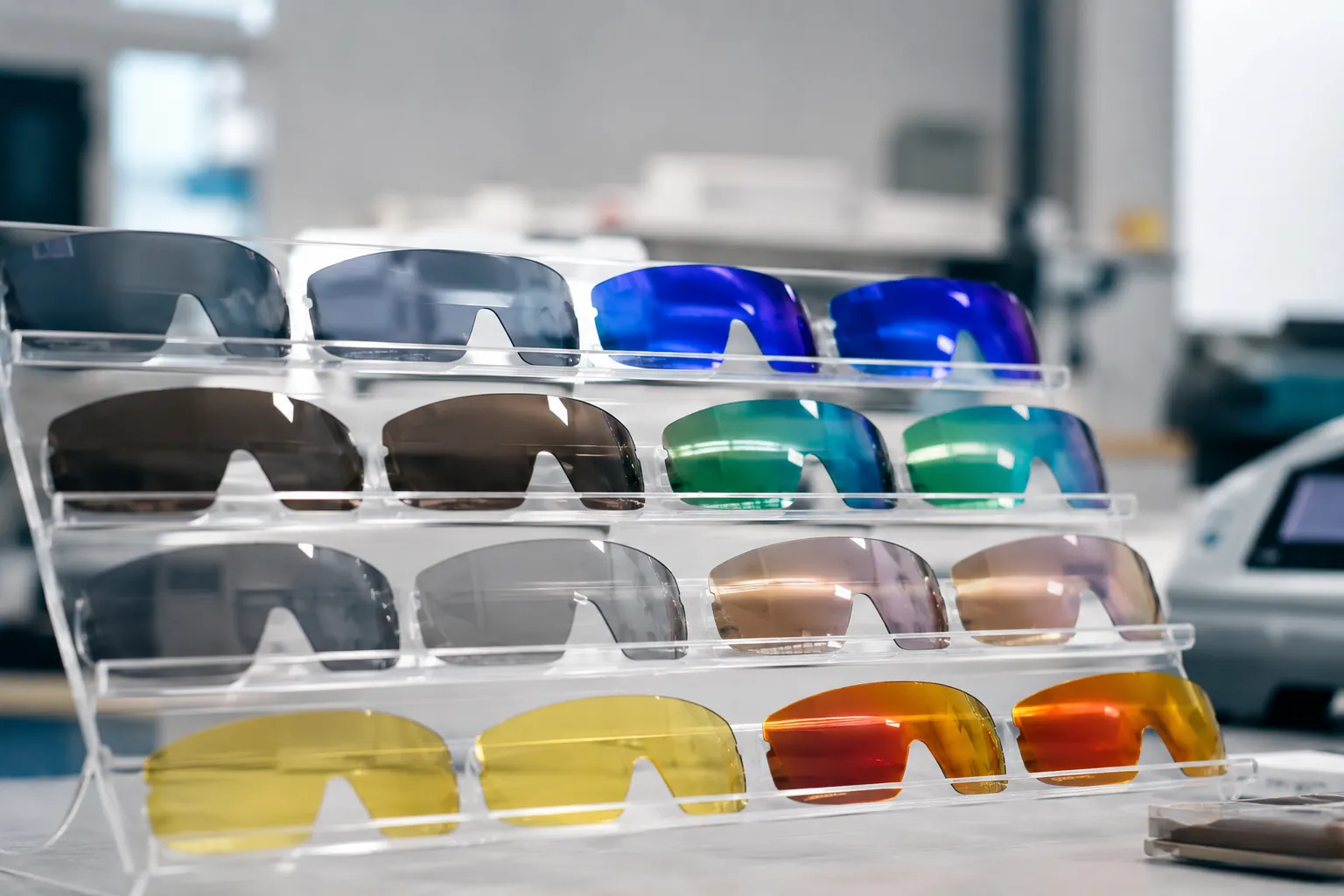
If you buy custom sunglasses for a brand, retail program, or distribution line, repeatable tint matters more than a perfect first sample. A lens that looks right on day one but shifts on reorder can cause complaints, returns, and SKU drift. This article explains the process controls, approval points, and buyer checks that keep tint stable from one order to the next.
What repeatability means in tinted lenses
Repeatability means the next production run matches the approved master sample within an agreed color tolerance. In sunglass production, buyers usually need consistency in three places: the overall shade, left-right matching within a pair, and lot-to-lot consistency across reorders.
Tinted lenses are not finished in one step. The final look depends on controlled variables: lens material, dye formulation, bath temperature, dip time, drying conditions, and post-process handling. If those variables move, a reorder can come back darker, lighter, greener, or more reflective than the approved sample.
"Looks close" is not enough. The standard should be written down. The approval record should identify the lens material, tint code or reference sample, finish type, and the inspection method used to judge acceptability.
Buyer rule: if the supplier cannot say what is fixed, what is measured, and what is allowed to vary, repeatability is not under control.
The process steps that drive color consistency
Tint stability starts before the lens reaches the dye bath. A repeatable result depends on the whole chain, from incoming material to final inspection.
- Incoming material check: the lens blank or resin lot is confirmed before production. Different lots can absorb tint differently.
- Lens preparation: the surface is cleaned so residue, oil, or dust does not affect dye uptake.
- Tint bath setup: dye concentration, bath temperature, and dwell time are set to the approved recipe.
- Color build: lenses are dyed to the target shade, with in-process checks against the master sample.
- Rinse and stabilization: controlled rinsing and drying help prevent uneven darkening, streaking, or shade shift.
- Final check: the finished lot is compared with the approved reference before packing.
Frame color also changes perception. A lens can appear different in a black frame than it does in a translucent or light-colored frame because the surrounding frame shifts how the eye reads the shade. So buyers should approve the complete finished product, not only a loose lens sample.
Dimensional control matters too. If a lens is poorly cut or mounted under stress, edge effects and optical distortion can make the color look uneven even when the tint process itself is correct.
The variables buyers should lock before mass production
If the goal is repeatable reorders, the approval package needs more detail than "dark gray lens." Vague instructions cause shade drift. That part is simple.
Lock these variables in writing:
- Lens material: PC, TAC, nylon, or another agreed substrate. Different materials can produce different tint results.
- Tint code or color name: use an internal code plus a physical master sample.
- Transmission target: if darkness matters, define the target clearly in the product spec.
- Finish type: solid tint, gradient tint, flash mirror, or coated appearance.
- Surface treatment: anti-scratch, AR, mirror layer, or plain tint only.
- Reference lighting: daylight-style inspection light or another agreed light source.
- Acceptance rule: what counts as pass, rework, or reject.
Photos help with communication, but they are not a color standard. White balance, screen settings, and lighting distort how a lens appears. Use physical pre-production samples before bulk production begins.
Commercial terms matter too. A lower MOQ can make it easier to start a program, but it does not protect the tint from drifting. If the specification is weak, order size will not fix it.
How to approve color so reorder drift stays under control
The sample approval step is where many reorder problems are prevented or created. Approve color only after checking it under the same type of light and viewing method used for production inspection. Otherwise, the sample and the shipment are not being judged the same way.
Use a structured approval pack:
| Checkpoint | What to verify | Buyer risk if skipped |
|---|---|---|
| Master sample | Keep one sealed physical reference for repeat orders | No stable target for later runs |
| Lighting standard | Compare under an agreed daylight-style light source | Shade looks different in factory vs. office |
| Left-right pair match | Both lenses in one pair should match closely | Uneven appearance on the shelf |
| Lot sample | Check multiple pieces from the same batch | Hidden drift inside one production lot |
| Reorder sample | Confirm the new run matches the saved standard | Change goes unnoticed until shipment |
Approve a golden sample and store it by SKU and color code. Do not rely on memory from a prior order. A reorder months later may use a different lens lot or a slightly adjusted process setting if the reference was never frozen.
Also define whether small visual differences are acceptable for mirrored or gradient lenses. Some variation is normal because reflective layers and gradients change with angle and light. Define the acceptable range before production starts.
Where tint variation usually comes from
Most tint variation comes from a short list of causes. They are common. They are also preventable if the process is controlled.
1. Material lot variation. Different lens blanks or resin batches can absorb dye differently, which can shift darkness or hue.
2. Temperature drift. Tint baths are sensitive to temperature. Even small changes can affect final shade, especially on lighter colors.
3. Time drift. A longer or shorter dip time can move the lens away from the approved target.
4. Surface contamination. Oil, dust, or residue can interfere with even dye uptake and create streaks or patches.
5. Operator judgment. If the line depends on subjective eye checks without a fixed standard, variation is more likely.
6. Finishing sequence. Decoration steps such as engraving, printing, or hardware assembly should follow the planned order, because later steps can affect how the tint is perceived.
In-house production and QC help because the tinting process does not need to be handed off between unrelated suppliers. Fewer handoffs usually mean fewer chances for the approved standard to be lost or reinterpreted.
What compliance means for tinted sunglass lenses
Repeatability is not only a visual issue. Tinted sunglasses sold into different markets also need to meet the relevant compliance framework. Common references in this category include CE EN ISO 12312-1, ANSI Z80.3, AS/NZS 1067, REACH, FDA registration, ISO 9001, and BSCI.
These serve different purposes. CE EN ISO 12312-1, ANSI Z80.3, and AS/NZS 1067 relate to sunglass performance and safety requirements in different markets. REACH addresses restricted substances in the EU supply chain. FDA registration is part of the U.S. regulatory context. ISO 9001 relates to quality management systems, and BSCI is a social compliance framework. None of them replace color approval, but they matter when a tinted lens is produced and sold at scale.
For procurement, the real question is simple: can the supplier keep the approved tint consistent while producing to the required compliance standard?
If the lens material, tint level, coating, or finishing method changes, treat it as a controlled change and request a new approval if needed. Do not assume the previous approval automatically covers the revised product.
How volume, MOQ, and lead time affect tint stability
Order size can affect how efficiently a tint program is run, but it does not replace a clear specification. Small runs can be easier to approve. Larger runs can be easier to reproduce once the process is fixed.
Commercial terms often influence how much control is needed at each stage:
| Order level | Commercial effect | Process implication |
|---|---|---|
| 50 pairs/design MOQ | Low entry point for custom work | Higher setup sensitivity; approval must be tight |
| 300 pairs | Better unit pricing | Batching becomes more efficient |
| 1000 pairs | Stronger price step-down | Repeat runs are easier if specs are frozen |
| 5000+ pairs | Lowest per-pair cost in high-volume programs | Documentation and lot control become more important |
Sample lead time and bulk lead time should be long enough to support proper approval, but not so loose that the standard changes midstream. If the buyer revises the tint reference late in the process, both schedule and consistency are at risk.
For reorders, use the same SKU code, lens material, tint reference, and packaging spec. If any of those elements changes, the visual result can shift enough to matter to the customer.
A buyer checklist for stable reorders
If you want the same sunglass tint on the next order, use a written control list and keep it with the purchase order file.
- Approve a physical golden sample, not only photos.
- Record lens material, tint code, finish type, and target darkness.
- Specify the inspection light source and viewing method.
- Confirm whether approval applies to loose lenses or finished sunglasses.
- Set the left-right matching rule for each pair.
- Request a pre-production sample if any material, coating, or process change occurs.
- Keep the same SKU naming across seasons and regions.
- Ask for lot traceability on each bulk run.
- Match compliance documents to the exact product version shipped.
Many tint complaints are not manufacturing failures. They are specification failures. The buyer approved a shade that was too vague, then expected the factory to remember the exact meaning later.
Repeatable tint is possible when the target is frozen, the inspection method is defined, and the reorder uses the same approved inputs. That keeps the appearance stable from one shipment to the next.
Have a custom sunglasses project in mind?
Send us your styles, target market and quantities and we will return a detailed quote with MOQ, lead time and a sample plan.
Get a QuoteWhy source this from Wenzhou with LumiShades
Wenzhou in Zhejiang Province is widely regarded as China’s eyewear manufacturing capital, producing a large share of the world’s sunglasses. That concentration matters to buyers: a deep local supply chain for acetate sheet, hinges, lens blanks, plating and packaging means shorter component lead times, easier color and material matching, and a workforce with decades of eyewear-specific skill. LumiShades has manufactured in this ecosystem since 2009, and our vertical integration — in-house injection molding, acetate cutting, CNC milling, lens tinting, decoration and quality control — means no part of your order is quietly subcontracted to a workshop you cannot audit.
For international buyers, that vertical control translates into accountability. When a single factory owns every step, defects are traced and fixed at source rather than bounced between vendors, and your specifications survive intact from first sample to bulk. We back this with 15+ years of experience, shipments to 60+ countries, more than 5 million pairs produced per year and a 98.5% on-time delivery rate. Our certifications — CE EN ISO 12312-1, FDA registration, ANSI Z80.3, AS/NZS 1067, REACH, ISO 9001 and BSCI audit — mean the compliance documentation your market requires already exists. Explore our manufacturing capabilities and quality control process to see how this works in practice.
Frequently asked questions
What is the biggest cause of tint mismatch on reorder? The most common causes are changes in lens material lot, dye recipe, bath temperature, or dip time. If the master sample and process settings are not frozen, the shade can drift on the next run.
Should I approve tint from photos or physical samples? Use physical samples for approval. Photos are useful for discussion, but lighting, camera settings, and screen display can change how the color appears.
How do I keep left and right lenses matching in each pair? Require pair-level inspection under the same light source used for approval. Define a written pass/fail rule for left-right shade match before production starts.
Does higher order volume improve tint consistency? Higher volume can make batching more efficient, but it does not correct a weak specification. Consistency depends on locked materials, locked process settings, and a fixed master sample.
What should I ask for on a reorder if I want the same color? Ask the supplier to use the same SKU, lens material, tint code, finish, and inspection standard. If anything has changed, request a new pre-production sample before bulk production.
Do certifications guarantee color repeatability? No. CE EN ISO 12312-1, ANSI Z80.3, AS/NZS 1067, REACH, FDA registration, ISO 9001, and BSCI relate to compliance, safety, or management systems. They do not guarantee that a tint will match your master sample.
Ready to start?
Explore our rimless sunglasses or request a quote — our sales team replies within 12 hours.
Request a Quote