
Polarized Lens Failures: Causes, Checks, and Claims
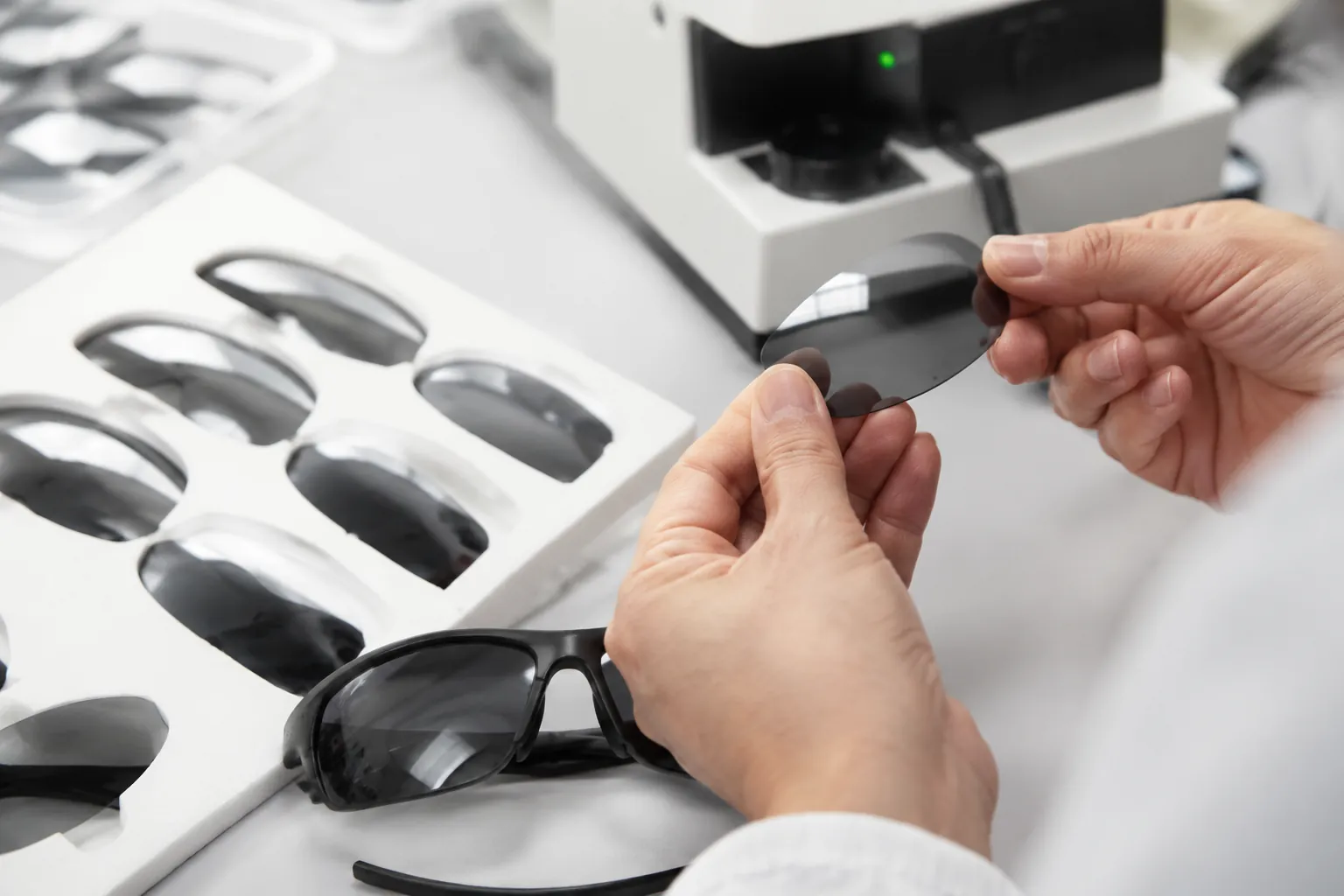
This guide is for brand owners, importers, distributors, and retail buyers sourcing polarized sunglasses in volume. The goal is straightforward: reduce returns caused by lens failure after goods reach your warehouse or your customers. If you buy custom eyewear, you need to know where polarized lenses fail, how those failures show up in the field, and which checks belong in sample approval and production control. The difference between a stable program and a claim-heavy one is rarely the word polarized on the spec sheet. It is the detail behind the lens stack, the assembly fit, and the inspection standard.
The three polarized lens failures behind most claims
Most complaints about polarized sunglasses do not start with polarization itself. They start with construction and process control. Three failure modes show up again and again: delamination, rainbow distortion, and cosmetic haze or edge lift. They often appear after heat exposure, shipping vibration, or frame insertion stress. Not always on day one.
Delamination means the polarized film loses adhesion inside the lens structure. You may see a bubble, a crescent near the edge, a cloudy patch, or a peeling line that grows after heat exposure. A lens can look fine at room temperature and still fail later if the adhesive softens or the substrate expands.
Rainbow distortion is different. The lens can still be structurally intact, but users see colored stress patterns, bands, or interference colors, especially when looking at LCD screens, polished glass, or road surfaces at an angle. In practice, this is usually birefringence: stress in the lens material or assembly process changes how light passes through the polarized stack.
Cosmetic haze and edge lifting are smaller defects buyers sometimes miss in casual inspection. Under ordinary room light they can be subtle. Under stronger inspection lighting, they become obvious. Do not dismiss them as minor. On fashion eyewear, a defect visible at arm's length can still trigger a complaint.
These are not lab-only issues. They become chargebacks, replacements, and lost margin. A buyer should treat polarized lens quality as failure prevention, not as a checkbox that says "polarized."
Where the lens fails: material stack and process weak points
A polarized lens is a stack, not a single piece. The exact structure depends on whether the factory is making TAC lenses, polarized PC lenses, or polarized nylon constructions, but the weak points are similar. Change the lens curvature, thickness, or frame fit, and you change the stress profile too.
Typical construction elements and risk points include:
- Polarized film quality: thickness consistency must stay within the agreed specification, or optical variation becomes more likely.
- Adhesive layer stability: weak systems may pass room-temperature inspection but soften after heat exposure.
- Base material behavior: TAC is generally used for optical stability; PC is tougher but more stress-sensitive; nylon can offer impact benefit but demands tighter process control.
- Lamination temperature and pressure: small drift matters. Temperature or pressure variation can create weak bond zones.
- Cooling and stress relief: lenses cut or formed too quickly may retain residual stress.
- Edge finishing: rough edges, burrs, or chip-outs are common starting points for edge lift.
Delamination often starts at the edge because that is where moisture, heat, and mechanical stress attack first. If the lens is cut too aggressively, edged with worn tooling, or inserted into a frame with too much force, the laminate can start to separate from the perimeter inward. On wrapped sport shapes, the outer edge often carries the highest load because the lens is slightly pre-bent into the frame groove.
Rainbow distortion is usually stress-related. Polycarbonate is especially sensitive if molding conditions are unstable or if the lens is forced into a frame opening that is too tight. A lens can pass a loose-lens inspection and still fail after assembly. That is why process control matters more than a nice sample photo.
At a factory with in-house injection molding, acetate cutting, CNC milling, lens tinting, decoration, and QC, the practical advantage is shorter feedback loops. If a polarization batch shows edge haze during inspection, the team can isolate whether the issue came from incoming film, lamination settings, edging, or frame insertion pressure. For bulk programs with standard production lead times, that speed matters. A slow diagnosis delays shipment.
Delamination: root causes buyers should ask about
Delamination claims usually have more than one cause. Buyers should ask for specific root-cause detail, not a vague promise that the lenses are "good quality." The right questions expose whether the supplier is controlling material, process, and assembly together.
- Heat sensitivity in the adhesive system. Some lens constructions survive normal wear but fail after container heat, dashboard exposure, or long retail display near windows. Ask what temperature range the adhesive system is intended to withstand in the finished product.
- Weak edge sealing. If the perimeter is poorly finished, moisture and cleaning chemicals can enter the laminate. Repeated wiping with aggressive cleaners can speed up edge lift on weak constructions.
- Over-stressed lens insertion. A frame groove that is too tight can create constant tension on the lens edge. In practice, issues often show up when the frame opening and final lens profile do not match after coating and edging tolerances are combined.
- Uneven lamination parameters. Pressure or temperature variation can create weak bond zones that may not appear in final inspection. A batch can look fine until it is heat-aged or bent during shipping.
- Material mismatch. A low-cost film combined with a demanding wrap geometry is a common problem. High base curvature and thin edge cross-sections increase the risk of local peel initiation.
Ask the supplier what happens after lens lamination and before assembly. Are lenses rested for stabilization before edging or assembly? Are edge chips screened at 100% inspection? Are wrapped styles tested after insertion, not before? Are lenses sampled from the beginning, middle, and end of a production run? Those details matter.
For lower-volume custom orders, minimum order quantity also affects risk management. A run at 50 pairs per design is best treated as process validation, not just a sales sample. It is the point where you verify fit, insert behavior, and whether the lens stack survives real assembly. At 300 pairs, you start to see whether packaging and handling create edge damage. At 1000 pairs, a small bond issue can become meaningful. At 5000 pairs and above, the cheapest lens stack is often not the least expensive program once claims and replacements are counted.
Rainbow distortion is usually a stress problem, not a coating problem
Buyers often describe rainbow distortion as a coating defect. Usually it is not. It is optical stress showing through the polarized structure. In many cases, there is no coating issue at all; the problem is birefringence from substrate stress, uneven cooling, or frame-induced load.
Common triggers include overpacked frame assembly, poor annealing after molding, and uneven thickness in the lens blank. Wrap sunglasses are more vulnerable because the frame shape and lens curvature increase insertion stress. Sport styles can look perfect in a still photo and still fail in actual use when the wearer looks at road signs, dashboard screens, or laminated glass.
A practical factory check is simple: inspect the lens through a polarized reference under strong directional light before assembly and again after assembly. If the stress pattern becomes much stronger after insertion, the frame fit is part of the problem. If the pattern is visible before assembly, the issue is upstream in the lens blank or lamination stage.
| Failure symptom | Likely root cause | Where to check | Buyer action |
|---|---|---|---|
| Rainbow bands under angled light | Internal stress from molding or frame insertion | Lens before and after assembly | Approve an assembled-sample stress check, not a loose-lens-only review |
| Colored interference on LCD view | Uneven lamination or high birefringence in the substrate | Polarized viewing test across multiple angles | Request comparison samples from two production lots |
| Edge bubble after heat exposure | Weak adhesive or edge finishing defect | Post-heat inspection around the perimeter | Add a heat-aging check before shipment |
| Cloudy crescent near the groove | Frame groove too tight or rough edge | Assembly line insertion and final QC | Review frame-lens fit tolerance and assembly method |
For product development, ask the supplier to compare at least two lens materials under the same frame design. A PC version may show more stress color than TAC if the frame fit is aggressive, while TAC may show better visual stability but less edge abuse tolerance. There is no universal winner. The right option is the one that survives your actual frame geometry and logistics route.
The checks that actually prevent returns
Many QC plans are too generic. "Check appearance, check logo, check packing" does not stop lens claims. Polarized sunglasses need a lens-specific control plan with clear numbers and decision points.
Use a three-stage control flow:
- Incoming material: verify film lot consistency, substrate appearance, and compliance documents for the intended market. Film thickness should be measured on a sample, and lot variation should be tracked by batch number.
- Pre-production sample: confirm polarization effect, tint consistency, visible light transmission target, and cosmetic quality under defined light conditions. A simple LCD test is not enough; check at least three angles and two light sources.
- In-process lamination: record temperature, pressure, and cycle time by lot. Even a basic log of each run helps identify the batch if a later claim appears.
- Post-edging: inspect the perimeter for chips, haze, lift points, and stress marks. Edge polish quality is especially important on high-wrap and shield styles.
- Post-assembly: repeat visual and stress checks after lens insertion into the frame. This is where many failures are first created.
- Aging check: short heat exposure and recovery inspection to catch weak adhesion before shipment.
For heat-aging, a practical buyer-level screen is moderate heat exposure followed by cool-down and perimeter inspection. That is not a full laboratory qualification, but it catches weak bond systems early. For distortion, rotate the finished sample slowly under a directional light source and inspect both lenses side by side. Symmetry matters. One lens showing more stress than the other often points to uneven insertion force.
If your supplier has in-house injection molding, acetate cutting, CNC milling, lens tinting, decoration, and QC, they can usually contain a problem faster because fewer handoffs are involved. But do not assume in-house means controlled. Ask for the actual inspection flow, the acceptance sample size, and the rejection criteria. A good factory can show you the checkpoints quickly.
For buyer approval, the minimum sensible package is: one golden sample, one approved lens color standard, one polarization confirmation sample, and one written defect standard with acceptance criteria for edge lift, haze, stress marks, and logo placement. If the style is a priority program, add a retained sample from the first production lot and a duplicate sealed sample kept at the factory.
What to put in your purchase order and approval file
Most claim disputes happen because the PO says too little. If you only specify "polarized TAC lens, smoke," you leave too much room for variation. The best purchase orders describe the lens as a functional system, not a color swatch.
Your PO and approval file should define:
- Lens construction type: TAC, PC polarized, or another agreed structure
- Lens thickness and target tolerance, where relevant
- Lens category or target visible light transmission range for the market program
- Polarization requirement and acceptance method, including the viewing test reference
- Cosmetic acceptance standard for center field and edge zone, with an allowed defect size or distance threshold
- Stress check requirement after frame assembly
- Heat-aging or stability check required before shipment
- Applicable compliance documents: CE EN ISO 12312-1, ANSI Z80.3, AS/NZS 1067, FDA registration where required, and REACH
- Quality system documents where relevant, such as ISO 9001 and BSCI, if you use them as supplier qualification evidence
- Decoration method for logo and graphics, such as laser engraving, pad printing, hot stamping, or molded temple insert, plus the approval location and color standard
Decoration can affect lens or frame quality indirectly. For example, pad printing on lens-adjacent frame areas can add solvent exposure if the ink system is too aggressive, while laser engraving on coated metal parts can create local heat marks if the process is poorly controlled. If the style uses transfer logos, ask whether the topcoat or curing step changes the frame opening tolerance before lens insertion. Small changes matter.
Be specific about the approved sample stage. A photo approval is not enough for polarized product. You need physical samples. A supplier that can produce samples quickly gives you a useful development window to compare lens constructions before bulk locking. That matters when you are balancing target price against return risk.
On cost logic, low MOQs are useful for trial runs, but not every lens construction is equally stable at every price point. At 50 pairs, you can validate function and fit. At 300 pairs, you can validate packaging and transport damage. At 1000 pairs, you should know whether the lamination and assembly route is repeatable. At 5000+ pairs, proceed only if the defect standard, heat test, and fit tolerance are locked. If the price drops sharply, ask exactly what changed: film source, substrate, lamination route, assembly method, or inspection depth.
Cost, lead time, and risk: the trade-offs
Polarized lens sourcing is not just a technical choice. It is a cost and lead-time choice. Better process control and better materials are rarely free, but returns are expensive too. The cheapest landed cost can become the most expensive program if claim rates rise.
| Order stage | Typical quantity point | What buyers gain | Main risk if spec is weak |
|---|---|---|---|
| Trial run | 50 pairs per design MOQ | Fast validation of fit, look, and market response | Too little testing before wider launch |
| Small bulk | 300 pairs | Better unit price and stable packaging setup | Claims become meaningful if the lens stack is not validated |
| Core bulk | 1000 pairs | Stronger pricing and production efficiency | A hidden lamination issue affects a full shipment |
| High volume | 5000+ pairs | Lowest unit cost, often near the lower end of a bulk program depending on spec and decoration | Small defect rates turn into large after-sales cost |
Lead time matters because rushed production can create lens problems. Samples in about 7 to 10 days and bulk in about 25 to 35 days are commonly achievable when the spec is clear and materials are ready. If a buyer changes lens color, logo plate, frame finish, or frame fit after sample approval, do not expect the same defect risk profile. Assembly stress can change with a small frame modification, even when the SKU name stays the same.
A simple rule works well: if your price target requires the supplier to remove a control step, make them state which step is removed and what new risk it introduces. If the answer is vague, the savings are not real.
Cheap polarized lenses are not always bad. Undefined polarized lenses are bad.
A practical buyer checklist before bulk release
Use this as a final gate. If any answer is unclear, fix it before deposit release or bulk approval. The goal is to remove ambiguity before the shipment exists.
- Have you approved the exact lens construction, not just the color?
- Has the factory checked stress before and after assembly?
- Did you review edge quality under strong light, not only casual room light?
- Is there a defined heat-aging or stability check for the finished sunglasses?
- Do compliance documents match your target market: CE EN ISO 12312-1, ANSI Z80.3, AS/NZS 1067, FDA registration as applicable, and REACH?
- Did you receive a golden sample that includes final logo decoration and final lens?
- If the price was reduced, do you know exactly what changed in material or process?
- Is the defect limit written in measurable terms, such as no visible edge lift at a defined inspection distance under defined lighting?
Good buyers do not wait for a customer return to discover lens construction problems. They force the discussion earlier, at sample stage and at pre-production meeting stage. That is where polarized lens claims are prevented.
For factories running in-house injection molding, acetate cutting, CNC milling, lens tinting, decoration, and QC, the next step is straightforward: review the actual production route for the model, then tie the inspection plan to that route. Keep meetings short. Keep checkpoints clear. Make acceptance criteria measurable. That is how you reduce surprises after shipment.
Have a custom sunglasses project in mind?
Send us your styles, target market and quantities and we will return a detailed quote with MOQ, lead time and a sample plan.
Get a QuoteWhy source this from Wenzhou with LumiShades
Wenzhou in Zhejiang Province is widely regarded as China’s eyewear manufacturing capital, producing a large share of the world’s sunglasses. That concentration matters to buyers: a deep local supply chain for acetate sheet, hinges, lens blanks, plating and packaging means shorter component lead times, easier color and material matching, and a workforce with decades of eyewear-specific skill. LumiShades has manufactured in this ecosystem since 2009, and our vertical integration — in-house injection molding, acetate cutting, CNC milling, lens tinting, decoration and quality control — means no part of your order is quietly subcontracted to a workshop you cannot audit.
For international buyers, that vertical control translates into accountability. When a single factory owns every step, defects are traced and fixed at source rather than bounced between vendors, and your specifications survive intact from first sample to bulk. We back this with 15+ years of experience, shipments to 60+ countries, more than 5 million pairs produced per year and a 98.5% on-time delivery rate. Our certifications — CE EN ISO 12312-1, FDA registration, ANSI Z80.3, AS/NZS 1067, REACH, ISO 9001 and BSCI audit — mean the compliance documentation your market requires already exists. Explore our manufacturing capabilities and quality control process to see how this works in practice.
Frequently asked questions
How can I tell if delamination risk is high before bulk production? Ask for a finished assembled sample, then require a heat-aging check and a perimeter inspection after cool-down. Compare lens appearance before and after frame insertion. Many weak laminations show first at the edge, especially if the frame groove is tight or the lens was cut aggressively. If the supplier cannot explain the adhesive system and the post-assembly inspection step, treat that as a risk signal.
Is rainbow distortion a reason to reject goods if polarization still works? Usually yes, if the distortion is visible in normal wear or at common viewing angles. Polarization function alone is not enough. Stress patterns can trigger consumer complaints even when the lens remains polarized. Ask whether the pattern appears before assembly or only after frame insertion, because that tells you where the fix belongs. If it is visible in the approved sample, do not ignore it in bulk.
What lens construction is safest for wrapped sport sunglasses? There is no universal safest option. Wrapped shapes need tighter control of stress, edge finishing, and frame fit. The right choice depends on curvature, substrate, and assembly method, so test the finished frame-lens combination, not the loose lens only. If possible, compare two materials under the same frame geometry before locking bulk. Approve the option that shows the least stress after assembly and the most stable appearance after a heat-aging check.
Which compliance documents should I ask for on polarized sunglasses? Ask for the documents required for your target market and product scope. Common references are CE EN ISO 12312-1 for the EU market, ANSI Z80.3 for the U.S. market, AS/NZS 1067 for Australia/New Zealand, FDA registration where applicable, and REACH for chemical compliance in the EU supply chain. Also ask whether the supplier's quality system is supported by ISO 9001 and, if relevant to your sourcing policy, BSCI. Always confirm that the documents match the exact style and lens build you are buying.
Does a lower MOQ help reduce risk on a new polarized style? Yes. Starting at 50 pairs per design lets you validate the actual lens construction, frame fit, decoration method, and assembly behavior before moving to 300 or 1000 pairs. Treat the first run as process validation, not just a sales sample. The lower MOQ does not remove risk, but it gives you a cheaper way to find process problems early. Use the first run to approve the sample, the stress behavior, and the packaging route before scaling.
Ready to start?
Explore our wayfarer sunglasses or request a quote — our sales team replies within 12 hours.
Request a Quote