
Polarized Sunglasses: Margin, Lead Time, Retail Tradeoffs
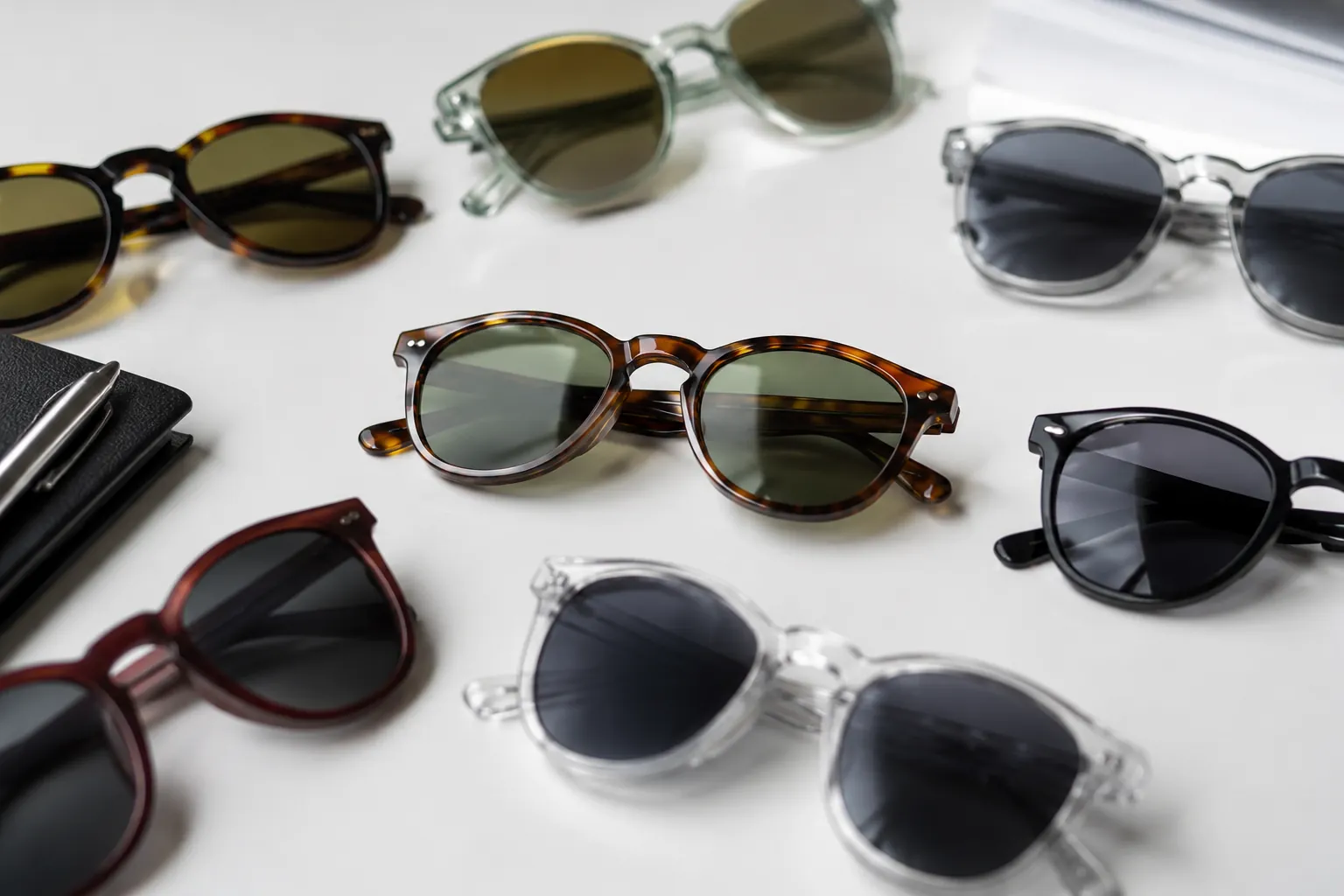
If you buy sunglasses for a brand, chain, catalog, or distribution program, polarized lenses are not just a feature. They can change unit cost, sample approval, labeling, product positioning, and sell-through. This article lays out the tradeoffs in plain terms so you can decide where polarization is worth the spend and where it adds work without adding value. The focus is margin, lead time, and retail performance. No hype.
What polarization changes in the product
A polarized lens includes a filter layer that reduces glare from light reflected off water, roads, glass, and snow. That is the core benefit. Polarization does not make a lens UV-protective by itself, and it does not replace tint. These are separate specifications.
In a typical sunglass build, the lens system may include the base lens material, tint or mirror coating, and the polarizing film or laminate. That extra layer changes handling and inspection. Buyers should confirm how the supplier checks lens orientation, color consistency, edge finish, and cosmetic defects before bulk approval.
Material choice matters. TAC polarized lenses are common because they are light and relatively easy to process. Polycarbonate polarized lenses are impact-resistant and often used in performance eyewear. CR-39 can offer good optical clarity, but buyers still have to weigh weight and impact requirements. The real question is not just whether the lens is polarized. It is whether the lens material, coating, and frame design fit the market and the compliance target.
At a factory like LumiShades, lens tinting and assembly are handled in-house. That helps control consistency from sampling through final inspection. Still, the commercial question stays the same: does glare reduction create enough retail value to justify the extra cost and tighter process control? In some channels, yes. In others, no.
Where polarized lenses help sell-through
Polarized lenses work best where glare is a real daily problem. Fishing, boating, driving, golf, waterside travel, and bright outdoor leisure are the obvious examples. In those channels, customers usually notice the difference fast. That makes the feature easier to explain at retail.
They are less useful in fashion-led channels where silhouette, color, and price drive the sale. If your assortment depends on impulse fashion or quick trend rotation, polarization can raise unit cost without lifting conversion enough to pay for it. A shopper may like the frame and lens, then pass because the feature does not matter to them.
Good fit:
- Outdoor, sport, and utility programs
- Driver-focused SKUs
- Mid-market and premium retail
- Private label programs where functional claims matter
Weak fit: pure trend-driven fashion lines, low-ticket promotions, and multi-SKU color programs that depend on aggressive price points.
Simple rule: if the customer can test the benefit on the spot, polarization has a better chance of selling. If the buyer is choosing mainly on style, the premium is harder to recover unless the frame already supports a higher retail price.
The cost stack: what polarization adds to landed cost
Polarization affects direct cost and hidden cost. Direct cost is the lens itself. Hidden cost can include tighter QC, stricter packing, and more rejection if the film, laminate, or coating is inconsistent.
At volume, the premium is usually manageable. On a small MOQ order, it is easier to feel. LumiShades quotes start at 50 pairs per design, and pricing improves at 300, 1000, and 5000+ pairs. That matters because polarization cost is easier to absorb when setup, testing, and color matching are spread over more units.
| Order level | Typical sourcing effect | Buyer takeaway |
|---|---|---|
| 50 pairs/design | Highest unit cost, little room to absorb upgrade cost, more risk if rejection occurs | Use polarization only if the SKU is a premium test or a hero style with clear demand |
| 300 pairs | Better unit economics, enough quantity for a meaningful retail test, less painful setup cost | Good level for a small polarized capsule or a regional rollout |
| 1000 pairs | Setup, QC, and packaging costs spread more efficiently; reorder planning becomes easier | Often the first level where polarization starts to make strong business sense for stable programs |
| 5000+ pairs | Best pricing, smoother production planning, lower per-unit overhead impact | Best for core seasonal or recurring polarized lines |
For a factory with multi-million-piece annual output, production systems can support polarized and non-polarized programs side by side. Buyers should still expect polarized SKUs to sit above standard tinted versions in landed cost. The size of the gap depends on lens material, coating, decoration method, packaging, and order volume. If your retail margin is tight, model the landed cost before approving the spec.
Lead time: where the schedule can slip
Standard samples and bulk production timelines vary by supplier and by specification. For a simple polarized program, lead time is often close to a non-polarized order if materials are available and the build is stable. The schedule becomes more sensitive when the order combines multiple custom variables.
Why? More steps mean more chances for delay. A tint batch may need adjustment if the color is off. A polarizing layer can fail orientation checks if handling is inconsistent. Mirror coating can add handling risk. A frame that is slightly out of tolerance can slow assembly because the lens fit needs to be checked before final packing.
Good suppliers manage this with process discipline: incoming material inspection, lens thickness checks, color comparison under standardized light, axis verification, and final random sampling before packing. Buyers should ask how the factory checks fit and what the acceptance limits are. If the groove is too tight or too loose, the lens may seat unevenly and create a cosmetic or stress issue.
Watch these lead-time triggers:
- Custom lens color plus polarization in the same order
- Mirror coating or other decorative finishes that complicate lens handling
- New frame tooling that still needs fit adjustments
- Small MOQ orders that do not justify batch optimization
- Complex pack-outs such as mixed retail sets or special barcode labeling
If your calendar is tight, keep the first polarized order simple: standard frame, standard lens shape, standard packaging, and one lens color only. Add complexity after the line is stable.
Compliance: what buyers should actually ask for
Do not treat polarization as a compliance shortcut. It is only one product feature. Sunglasses still need to meet the target market standard for lens performance, labeling, and documentation. The relevant standards depend on the destination market and the product category.
LumiShades lists the following certifications and registrations only: CE EN ISO 12312-1, FDA registration, ANSI Z80.3, AS/NZS 1067, REACH, ISO 9001, and BSCI. Buyers should ask for documentation that matches the exact ordered product, not a generic statement.
For overseas buyers, the standard depends on the sales market:
- EU: CE EN ISO 12312-1
- US: FDA registration and ANSI Z80.3 where applicable
- Australia/New Zealand: AS/NZS 1067
- Chemical and material control: REACH
Polarized lenses do not replace UV requirements. They also do not fix weak documentation. Ask for the test basis on the exact lens type you are ordering, not only a generic factory file. If the supplier cannot connect the sample and bulk spec to the compliance documents, the order is not ready.
Also confirm whether the hangtag, carton, or product description needs to distinguish between polarized and non-polarized SKUs. In mixed programs, keep the labeling and internal SKU codes clear so retail staff do not guess what they are selling. If claims differ by style, the documents should differ by style too.
One practical step: request the compliance packet before mass production begins, not after. That packet should reference the ordered frame, lens material, lens color, and coating combination. Generic paperwork is not enough when the build is custom.
How to decide if the upgrade is worth it
Start with the buyer, the shelf, and the margin model. Do not start with the lens feature.
| Question | If yes | If no |
|---|---|---|
| Will the customer notice glare reduction immediately? | Polarization is likely worth it | Stay with standard tint or add polarization only to hero SKUs |
| Can the retail price absorb a higher landed cost? | Build polarization into the spec | Do not force it into a low-margin program |
| Is the line outdoors-, driver-, or sport-led? | Functional value supports the upgrade | Fashion lens colors may sell better than polarization |
| Do you need fast replenishment with low risk? | Keep the first run simple | Consider broader SKU complexity later |
A useful test is gross-margin preservation. If polarization adds cost but does not lift retail price enough to preserve the target margin, the feature is probably not justified for that SKU. That does not mean it has no value. It means it belongs in a narrower assortment.
Polarized lenses make the most sense in core styles with repeat demand. They are less sensible in short-run fashion experiments. If a style has a longer shelf life, a clear use case, and repeat reorder potential, polarization can be a durable upsell. If the style depends on a one-off color story, the extra complexity is harder to justify.
Specification choices that protect margin
If you want polarized lenses without weakening margin, control the spec tightly. The main levers are lens material, tint depth, frame style, logo decoration, and packaging. A heavily decorated lens or a complicated retail set can eat up the value gained from the feature.
LumiShades handles injection molding, acetate cutting, CNC milling, lens tinting, decoration, and QC in-house. That can reduce handoffs and help keep a polarized program consistent across reorders. But it only works if the specification is disciplined.
Decoration matters more than many buyers expect. Pad printing is usually the simplest and lowest-risk decoration method for small logos. Laser engraving can create a clean premium look on some frame materials, but it is not equally suitable across all substrates. Metal inlays, foil stamping, and multi-step embellishment add labor and create more QC touchpoints. The same is true for specialty packaging: a standard pouch and carton are easier to control than a multi-piece retail set with inserts and custom hangtags.
Practical ways to protect margin:
- Use one polarized base lens color across multiple frame colors
- Limit first-order customization to one or two decoration methods
- Avoid very dark tints unless the market specifically wants them
- Choose frame designs with stable lens fit and low rework risk
- Bundle polarized SKUs into 300+ unit runs where possible
- Keep mirror coatings, if used, on a limited number of hero colors
From a production standpoint, the cleanest orders are the ones that do not force constant line changes. From a commercial standpoint, the strongest programs are the ones with a clear hero style and a controlled extension range. That is how you keep a polarized line profitable instead of merely attractive on paper.
A buyer's short checklist before placing the order
Before you approve a polarized run, check the following. It saves time later.
- Target market standard confirmed: CE EN ISO 12312-1, ANSI Z80.3, or AS/NZS 1067 as needed
- Polarization required on every pair, or only on selected SKUs
- MOQ accepted at 50 pairs/design, with volume targets planned at 300, 1000, or 5000+ pairs
- Sample approval includes lens color, glare performance, axis alignment, and frame fit
- Packaging and labeling distinguish polarized from non-polarized inventory
- Bulk lead time still fits the sales calendar
- REACH and other material requirements confirmed for the destination market
- Decoration method chosen with production complexity in mind
There is no need to overcomplicate it. If the customer wants glare reduction and your margin can handle the cost, polarized is a sensible upgrade. If not, it is just another feature that looks good on a spec sheet and weak on a P&L.
Have a custom sunglasses project in mind?
Send us your styles, target market and quantities and we will return a detailed quote with MOQ, lead time and a sample plan.
Get a QuoteWhy source this from Wenzhou with LumiShades
Wenzhou in Zhejiang Province is widely regarded as China’s eyewear manufacturing capital, producing a large share of the world’s sunglasses. That concentration matters to buyers: a deep local supply chain for acetate sheet, hinges, lens blanks, plating and packaging means shorter component lead times, easier color and material matching, and a workforce with decades of eyewear-specific skill. LumiShades has manufactured in this ecosystem since 2009, and our vertical integration — in-house injection molding, acetate cutting, CNC milling, lens tinting, decoration and quality control — means no part of your order is quietly subcontracted to a workshop you cannot audit.
For international buyers, that vertical control translates into accountability. When a single factory owns every step, defects are traced and fixed at source rather than bounced between vendors, and your specifications survive intact from first sample to bulk. We back this with 15+ years of experience, shipments to 60+ countries, more than 5 million pairs produced per year and a 98.5% on-time delivery rate. Our certifications — CE EN ISO 12312-1, FDA registration, ANSI Z80.3, AS/NZS 1067, REACH, ISO 9001 and BSCI audit — mean the compliance documentation your market requires already exists. Explore our manufacturing capabilities and quality control process to see how this works in practice.
Frequently asked questions
Do polarized lenses always cost much more than standard tinted lenses? Not always, but they do add cost. The premium is easier to absorb at higher volumes than at a small MOQ. The exact delta depends on lens material, coating, decoration, packaging, and order quantity. The best way to evaluate it is to compare landed cost on the exact SKU spec, not on a general estimate.
Will polarized lenses extend my lead time? Not automatically. If the spec is simple and materials are available, the schedule may be close to a standard tinted order. Lead time is more likely to slip when you combine polarization with custom lens color, mirror coating, new tooling, multiple decoration steps, or special pack-outs. Ask the supplier to confirm the critical path before approval.
What should I ask about lens quality on a polarized program? Ask for the supplier's checks on axis alignment, haze, color consistency, edge finish, and cosmetic defects. Also confirm the lens material and whether inspection happens after coating and before final assembly. If the supplier cannot explain the inspection points clearly, the risk is not well controlled.
Are polarized lenses enough for compliance in the US or EU? No. Polarization is only one lens feature. You still need the correct market standard and documentation for the destination, such as CE EN ISO 12312-1, ANSI Z80.3, or AS/NZS 1067, depending on where the product is sold. For US programs, confirm the product and documentation requirements with the supplier and your compliance team.
Which retail channels benefit most from polarized sunglasses? Outdoor, driving, fishing, boating, golf, and mid-to-premium retail channels usually benefit most because the customer can feel the glare reduction quickly. Fashion-led channels often respond more to frame shape, color, and price, so polarization may not pay back unless the style already supports a higher ticket.
Can I mix polarized and non-polarized styles in one program? Yes, and that is often the most practical approach. Use polarization on hero SKUs with clear functional value, and keep fashion-only styles standard to protect margin and simplify replenishment. Just make sure the SKUs, labels, and packaging are clearly separated so retail teams and buyers do not confuse them.
Ready to start?
Explore our sport wrap sunglasses or request a quote — our sales team replies within 12 hours.
Request a Quote