
Core Lens Colors for Wholesale Sunglasses
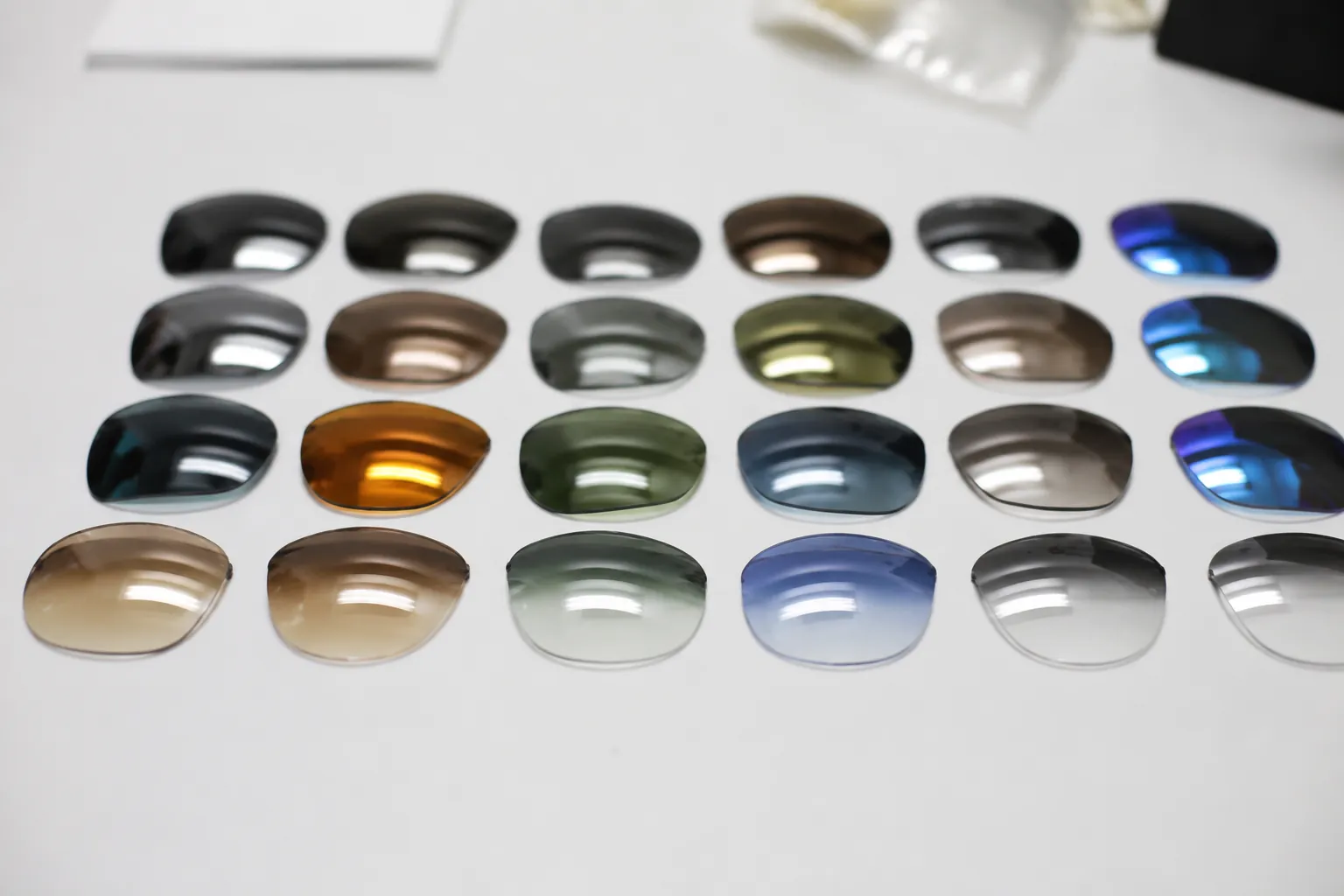
This guide is for brand owners, importers, distributors, and retail buyers building sunglass ranges that need to sell, reorder cleanly, and meet market requirements. The goal is not to pick a favorite tint. It is to build a lens-color structure that fits the channel, protects margin, and avoids weak variants that burn MOQ without earning repeat orders. If you are managing cost breaks, sample approval, lens consistency, logo visibility, carton labels, and compliance paperwork, use this framework to decide which core lens colors deserve a place in the range.
Start with the program, not the color chart
Many wholesale sunglass assortments launch with too many lens colors. Then the problems start: slow sell-through, fragmented reorders, mixed cartons, and order quantities that meet the supplier's minimum but miss the next useful price break.
A lens color is not just a style choice. It creates a separate inventory position, approval reference, bill-of-materials line, inspection point, barcode, and reorder risk.
For most commercial programs, four core lens families cover the main use cases: smoke, brown, green, and G15. That does not mean every opening range should use all four. In a new line, two or three lens colors are often easier to manage. Volume stays concentrated. Reorders are cleaner. Winners are easier to read.
A frame ordered deeply in one proven color is usually better business than the same frame split thinly across several uncertain tints.
MOQ and price breaks vary by supplier, material, lens process, decoration method, and order structure. Do not assume that splitting one frame across several lens colors will qualify the same way as ordering one lens color in higher volume. Before confirming the range, ask the factory how it counts MOQ: by frame model, frame color, lens color, polarization, mirror coating, or finished SKU. This one question can prevent an expensive line plan.
Before approving any lens color, use three filters:
- Channel fit: Does this tint suit how the product is sold—mass online, optical retail, department store, travel retail, resort, or driving-led specialty?
- Frame fit: Does it support the frame material and color story—black injection, silver metal, tortoise acetate, crystal, olive, champagne, or gunmetal?
- Inventory fit: Is it strong enough to justify its own SKU, QC standard, barcode, reorder line, and carton label?
If one answer is weak, the color probably does not belong in the first bulk order.
What each core lens color does commercially
| Lens color | Common commercial VLT target* | Visual effect | Best commercial fit | Main risk |
|---|---|---|---|---|
| Smoke | Usually planned around a dark sunglass range, commonly near category 3 territory where applicable | Neutral color perception, dark appearance, broad frame compatibility | Mass retail, fashion e-commerce, unisex lines, black frames, silver metal, gunmetal | Can make the collection feel generic if every frame uses the same lens story |
| Brown | Usually planned as a medium-to-dark sunglass tint depending on market requirement and intended use | Warmer view, stronger contrast impression, natural fit with warm frame colors | Lifestyle, travel, driving-oriented styling, tortoise, amber, honey, gold-tone frames | Can look mismatched on cool gray, icy transparent, silver-blue, or very technical palettes |
| Green | Usually planned as a medium-to-dark classic sunglass tint | Traditional sunglass appearance, softer than deep smoke, less warm than brown | Heritage acetates, classic optical-store assortments, traditional mid-market programs | May be less immediately understood than smoke in broad fashion channels |
| G15 | Usually planned as a dark green-gray sunglass tint; exact VLT must be specified and tested | Green-gray appearance with a recognizable classic lens story | Aviators, military-inspired frames, premium classics, iconic metal shapes | Can be overused as a marketing term where the buyer or consumer does not value the distinction |
*VLT means visible light transmission. The table gives planning language only. It is not a compliance approval. Final classification and suitability depend on the finished lens, destination-market standard, lens category, labeling, and test results.
Smoke is the safest volume tint. Shoppers understand it fast. Buyers can pair it with black, silver, gunmetal, crystal gray, clear, and many mixed materials. It is also easier to photograph and merchandise across a broad collection than warm or green-based tints.
Brown works best when the frame already has warmth. Think tortoise, amber, honey, cognac, gold-tone hardware, and many travel or driving-oriented designs. Do not choose brown just to add an alternative to smoke. Choose it because it makes the frame easier to sell.
Green and G15 can look close from a distance, but they do different jobs. Standard green gives a broader classic cue. G15 is more specific. Use it where the lens identity supports the product: aviators, square metal classics, military references, or premium heritage styling.
Build SKU architecture by channel, not taste
The right lens mix depends less on trend language than on where the frame will be sold and how fast each SKU must turn. A broad e-commerce seller needs low hesitation and simple product photos. An optical retailer can support a more traditional lens look. A resort or travel program may value instant visual appeal and easy replenishment over technical detail.
Use channel logic like this:
- Mass retail or broad e-commerce: Smoke should usually carry the range. Brown is the safest second color when the frame palette supports it. Add G15 only on aviators or proven classic metals.
- Optical stores: Smoke plus green or G15 can work on classic shapes. Brown fits warm acetates and driving-oriented styles.
- Department store fashion programs: Keep the lens count tight. Smoke usually anchors the line. Brown should be selective. Green or G15 needs a clear frame story.
- Outdoor, travel, or driving-led programs: Brown deserves serious consideration. Smoke still matters, but it should not be assigned to every hero style by default.
For a new line, set the lens-color allocation before choosing colors style by style. A simple method works: assign one default lens per frame family, then approve a second lens only where the channel, frame color, and projected volume justify another SKU.
Every extra variant adds work: another BOM line, lens tint or coating approval, QC reference, carton label, barcode, product photo, and packing risk. SKU expansion looks cheap in a spreadsheet. It gets expensive in a warehouse.
How lens color affects MOQ, cost, and lead time
In production, lens color affects batching, yield, approval control, and inspection. Factories with in-house lens tinting, coating coordination, or lens processing may control repeatability better than suppliers that outsource each step. But do not assume. Verify it.
Ask what is done in-house, what is subcontracted, how master samples are retained, and how tint drift is checked on repeat orders.
A practical rule by order size:
- Small test orders: Keep to one lens color per frame unless the supplier confirms the split will not hurt cost, timing, or inspection control.
- Moderate repeat orders: Two lens colors can work if one is the clear volume driver and the second has a defined channel reason.
- Scaled programs: A fuller lens-color plan becomes easier to support once each finished SKU has enough volume to justify separate materials, inspection, labeling, and reorder management.
Do not rely on a generic lead-time promise. Ask the supplier to quote sample timing and bulk timing after the lens material, tint, polarization, mirror coating, decoration, packaging, and test requirements are known. Late changes to tint, VLT target, polarization, or mirror level can delay approval even when the frame tooling or frame color is already stable.
Material choice matters too. Polycarbonate, TAC, nylon, and CR-39 can differ in optical properties, processing route, tint appearance, coating compatibility, and cost. A color approved on one lens material may not match perfectly on another. Gradient lenses, polarized lenses, flash mirrors, and full mirror coatings add more variables. Approve them as separate finished-lens specifications.
Decoration should be checked against the approved lens color. A white pad print that reads sharply against smoke may lose contrast against brown. A laser mark, foil mark, or metal logo plate can feel more or less premium depending on the lens and frame combination. Lock the lens appearance before approving final decoration photos.
Compliance is color-neutral. Specs are not.
Some buyers assume a dark-looking lens is automatically compliant. It is not.
Compliance depends on the tested finished product, not the commercial color name. Smoke, brown, green, and G15 can all pass or fail depending on visible light transmission, UV performance, optical quality, lens category, labeling, material, coating, and destination-market standard.
For export programs, common checkpoints may include CE / EN ISO 12312-1 for relevant European-market sunglasses, ANSI Z80.3 for nonprescription sunglasses in the United States, and AS/NZS 1067 for Australia and New Zealand where applicable. Chemical and material controls may also apply, including REACH requirements for the European market. For the United States, confirm whether FDA registration and device listing obligations apply to the manufacturer, importer, or product category. Factory registration is not a substitute for product testing.
Factory system documents can support supplier due diligence, but they do not prove sunglass compliance by themselves. ISO 9001 relates to quality management systems. BSCI relates to social compliance auditing. Both may be useful in supplier qualification. Neither replaces product-specific testing to the applicable sunglass standard.
The practical color issue is repeatability. A smoke lens that is visibly lighter than the approved sample, or a green lens that shifts toward gray, can create mixed-carton inconsistency even if the frame, hinge, and logo are correct. Better programs define a target VLT or lens category, retain an approved master sample, and require the supplier to compare production against that standard.
Your approval sheet or tech pack should specify:
- Lens material: for example PC, TAC, nylon, or CR-39 where relevant
- Base color and final appearance: solid, gradient, flash mirror, full mirror, polarized, or coated finish
- Target VLT or required lens category, plus any use limitation required by the market standard
- UV requirement and any polarization requirement
- Approved master sample reference retained by buyer and factory
- Applicable test standard by shipping market
- Required markings, warnings, user information, and packaging language
- Inspection method for left-right matching, pair-to-pair consistency, and cosmetic appearance
This matters even more on repeat orders. A supplier with retained standards, documented QC, and a controlled approval process is more useful than one that can only reproduce what looked close in a photo.
Avoid the lens-color mistakes that hurt reorders
Mistake one: choosing by personal preference. Buyers often overvalue the tint they personally wear. Commercial planning is different. Give each color a job: smoke for breadth, brown for warm or driving-led styling, G15 for specific classics, and green for traditional positioning where it clearly belongs.
Mistake two: multiplying combinations too early. A black frame offered in smoke, brown, green, and G15 sounds flexible. In practice, only some variants will earn repeat orders. Start with the strongest combination. Add lens options after sell-through or buyer feedback proves demand.
Mistake three: approving color from one image. Lens color must be judged in both transmitted light and reflected appearance. G15, green, gradient lenses, and mirror lenses can photograph differently depending on background, angle, and lighting. If the lens tint is part of the product story, request physical samples and compare them side by side under controlled lighting.
On production orders, also ask the factory to control:
- Left-right lens matching: Both lenses in one frame should read the same under direct and transmitted light.
- Pair-to-pair consistency: Cartons should not mix visibly different shades under the same SKU.
- Scratch and cosmetic checks: Dark and mirror lenses can hide or reveal different defects depending on retail lighting.
- Assembly separation: Brown, green, G15, polarized, and mirror lots should be clearly isolated to prevent wrong-color packing.
This is not cosmetic nitpicking. It prevents returns, split reorders, and disputes over whether the second shipment matches the first.
Use a buyer workflow that keeps the range tight
Do not debate lens colors style by style. Use a fixed workflow. It keeps the range coherent and makes bulk approval easier.
- Map the frame families. Group black metal, silver metal, black injection, crystal, olive, and tortoise acetate separately.
- Assign one default lens per family. Example: smoke for black metal and black injection, brown for tortoise acetate, G15 for aviators, green for selected heritage acetate.
- Add only one optional second lens if there is a selling reason. A sample that looks attractive is not enough. The second lens must justify its own SKU, barcode, inspection standard, and reorder forecast.
- Request physical samples and compare them side by side. Review appearance, VLT target or category, logo visibility, frame-lens harmony, and whether each version deserves inventory.
- Confirm MOQ and price breaks by finished SKU. Ask whether different lens colors, polarized versions, mirror coatings, or frame colors are counted separately.
- Consolidate toward proven combinations. Push volume into the versions most likely to reorder instead of spreading units thinly across marginal variants.
- Freeze the approval package. Lock lens color, material, VLT or category target, UV requirement, logo method, carton labeling, barcode, user information, and test requirement before bulk production starts.
This workflow works best when the supplier can document its production route, retain master samples, and manage QC consistently. Integrated production may reduce handoff risk, but it cannot rescue a weak buyer brief. The strongest programs define the lens role early and protect that decision through sampling, testing, and bulk approval.
What most buyers should order first
If you need a direct recommendation for a first wholesale order, start with smoke. It is the broadest commercial lens color and the least likely to cause hesitation in mass or mixed channels.
Add brown second if the range includes tortoise, amber, honey, gold-tone, or driving-oriented styles. Add G15 only where the frame supports it, most often aviators, square metal classics, or products with a clear heritage story. Use plain green selectively for traditional sunglass styling where you want classic character without relying on a G15-specific sales narrative.
For many buyers, the most efficient core is three lens colors: smoke, brown, and G15. That covers broad commercial demand without turning every frame into four separate finished SKUs. If the line is small or MOQ is tight, two colors may be enough for the opening order.
The best lens plan is not the one with the most options. It is the one you can reorder quickly, match accurately, price competitively, test properly, and explain clearly to the customer.
Have a custom sunglasses project in mind?
Send us your styles, target market and quantities and we will return a detailed quote with MOQ, lead time and a sample plan.
Get a QuoteWhy source this from Wenzhou with LumiShades
Wenzhou in Zhejiang Province is widely regarded as China’s eyewear manufacturing capital, producing a large share of the world’s sunglasses. That concentration matters to buyers: a deep local supply chain for acetate sheet, hinges, lens blanks, plating and packaging means shorter component lead times, easier color and material matching, and a workforce with decades of eyewear-specific skill. LumiShades has manufactured in this ecosystem since 2009, and our vertical integration — in-house injection molding, acetate cutting, CNC milling, lens tinting, decoration and quality control — means no part of your order is quietly subcontracted to a workshop you cannot audit.
For international buyers, that vertical control translates into accountability. When a single factory owns every step, defects are traced and fixed at source rather than bounced between vendors, and your specifications survive intact from first sample to bulk. We back this with 15+ years of experience, shipments to 60+ countries, more than 5 million pairs produced per year and a 98.5% on-time delivery rate. Our certifications — CE EN ISO 12312-1, FDA registration, ANSI Z80.3, AS/NZS 1067, REACH, ISO 9001 and BSCI audit — mean the compliance documentation your market requires already exists. Explore our manufacturing capabilities and quality control process to see how this works in practice.
Frequently asked questions
Should I offer both green and G15 in the same opening range? Usually no. For a small or first-time launch, choose one unless each color has a clear frame family and enough volume to justify a separate SKU. Use G15 for aviators, military-inspired metals, and classic shapes where the green-gray lens story helps sell the product. Use plain green for a broader traditional look on heritage acetate or optical-store assortments. If buyers cannot explain why both are needed, keep only the stronger one.
Which lens color is safest for a first private label order? Smoke is the safest first lens color because it works across the widest range of frames, channels, and product photography setups. For the second color, choose brown if the assortment includes tortoise, amber, honey, gold-tone hardware, or driving-led styling. Choose G15 only when the frame shape supports a classic or heritage story. Do not add a lens color unless it has a clear commercial role and reorder logic.
Does adding a second lens color always increase lead time? Not always, but it adds approval and handling steps that can affect timing. Ask the supplier to quote sample timing and bulk timing after all lens details are confirmed: material, tint, VLT or lens category, polarization, mirror coating, logo method, packaging, and test requirements. To avoid delays, approve physical lens samples before bulk production and do not change tint, VLT target, or mirror level after the production specification is frozen.
How should I write lens color into my purchase specification? Do not write only "smoke" or "brown." A workable specification should include lens material, commercial color name, base color, solid or gradient appearance, mirror or flash coating if any, polarization if required, target VLT or lens category, UV requirement, destination-market standard, approved master sample reference, labeling requirements, and inspection method for left-right and pair-to-pair matching.
Can I split low MOQs across many lens colors to test demand? You can, but it often weakens the test. Multiple lens colors can raise handling complexity, dilute reorder signals, and create slow-moving inventory. For a low-MOQ first order, one strong lens color per frame is usually cleaner. If you must test two colors, make one the planned volume color and one the specific test color, then track sell-through by finished SKU before expanding.
Ready to start?
Explore our sport wrap sunglasses or request a quote — our sales team replies within 12 hours.
Request a Quote