
RX-Ready Sunglass Frames: Specs That Stop Lab Rejection
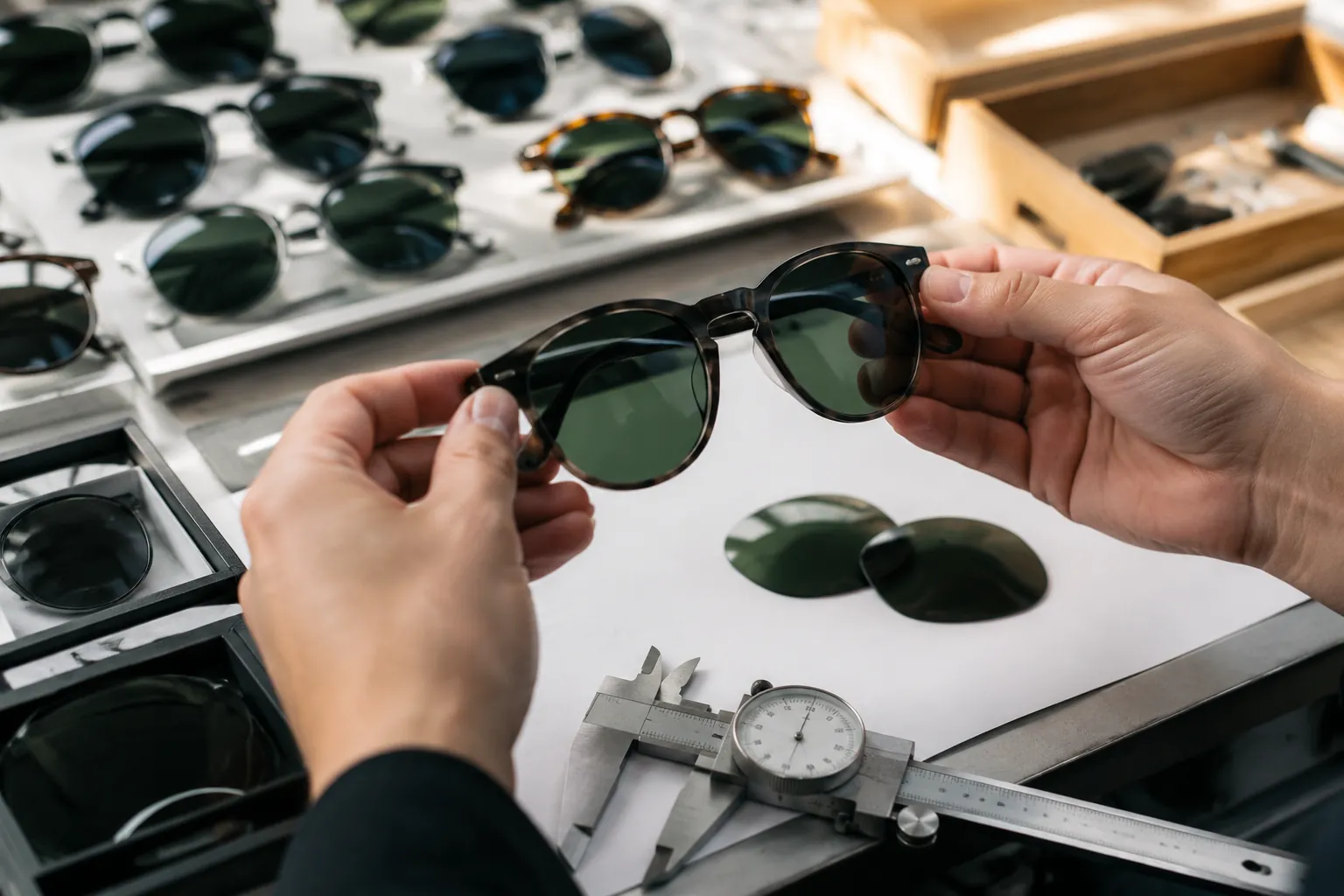
This guide is for optical retailers, importers, distributors, and private-label eyewear brands sourcing sunglass frames that must accept prescription lenses after sale. RX-ready is not a style label. It is a frame-design, material, groove, bevel, and lab-process requirement. It must be proven on physical samples. The goal is simple: fewer lab rejections, fewer cracked rims, stronger lens retention, and clearer factory communication before tooling or bulk production. The sections below cover the sourcing details buyers can check: frame curve, groove geometry, material behavior, lens shape, decoration placement, compliance files, MOQ planning, sampling, and approval testing.
Start With the Optical Lab, Not the Rendering
An RX-ready sunglass frame is not just a plano sunglass frame with removable demo lenses. It must survive lens removal, prescription lens edging, lens insertion, adjustment, shipping, retail handling, and daily wear after the replacement lenses are installed. Many fashion sunglass frames look fine in a front-view drawing. Then the lab tries to mount real prescription lenses. That is where problems show up.
Before asking for a quotation, write a short RX brief. Include the target selling market, expected prescription range, intended lens material, whether the retailer will use stock or surfaced lenses, whether polarized RX lenses are expected, and whether the frame will be advertised as prescription-capable at the point of sale. A general lifestyle RX sun program may cover moderate prescriptions, but the exact range should come from the buyer's optical lab. Not from guesswork. Not from the factory alone.
The lab will look at effective diameter, lens curve, groove depth, bevel fit, bridge clearance, pantoscopic angle, temple spread, screw access, and whether the rim can be opened without whitening, cracking, or losing shape. Review these points before tooling or bulk approval.
For Wenzhou production, or any custom eyewear program, RX-ready development should be separated from ordinary promotional sunglass development. Appearance samples can confirm color, shape, and decoration. They do not prove RX performance. RX verification should happen before pre-production approval. If your optical lab has not removed the original lenses, edged replacements, and reinserted them, the frame is not proven RX-ready.
Practical rule: approve an RX-ready frame only after your lab confirms lens retention, insertion force, cosmetic condition, and adjustment behavior on physical samples.
Frame Curve: The Number Behind Many RX Failures
Base curve controls how wrapped the lens sits in the frame. Fashion sunglasses often use higher curves because they look sporty and give more side coverage. Prescription lenses are less forgiving. Strong powers in a high-wrap frame can create distortion, thick edges, decentration issues, difficult edging, and complaints about peripheral vision. Wrap compensation and specialized lens designs can help, but they require the right lab capability and a narrower RX claim.
For broad optical retail use, a moderate front is usually safer. Base 2-4 is commonly easier for prescription sunglass programs. Base 5-6 can work for many mild prescriptions if the lab confirms lens availability, blank size, surfacing, and edging process. Base 7-8 should be treated as a specialty sport or performance option, not a universal RX platform.
| Frame curve | Typical use | RX risk | Sourcing recommendation |
|---|---|---|---|
| Base 2-4 | Lifestyle and optical-friendly sun frames | Lower | Best default for independent optical retailers and broad prescription coverage. |
| Base 5-6 | Mild wrap fashion and everyday sunwear | Medium | Test with the buyer's expected minus, plus, and cylinder range before approving bulk. |
| Base 7-8 | Sport, cycling, fishing, and performance styles | High | Requires planned RX lens design, lab capability, and limited prescription claims. |
| Shield or one-piece lens | Fashion shields and performance shields | Very high | Usually not practical for normal direct RX replacement unless using inserts or specialized lab systems. |
Also check face-form angle and pantoscopic angle. A frame can have a moderate nominal base curve and still fit poorly if the temples force too much wrap on the wearer. For most lifestyle RX sunglasses, keep the fitting geometry conservative: stable bridge, balanced temple spread, and no extreme forward tilt. If the retail network serves general prescription wearers, keep plano fashion styles separate from the smaller group of lab-tested RX-ready frames.
Groove Depth, Bevel Fit, and Lens Retention
The lens groove is small. It decides whether the lens stays in the frame.
For full-rim plastic sunglass frames, the groove must be deep, clean, and consistent enough to hold an edged prescription lens without overstressing the rim. If the groove is too shallow, lenses may pop out. If it is too deep, rough, narrow, or uneven, insertion can chip lens edges, open the rim, or leave stress marks.
Do not write only "optical quality" in the specification. That is too vague. Ask the factory to confirm groove depth, groove consistency, and bevel compatibility on physical samples. As a practical buyer target, many full-rim plastic RX designs use a groove around 0.6-0.8 mm deep, but this is not a universal rule. The correct number depends on material, rim thickness, eyewire shape, lens bevel, and the lab's edging process. A loose groove spec is a common cause of rejection.
- Groove consistency: check the top, bottom, nasal corner, and temporal corner. Corners can become thin after polishing or finishing.
- Bevel match: confirm whether the lab uses standard V-bevel edging, mini-bevel, safety bevel, or customized bevel placement.
- Rim opening: the frame must accept lens insertion without whitening, cracking, chipping, or permanent distortion.
- Repeated handling: test at least two removal and insertion cycles. One successful insertion is not enough for an RX claim.
- Retention check: after insertion, apply normal thumb pressure around the lens edge and check for popping, clicking, gaps, or lens rock.
- Thermal behavior: acetate can usually be warmed and adjusted; some injection materials are less forgiving and need tighter design control.
For injection-molded frames, the mold controls much of the groove geometry. Tooling should allow clean groove formation without sink marks, flash, or thin rim sections. For acetate, CNC milling, lamination quality, tumbling, and hand polishing affect the final groove. Buyers should request lens-fit samples and lab comments, not just polished appearance samples.
Material Choice: Acetate, TR, PC, and Metal
Material choice affects RX performance more than many buyers expect. A promotional sunglass frame may pass visual inspection and still be a poor prescription carrier. Optical retailers need frames that can be adjusted, heated where appropriate, reopened, and worn for months without lens movement.
| Material | RX-ready strengths | Common weakness | Best sourcing use |
|---|---|---|---|
| Acetate | Good adjustability, premium feel, can usually be heated, polished, and refitted | Heavier than TR; longer processing; polishing can affect groove if uncontrolled | Independent optical retail, private-label fashion, premium RX sun collections |
| TR90 / nylon | Lightweight, flexible, impact-resistant, suitable for active wear | Harder to adjust permanently; lens retention depends heavily on groove design and material memory | Sport-inspired RX sun frames with moderate curve and verified retention |
| PC injection | Low cost, fast molding cycle, broad color options for volume sunwear | Can be less forgiving during lens replacement; may stress, crack, or deform if design and processing are weak | Plano sunwear or limited RX programs after strict lab testing |
| Metal | Stable eyewire construction, screw closure, thinner profile | Needs plating control, screw quality, solder strength, nose pad consistency, and clean eyewire closure | Classic optical sun frames, aviators, thin-rim lifestyle styles |
Acetate is often a safe choice for independent optical retailers because many opticians know how to heat and adjust it. TR can be excellent for lightweight RX sunglasses, but the design must account for spring-back and lens retention from the start. PC needs caution. It can support aggressive price targets, but a very low-cost PC frame is rarely the best platform for repeated prescription replacement unless a lab has proved it.
Cost should match the product claim. A basic plano sunglass frame and an RX-ready frame should not be sourced to the same specification. RX-ready acetate, metal, or higher-spec TR frames usually need better material control, cleaner finishing, tighter groove inspection, reliable hardware, and more sampling. If the frame must support optician handling, build the costing model around durability and lens fit before decoration.
Lens Shape and Size: Good-Looking Can Still Fail
Large sunglass lenses look strong on a retail wall. They can be bad for RX. The bigger the lens, the more likely the wearer will see thick edges, higher weight, blank-size limits, and edging difficulty. Dramatic cat-eye points, narrow corners, and sharp geometric shapes can also concentrate stress and cause lens-retention failures.
For RX-ready sunglasses, keep the design attractive but controlled. Many commercial RX sun programs work better when lens widths stay moderate, bridge fit is stable, and lens height is not excessive. A 54-56 mm eye size is often easier to manage than a 60 mm fashion lens, especially for stronger powers. Deep B measurements can increase lens weight and make the frame slide after RX lenses are installed.
- Check A, B, DBL, and ED together. Effective diameter drives lens blank requirements, edge thickness, and edging feasibility.
- Review bridge fit. Heavier RX sun lenses increase sliding risk, especially for low-bridge wearers.
- Control pantoscopic angle. Excessive tilt can affect comfort, fitting, and optical alignment.
- Confirm temple spread. A display-head fit is not the same as a real fitting on different face widths.
- Test tinted RX-like lenses. Clear trial lenses may hide edge thickness, reflections, tint darkness, or cosmetic problems.
Ask for technical drawings showing lens width, lens height, bridge, temple length, front curve, hinge-to-hinge measurement, and intended lens groove. For custom designs, revise the shape during sampling if the lab flags a risk. Changing a corner radius or reducing lens height by 1-2 mm during development is much easier than correcting a production order after optical accounts reject the style.
Decoration Must Not Interfere With Lens Work
Branding should support the retail story without weakening the frame. A large metal logo plate near the hinge may look premium, but it can stiffen the front corner, create a stress point, or reduce usable wall thickness. Then the optician struggles during lens insertion. Thick temple decoration can also affect balance once prescription lenses are fitted.
Review decoration as part of the engineering file, not only as artwork. Logo position, drilling depth, adhesive area, plating thickness, logo-plate attachment, and cleaning resistance all matter. Evaluate decoration on the same physical samples used for lab fitting because polishing, plating, and inserted trim can change how the frame behaves.
- Laser engraving: low profile and durable; useful for temple logos, inside markings, and subtle premium branding.
- Pad printing: economical for logos and model codes; should be checked with tape, rub, sweat, and alcohol-resistance tests where relevant.
- Metal logo plates: strong retail appearance; require controlled slot depth, secure attachment, and no weakening of hinge corners.
- Hot stamping: useful for inside temple branding; check legibility after adjustment, cleaning, and wear simulation.
- Lens logo printing: useful for plano retail sales, but may be unnecessary if optical retailers remove the lenses locally.
If the frame ships with plano sun lenses that optical stores will discard, do not overspend on premium plano lenses unless they support the sales plan. Still, shipped lenses must meet the target market's sunglass requirements if the product is imported or sold as sunglasses before RX replacement. Keep frame value separate from temporary lens value in the bill of materials.
Compliance Files Are Not RX Approval
Prescription readiness is not the same as regulatory compliance. A frame can hold RX lenses well and still need sunglass compliance for the plano lenses supplied at shipment. Overseas buyers should define the selling market before production and request documents that match the actual product being shipped.
Common compliance references for sunglass programs may include CE EN ISO 12312-1, ANSI Z80.3, AS/NZS 1067, REACH, FDA registration, ISO 9001, and BSCI. These are not interchangeable. CE EN ISO 12312-1 is relevant for sunglasses in many European contexts. ANSI Z80.3 applies to nonprescription sunglasses in the United States. AS/NZS 1067 applies to Australia and New Zealand sunwear. REACH concerns chemical restrictions for the EU market. FDA registration relates to U.S. regulatory registration obligations. ISO 9001 relates to quality management systems. BSCI relates to social compliance expectations.
For an RX-ready sunglass order, keep three files: the frame specification, the plano lens compliance file, and the material or chemical compliance file. Test reports should match the actual lens color, filter category, material, coating, and production batch where applicable. A report for a black category 3 lens does not automatically prove compliance for a brown gradient lens, a mirrored lens, or a different lens material. Paperwork that does not match the shipped goods will not help much during customs, marketplace, or retailer audits.
Define inspection standards early. Critical checks may include sharp edges, lens retention, screw security, hinge operation, chemical odor, logo position, color matching, barcode accuracy, filter-category marking, and packaging accuracy. Use an agreed AQL plan for cosmetic defects, but treat safety, compliance, and lens-retention failures as critical issues. They are not ordinary appearance defects.
Sampling, MOQ, Pricing, and Bulk Approval
A serious RX-ready program needs a tighter approval process than a basic sunglass order. Confirm the supplier's MOQ, sample timing, tooling requirements, bulk lead time, and documentation process before committing to a launch date. Low MOQs can help with pilot runs, regional tests, optical retailer trials, or market validation before a larger buy. But the pilot must use the same material, groove, decoration, hardware, and lenses intended for production.
Use the sample stage to stress the frame, not admire it. Send samples to your optical lab. Ask the lab to remove the original lenses, edge replacement lenses, insert them, adjust the frame, and report stress marks, popping, screw problems, cosmetic damage, and fitting concerns. For a new shape, test more than one color and material finish if the finishing process differs.
| Stage | Buyer action | Typical timing question | Pass condition |
|---|---|---|---|
| Design brief | Confirm curve, material, RX range, lens size, market, and compliance target | Ask before quotation | Factory and lab agree the design is suitable for RX sampling. |
| Prototype sample | Check fit, groove, lens removal, decoration, and lab edging | Confirm supplier sample lead time | Lab inserts RX-like lenses without damage or retention failure. |
| Pilot order | Run a small controlled quantity for retailer or lab feedback | Confirm MOQ and pilot lead time | Returns, complaints, and lab rejection rate are acceptable. |
| Bulk production | Approve final color, logo, hardware, packaging, QC plan, and documents | Confirm production lead time after approval | Inspection matches agreed AQL and critical RX checks. |
Volume price breaks are useful, but volume should follow validation. Do not jump to a large order before lab approval if the shape, material, or supplier process is new. A rejected RX frame is expensive because the defect often sits in the design, tooling, or specification, not only in one production batch.
Final QC should include frame alignment, hinge tension, screw security, groove cleanliness, lens retention, rim whitening, surface defects, logo position, color consistency, filter-category marking, polybag or case accuracy, and carton labeling. The factory can control production against an agreed specification. It cannot fix a weak RX specification that was approved too early.
Have a custom sunglasses project in mind?
Send us your styles, target market and quantities and we will return a detailed quote with MOQ, lead time and a sample plan.
Get a QuoteWhy source this from Wenzhou with LumiShades
Wenzhou in Zhejiang Province is widely regarded as China’s eyewear manufacturing capital, producing a large share of the world’s sunglasses. That concentration matters to buyers: a deep local supply chain for acetate sheet, hinges, lens blanks, plating and packaging means shorter component lead times, easier color and material matching, and a workforce with decades of eyewear-specific skill. LumiShades has manufactured in this ecosystem since 2009, and our vertical integration — in-house injection molding, acetate cutting, CNC milling, lens tinting, decoration and quality control — means no part of your order is quietly subcontracted to a workshop you cannot audit.
For international buyers, that vertical control translates into accountability. When a single factory owns every step, defects are traced and fixed at source rather than bounced between vendors, and your specifications survive intact from first sample to bulk. For procurement review, buyers can request process records, approved samples, quality checkpoints and project-specific compliance files before placing a bulk order. Required testing and documentation are confirmed against the destination market and product specification rather than assumed from a generic certificate list. Explore our manufacturing capabilities and quality control process to see how this works in practice.
Frequently asked questions
What is the safest base curve for RX-ready sunglasses? For broad optical retail, Base 2-4 is usually the safest starting range because it is easier for labs to edge and fit prescription sun lenses. Base 5-6 can work, but the buyer should confirm lens availability, blank size, prescription limits, and edging process with the lab. Base 7-8 wrap frames should be treated as specialty products with restricted RX claims and, where needed, wrap-compensated lens designs.
What groove depth should I specify for RX-ready plastic frames? Many full-rim plastic RX designs use a groove around 0.6-0.8 mm deep, but the correct value depends on material, rim thickness, eyewire shape, bevel type, and the lab's edging process. Specify consistent groove depth around the full eyewire, especially at the nasal and temporal corners. Then verify it on physical samples by removing the original lenses, edging RX-like replacements, inserting them, and checking for popping, gaps, whitening, or cracking.
Can PC injection frames be used for prescription sunglass programs? Yes, but only after careful testing. PC injection frames can be cost-effective for plano sunglasses and high-volume programs, but they may be less forgiving during repeated lens removal and insertion. If you plan to sell them as RX-ready, ask the lab to test the actual production material and shape, not a similar sample. Acetate or well-designed TR is often a safer choice for optical retail RX use.
What should I send to my optical lab during sampling? Send the actual frame sample, technical drawing, target prescription range, intended lens material, tint or polarization plan, expected selling claim, and any supplier notes on base curve and groove design. Ask the lab to remove the original lenses, edge RX-like replacements, insert them, adjust the frame, and report lens retention, stress marks, rim whitening, cosmetic damage, screw or hinge issues, bridge fit, and any limits on prescription range.
Does a sunglass compliance certificate prove the frame is RX-ready? No. Compliance documents such as CE EN ISO 12312-1, ANSI Z80.3, AS/NZS 1067, REACH, FDA registration, ISO 9001, and BSCI address regulatory, chemical, quality-system, or social-compliance requirements. RX readiness must be proven through physical lens replacement, bevel fit, retention checks, adjustment testing, and lab feedback.
What MOQ makes sense for a new RX-ready sunglass design? Start with samples and lab testing before committing to volume. If the style is new, use the supplier's lowest practical pilot quantity to collect lab and retailer feedback. Move to larger quantities only after the lab confirms lens insertion, retention, cosmetic condition, and prescription limitations. A lower unit price does not help if the frame creates lab rejections.
Should RX-ready sunglasses ship with premium plano lenses? Only if retailers will also sell them as plano sunglasses. If most optical stores will remove the lenses and fit prescriptions, specify compliant but cost-controlled plano lenses and invest more of the budget in the frame, groove quality, hardware, fit, and inspection. Even temporary plano lenses must still match the compliance requirements of the selling market if the product is imported or sold as sunglasses.
Ready to start?
Explore our shield & oversized sunglasses or request a quote — our sales team replies within 12 hours.
Request a Quote