
PC, TR90, Acetate: Build a Clear 3-Tier Sunglasses Line
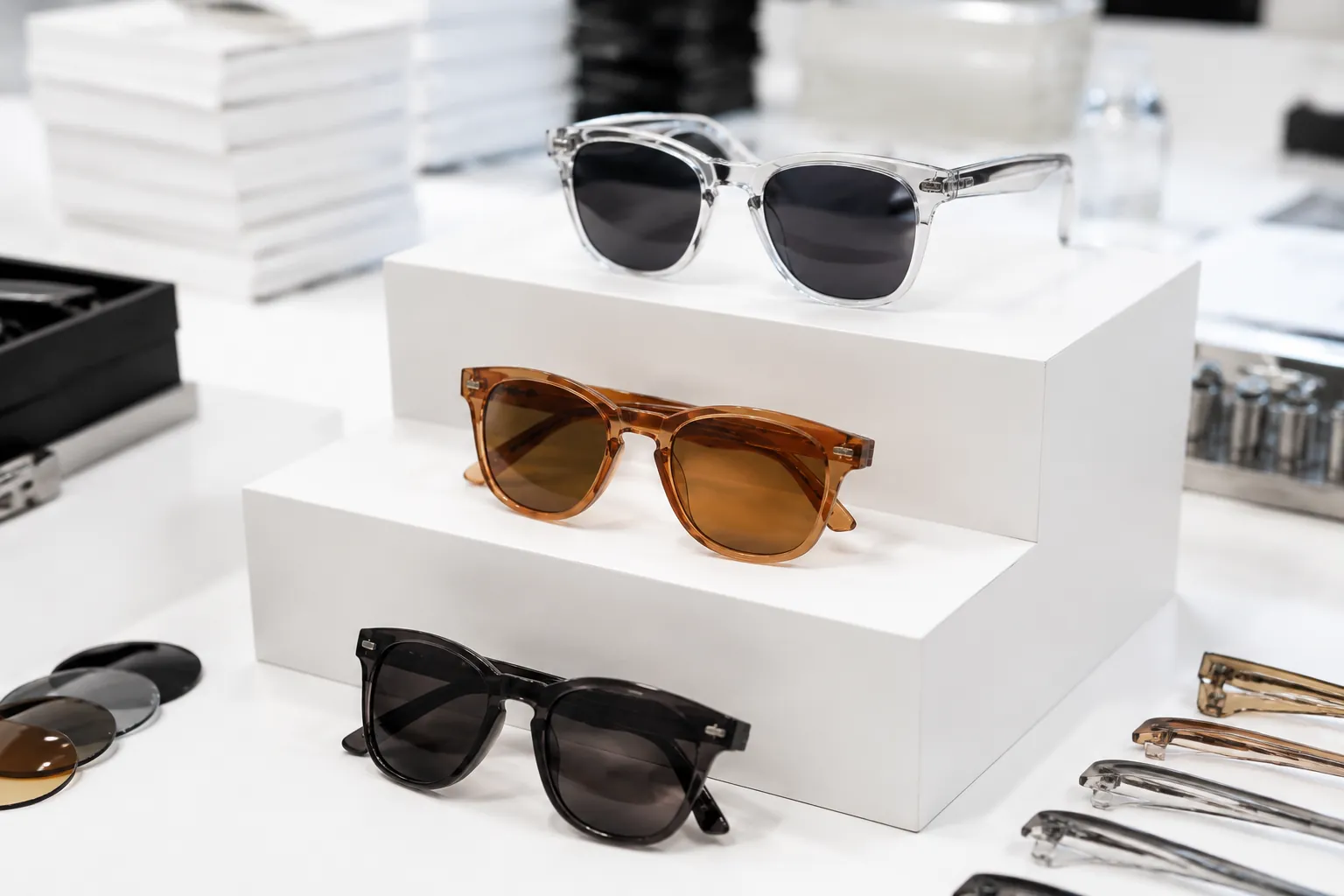
This guide is for distributors, private-label brands, importers, and retail buyers building a tiered sunglasses range, not a random mix of styles. The aim is simple: use PC, TR90, and acetate to create a clear ladder—opening price for volume, a middle tier for comfort and durability, and a premium tier for stronger perceived value. Set that logic early and the rest gets easier. Quotes are easier to compare. SKU planning is cleaner. Quality expectations are easier to align across sourcing, sales, and production.
Start with the lineup, not single styles
Many eyewear programs are built one frame at a time. That usually creates overlap. Two styles look similar, land at different costs, and the sales team cannot explain the gap fast enough.
Start with the tier structure first. Then assign material, hardware, finish level, target cost, and intended retail position before style development begins.
For many B2B sunglass collections, a practical structure is:
- Good: PC frames for opening price points, promotional programs, and broad-volume basics.
- Better: TR90 frames for lightweight comfort, fit flexibility, and everyday durability.
- Best: Acetate frames for premium presentation, richer color development, and a more substantial hand feel.
This is not about claiming one material is always better. It is about giving each tier a job. PC usually fits programs where cost efficiency, output consistency, and repeat replenishment matter most. TR90 fits programs where low weight, flexibility, and comfort matter more. Acetate fits programs where the buyer wants a more premium look and feel, including thicker profiles, polished edges, and layered or translucent color effects.
Set the non-negotiables early: target FOB by tier, retail band, MOQ by style, acceptable frame weight, and the minimum visible upgrade from one level to the next. If those points stay vague, the range drifts. Then too many similar products chase the same customer at the same price point.
The rule is simple. Build the range as a system. If the tier logic is clear before sampling starts, design decisions get easier and price or quality disputes later are less likely.
What each material does in a commercial range
Buyers often compare PC, TR90, and acetate on price alone. That is too narrow. A better comparison looks at weight, flexibility, surface feel, color depth, resistance to visible wear, hinge stability, and how the frame still looks after repeated handling in stores or daily use.
| Material | Typical frame weight feel | Best use in lineup | Main strengths | Main trade-offs |
|---|---|---|---|---|
| PC | Light to medium, usually a straightforward commercial feel | Entry tier, promotions, youth, high-volume basics | Lower unit cost, efficient injection production, good impact resistance, strong repeatability on replenishment orders | Less premium surface feel, less depth in color effects than acetate, high-gloss surfaces may show wear more easily over time |
| TR90 | Very light, comfort-focused | Mid tier, active, sport-casual, comfort-led everyday use | Low weight, flexibility, shape recovery, good comfort for extended wear | Higher cost than PC, appearance can look too thin if the design is not balanced well, does not provide the same visual richness as acetate |
| Acetate | Medium to heavier, more substantial hand feel | Premium tier, fashion-led, brand-building, gift-oriented retail programs | Strong polish, layered or crystal color effects, thicker visual profile, high perceived value | Longer production route, more machining and polishing labor, higher material and processing cost |
PC is often the right call when the brief is clear: dependable sunglasses, safe commercial styling, and a competitive opening price. TR90 usually sits above PC when the buyer wants a lighter frame and a stronger comfort story. Acetate is usually the premium step because customers can see and feel the difference fast—in thickness, finish, and color character.
Separation matters. If a PC style and a TR90 style share the same silhouette, hinge approach, lens package, and shelf presence, the middle tier is hard to defend. If an acetate frame looks no different from an injection-molded frame in construction or finish, the premium story weakens too. Material choice must show up in the finished product, not just on the spec sheet.
Build separation into specs, hardware, and decoration
A good-better-best structure fails when the only change is the material name. Buyers need to see the upgrade in the product, the quotation, and the sales story.
- Change the construction logic. PC should stay efficient and commercially clean. TR90 should emphasize low weight, flexibility, and balanced fit. Acetate should show stronger front thickness, bevel work, lamination, or a deeper polished edge where the design supports it.
- Change the hardware level. Entry PC can use standard hinge construction and basic logo execution. TR90 can step up with features that support wear comfort or an upgraded lens offer, such as polarized options where appropriate. Premium acetate should use hardware and branding details that match the price position, such as cleaner hinge finishing, embedded logos, or metal brand elements if the design allows.
- Change the decoration method. Lower-tier programs often rely on pad printing. Mid-tier lines may justify cleaner branding methods depending on frame geometry and surface. Premium acetate can support details such as foil logos, hot stamping, metal inlays, or CNC logo recesses when those choices make commercial sense.
- Change the finish language. A polished acetate frame with layered havana or crystal lamination should not be presented with the same edge profile and finish story as an entry injection-molded frame if the goal is clear price separation.
Use the specifications to enforce those differences. A PC opening line may stay in safer commercial sizes and fewer colors, with dimensions optimized for injection efficiency. A TR90 line should prioritize comfort, stable fit, and shape recovery. An acetate line should keep bolder fronts, visible edge depth, and colors that read especially well in cellulose acetate, such as crystal tones, layered tortoise patterns, or laminated two-tone effects.
Do not force all three materials into the same design language. That is the short version. Let each material do the job it does best.
Use MOQ, price breaks, and lead time to support the ladder
Material strategy only works if the order structure supports it. Buyers need to plan around real production economics, not just the lowest technical minimum. In most programs, efficiency improves as volume rises. Too many low-volume SKUs do the opposite. They weaken cost, complicate approvals, and slow replenishment.
As a rule, PC is usually the most cost-efficient route for volume programs because it is injection molded and built for repeat production. TR90 usually costs more than PC because both the material and market position differ. Acetate usually sits above both because the production route includes cutting, CNC shaping, tumbling, polishing, and more manual finishing.
- PC good tier: keep color repetition high, limit unnecessary SKU fragmentation, and use volume to improve consistency and pricing.
- TR90 better tier: carry fewer styles than PC, but choose broader-appeal shapes that can build volume around the comfort and lightweight story.
- Acetate best tier: reduce style count and edit colors tightly. Premium lines usually work better when the assortment is narrower and more deliberate.
Lead time matters too. Sample timing and bulk timing vary by supplier, design complexity, material route, decoration, and approval process. Acetate programs usually need an earlier design freeze than injection programs. The route has more machining and finishing steps, and it leaves less room for late changes without affecting delivery.
A common planning mistake is spreading small quantities across too many colors and materials. A buyer may technically hit MOQ per style and still end up with weak pricing, diluted product focus, and slow approvals. Often, fewer clearly differentiated SKUs perform better than a broad assortment with overlapping roles.
Know the production route before approving design
The same CAD drawing behaves differently in each material. Buyers who understand the production route avoid expensive mistakes—wall sections that are hard to mold cleanly, grooves that complicate lens fitting, or acetate shapes that need too much polishing to reach a consistent finish.
PC and TR90 injection route: tooling review, color confirmation, molding, trimming, hinge fitting, lens fitting, decoration, inspection, and packing. Injection offers strong repeatability, but gate location, shrinkage behavior, wall thickness, and part geometry still affect appearance and assembly.
Acetate route: sheet selection, rough cutting, CNC milling, tumbling, manual shaping, polishing, hinge setting, lens fitting, decoration, inspection, and packing. This route is more labor-intensive and usually takes more time. That is one reason acetate sits in a higher price tier.
At factory level, dimensional control is critical. Lens groove consistency, front symmetry, temple alignment, hinge setting, and bridge geometry all affect assembly yield and cosmetic consistency. A sample can look acceptable in a quick review and still create rework during lens fitting or final assembly if dimensional control is weak.
Ask direct technical questions during development. What is the front thickness at the end piece? What is the target finished weight? How is hinge stability controlled? Is the groove suitable for the planned lens thickness and base curve? Which decoration method will be used, and at what production stage? These questions move the discussion from concept to manufacturable product before tooling or acetate cutting begins.
Match compliance to material, lens, and market
Material choice does not remove compliance work. It changes what you need to confirm early. For sunglasses, the applicable requirements depend on the target market and the finished product configuration. Common references include CE EN ISO 12312-1, ANSI Z80.3, and AS/NZS 1067 for product performance, plus REACH where relevant for chemical compliance. Some buyers in the United States also request supplier information related to FDA registration. At supplier-system level, buyers may also ask about ISO 9001 and BSCI status as part of qualification.
The practical rule is this: assess the finished product, not just the raw material. A compliant frame material does not prove that the completed sunglass meets the required standard. Lens category, visible light transmission, coatings, decoration materials, markings, and labeling can all affect the compliance path.
This matters in a three-tier program because the lens package and branding details may differ by level. An entry PC frame with a basic tint, a TR90 style with polarized lenses, and an acetate premium style with a different coating or decoration may each need separate review of document support and test scope.
During development, confirm the target market for each SKU, the lens category and visible light transmission range, the decoration materials used on the frame, the labeling and packaging requirements, and whether the available reports apply to the finished product or only to a component. That approach is safer than trying to apply one generic document set to an entire mixed-material collection.
Set QC checkpoints by tier, not one generic checklist
If all three materials go through one generic QC checklist, important issues get missed. Good QC is staged control through the process, not just final inspection.
| Tier | Critical QC focus | Common failure to watch | Why it matters |
|---|---|---|---|
| PC | Surface marks, lens seating, hinge tightness, color consistency | Scratches, loose assembly, unstable lens fit | Entry-price goods are compared closely on visible defects, and rework can quickly erode margin |
| TR90 | Shape recovery, temple balance, stress marks, comfort fit | Warping, whitening under stress, poor recovery after handling | Mid-tier buyers are paying for comfort and durability, not only appearance |
| Acetate | Polish quality, lamination appearance, alignment, bevel consistency | Uneven polish, asymmetry, color mismatch between parts | Premium buyers inspect by hand and expect visible finishing quality |
In practice, PC needs strong in-line control around cosmetic handling and lens insertion. TR90 benefits from flex and recovery checks during production, not only at final inspection, because the material's value depends on comfort and resilience. Acetate needs careful review under consistent lighting for front-and-temple color match, surface uniformity, symmetry, and polishing consistency before final approval.
For mixed-material programs, the most reliable approach is to tie QC checkpoints to the process route: molding inspection for PC and TR90, post-CNC and post-polish inspection for acetate, then final alignment, lens check, and packing verification across all tiers.
A practical blueprint for distributors and private-label buyers
If you need a simple model, use this structure:
- Good: 3 to 4 PC styles, proven commercial shapes, 2 to 4 colors per style, standard lenses, opening-price positioning.
- Better: 3 TR90 styles, lighter-weight story, fit-driven development, stronger daily durability message, cleaner logo execution, optional polarized upgrade where the market supports it.
- Best: 2 acetate styles, fewer but stronger colors, thicker fronts, premium polish, and more deliberate hardware and brand presentation.
This gives the sales team a clear pitch and gives sourcing a more realistic allocation plan. Higher-volume demand can sit in the PC tier, where injection efficiency matters most. The TR90 line can serve buyers who care about comfort, repeat wear, and fewer fit-related complaints. Acetate can carry more margin and support brand image higher in the range, where visible finish quality helps justify the premium.
Do not overbuild the premium tier at launch. Keep it tight. A narrow acetate offer is usually easier to control and easier to explain. At the same time, do not let the entry line become a dumping ground for weak designs. Lower-cost eyewear still needs clean fit, acceptable finish, and finished-product compliance for the destination market.
The best good-better-best collections can be explained in one sentence: PC for price and volume, TR90 for comfort and lightweight durability, acetate for premium presentation and perceived value. If your team cannot explain the lineup clearly, simplify it before sampling begins.
Have a custom sunglasses project in mind?
Send us your styles, target market and quantities and we will return a detailed quote with MOQ, lead time and a sample plan.
Get a QuoteWhy source this from Wenzhou with LumiShades
Wenzhou in Zhejiang Province is widely regarded as China’s eyewear manufacturing capital, producing a large share of the world’s sunglasses. That concentration matters to buyers: a deep local supply chain for acetate sheet, hinges, lens blanks, plating and packaging means shorter component lead times, easier color and material matching, and a workforce with decades of eyewear-specific skill. LumiShades has manufactured in this ecosystem since 2009, and our vertical integration — in-house injection molding, acetate cutting, CNC milling, lens tinting, decoration and quality control — means no part of your order is quietly subcontracted to a workshop you cannot audit.
For international buyers, that vertical control translates into accountability. When a single factory owns every step, defects are traced and fixed at source rather than bounced between vendors, and your specifications survive intact from first sample to bulk. For procurement review, buyers can request process records, approved samples, quality checkpoints and project-specific compliance files before placing a bulk order. Required testing and documentation are confirmed against the destination market and product specification rather than assumed from a generic certificate list. Explore our manufacturing capabilities and quality control process to see how this works in practice.
Frequently asked questions
Should TR90 always sit above PC in price? Usually, yes, but check it style by style. TR90 is commonly positioned above PC because buyers expect lower weight, more flexibility, and better wear comfort. To test whether the price gap is justified, compare the full specification: frame dimensions, hinge construction, lens type, decoration method, packaging, and order quantity. If the TR90 style does not deliver a clear visual or wear upgrade over the PC option, the higher price will be hard to defend with distributors or retailers.
What MOQ works best for a three-tier launch? The best MOQ is the one that keeps the tier logic clear without fragmenting volume too far. Start by setting the number of styles per tier, then assign volume to the strongest shapes first. Buyers usually get better results when they concentrate quantity into fewer SKUs and fewer colorways instead of launching too many low-volume options. In practice, ask your supplier for costing at several quantity levels per style and per color so you can see the real breakpoints before you lock the assortment.
How early should acetate be developed compared with PC or TR90? Acetate should usually be locked earlier. The route includes sheet selection, cutting, CNC work, tumbling, polishing, and more manual finishing, so late design changes are more likely to affect timing, finish consistency, and cost. A practical buying step is to freeze acetate fronts, colors, and branding details first, then finalize the injection-molded PC and TR90 items after the premium tier is technically stable.
Can one compliance package cover the full lineup? Not automatically. Compliance should be checked against the finished product configuration and the destination market for each SKU. Review the frame material, lens category, visible light transmission, coatings, decoration materials, markings, and packaging. Then confirm which reports apply to the complete sunglass and which apply only to a component. For most buyers, the safer process is a SKU-by-SKU compliance checklist that references the applicable standards such as CE EN ISO 12312-1, ANSI Z80.3, AS/NZS 1067, REACH, and any required supplier documentation related to FDA registration, ISO 9001, or BSCI.
What is the most common mistake in good-better-best eyewear programs? Poor tier separation. If PC, TR90, and acetate frames look too similar, use the same finish language, or rely on nearly identical hardware and lens packages, buyers and end customers will not understand why the price changes. Fix that in writing. Define what must change from one tier to the next: material role, weight feel, frame thickness, lens offer, branding method, hardware level, and target customer. That makes the assortment easier to source, sell, and defend.
Ready to start?
Explore our cat-eye sunglasses or request a quote — our sales team replies within 12 hours.
Request a Quote