
TR90 Sunglass Frame Tolerances for Bulk Orders
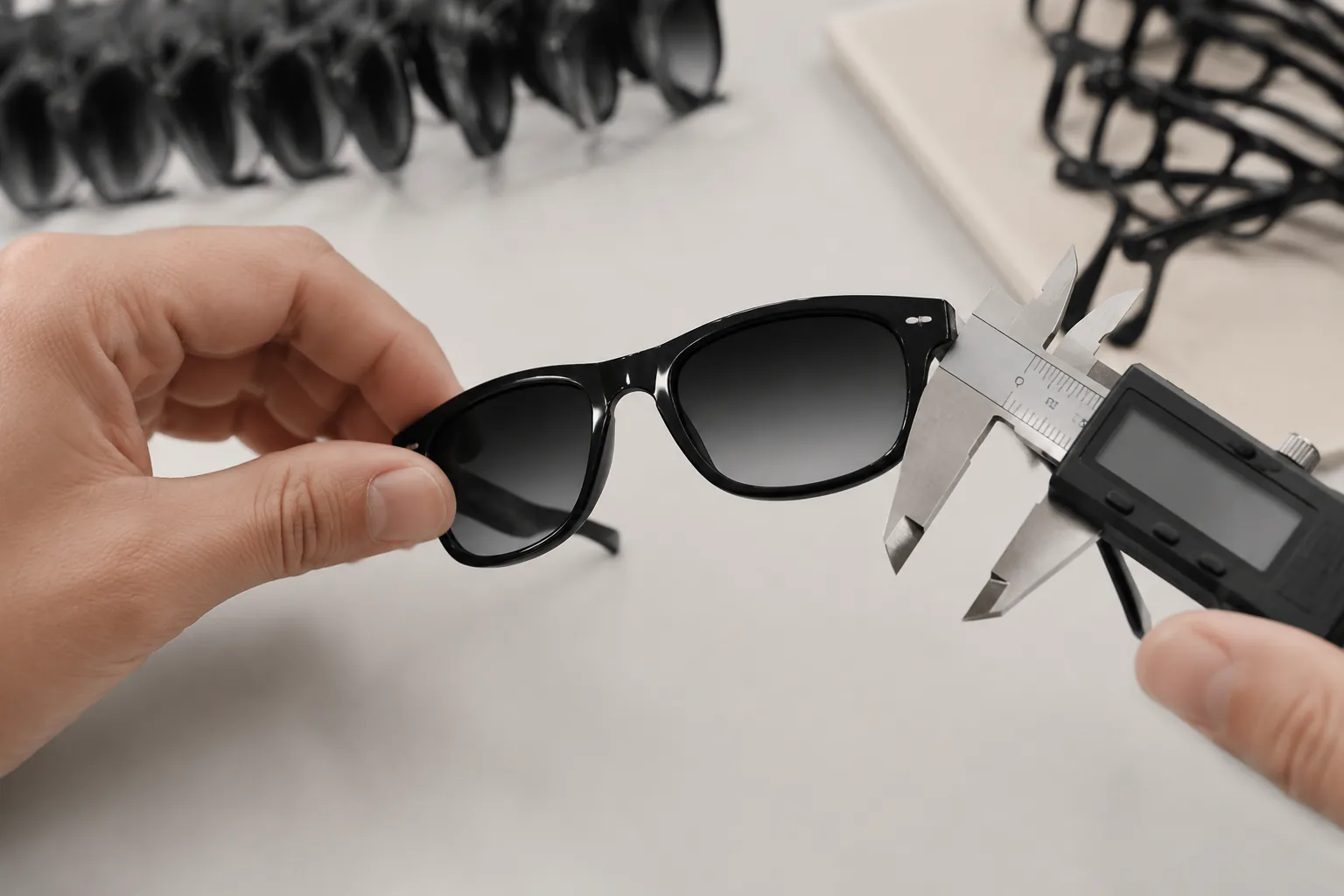
This guide is for brands, importers, distributors, and retail buyers ordering lightweight TR90 sunglasses in volume. TR90 is flexible and useful for many sunglass styles, but it is still an injection-molded material. It shrinks. Cavities vary. Frames can warp. Lens fit can fail. The goal is simple: define dimensions, test methods, approval samples, and rejection limits before tooling approval and pilot production—not after finished goods are packed.
The tolerance problem buyers find too late
TR90 is popular for custom sunglasses because it is light, flexible, and suitable for sport, fashion, travel, and promotional eyewear. Those advantages do not cancel basic molding physics. An injected TR90 frame can change during filling, packing, cooling, ejection, conditioning, lens assembly, and hot-part handling.
During molding, molten material fills the cavity, packs under pressure, cools, and shrinks. Shrinkage is not equal across the bridge, rims, end pieces, hinge bosses, and temples. Thick zones cool more slowly. Thin rims can pull inward. A small bridge-width change can affect comfort on the nose. A left-right temple angle difference can make a good-looking frame feel cheap.
Buyers usually notice the problem as frames that rock on a table, lenses that rattle or pop out, temples that do not close evenly, hinge screws that bind, or a front width that is narrower than the approved sample. These are not only cosmetic defects. They may come from mold compensation, gate position, wall thickness, cooling balance, resin drying, packing pressure, ejection timing, or handling while the part is still warm.
For bulk orders, the risk is not one bad pair. The risk is a cavity, shift, machine setting, or assembly method drifting away from the approved fit. A serious TR90 order needs agreed inspection points: frame front width, bridge width, lens groove condition, hinge position, temple spread, pantoscopic angle if specified, screw torque or hinge function, and warpage on a flat reference plane.
How TR90 differs from acetate, PC, and metal
TR90 is an injected thermoplastic, not a sheet material. Many dimensional decisions are locked before mass production starts: part design, shrinkage allowance, gate location, wall thickness, cooling channel layout, and mold-steel correction after trial shots. Final assembly can adjust small fit issues. It cannot rescue a poor mold or unstable process.
| Material | Main forming method | Typical dimensional risk | Buyer control point |
|---|---|---|---|
| TR90 | Injection molding | Shrinkage variation, warpage, lens groove variation, hinge boss shift | Tool trial report, cavity-by-cavity measurement, locked molding parameters |
| Acetate | Sheet cutting, CNC milling, tumbling, heat adjustment | Polishing variation, temple curve inconsistency, thickness loss during finishing | Sheet thickness, CNC program, polishing standard, final adjustment jig |
| PC | Injection molding | Stress marks, brittle hinge areas if poorly designed, visible flow lines, stiff wearer feel | Wall thickness, gate design, impact or drop check, stress inspection after lens assembly |
| Metal | Stamping, cutting, bending, soldering, plating, assembly | Bridge symmetry, solder strength, plating thickness, screw loosening | Forming and welding jigs, plating test, torque requirement, salt-spray test if required |
Compared with acetate, TR90 can be repeatable when injection parameters are controlled. Compared with PC, TR90 is often chosen for a more flexible feel. That flexibility can hide early stress until lenses are inserted. A thin TR90 rim may bend and recover, while a misplaced hinge boss can still make the temple sit wrong.
The key question is not whether TR90 is a good material. The key question is whether the supplier can measure, document, and hold the approved geometry through molding, lens fitting, decoration, and final packing.
Critical measurements to define before production
A TR90 tolerance sheet should be short, measurable, and tied to the approved golden sample. The phrase "same as sample" helps with appearance. It is not enough for engineering control. Samples may be made with extra care by senior technicians. Bulk production depends on repeatable settings, trained operators, and clear inspection limits.
For most commercial TR90 sunglasses, buyers should define these points before pilot production:
- Frame front width: define one measuring method, such as hinge screw center to hinge screw center or widest outside point to widest outside point. Do not let the supplier and buyer use different methods.
- Bridge width: measure between agreed reference points, such as lens openings or nose contact points. Narrow-fit styles need tighter control because small changes are easy to feel.
- Lens groove width and depth: specify the inspection method and acceptance standard. Too shallow can allow lens pop-out. Too tight can create rim stress, lens edge chipping, or assembly damage.
- Lens opening size: check A-size, B-size, and DBL against the final lens curve, lens thickness, and bevel. Thin rims and high-base lenses need extra attention.
- Temple opening angle: define total spread and left-right difference. Use a fixture or agreed measuring jig, not visual judgment alone.
- Temple length and drop: measure from hinge center to temple tip end, and define the bend or drop behind the ear if wearer fit is critical.
- Flatness and twist: place the frame on a granite plate or flat inspection board. Define the maximum permitted gap and where it is measured.
- Hinge screw torque or hinge function: define a functional range or standard check so temples are not loose, binding, or over-tightened. The right value depends on hinge design and screw size.
Do not copy one tolerance table across all designs. Oversized shields, thin-rim fronts, deep-wrap sports styles, transparent colors, and frames with metal parts need style-specific review. A practical method is to measure several approved samples, record actual values, then set limits the process can hold without constant rework.
Shrinkage control starts before steel is cut
Shrinkage is not fixed by final inspection. Inspection only tells you which parts are outside the limit. Control starts with design review, material selection, mold design, trial shots, and measurement before mass production. For TR90 frames, the mold must account for shrinkage in the front, bridge, hinge areas, temples, and lens groove before the buyer approves bulk production.
The usual TR90 molding sequence is: material drying, machine setup, injection filling, packing, cooling, ejection, de-gating, conditioning, then assembly. Each step can affect dimension and shape.
| Process step | What to control | What can go wrong |
|---|---|---|
| Material drying | Drying time and temperature recorded by batch according to material guidance | Surface defects, unstable processing, weak appearance, dimensional inconsistency |
| Injection filling | Fill speed, pressure, gate balance, complete cavity fill | Short shots in thin rims, flow marks, uneven shrinkage |
| Packing pressure | Pressure and hold time locked after approval | Sink marks, oversize or undersize drift, internal stress |
| Cooling | Cycle time, mold temperature, cooling balance across cavities | Warpage, twist, cavity-to-cavity dimensional difference |
| Ejection | Ejector balance and part temperature at release | Warm frames bent during release or handling |
| Conditioning | Measure after parts reach a stable condition, not only immediately at the machine | False approval of parts that continue to move after cooling |
Buyers should request first-article inspection from every cavity, with cavity identification. Pretty samples without cavity marks prove little. If one cavity consistently produces a narrower bridge, wider temple spread, poor lens seating, or more twist, the factory should correct the tool, adjust the process, or segregate that cavity before mass production.
A useful first-article report includes multiple conditioned pieces from each cavity, the measuring method, the measuring tool, actual readings, pass/fail judgment, and photos of the inspection setup. For larger orders, request in-process checks at production start, after shift change, after material batch change if applicable, and after any machine restart.
Warpage and lens fit ruin comfort quietly
Warpage is dangerous because it often does not show clearly in product photos. It appears when the frame rocks on a flat table, one temple touches before the other, the front twists, or the wearer sees one lens sitting slightly higher. It can also appear only after lenses are installed because lens pressure can push against an already stressed rim.
Common causes include uneven wall thickness, unbalanced gate location, poor cooling, early ejection, forced assembly, and stacking warm parts in deep bins. Do not pile warm TR90 fronts in a way that lets them cool under weight or pressure. For controlled production, molded fronts should cool and rest in trays, fixtures, or shallow containers that do not deform the part.
A good QC method is simple and repeatable: check the molded front on a flat plate, check temple spread with a fixture, install the final lens, then check again. If warpage increases after lens insertion, investigate lens curve, lens size, bevel shape, lens thickness, groove depth, rim flexibility, and assembly force. For polarized, mirrored, or coated lenses, confirm the actual production lens stack, not a substitute lens.
Lens fit should be defined by function. The lens should not rattle under light tapping. It should not require forced insertion that whitens or stresses the rim. It should not pop out during normal opening, closing, wiping, cleaning, or reasonable temperature change. If the buyer requires a specific drop test, flex test, or thermal cycling test, put it in the tech pack before production.
Blunt rule: do not approve a TR90 bulk order from decorated samples alone. Approve molded frame geometry first. Approve lens fitting second. Then approve logo, finish, and packaging.
Frame color, lens tint, lens curve, and decoration method should be included in the approval sample set. Check them together. A lens that fits well in one color or coating combination may not behave the same in the final production configuration.
Decoration tolerances must be written down
Decoration can improve perceived value, but it can also create disputes over position, durability, and appearance. TR90 can support pad printing, laser marking or engraving where suitable, heat transfer details, metal logo plates, and color effects depending on the design and supplier capability. Each method has a control point.
| Decoration method | Best use | Typical control point |
|---|---|---|
| Pad printing | Small logos on temples or selected lens areas if specified | Logo position, color match, ink adhesion, surface curvature |
| Laser marking or engraving | Subtle marks, serial marks, tone-on-tone branding where material color allows contrast | Contrast test on actual TR90 color; depth and heat effect must not weaken thin areas |
| Metal logo plate | Higher perceived value on temple exterior | Stable recess or mounting area; glue, rivet, or insert strength check |
| Color injection or mixed color | Sport and fashion color stories | Color chip approval, batch consistency, inspection under agreed lighting such as D65 |
The buyer tolerance agreement should be included in the purchase order, tech pack, or approved sample report before deposit or tooling approval. It does not need to be long. It must be measurable. Include golden sample sealing, cavity tracking, frame dimensions, lens fit, temple angle, warpage check, hinge function, logo position, packaging specification, inspection level, and defect definitions.
MOQ and price affect customization choices. Small trial orders are usually better suited to existing molds, standard lenses, and simple decoration. Structural changes, special lens development, custom colors, and custom packaging add setup time and increase the need for engineering approval. For volume programs, ask the supplier to separate tooling cost, frame cost, lens cost, decoration cost, packaging cost, testing cost, and inspection requirements in the quotation. Later changes then have a clear cost trail.
Lead time should be planned from the final approval point, not from the first conversation. A simple logo and standard lens program can move faster than a project with new mold work, special polarized lenses, mirror coatings, custom packaging, color correction, or compliance testing. The cheap mistake is unclear customization before quoting. The expensive mistake is changing structure after mold trial approval.
Compliance checks are not fit checks
A frame can fit well and still fail compliance. The reverse is also true. Treat TR90 dimensional control and sunglasses compliance as linked but separate tracks. Fit inspection protects comfort, assembly quality, and lens retention. Compliance testing protects market access, product claims, labeling, and importer responsibility.
For overseas B2B buyers, relevant documents may include CE EN ISO 12312-1 for sunglasses sold in many European markets, ANSI Z80.3 for the United States, AS/NZS 1067 for Australia and New Zealand, REACH for restricted substances, and FDA registration where applicable to the supplier or eyewear business requirements. LumiShades holds CE EN ISO 12312-1, ANSI Z80.3, AS/NZS 1067, REACH, FDA registration, ISO 9001, and BSCI. Buyers should request current documents that match the product type, selling market, and order configuration.
Compliance should be checked against the final production configuration: same TR90 color, same lens tint, same UV claim, same polarization or mirror coating, same decoration, and same packaging labels. A black frame with smoke lenses is not automatically the same test case as a transparent frame with mirrored polarized lenses. Colorants, coatings, lens category, optical claims, and label wording matter.
Ask for reports that match your selling market and product category. Confirm UV400 or UV protection claims, filter category markings, optical quality, transmittance, restricted substances, warning labels, country-of-origin marking, and importer labeling requirements. If your importer of record needs a specific document format, send it before production. Rebuilding compliance paperwork after goods are packed can delay shipment and add cost.
A practical approval flow for bulk TR90 orders
The safest approval flow is not complicated. It requires discipline. Skipping measurement steps may save a few days and risk the whole run. For any meaningful TR90 bulk order, warpage, lens fit, and cavity consistency should be reviewed during first articles and pilot production—not only at final inspection.
- Design review: confirm frame size, lens curve, rim thickness, hinge type, bridge, temple length, logo method, packaging, target market, and compliance requirements.
- Sample build: review appearance, weight, lens tint, logo method, comfort, hinge function, and basic fit.
- Engineering measurement: record critical dimensions from the approved sample and convert them into written tolerance limits.
- Mold trial or adjustment: correct shrinkage, bridge width, lens groove, hinge boss position, front flatness, and temple alignment before bulk approval.
- Pilot run: inspect parts by cavity and shift. Measure conditioned molded frames, not only finished packed pairs.
- Pre-production approval: sign off molded geometry, final lens assembly, decoration, color, packaging, and required compliance documents together.
- In-process QC: check dimensions during injection, after lens fitting, after decoration, and before packing. Record any machine restart, material batch change, or rework instruction.
- Final inspection: verify AQL plan, function, cosmetics, cartons, barcodes, country labels, packing method, and required reports before shipment release.
A serious supplier should accept clear tolerances. They protect both sides. The buyer gets predictable fit, lens security, and brand consistency. The factory gets fewer subjective disputes after shipment. That is how TR90 sunglasses should be sourced in bulk: not by hope, not by photos alone, but by controlled samples, recorded dimensions, process records, and inspection points agreed before production starts.
Have a custom sunglasses project in mind?
Send us your styles, target market and quantities and we will return a detailed quote with MOQ, lead time and a sample plan.
Get a QuoteWhy source this from Wenzhou with LumiShades
Wenzhou in Zhejiang Province is widely regarded as China’s eyewear manufacturing capital, producing a large share of the world’s sunglasses. That concentration matters to buyers: a deep local supply chain for acetate sheet, hinges, lens blanks, plating and packaging means shorter component lead times, easier color and material matching, and a workforce with decades of eyewear-specific skill. LumiShades has manufactured in this ecosystem since 2009, and our vertical integration — in-house injection molding, acetate cutting, CNC milling, lens tinting, decoration and quality control — means no part of your order is quietly subcontracted to a workshop you cannot audit.
For international buyers, that vertical control translates into accountability. When a single factory owns every step, defects are traced and fixed at source rather than bounced between vendors, and your specifications survive intact from first sample to bulk. For procurement review, buyers can request process records, approved samples, quality checkpoints and project-specific compliance files before placing a bulk order. Required testing and documentation are confirmed against the destination market and product specification rather than assumed from a generic certificate list. Explore our manufacturing capabilities and quality control process to see how this works in practice.
Frequently asked questions
What tolerance should I request for TR90 sunglass frames? Start with the approved golden sample, then define measurable limits for each critical dimension. At minimum, specify frame front width, bridge width, lens opening, lens groove condition, temple opening angle, temple length, flatness or twist, and hinge function. Do not use one universal tolerance for every style. Thin rims, oversized fronts, wrap frames, and high-base lenses need tighter engineering review. Ask the supplier to confirm the tolerance with cavity-by-cavity first-article data before bulk production.
Can TR90 warpage be fixed after production? Only minor adjustment may be possible. Serious warpage usually comes from mold design, uneven cooling, early ejection, forced lens assembly, or hot-part handling. If many parts show the same twist or rocking, treat it as a process or tooling issue, not a final adjustment issue. Stop production, identify the affected cavity or shift, check conditioned molded fronts before lens assembly, and correct the root cause before packing more goods.
Should I approve TR90 samples before lens fitting? Yes. Use two stages. First approve the molded frame geometry without lenses: front width, bridge, lens opening, groove, hinge position, temple spread, and flatness. Then approve the same frame with the final production lenses installed. Lens curve, bevel, thickness, coating, and size can change stress and warpage. Keep both approved samples sealed or clearly labeled for later inspection comparison.
What order quantity makes sense for custom TR90 sunglasses? For small market tests, use existing molds, standard lens options, and simple logo decoration whenever possible. For larger orders, you can justify more engineering work such as color matching, custom decoration, special lenses, packaging, and stricter QC documentation. Before placing the order, ask the supplier to state MOQ by design, color, lens type, and decoration method, because each one may have a different setup requirement.
Which decoration method is best for TR90 sunglasses? Choose based on surface shape, durability target, logo size, color contrast, and budget. Pad printing is common for small temple logos but needs adhesion and rub testing. Laser marking can look premium, but contrast must be tested on the actual TR90 color. Metal logo plates need a stable recess or mounting area and a pull or adhesion check. Whatever method you choose, approve position tolerance, color standard, durability test, and a signed decoration sample before bulk production.
Which compliance documents should overseas buyers request? Request documents for the market where the sunglasses will be sold, not just any certificate the supplier has. Common documents include CE EN ISO 12312-1, ANSI Z80.3, AS/NZS 1067, REACH, and FDA registration where applicable. The report or declaration should match the final product: frame material and color, lens tint, UV claim, filter category, polarization or mirror coating, decoration, and labeling. If your importer requires a specific format, provide it before production starts.
How should I inspect lens fit on TR90 sunglasses? Inspect lens fit after the final production lens is installed, not with a substitute lens. Check for rattle, visible gaps, whitening or stress around the rim, lens pop-out during normal opening and wiping, and added warpage after assembly. If the style is high wrap, polarized, mirrored, or thin-rimmed, add a specific retention or handling test in the tech pack. Record the lens curve, thickness, bevel, and groove condition so failures can be traced.
What should be included in a first-article report for TR90 frames? A useful first-article report should show cavity identification, sample quantity per cavity, conditioning time before measurement, measuring tools, actual readings, pass/fail limits, photos of the inspection setup, and comments on warpage, lens seating, hinge function, and decoration location if applicable. Do not accept only attractive photos or one unmarked sample when approving a multi-cavity mold.
Ready to start?
Explore our rimless sunglasses or request a quote — our sales team replies within 12 hours.
Request a Quote