
Retail-Ready Sunglasses Packaging Specs to Lock
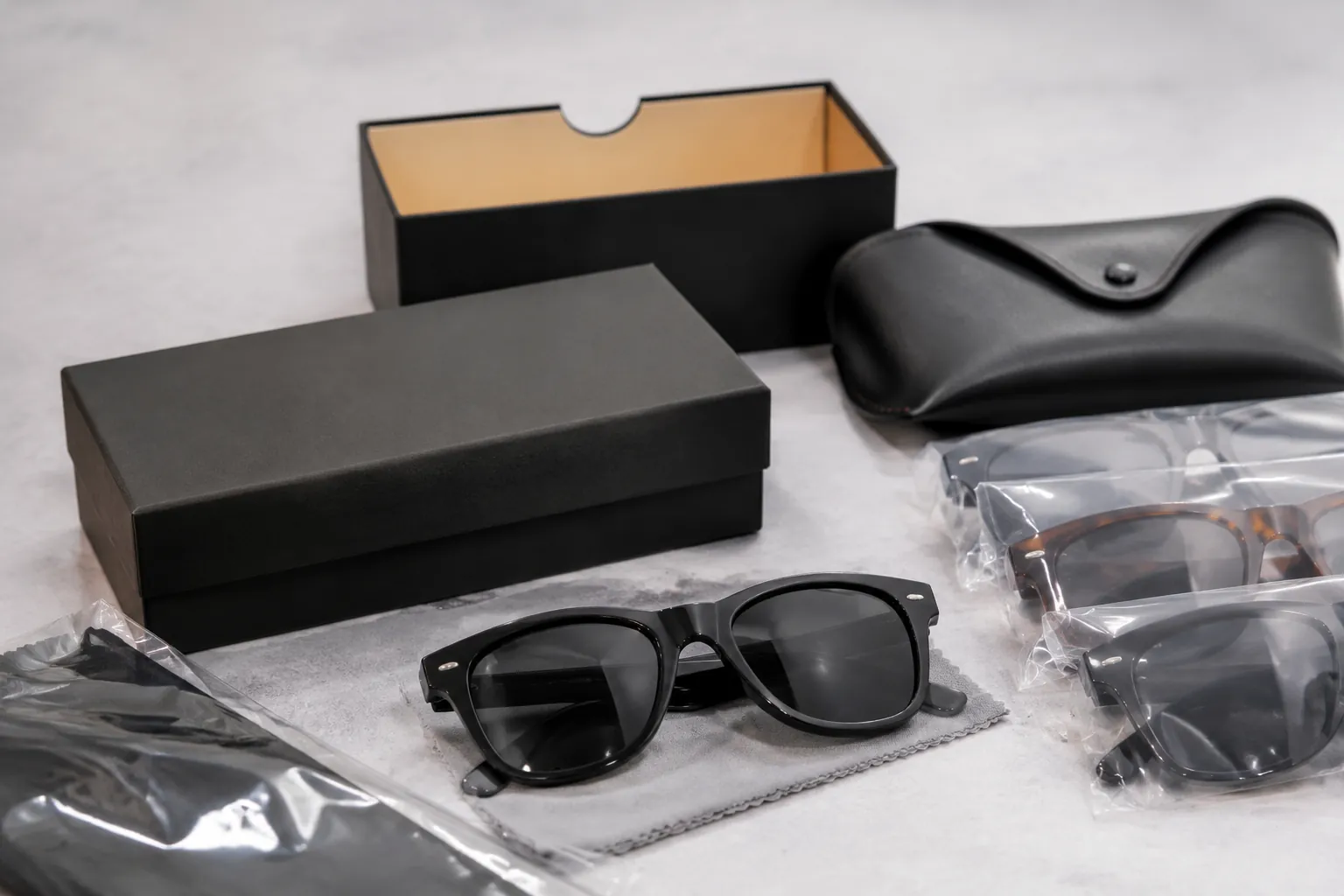
If you buy sunglasses for retail, packaging is not a side note. It affects shelf presentation, barcode scanning, carton use, and how many pairs arrive damaged. Before you place a PO, lock the specs that control those outcomes: retail unit type, insert fit, barcode placement, master carton count, and outer-carton strength. Change them later and you create rework, freight cost, and reject risk.
Start with the packing unit, not the carton
The first decision is the sellable unit. For sunglasses, that usually means one of three formats: a rigid retail box, a pouch plus outer sleeve, or pouch-only for low-cost online or promo programs. Decide this before you ask for quotes. A factory cannot price carton count, insert material, or print area accurately if the final unit is still open.
For retail buyers, the brief should specify one pair per retail unit, what sits inside the unit, and what the shopper sees first. If the product hangs on a peg, the pack must support a hang tab or be ready for a peg shipper. If it sits on a shelf, front-face print and window placement matter more than top-flap construction. If the sunglasses are sold in a clear display tray, the tray itself becomes part of the presentation spec.
Frame construction changes packaging behavior. Thick acetate frames and metal-accent styles usually need more crush clearance than slim injection styles. Leave enough space to prevent rubbing, but not so much that the frame moves in transit. No hard surface should touch the lens directly.
Packaging should also match the product build. A lightweight injection-molded frame may ship safely in a folded carton with an insert, while a heavier acetate style often needs a stiffer board grade or a molded tray.
Lock the retail unit before you ask for a quote. Pricing, lead time, and carton efficiency all depend on it.
Change the retail unit after sample approval, and you usually need new artwork, a new dieline check, and at least one more sample round. That costs time.
Standardize the carton count and master carton size
Carton efficiency is where packaging cost becomes visible. A clear master carton count reduces freight waste, speeds receiving, and lowers the chance of mixed-SKU errors. For sunglasses, common master carton counts are 12, 24, 48, or 96 pairs, but the right count depends on unit box size, unit weight, and pallet plan.
Use this logic:
- Fix the retail unit dimensions first. Measure the finished pack, not the dieline.
- Ask for a target master carton size that fits your pallet pattern. For example, a 600 x 400 mm export carton footprint often stacks more efficiently than an arbitrary size.
- Keep one SKU per master carton if possible. Mixed cartons save space on paper and create receiving errors.
- Confirm whether outer cartons need single-wall or double-wall board. For sea freight or long warehouse dwell times, double-wall is often the safer choice.
Practical carton limits matter. If your warehouse or 3PL treats anything above 12-15 kg as a two-person lift, design around that threshold. A 24-pair carton may be ideal for a compact box, but if the retail unit is oversized, the same count can push the carton weight and cube too high. Even a small increase in unit width can reduce row count enough to change freight cost per pair.
Ask the supplier for three numbers before you approve bulk: net unit weight, master carton gross weight, and estimated carton cube. If the supplier cannot provide those figures, the packing plan is not fully defined.
| Packaging option | Typical use | Pros | Trade-off |
|---|---|---|---|
| Rigid paper box | Premium retail, gift sets | Better shelf look, stronger crush resistance | Higher unit cost and larger carton volume |
| Folding carton | Mass retail, private label | Lower cost, flat-shipped if needed | Less protection unless insert design is correct |
| Pouch only | Value programs, online bundles | Lowest material cost, compact | Higher scratch and compression risk |
| Rigid box + molded tray | Premium chain retail | Best product presentation and protection | Highest cost and largest cube |
MOQ and price move with print and structure. A plain folding carton with one-color print may be available at lower quantities than custom rigid packaging, which often needs a larger order because of board sourcing and handwork.
Barcode rules: define them before print runs start
Barcodes are workflow tools, not decoration. If the code is too small, too close to a fold, or printed on glossy art that reflects badly under scanners, receiving slows down and retail setup gets messy. Standardize barcode type, size, location, and human-readable text before artwork is finalized.
For eyewear packaging, define these items in writing:
- Barcode type: EAN-13, UPC-A, or your internal SKU code
- Minimum size: use the printer's recommended scan-safe size; do not shrink it without testing
- Placement: back panel, bottom flap, or side panel
- Quiet zone: keep clear space around the code, typically at least 2-3 mm on each side, more if your printer requires it
- Contrast: dark code on light background is safer than reversed or metallic printing
- Human-readable SKU: always include it
Do not place the barcode across a fold, seam, gloss lamination edge, or metallic logo plate. Keep it away from trim and folding lines where possible. If you sell into multiple countries, align the barcode plan with the destination market before samples are approved. Reprinting cartons because the code format is wrong is expensive and avoidable.
If you use pad printing, laser engraving, or metal logo plates on the product itself, keep the packaging code separate and easy to scan. Product branding and supply-chain labeling are different jobs. On the box, scannability wins; on the frame, brand finish wins.
For retail chains, ask the supplier to provide a scan test on sample packs before bulk. If your internal team uses GS1 standards, send the exact data format, not just a photo of the box.
Pick inserts based on frame material and scratch risk
Insert design is where damage rates are won or lost. A soft pouch alone may be enough for low-cost polycarbonate frame programs. It is not enough for acetate sunglasses with polished surfaces, spring hinges, or mirror-coated lenses. The insert must stop lens rubbing, temple pressure, and nose-piece deformation during transit.
Match the insert to the frame and the channel:
- Injection frames: molded pulp tray, EVA insert, or folded card support can work
- Acetate frames: soft wrap plus rigid support is safer
- Metal frames: avoid point pressure on hinges and bridge areas
- Mirror or tinted lenses: use a lens-safe film if scratching has been a problem
Material behavior matters. Molded pulp is sustainable and cost-effective, but it can shed dust and compress under humidity if the wall thickness is too low. EVA is cleaner and more protective, but it adds cost and may retain odor if packed immediately after production. Card inserts are the cheapest, but they only work when die-cut accurately and folded consistently. For most programs, insert thickness is typically selected in the 1.5-3 mm range for card or EVA solutions and 2-4 mm for molded pulp, depending on the frame size and required support.
Ask for fit testing with actual frames, not just a drawing. A box can look fine and still fail after vibration in a carton. Run a simple test: pack the frame, shake the box for 30 seconds, then inspect for temple movement, lens rubbing, and corner crush. If possible, request drop-test feedback from the supplier on sample packs before bulk approval.
Packaging and assembly teams need to work from the same fit standard. If they do not, you get crushed corners or inserts that do not hold the frame where they should.
For samples, allow time for the full loop: structure, artwork, fit check, and rework if needed. Bulk packing is fastest when specs are frozen before production starts.
Use a packaging spec sheet, not email threads
Email is where packaging projects go to die. Buyers should standardize one spec sheet per SKU and treat it as the source of truth. That sheet should include dimensions, materials, print method, insert type, barcode format, carton count, and shipping marks. If any of those are missing, the factory will make assumptions.
A usable packaging spec sheet should cover:
- Retail box dimensions in millimeters, finished size after print and folding
- Board grade or paper weight, such as 250-400 gsm folding stock or rigid board build-up
- Print sides and color references, including Pantone or CMYK values
- Finish: matte, gloss, soft-touch, UV spot, foil, or uncoated
- Insert material, thickness, and color
- Unit weight and master carton gross weight target
- Carton dimensions, stack limit, and pallet pattern
- Label content and barcode placement
Decoration method also matters. Offset printing is suitable for clean graphics and larger runs. Foil stamping gives a premium effect but raises cost and limits fast changes. Spot UV works for branding accents but should be used with a box structure that can handle the finish without cracking at heavy folds. For frames with laser-engraved temples or metal logo plates, keep the box design aligned with the same brand language so the package does not look disconnected from the product.
Consistency matters more than elaborate design. If the logo is laser engraved on the frame, the retail box should not show an outdated logo version. If you use metal logo plates, confirm whether the print should mirror the same finish family or stay neutral.
One spec sheet per SKU. If style name, color code, and barcode are not on the same document, expect mistakes.
Add a revision number and approval date. A simple version system helps prevent old dielines from being used in bulk.
Compare packaging choices against freight and damage risk
The cheapest pack is rarely the cheapest landed option. Compare unit cost, carton density, and damage exposure together. In sunglasses, a small increase in packaging cost can reduce returns, claims, and store rejection.
| Spec choice | Unit pack cost | Carton efficiency | Damage risk |
|---|---|---|---|
| Rigid box + insert | Higher | Lower | Lowest |
| Folding carton + molded tray | Medium | Medium | Low to medium |
| Pouch only + shipper | Lowest | Highest | Higher |
| Rigid box + window + foam insert | Highest | Lowest | Lowest for premium shelf retail |
If your retail channel is chain stores, damage risk usually costs more than the box does. If your channel is e-commerce or discount wholesale, compactness may matter more than shelf look. Decide by channel, not taste. For chain retail, you may accept a higher unit pack cost if it reduces returns or store rejection. For DTC or marketplace programs, a smaller pouch-and-shipper format may be acceptable if the parcel has additional protective outer packaging.
Check freight implications early. A rigid box can add significant cube compared with a folding carton in some styles, which changes how many pairs fit per master carton and per pallet. That is where landed cost shifts. Also check whether the destination market needs specific package marking, such as country of origin, carton quantity, or importer information. Compliance for the sunglasses themselves is separate from retail packaging, but the package must not contradict the product claims.
Keep packaging claims aligned with the actual product certification set. Use only the certifications and compliance references that apply to the product and market.
Build the approval flow: sample, preproduction, bulk
Packaging approvals should follow the same sequence as the product, but faster. Do not approve artwork before you approve structure. Do not approve structure before you check fit with the actual frame. A clean flow prevents expensive rework.
A basic approval flow looks like this:
- Confirm product dimensions and frame type.
- Approve the retail box dieline and insert layout.
- Approve artwork, barcode, and shipping marks.
- Run a sample pack with actual frames.
- Check scuffing, collapse, label readability, and master carton fit.
- Lock the preproduction sample and sign off on bulk.
Ask for a pre-shipment carton check too. Verify count, outer carton marks, and whether the retail units are packed face-up or face-down. Orientation sounds minor, but it can matter for shelf presentation and first opening experience.
Before PO release, freeze the specs that change money, time, or damage rates:
- Retail unit type and dimensions
- Insert material and fit method
- Barcode type and exact placement
- Master carton count and dimensions
- Outer carton grade and stacking limit
- Print method, colors, and finish
- Label content, including SKU and country marks
The practical rule is blunt: if your packaging spec is not detailed enough for a factory QC team to pack without follow-up questions, it is not ready for production.
Have a custom sunglasses project in mind?
Send us your styles, target market and quantities and we will return a detailed quote with MOQ, lead time and a sample plan.
Get a QuoteWhy source this from Wenzhou with LumiShades
Wenzhou in Zhejiang Province is widely regarded as China’s eyewear manufacturing capital, producing a large share of the world’s sunglasses. That concentration matters to buyers: a deep local supply chain for acetate sheet, hinges, lens blanks, plating and packaging means shorter component lead times, easier color and material matching, and a workforce with decades of eyewear-specific skill. LumiShades has manufactured in this ecosystem since 2009, and our vertical integration — in-house injection molding, acetate cutting, CNC milling, lens tinting, decoration and quality control — means no part of your order is quietly subcontracted to a workshop you cannot audit.
For international buyers, that vertical control translates into accountability. When a single factory owns every step, defects are traced and fixed at source rather than bounced between vendors, and your specifications survive intact from first sample to bulk. We back this with 15+ years of experience, shipments to 60+ countries, more than 5 million pairs produced per year and a 98.5% on-time delivery rate. Our certifications — CE EN ISO 12312-1, FDA registration, ANSI Z80.3, AS/NZS 1067, REACH, ISO 9001 and BSCI audit — mean the compliance documentation your market requires already exists. Explore our manufacturing capabilities and quality control process to see how this works in practice.
Frequently asked questions
What packaging info should I send first to get an accurate sunglasses quote? Send frame type, retail unit type, box dimensions if known, barcode format, carton count target, insert requirement, and destination market. Also include target weight and whether the pack must hang or shelf-display. The more complete the brief, the less the factory has to assume.
How early should barcode placement be approved? Before artwork approval. Barcode size, location, and quiet zone affect the dieline and print file. If you change them late, you usually need a revised proof and sometimes a reprint.
Is a pouch enough for retail sunglasses? Only for some low-cost or online programs. For shelf retail, a rigid or folding box with a proper insert usually gives better protection and a more controlled presentation.
What master carton count is best? There is no universal best count. It depends on unit box size, pallet plan, carton weight limits, and whether you want single-SKU cartons. Many programs use 12, 24, 48, or 96 pairs.
Can packaging changes affect lead time? Yes. If artwork, insert size, print method, or carton structure changes after sample approval, expect delay. Bulk is fastest when the retail unit, barcode, and carton specs are frozen early.
Ready to start?
Explore our square sunglasses or request a quote — our sales team replies within 12 hours.
Request a Quote