
How to Mix Print, Laser, and Metal Logos on Sunglasses
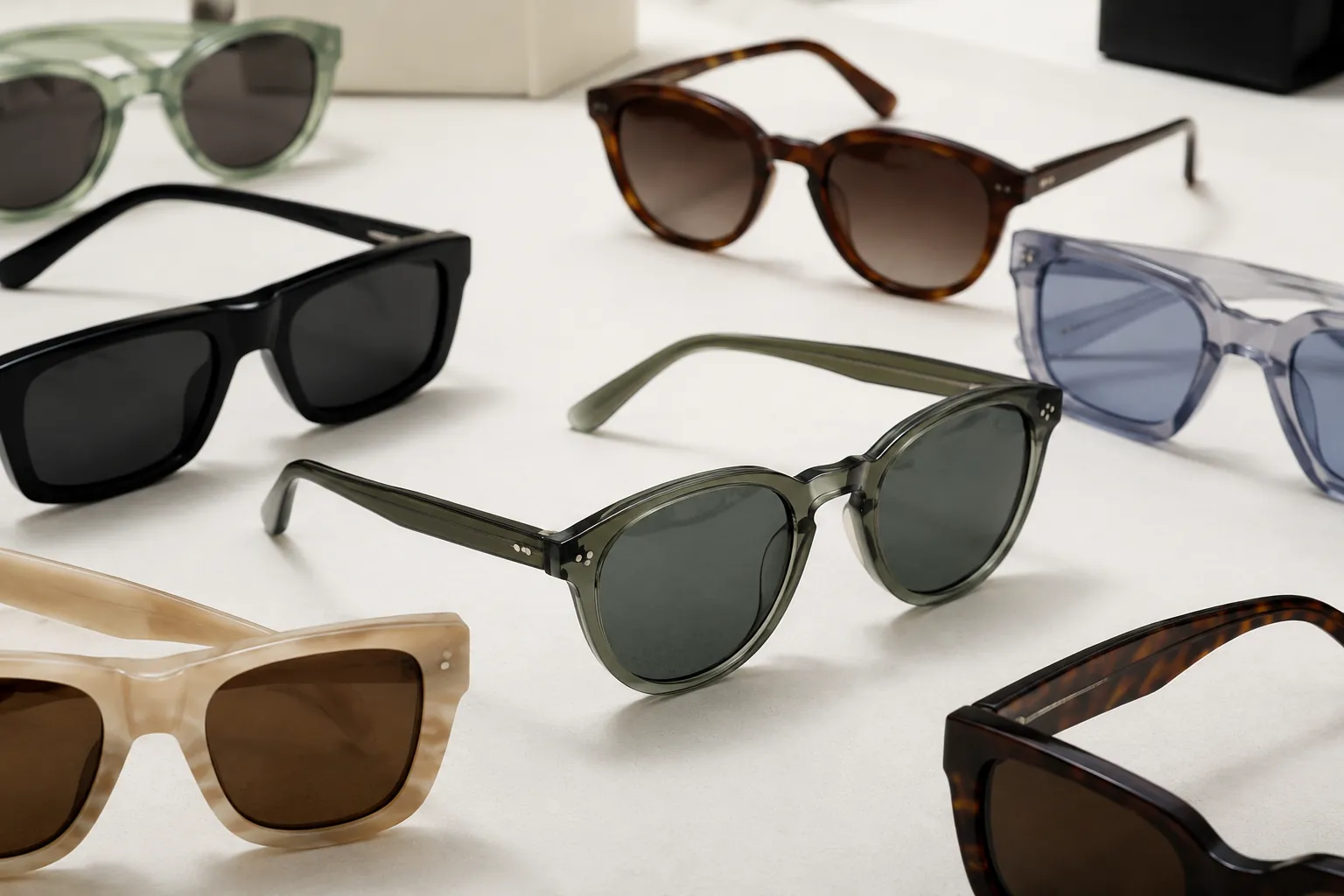
This guide is for buyers building a sunglasses line across multiple price tiers and logo methods. The hard part is not picking the most premium decoration. It is assigning pad printing, laser engraving, and metal logo plates across entry, mid, and premium SKUs without losing one clear brand language. Use this framework to brief factories, compare process fit, set tolerances, and cut sample-stage rework. The focus is practical: frame material, logo size, MOQ, assembly risk, wear performance, and how each method behaves on real sunglass parts.
Map the tier first, then choose the logo process
Most branding mistakes start with the wrong question: Which logo method looks best? The production question is different: Which method fits this SKU tier, this material, and this retail target without making the line look disjointed?
A workable sunglasses program usually has three levels. Entry SKUs need low decoration cost, simple setup, and repeatable output at modest volumes. Mid-tier SKUs need a visible step up in perceived value without too much added process risk. Premium SKUs need stronger detail, better material expression, and better long-term wear performance.
Branding should follow both price tier and frame construction. A broad injection-molded temple in TR90 or PC may suit pad printing. A polished acetate temple may suit laser engraving or a machined recess for a metal logo plate. A thin or sharply curved temple may suit none of them unless the artwork is reduced and repositioned.
Set one master brand system across all tiers. Keep the same logo geometry, placement logic, and finish hierarchy even if the process changes. In practice, that usually means defining:
- Outer temple logo zone: a fixed placement window referenced from the hinge centerline or another repeatable datum.
- External placement tolerance: an agreed left-right and front-back tolerance shown on the artwork drawing.
- Logo height: a controlled range based on temple width and curvature.
- Inner temple text order: one consistent sequence for model code, color code, origin marking, and traceability text.
This matters. Otherwise the entry SKU gets a bold print, the mid-tier style gets a faint laser mark, and the premium frame gets hardware that looks like it belongs to another brand.
What each logo method actually does well
Pad printing, laser engraving, and metal plates are not interchangeable. They create different visual effects. They wear differently. They also fail in different ways.
| Method | Best substrates | Typical logo size | Main strengths | Main limits |
|---|---|---|---|---|
| Pad printing | TR90, PC, injection-molded plastics, broad temples | Small to medium external logos; exact range depends on temple shape and artwork | Low unit cost, direct color matching, flexible artwork changes | Wear depends on ink system, curing, and surface preparation; performance varies by substrate |
| Laser engraving | Acetate, coated metals, some painted or molded plastics, inner temples | Fine text and small to medium logos; result depends on substrate response and fixture stability | No ink required, strong repeatability for text, permanent mark when the material response is suitable | Contrast depends on substrate and finish; some glossy or dark surfaces give weak results |
| Metal logo plates | Acetate or thicker temples with enough wall thickness for a cavity or mounting feature | Usually small to medium hardware logos sized to the available flat area | High perceived value, tactile detail, premium retail signal | Extra parts, tighter machining tolerance, more assembly steps, higher cosmetic risk |
Pad printing is usually the most efficient choice for visible branding on volume sunglasses. It works best on a surface that is reasonably flat or only mildly curved, with enough contact area for clean transfer from the silicone pad. Fine detail is possible. Do not assume it will hold. Clean edges depend on substrate, texture, curvature, ink system, and process control. Approve minimum line width from tests on the exact part.
Laser engraving is often better for permanence and for small inner temple information. It removes ink variation from the equation. But laser does not produce one standard look. On one acetate color, the mark may appear crisp and bright. On a glossy black plastic, the same setting may produce weak contrast or visible heat effect. Test it on the exact finished substrate. Not on a generic material chip.
Metal logo plates are not just decoration. They are a small assembly operation. The cavity must be machined cleanly. Plate thickness must match recess depth. The fixing method must be controlled. Alignment must stay stable through curing and finishing. If any of that drifts, the defect is obvious.
How to assign methods across entry, mid, and premium
If your line covers multiple price points, assign decoration by both SKU role and material behavior. That gives you consistency without forcing the same method onto the wrong product.
- Entry program: use pad printing for outer temple logos on injection frames where surface geometry supports clean transfer. Keep artwork simple. Avoid very fine strokes unless the factory has proven capability on the exact part. Request an adhesion or rub test on pre-production samples. Inner temple text may be pad printed or laser marked depending on readability and substrate response.
- Mid program: combine pad printing for colored or more visible logos with laser engraving for fine inner temple details or quieter outer temple branding. This tier often mixes constructions, so one method rarely fits every style.
- Premium program: reserve metal logo plates for lead SKUs where temple construction can support the extra process steps. Pair them with laser engraving for inner temple text and subtle secondary branding so the premium line still feels related to the lower tiers.
A useful model is one visual family with three execution levels. For example, the same logo shape appears as one-color pad print on entry, tone-on-tone laser on mid, and a brushed or plated metal insert on premium. The shape, proportion, and position stay fixed. The material expression changes.
MOQ should influence the choice too. At lower trial volumes, pad printing and laser engraving are usually easier to justify because they do not require extra hardware inventory. Metal plates usually make more sense when the SKU can absorb added assembly cost, inspection time, and reject risk. The break point depends on margin, retail target, and the factory's hardware control.
Design rules that stop brand drift
The main risk in a mixed-method program is drift. One SKU looks oversized. Another looks faint. The premium frame carries a logo shape that does not translate well into print. Fix that at artwork stage.
- Lock one master vector file: do not redraw the logo separately for print, laser, and hardware.
- Set a minimum stroke rule: define the minimum stroke and gap from tested production capability for each substrate and process.
- Control clear space: leave enough margin around the logo so edge polish, mold parting lines, texture, or temple curvature do not crowd it.
- Keep finish logic consistent: a quiet brand should not pair mirror-bright hardware with aggressive high-contrast print on entry items unless that contrast is intentional across the range.
- Separate decorative branding from technical text: do not force compliance or traceability information into the same visual treatment.
Color is another common mistake. Pad printing can be matched to a specified ink color. Laser depends on how the base material reacts. A black printed logo may be possible on a translucent temple. A black laser result is not. Laser changes the surface. It does not add a colored layer.
Metal plates also need proportion control. Too small, and they look incidental. Too large, and they overpower the temple and raise the risk of edge lifting, sink, or visible cavity lines. On acetate, keep enough wall thickness around the recess, especially if the part will be polished again after machining.
What to confirm during sampling
Most decoration failures come from missing questions. Not bad intent. Put process details in the tech pack before sampling starts.
For pad printing, confirm the temple surface state: untreated molded plastic, rubber-coated finish, painted finish, or polished acetate. Ink adhesion changes with surface chemistry. Ask which ink system is used, how the part is cleaned before printing, and how curing is controlled. Ask the factory to define its internal adhesion or rub test and use that same check for sample approval.
For laser engraving, confirm the machine type if relevant, the expected mark color or contrast level, and whether the factory has tested the exact material and finish combination. If you are buying multiple colors of the same frame, do not assume one setting will give equal contrast on all of them. Dark tortoise, solid black, and translucent smoke can react differently.
For metal logo plates, confirm cavity dimensions, corner radius, target recess depth, plate thickness, plating finish, and adhesive or insertion method. Also confirm how the part is inspected after assembly: visual alignment only, or alignment plus flushness and edge-quality checks.
Discuss lead time at sampling stage too. Decoration choices can affect tooling, fixtures, strike-offs, and rework cycles. If a mid-tier SKU is still undecided between print and laser when bulk approval starts, the whole line can slip.
Cost, MOQ, and lead-time trade-offs
Decoration affects cost in at least three ways: setup, direct unit labor, and scrap exposure. Many buyers price only the logo itself and miss the cost of rework, alignment checks, or extra handling.
| Method | MOQ fit | Lead-time effect | Cost pattern | Typical risk point |
|---|---|---|---|---|
| Pad printing | Usually suitable for lower MOQs because it does not require extra hardware | Usually limited if artwork is frozen early and the factory already has the fixture plan | Low unit cost on standard external logos | Print shift, poor adhesion, inconsistent opacity or edge definition |
| Laser engraving | Usually suitable from low MOQ upward if the substrate gives acceptable contrast | Low to moderate depending on fixture setup and test cycle | Moderate setup with stable repeatability for text and simple marks | Weak contrast, overburn, or visible heat effect on sensitive surfaces |
| Metal logo plates | Usually more efficient on styles with enough volume or margin to justify extra handling | Moderate because it adds hardware sourcing, machining, assembly, and inspection steps | Higher unit cost and greater scrap sensitivity | Plate rotation, cavity mismatch, adhesive defects, flushness variation |
If you launch with a small trial order per design, pad printing and laser are usually easier to justify. At that level, a metal plate can still work, but only if the retail price and margin can absorb the added process burden. As volume rises, metal hardware can become more viable for hero SKUs, but QC discipline matters even more because one repeat defect can affect a large run.
Ask the hard question. Not whether a metal plate is affordable by itself, but whether it improves the SKU enough to justify the extra sourcing, assembly, and inspection load.
Keep compliance marking separate from decorative branding
Brand decoration and compliance marking are related, but they do not do the same job. Keep them separate in the specification sheet and in QC checkpoints.
For sunglasses sold into regulated markets, product planning should align with the standards relevant to the target market, including CE EN ISO 12312-1, ANSI Z80.3, and AS/NZS 1067 where applicable. Chemical and material controls matter too, including REACH requirements or customer-specific restricted substance expectations. Depending on product classification and market route, buyers may also need documentation linked to FDA registration. A supplier operating under ISO 9001 and BSCI may offer a more structured quality and social compliance process, but buyers should still verify scope and current status directly.
The practical rule is simple: do not crowd decorative branding into areas needed for model identification, traceability, or other required product information. In many programs, laser engraving is a better choice for inner temple technical text because it can produce smaller, more permanent characters than print when the substrate response is suitable. Use print or metal mainly for the visible brand signal. Use a stable, readable method for information that may need to be checked later by the importer, retailer, or regulator.
This also makes inspection more objective. QC can judge logo appearance, placement, and cosmetic finish as one checkpoint, and technical text readability and correctness as another.
Use a strict sample-to-bulk workflow
Mixed branding works best when the approval path is blunt and controlled. No guesswork.
- Approve the tier map first: decide which SKUs will use print, laser, or metal before sample work starts.
- Issue one artwork pack: include vector files, logo dimensions, placement drawings, finish notes, and separate inner temple text artwork.
- Review material-specific strike-offs: check each method on the actual frame material, color, and surface finish.
- Approve pre-production samples side by side: compare entry, mid, and premium styles together rather than approving them in isolation.
- Set QC checkpoints: placement, contrast, adhesion, alignment, cavity fit, edge quality, and text readability.
- Lock golden samples: keep at least one approved sample per tier with written sign-off notes.
This side-by-side review catches problems early. A premium metal plate may look good on its own but still feel off if the logo sits much farther forward than the printed entry style. The customer may not describe that as a placement issue. They will just feel that the line lacks cohesion.
Even if a supplier handles molding, machining, decoration, and QC in-house, that does not replace a clear specification. It only makes a good specification easier to execute. Done right, a mixed branding program gives you cost control at the bottom, margin support at the top, and one recognizable brand language across the collection.
Have a custom sunglasses project in mind?
Send us your styles, target market and quantities and we will return a detailed quote with MOQ, lead time and a sample plan.
Get a QuoteWhy source this from Wenzhou with LumiShades
Wenzhou in Zhejiang Province is widely regarded as China’s eyewear manufacturing capital, producing a large share of the world’s sunglasses. That concentration matters to buyers: a deep local supply chain for acetate sheet, hinges, lens blanks, plating and packaging means shorter component lead times, easier color and material matching, and a workforce with decades of eyewear-specific skill. LumiShades has manufactured in this ecosystem since 2009, and our vertical integration — in-house injection molding, acetate cutting, CNC milling, lens tinting, decoration and quality control — means no part of your order is quietly subcontracted to a workshop you cannot audit.
For international buyers, that vertical control translates into accountability. When a single factory owns every step, defects are traced and fixed at source rather than bounced between vendors, and your specifications survive intact from first sample to bulk. We back this with 15+ years of experience, shipments to 60+ countries, more than 5 million pairs produced per year and a 98.5% on-time delivery rate. Our certifications — CE EN ISO 12312-1, FDA registration, ANSI Z80.3, AS/NZS 1067, REACH, ISO 9001 and BSCI audit — mean the compliance documentation your market requires already exists. Explore our manufacturing capabilities and quality control process to see how this works in practice.
Frequently asked questions
Should I use the same branding method on every SKU for consistency? No. Consistency should come from the same master logo artwork, placement logic, size rules, and finish hierarchy, not from forcing one decoration method onto every frame. Start with approved placement zones, minimum and maximum logo dimensions, and process-specific artwork rules. Then assign pad print, laser, or metal based on substrate, curvature, and price tier.
Which method is safest for a small trial order? Usually pad printing or laser engraving, because neither requires extra logo hardware inventory. To choose between them, ask three questions: does the substrate accept ink well, does the surface geometry allow clean pad transfer, and does laser produce readable contrast on the exact material and finish? Approve the answer from sample tests, not from a generic capability statement.
Can laser engraving replace pad printing on all black frames? Not reliably. Laser contrast on black frames depends on the resin, pigment, coating, polish level, and machine settings. On some black surfaces the mark is clear; on others it is weak or cosmetically rough. If you want to replace print with laser, request strike-offs on the exact black frame, compare readability under normal retail lighting, and define an approval standard for contrast before bulk production.
When do metal logo plates start making commercial sense? There is no universal MOQ threshold. Metal plates make sense when the SKU has enough margin, enough visual importance in the line, and enough temple thickness to support the added process. Before approving them, confirm cavity design, fixing method, inspection criteria, and expected reject risk. If the style is not a hero SKU, print or laser is often the more efficient choice.
What should I inspect on decorated sunglasses before approving bulk? Check the sample against a written approval checklist. For external branding, inspect position from a fixed datum, left-right consistency, edge clarity, color or contrast, and cosmetic defects around the logo area. For pad print, check adhesion using the agreed test method. For laser, check readability and unwanted heat effect. For metal plates, check alignment, flushness, edge condition, and any adhesive visibility. Also verify inner temple text content, order, and legibility, and compare all tiers side by side before sign-off.
Ready to start?
Explore our wayfarer sunglasses or request a quote — our sales team replies within 12 hours.
Request a Quote