
Do Metal Logo Plates Add Real Value to Sunglasses?
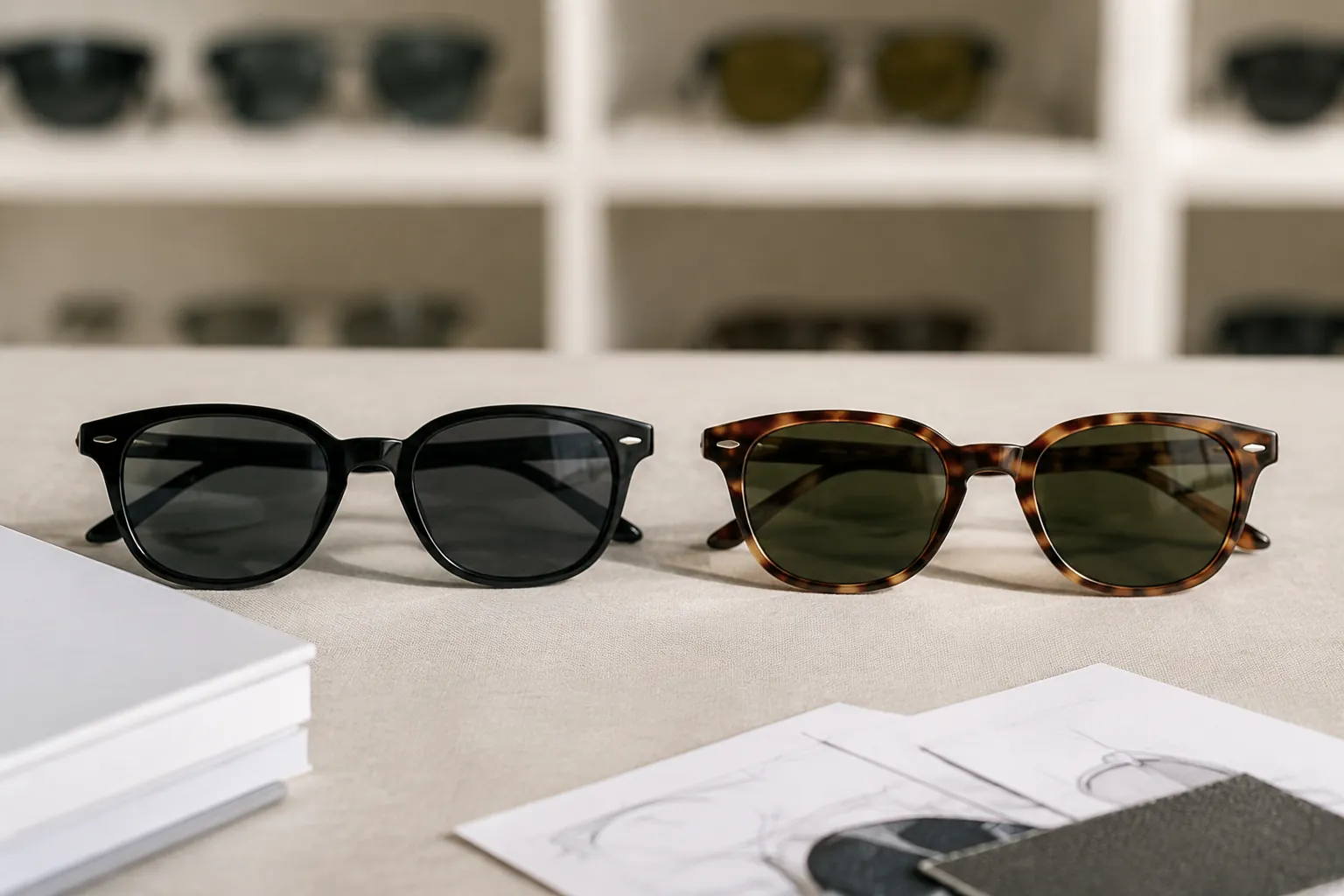
This guide is for brand owners, importers, and retail buyers deciding how to brand private label sunglasses without adding cost the product cannot recover. Metal logo plates can make a frame look more premium. They also add components, assembly steps, and quality risk that print or engraving usually do not. So the real question is simple: will the plate lift perceived value enough to support the target retail position after tooling, MOQ planning, lead time, process control, and after-sales risk are factored in?
Start with the buying decision, not the trim
Metal logo plates are not automatically the best branding choice. They work best when the frame is already meant to sell at a higher retail tier and the customer expects visible hardware detail. On a low-cost giveaway or entry promotional frame, a metal plate can look forced. Worse, it can eat margin without helping conversion.
On a fashion acetate frame or a more design-led injected style, the effect can be different. The frame may look like a branded product from the start, not a blank item decorated at the end.
That is the first filter. Commercial fit comes before aesthetics. Ask one blunt question: will the trim change how the end customer values the frame in the first few seconds on shelf, in hand, or in a product image? If yes, the extra process may be justified. If not, pad print or laser engraving will usually do the job with less manufacturing complexity.
In practice, metal plates make the most sense in three situations:
- Retail-led collections where shelf appeal, gifting, and visible detailing matter.
- Brand launch or upgrade programs where the buyer wants branding that feels more intentional than standard print.
- Frames with enough temple area to mount the part securely without crowding the design.
They make less sense for very slim temples, highly flexible sport constructions, or programs driven mainly by landed cost. A metal plate can reinforce value that already exists in the frame design and target market. It rarely creates value on its own.
How plates change perceived value vs print or engraving
Printed branding is usually the simplest and lowest-risk option. It scales well, adds little hardware, and suits promotional or price-sensitive programs. Laser engraving can offer better permanence on compatible surfaces and often looks cleaner on quieter designs. Both are still surface decoration.
A metal plate changes the visual logic of the product. The frame no longer looks as if a logo was only marked onto the temple. It looks as if a branded component was built into the assembly. That matters. Buyers and end consumers tend to respond to visible depth, crisp edges, and light reflection. On black, tortoise, crystal, or matte temples, a metal element can also stay more visible in product photography than a print mark.
But the uplift is conditional. Not automatic. A plate that is too large, too bright, poorly aligned, or badly seated can make the frame look cheaper, not better.
Common failure patterns include:
- Oversized logos that dominate the temple.
- Finishes that do not fit the frame style, such as highly polished gold on a low-cost sport shape.
- Visible adhesive around the perimeter.
- Uneven seating or a visible gap between insert and frame.
- Left-right placement mismatch that becomes obvious when both temples are compared.
Rule of thumb: if the base frame does not already support a stronger retail position, a metal logo plate will not fix that. Decoration can sharpen positioning. It cannot make up for weak design, low material quality, or poor finishing.
Cost, MOQ, and lead-time trade-offs in plain numbers
Adding a metal logo plate affects cost in several places: the metal component, the attachment process, the sampling cycle, and the reject risk if fit or bonding is inconsistent. There may also be a one-time charge for a custom die, mold insert, CNC setup, or finishing trial, depending on the design and attachment method.
So compare quotations properly. Like for like. Use the same frame, same packaging, same quantity, same branding position, and same Incoterm across pad print, engraving, and plate options. Also ask whether the quotation includes the metal part, assembly labor, surface preparation, and any extra inspection step.
| Branding method | Typical cost effect vs plain temple | One-time setup/tooling | Lead-time impact | Typical risk level | Best use case |
|---|---|---|---|---|---|
| Pad print | Usually the lowest added cost | Artwork/printing setup may apply | Usually limited if artwork is approved early | Low | Promo, entry-price basics, high-volume programs |
| Laser engraving | Usually low to moderate added cost | Generally limited setup if the surface is suitable | Usually limited if artwork is final | Low to moderate | Understated branding, matte finishes, durable mark |
| Metal logo plate | Moderate added cost due to part and assembly | Custom die, CNC, or attachment setup may apply | Often adds sampling and approval coordination | Moderate | Fashion, gift, mid-tier private label, thicker temples |
| Metal plate with color fill or enamel | Higher added cost than plain plate | Higher setup complexity | Can extend approvals if color or finish changes | Moderate to high | Brand-led capsules, limited collections, stronger logo emphasis |
Lead-time impact is usually manageable if the logo artwork, finish, and mounting area are fixed early. Delays usually come from revisions that should have been settled before sampling: changing the logo size after seeing a physical sample, changing plating color after hardware has been matched, or adding a recess after the temple design was already approved.
The logic is straightforward. Metal plates are easier to justify when the program has enough retail margin, enough design value, or enough volume to absorb setup work and tighter QC.
Technical fit: where plates work and where they fail
Material and temple geometry decide most of the outcome. Acetate is often the safest substrate because it usually provides enough body for pocket milling, stable adhesive placement, and cleaner visual edges. Injection-molded plastics such as PC or TR90 can also work, but thin walls, strong curvature, and repeated flexing create more risk. A flat or gently radiused mounting zone is usually safer than a twisted or heavily curved one.
Before approving artwork, review four technical points:
- Plate size versus temple proportion. The logo plate should fit the usable branding area without crowding the temple edge or hinge area.
- Plate thickness. The part needs enough thickness to hold shape and finish, but not so much that it snags or feels bulky.
- Attachment method. Adhesive-only attachment may suit some fashion styles, while recessed placement, posts, pins, or hybrid methods may be more secure for higher-use programs.
- Finish coordination. The metal finish should be reviewed against hinge color, exposed core wire if visible, and the overall frame design language.
At factory level, failures are predictable. On injection temples, sink, warpage, or poor surface energy can affect seating and bonding. On acetate, a recess cut too shallow can leave the plate standing proud. A recess cut too deep can weaken the wall or create a visible shadow line. If a coated temple is not prepared correctly, adhesive performance can also become inconsistent.
Good factories define fit standards before bulk production. That should include a reference drawing for position, a clear statement on whether the plate should sit flush or slightly raised, and a visual standard for acceptable gap, rotation, and finish consistency. The key point is simple: engineer the plate with the frame. Do not bolt it on as an afterthought.
How the factory process changes
Compared with print or engraving, a metal plate adds more process steps. Every extra step creates another chance for variation. Buyers should ask for more than a quotation. Ask for the attachment method, inspection criteria, and rework policy too.
A typical production flow is more detailed than many buyers expect:
- Approve vector artwork, actual plate dimensions, corner radius, finish, and placement drawing.
- Produce trial metal parts by stamping, CNC machining, casting, or another suitable method based on design and thickness.
- Verify finish against hinges and any other visible hardware.
- Build a sample in the final temple material and final surface finish, because coating and polishing can affect fit and bonding.
- Prepare the mounting area by molded flat spot, CNC recess, drilling, or surface treatment as required.
- Attach the plate using the agreed method; then cure, clean, and inspect.
- Carry out defined durability and appearance checks before packaging approval.
Factories with stronger control over machining, decoration, and final inspection usually manage this process better because they can correct small fit issues faster. For buyers, the real issue is not whether every process is done in-house. It is whether the supplier can document the process and keep it stable in bulk production.
Ask for two specific controls. First, request a measurable placement standard so left and right temples stay consistent in mass production. Second, request the bonding verification method, especially if the product may sit in summer heat during storage or transport.
Compliance stays the same, but decoration can still trigger claims
Metal logo plates do not change the core compliance obligations of sunglasses. The finished product still needs to meet the requirements that apply in the destination market, such as CE EN ISO 12312-1, ANSI Z80.3, or AS/NZS 1067 where relevant. Chemical compliance expectations such as REACH may also apply to frame materials, coatings, adhesives, and decorative hardware. FDA registration may appear in US documentation or importer workflows, but it is not a substitute for product performance testing.
Process certifications and social audit credentials should also be read correctly. ISO 9001 can indicate that a supplier operates a documented quality management system, and BSCI can indicate participation in a social compliance audit framework. Neither proves that a specific sunglass model meets optical, mechanical, or chemical requirements. Treat them as supporting factory credentials, not product approvals.
The decoration itself can still create after-sales problems if handled badly. Sharp edges are the obvious risk, but not the only one. Plating can discolor. Painted or filled areas can wear. Adhesive can weaken if it is not compatible with the substrate, coating, or temperature conditions.
- Check edge finish: no burrs, no sharp corners, no exposed fixing elements.
- Check rub resistance: especially on plated, painted, or color-filled parts.
- Check heat stability: ask how the supplier verifies bonding after temperature exposure.
- Check tarnish behavior: request information on plating performance in normal handling conditions.
- Check chemical declarations: confirm that decorative materials align with REACH or other destination-market requirements where applicable.
These checks matter because decorative failures create visible consumer complaints even when the frame itself passes optical and structural testing.
When the extra spend pays back
Take two programs using the same sunglass shape. Program A is a seasonal promotion sold mainly on price. Program B is a fashion capsule sold with stronger packaging, better photography, and a clearer brand story.
Program A will often be better served by print or engraving. If the product has to hit a strict landed-cost target, the extra component and inspection work of a metal plate may not produce a commercial return.
Program B is different. Here, the buyer is selling not only sun protection but also presentation, differentiation, and brand identity. A visible temple plate may improve shelf impact and image performance enough to support the intended product position.
Use this screen before approving plates:
- Is the planned retail position high enough that visible hardware detail will be noticed and valued?
- Does the temple provide enough stable area and thickness for secure mounting?
- Will the logo remain legible at actual production size without becoming oversized?
- Can the program absorb setup work, a more detailed sample cycle, and tighter QC?
- Will the style run long enough or in enough volume to justify the extra development effort?
If most answers are yes, a metal plate is worth sampling. If not, print or engraving is often the better commercial choice.
The approval checklist serious buyers should use
Do not approve from a flat rendering alone. Approve from a real assembled sample made in the final frame material, with the final finish and the final branding method. A logo that looks balanced in artwork can look heavy, bright, or mis-scaled once installed.
Before mass production, buyers should check:
- Alignment: left and right temples match in position, angle, and setback from a defined reference point.
- Bonding or fixing: the part is secure, with no visible movement and no obvious weakness at the edge.
- Edge quality: the perimeter is smooth and safe to handle.
- Gap control: the insert sits consistently, with no obvious mismatch from sample to sample.
- Color match: the plate finish works with hinges and any other visible hardware.
- Visual balance: the logo size suits the temple proportion and does not overpower the frame.
- Aging check: appearance remains acceptable after the supplier's agreed rub, handling, and heat checks.
- Packing check: the pouch, polybag, or case does not scratch the metal part in transit.
This is the practical answer to the value question. Metal logo plates raise perceived value only when design restraint, process control, and QC are strong enough that the detail still looks precise after packing, shipping, stocking, and customer handling. Otherwise, the buyer is paying for extra complexity without a reliable return.
Have a custom sunglasses project in mind?
Send us your styles, target market and quantities and we will return a detailed quote with MOQ, lead time and a sample plan.
Get a QuoteWhy source this from Wenzhou with LumiShades
Wenzhou in Zhejiang Province is widely regarded as China’s eyewear manufacturing capital, producing a large share of the world’s sunglasses. That concentration matters to buyers: a deep local supply chain for acetate sheet, hinges, lens blanks, plating and packaging means shorter component lead times, easier color and material matching, and a workforce with decades of eyewear-specific skill. LumiShades has manufactured in this ecosystem since 2009, and our vertical integration — in-house injection molding, acetate cutting, CNC milling, lens tinting, decoration and quality control — means no part of your order is quietly subcontracted to a workshop you cannot audit.
For international buyers, that vertical control translates into accountability. When a single factory owns every step, defects are traced and fixed at source rather than bounced between vendors, and your specifications survive intact from first sample to bulk. We back this with 15+ years of experience, shipments to 60+ countries, more than 5 million pairs produced per year and a 98.5% on-time delivery rate. Our certifications — CE EN ISO 12312-1, FDA registration, ANSI Z80.3, AS/NZS 1067, REACH, ISO 9001 and BSCI audit — mean the compliance documentation your market requires already exists. Explore our manufacturing capabilities and quality control process to see how this works in practice.
Frequently asked questions
How much more does a metal logo plate usually add compared with pad print? There is no reliable universal figure because cost depends on plate size, metal type, finish, attachment method, order quantity, and reject risk. In most cases, a metal plate costs more than pad print because it adds a separate part and an assembly step. To compare accurately, ask the supplier for side-by-side quotations on the same frame, quantity, packaging, and Incoterm, and confirm whether the quote includes tooling, assembly labor, and any extra QC requirement.
What frame materials are safest for metal logo plates? Acetate is often the safest option because it usually offers more material thickness and is easier to machine for a recess if needed. Injection-molded plastics can also work, but they should be reviewed more carefully if the temple is thin, highly curved, or designed to flex heavily. Ask the supplier to confirm the mounting method for your exact temple construction and to provide a real sample in the final material and finish before approval.
Will metal plates delay my order? They can, but delays are usually caused by approval changes rather than the metal part alone. Common causes include changing the logo size after the first sample, revising the finish to match hardware, or discovering that the temple needs a different mounting area. To reduce delay, lock the artwork early, approve the finish against a physical sample, and ask the supplier to show the full sample timeline from plate development through final assembly approval.
Do metal logo plates affect compliance testing? They do not replace the main sunglass requirements for the selling market. The product still needs to meet the relevant standard, such as CE EN ISO 12312-1, ANSI Z80.3, or AS/NZS 1067, where applicable. The plate should also be checked as part of the finished product for edge safety, finish durability, bonding stability, and chemical compliance such as REACH where relevant. If a supplier mentions FDA registration, treat it as an administrative or facility-related point, not as proof that the sunglasses meet optical performance requirements.
What should I ask a supplier before approving a plated-logo private label style? Ask for five things: 1) the exact attachment method, 2) a drawing showing logo position and reference points, 3) the finish specification and how it will be matched to hinges or other hardware, 4) the inspection standard for alignment, seating, and appearance, and 5) the durability checks used before bulk approval. Also ask whether the factory operates under ISO 9001 and whether it has BSCI audit status if those credentials matter to your sourcing policy, but remember that those credentials do not replace product-level testing.
Ready to start?
Explore our round sunglasses or request a quote — our sales team replies within 12 hours.
Request a Quote