
Private Label Sunglasses Packaging That Cuts Breakage
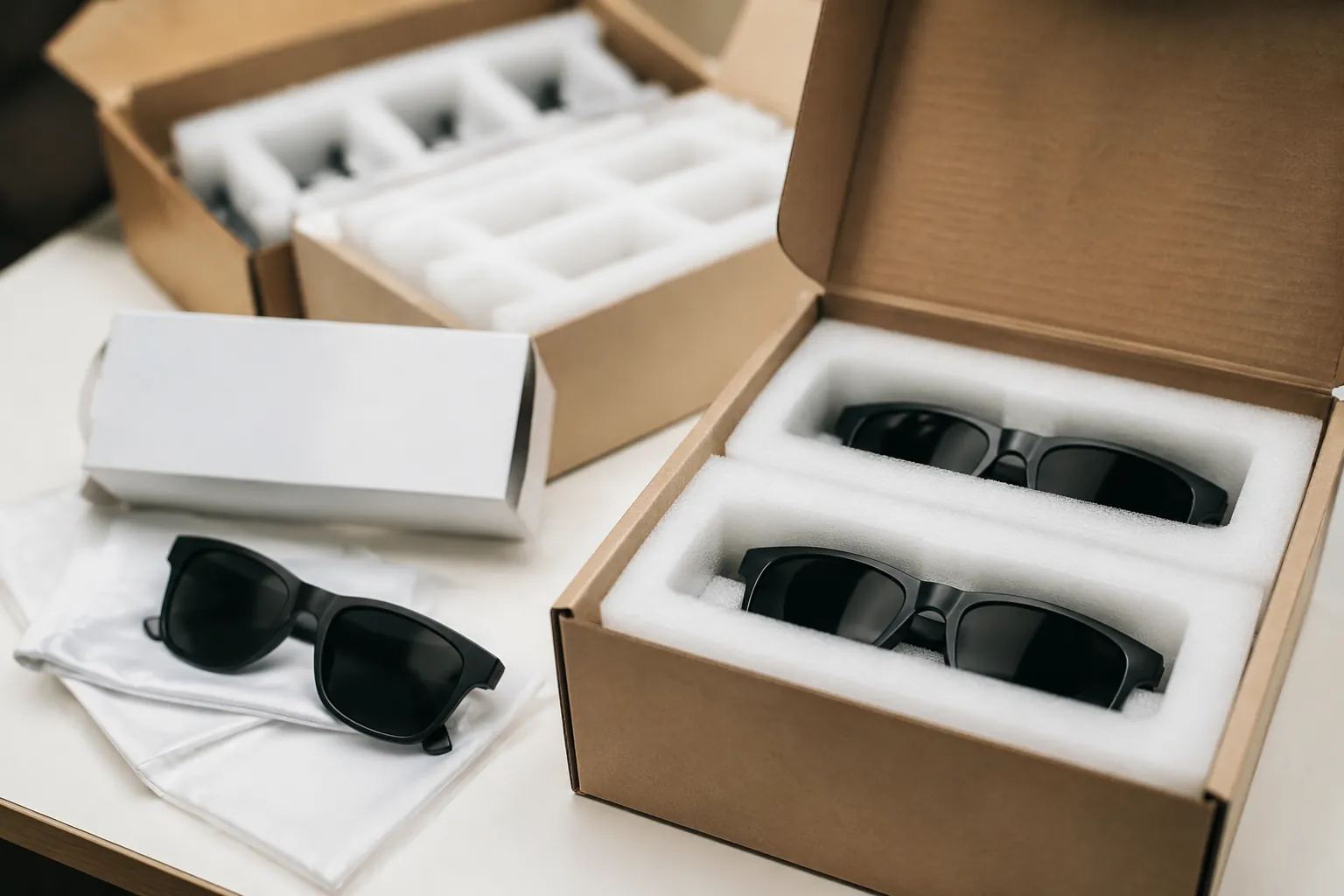
This is for brand owners, importers, distributors, and retailers buying private label sunglasses in volume. Packaging is not decoration. It affects breakage rates, carton density, freight cost, and first-touch perception. If you buy from a Wenzhou factory like LumiShades, decide the packaging spec at the same time as the frame, lens, and decoration. Fix it late and you pay for rework, damage, slower packing, and wasted freight.
Start with the job packaging must do
For sunglasses, packaging has three jobs: protect the frame and lens, survive transit, and support the price point on shelf or in the mailer. Miss one, and the buyer notices. A scratched lens, a crushed hinge, or a box that looks cheaper than the product can wipe out the margin you thought you saved.
The common mistake is treating packaging as one item instead of a system. It is usually an outer carton, inner box or pouch, insert, cleaning cloth, hangtag, barcode label, and sometimes a retail sleeve or mailer. Each layer changes labor time, damage risk, and dimensional weight. On a 50-pair MOQ design, a 3 mm insert change or a 5 mm carton width change can move the quote because it affects carton pattern, die-cut tooling, and master carton count.
Packaging should follow the frame geometry. A thick acetate frame with a 150 mm front width needs different headspace than a slim wire frame with flexible temples or a wrap style with deeper lens curvature. If the box is designed before the frame sample is locked, the factory often ends up trimming, padding, or reworking inserts. That is slower. It is usually worse, too.
LumiShades can build the frame in-house through injection molding, acetate cutting, CNC milling, decoration, and QC. That matters because packaging can be matched to the finished geometry instead of guessed from a stock spec. The right box is not the one that looks best in a PDF. It is the one that survives a 1 m drop, packs at line speed, and keeps the lens off hard edges.
Choose the packaging structure by sales channel
The right structure depends on where the glasses sell. A DTC parcel, a wholesale display case, and a chain-store shelf pack are not the same spec. Pick wrong and you either overpay for freight or underdeliver on protection.
| Packaging type | Best use | Protection level | Typical trade-off |
|---|---|---|---|
| Microfiber pouch only | Low-cost promos, bulk giveaways, simple wholesale | Low | Lowest cost and lightest weight, but weak crush protection and limited perceived value |
| Folding paper box + insert | Private label retail, e-commerce, distributor programs | Medium | Best balance of presentation, protection, and cube efficiency; adds packing labor and some carton volume |
| Rigid box + molded insert | Premium retail, gift sets, higher ASP | High | Best unboxing and strongest presentation; highest unit cost and worst shipping cube |
| Mailer box + inner retail box | DTC subscription, marketplace fulfillment, shipped-to-consumer orders | Medium to high | Extra outer layer improves transit survival, but raises material cost and assembly time |
For volume buyers, the practical sweet spot is usually a folding box with a shaped insert and a microfiber pouch inside. That combination protects the lens from rub, prevents temple scuffing, and still stacks efficiently in master cartons. A typical folding carton for sunglasses might be in the 160-170 mm long range, 70-80 mm wide, and 60-70 mm high, but the right size depends on the closed frame profile and whether the temples fold flat or stack high.
For mail-order programs, check outer dimensions early. A box that is 8 mm too wide can force a larger master carton pattern, reduce pallet density, and push you into a worse dimensional-weight bracket. Freight cost climbs quietly there. On a 5,000-pair order, a small cube increase can matter more than a few cents of print upgrade.
As a rule, if the product sells below a mid-market retail price point, keep the structure simple: folding box, fitted insert, pouch, cloth, and one clean branding layer. If the retail price is high enough to support a premium box, then add rigidity and finish. Do not force a luxury box onto a value SKU just because it looks good in a sample room.
Materials, finishes, and decoration methods
Material choice affects failure rate and brand perception. Paperboard is the standard because it prints well, folds fast, and gives enough stiffness for most sunglasses. The real decision is board weight, finish, and how much decoration you apply.
- Paperboard: Best for folding cartons; common for private label; usually 300-400 gsm for retail packs, depending on box size.
- Greyboard or rigid board: Better crush resistance and a more premium hand feel; often used at 1200-1600 gsm wrapped with printed paper.
- EVA or molded pulp inserts: EVA gives a tighter fit and cleaner cut edges; molded pulp is more recyclable and good for brands emphasizing sustainability.
- Microfiber pouch: Useful as a secondary layer for lens protection, but not enough by itself for long transit or parcel shipping.
- Specialty paper or laminated wrap: Can improve shelf appeal, but adds cost and can show scuffs if the finish is too glossy.
Decoration method matters as much as the base material. Offset printing is the workhorse for larger runs because color is stable and detail is clean. Digital print can work for lower MOQs, but the per-unit cost is higher and special effects are limited. Hot foil stamping works well for logos and model names when you want a premium accent. Use it sparingly. Too much looks busy. Spot UV can highlight a logo or pattern, but it should be used carefully because it shows rubbing and can crack on tight folds if the board is too thin.
Finish also changes the first impression. Gloss lamination makes color pop and gives moisture resistance, but it shows fingerprints, micro-scratches, and corner whitening more easily. Matte film hides handling marks better and usually reads more restrained. Soft-touch film feels premium, but it adds cost and can mark if cartons rub together in export handling or in a retail warehouse. If the frame itself is already glossy or metallic, use a quieter carton finish so the pack does not compete with the product.
One production detail buyers often miss: laminate direction and folding score quality. If the board is too thick for the score line, corners crack when the box is folded. If the laminate is not properly bonded, edges lift after repeated handling. A good factory will test the line by folding 20-30 sample cartons and checking whether the corners stay clean after opening and closing. That small step prevents ugly shelf returns.
Insert design is where breakage gets solved
The insert is the part that actually stops movement. If the frame can slide, the box is not doing its job. Most lens scratches and temple scuffs happen because the product moves inside the pack and rubs against a hard edge, a staple point, or a loose cloth bundle.
Good insert design keeps the frame centered, supports the bridge, and prevents the temples from opening under pressure. For metal frames, a tighter headspace is needed because thin arms can rattle. For acetate frames, the temples need a controlled fold angle so the hinge is not forced against the box wall. Sports wraps usually need deeper recesses because the lens curve changes where the temples rest.
The practical tolerance target is simple: the glasses should sit with about 2-4 mm of clearance in the recess at the tightest points, but they should not have more than about 1-2 mm of free side-to-side movement once the box is closed. If the insert is EVA, the cavity can be slightly tighter because the material grips the frame. If it is molded pulp, you often need a bit more clearance because pulp is less forgiving on surface finishes and can abrade a high-gloss lens edge.
- Measure the closed frame width, lens height, bridge height, and temple stack.
- Confirm the hinge position and whether the temples naturally sit flat or spring outward.
- Leave enough clearance so the glasses fit without forcing the hinge or rubbing the lens.
- Use a shaped cutout, molded recess, or strap hold-down so the frame cannot shift during transport.
- Check that the cleaning cloth does not press directly on the lens surface or bunch under the bridge.
- Run a manual shake test and a drop test on packed samples before approving mass production.
A useful factory check is to pack one sample, shake it for 10 seconds in each direction, and listen. If you hear a click or rattle, the insert needs revision. Then do a simple drop test from about 1 m onto a hard surface at the corner and flat face. You are not trying to certify the carton in a lab. You are trying to catch the movement that later becomes a scratch complaint or a bent temple.
For sunglasses packaging, the cheapest insert is often the most expensive mistake. If the frame moves, you pay later in returns, rework, and lost resale value.
Packaging, MOQ, and price: where the numbers change
Buyers usually focus on frame price and miss packaging cost until the quote lands. That is backwards. Packaging changes at the same breakpoints as the frame, especially when you move from 50 pairs to 300, 1,000, and 5,000+ pairs per design. At low volume, setup and print tooling dominate. At higher volume, unit cost drops because the packaging line can be standardized and the insert tooling gets spread across more units.
| Volume level | Common packaging choice | Cost behavior | Lead-time impact |
|---|---|---|---|
| 50 pairs/design | Stock box with simple print, pouch, standard insert | Highest unit cost; tooling spread over few units | Fastest to approve; fewer custom steps |
| 300 pairs/design | Custom printed folding box, matched insert | Better unit cost; die-cut and print setup begins to pay back | Small extra time for artwork and sample approval |
| 1,000 pairs/design | Dedicated retail box spec, refined insert, cloth and card set | Clear cost drop; better carton utilization and packing efficiency | Usually steady once approved |
| 5,000+ pairs/design | Optimized box size, custom insert, branded accessory set | Lowest packaging cost per pair; best chance to approach true volume pricing | More stable, but only if artwork is locked early |
In quoting, packaging cost can swing by 10-30% across these breakpoints depending on print method, insert material, and whether the carton is stock or fully custom. A simple stock white box with one-color print can be economical at 50 pairs, while a fully custom printed rigid box may only make sense once volume is high enough to absorb tooling and assembly labor. For some programs, the difference between a pouch-only pack and a full retail set can be under a dollar; for others, especially with premium finishes, it can be several dollars per pair.
Lead times follow the same logic. Sample development for a carton can take 7-10 days if the artwork is ready and the die size is standard. If the insert needs a new cavity, add another 3-7 days for proofing and adjustment. Bulk production is often 25-35 days for the sunglasses order, but packaging changes can push the schedule if artwork arrives late or if the factory has to rework the die line. That is why packaging approval should happen before bulk frame production starts. If you wait until the frames are finished, the pack becomes the bottleneck.
There is also a packing-speed effect. A good insert and a clear folding sequence can reduce assembly time by a few seconds per unit. That sounds small, but on a 5,000-pair order it can mean hours of labor. Small operational gains matter because they reduce both cost and handling damage.
Compliance and claims: keep the box accurate
Packaging should support the actual compliance status of the product, not invent it. If the glasses are certified or tested, the box and leaflet can reference the correct standard. If not, do not print claims you cannot document. A clean pack with accurate information is stronger than a crowded one with questionable logos.
For LumiShades production, the relevant compliance references are CE EN ISO 12312-1, FDA registration, ANSI Z80.3, AS/NZS 1067, REACH, ISO 9001, and BSCI. That matters for labeling and market-specific packaging text. A buyer selling into Europe may need the packaging to avoid chemical claims that clash with REACH documentation. A U.S. buyer may want the retail pack aligned with FDA registration and the relevant test basis. Australia and New Zealand buyers often care about AS/NZS 1067 language on the product page and carton.
Do not overload the box with certification logos. Too many marks make the pack look cluttered and can create audit headaches if one market version differs from another. Use only what the product file supports, and keep the visual hierarchy simple: brand, model code, lens category or warning text if required, then origin and barcode. If the same design is sold into multiple markets, build separate artwork versions rather than trying to force one universal panel to do everything.
Also check the practical label items: country of origin, model code, lens category if required by the target market, barcode, pack quantity, and any retailer-specific sticker fields. For chain-store programs, make sure the barcode sits on a flat area that scans cleanly and does not wrap over a fold. A clean, legible back panel beats a crowded front face every time.
A buyer checklist before you approve production
Before you sign off, ask the factory to confirm the following in writing and with a physical sample.
- Outer box dimensions fit the frame and insert without forcing the temples.
- The frame passes a shake test with no rattle.
- The lens surface does not touch hard board edges.
- The cleaning cloth is folded so it does not create pressure points.
- Printing color matches the approved proof under normal light.
- Carton count per master carton supports your freight target.
- Retail marks and compliance text match the market version.
- Drop testing and unpacking are checked on at least one packed sample per SKU.
Then verify the final sample the same way your warehouse or fulfillment team will handle it. Open the box, remove the cloth, remove the glasses, and repack it a few times. If assembly feels awkward, that will multiply at scale. If the box opens too loosely, it may pop during transport. If the insert is too tight, operators will waste time and eventually bend temples or scuff lenses during repetitive packing.
Good packaging is not fancy packaging. It protects the frame, looks intentional, supports the brand story, and does not waste freight. That is the brief. Get the structure, insert, finish, and artwork right together, and breakage goes down.
Have a custom sunglasses project in mind?
Send us your styles, target market and quantities and we will return a detailed quote with MOQ, lead time and a sample plan.
Get a QuoteWhy source this from Wenzhou with LumiShades
Wenzhou in Zhejiang Province is widely regarded as China’s eyewear manufacturing capital, producing a large share of the world’s sunglasses. That concentration matters to buyers: a deep local supply chain for acetate sheet, hinges, lens blanks, plating and packaging means shorter component lead times, easier color and material matching, and a workforce with decades of eyewear-specific skill. LumiShades has manufactured in this ecosystem since 2009, and our vertical integration — in-house injection molding, acetate cutting, CNC milling, lens tinting, decoration and quality control — means no part of your order is quietly subcontracted to a workshop you cannot audit.
For international buyers, that vertical control translates into accountability. When a single factory owns every step, defects are traced and fixed at source rather than bounced between vendors, and your specifications survive intact from first sample to bulk. We back this with 15+ years of experience, shipments to 60+ countries, more than 5 million pairs produced per year and a 98.5% on-time delivery rate. Our certifications — CE EN ISO 12312-1, FDA registration, ANSI Z80.3, AS/NZS 1067, REACH, ISO 9001 and BSCI audit — mean the compliance documentation your market requires already exists. Explore our manufacturing capabilities and quality control process to see how this works in practice.
Frequently asked questions
What packaging gives the best balance of cost and perceived value for private label sunglasses? A custom folding box with a fitted insert is usually the best balance. It looks retail-ready, protects better than a pouch alone, and does not add the freight penalty of a rigid box.
Should I use a microfiber pouch inside the box? Yes, if you want extra scratch protection and a better unboxing feel. It works best as a secondary layer, not as the only transit protection.
How early should I approve packaging artwork? Before bulk production starts. Late artwork changes can push sample timing, add die-cut rework, and delay the 25-35 day bulk window.
Can packaging affect breakage rates during shipping? Yes. Insert fit, box stiffness, carton size, and the amount of free movement inside the pack directly affect lens scratches, temple stress, and crush damage.
What should I print on the packaging for compliance? Only what the product file supports: model code, country of origin, required market labeling, barcode, pack quantity, and the correct claims for CE EN ISO 12312-1, FDA registration, ANSI Z80.3, AS/NZS 1067, or REACH where applicable.
How does packaging affect unit cost at higher volume? At 300, 1,000, and 5,000+ pairs, better box sizing, standardized inserts, and simpler packing steps reduce setup waste, labor time, and freight cube, so the per-pair packaging cost drops.
Ready to start?
Explore our wayfarer sunglasses or request a quote — our sales team replies within 12 hours.
Request a Quote