
Metal Logo Plates for Custom Sunglasses Branding
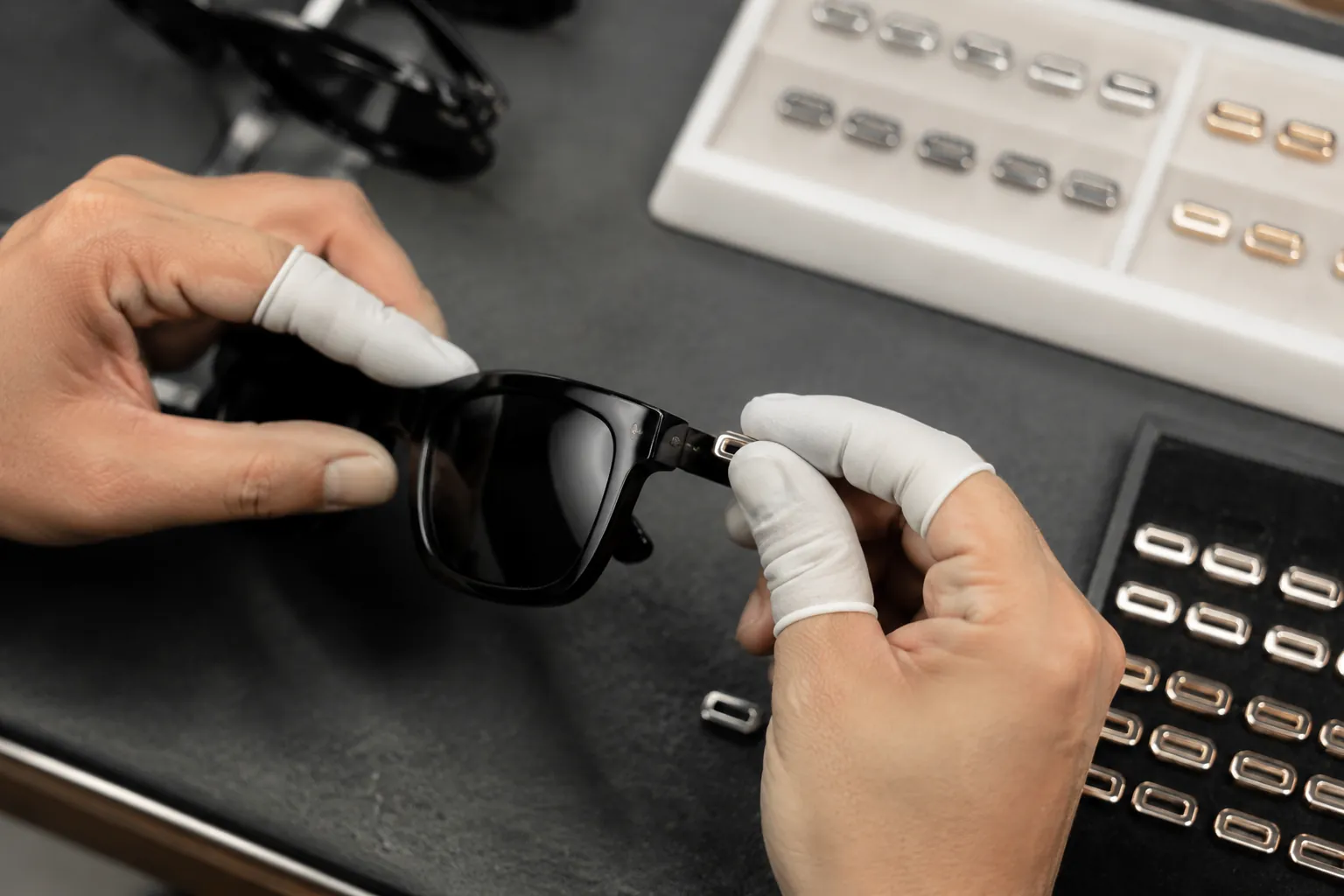
This guide is for overseas brands, importers, distributors, and retailers planning custom sunglasses without paying for a new frame mold. Metal temple logo plates can give a higher-end look than printing while keeping development time and MOQ under control. The payoff is practical: better branding, clearer specs for your supplier, fewer approval delays, and fewer logo failures after shipment.
Why Metal Plates Work When New Molds Do Not
A new sunglass frame mold is useful when the shape itself must be owned by the brand. It is also slow and expensive compared with decoration changes. For many B2B programs, the smarter move is to use an existing frame and add a custom metal logo plate on the temple. The buyer gets a more solid brand detail without changing the injection mold or acetate cutting program.
Metal plates are most common on the outer temple, near the hinge or centered along the arm. They can be flat, slightly curved, debossed, engraved, color-filled, plated, brushed, or polished. On a basic PC or TR90 frame, a clean plate can make the product look less generic. On acetate, it can match the heavier, boutique-style feel buyers often want for fashion collections.
The main advantage is control. At LumiShades in Wenzhou, a buyer can start from MOQ 50 pairs per design for many custom sunglass orders, then improve unit pricing at 300, 1000, and 5000+ pairs. A metal plate usually needs its own small logo tooling, but not a full frame mold. Samples can normally be prepared in 7-10 days once artwork, plate size, and placement are confirmed. Bulk production is usually 25-35 days, depending on order size, finish, QC requirements, and packaging.
This is not magic. Poor plate design still fails. Thin strokes disappear. Tall plates snag hair. Weak adhesive lifts in heat. The buyer needs a proper spec before sampling.
The Buyer Decision: Plate, Print, Laser, or Molded Logo
Temple plates sit between low-cost decoration and full structural customization. The right choice depends on brand position, order volume, material, and durability expectations. A distributor ordering a promotional style may not need metal. A fashion brand selling through retail often does.
| Branding Method | Best Use | MOQ And Cost Logic | Main Risk |
|---|---|---|---|
| Pad printing | Simple logos, low-cost runs, color marks | Low setup cost; works well at 50-300 pairs | Can rub off if ink system or curing is poor |
| Laser engraving | Subtle marks on metal parts or coated areas | Good for small batches; no plate tooling | Low visual impact on some plastics |
| Metal logo plate | Higher-end temple branding without new frame mold | Small plate tooling; better cost spread at 300+ pairs | Bad fit, plating defects, or weak attachment |
| New frame mold logo | Long-term proprietary style or large program | Higher tooling cost; sensible at larger volumes | Longer development and harder design changes |
For many buyers, the break point is simple. If the design may change next season, use a plate. If the frame shape must be protected for several years and volumes are steady, discuss a mold. At 50 pairs, a plate can be possible but the tooling cost is spread over very few units. At 1000 or 5000+ pairs, the plate cost becomes much easier to absorb, and LumiShades' volume pricing can move toward about $2.10 per pair on suitable high-volume programs.
Spec the Plate Before You Ask for a Quote
A vague request like "add a metal logo on the side" creates slow quoting and bad samples. A useful request gives the supplier enough information to check tooling, placement, color, and assembly method.
- Logo file: Send vector artwork, preferably AI, PDF, or SVG, with fonts outlined. Bitmap logos create edge problems.
- Plate size: Common temple plates are roughly 8-35 mm long, depending on frame style. Very small plates cannot hold fine lettering.
- Thickness: Thin plates may bend during assembly. Thick plates can feel bulky. The supplier should confirm the workable range for the temple curve.
- Finish: Specify polished gold, brushed silver, gunmetal, black nickel, matte paint, enamel fill, or another agreed finish. Do not rely on a photo alone.
- Placement: Mark the distance from hinge and top or bottom temple edge. A 1-2 mm shift is visible on eyewear.
- Attachment: Confirm adhesive, heat staking, pin fixing, mechanical inset, or a combination. Each has different tooling and durability limits.
The plate should be designed for the frame, not copied blindly across all frames. A wide plate that fits a thick acetate temple may look clumsy on a slim metal or TR90 temple. Curved temples need a matched curve. If the plate stays flat while the temple curves, the edges lift first.
LumiShades can combine in-house injection molding, acetate cutting, CNC milling, lens tinting, laser engraving, pad printing, metal logo plates, and QC. That matters because plate placement must be checked against the actual frame material and production fixture, not just a rendering.
Tooling and MOQ: Where the Money Goes
A metal logo plate usually needs a small die, stamping tool, CNC program, or etching setup, depending on logo detail and material. The buyer does not need a new sunglass frame mold, but the plate is still a custom part. That is why cost per pair drops as volume rises.
At 50 pairs per design, the project can work for sampling, capsule launches, retail tests, or influencer drops. The buyer should expect the fixed setup cost to feel heavy. At 300 pairs, the economics become more reasonable. At 1000 pairs, unit cost improves further because procurement, plating, inspection, and assembly are spread across more pieces. At 5000+ pairs, the factory can plan material purchasing and line time more efficiently.
Do not judge the quote only by the sunglass unit price. Ask whether the plate tooling is charged separately, amortized into the unit price, or waived above a certain volume. Also ask whether reorders use the same plate tool. If the logo does not change, reorders should normally avoid repeat tooling, although finish changes may still need new approval.
A clean sourcing question sounds like this: "We need 300 pairs now, possible reorder of 1000 pairs in 60 days. Same logo plate, brushed silver finish, placed 12 mm from hinge on the outer temple. Please quote tooling separately and confirm reorder unit price using the same plate tool." That gives the factory something real to work with.
Placement Rules That Prevent Cheap-Looking Results
Good logo plates look intentional. Bad ones look pasted on. Placement is where many samples go wrong.
Near-hinge placement is common because the temple is usually thicker and more stable there. It also keeps the logo visible when the sunglasses are worn. Center placement can work on wide temples but may interfere with temple curvature and folding. Rear placement is less common for branding because it is less visible, but it can suit minimalist styles.
- Check the temple width at the chosen point, not just the widest point of the arm.
- Keep enough margin around the plate so the plastic does not crack, chip, or look crowded.
- Avoid hinge screws, wire cores, spring hinge hardware, and high-flex zones.
- Confirm left, right, or both-temple branding before sampling.
- Ask for a physical sample photo from front, side, folded, and worn angle if available.
For acetate frames, the temple surface may be CNC milled to accept an inset plate. That gives a cleaner edge and reduces snagging. For injection frames, the supplier may use a shallow recess, adhesive bonding, or heat-based fixing depending on the mold and material. If there is no recess, the edge finish matters more. Sharp plate corners catch on hair and packaging sleeves.
Small tolerances matter. A plate placed 1 mm too high on a narrow temple can look off-center. A plate with uneven glue squeeze-out will fail retail inspection quickly. Build these checks into the approval sample.
Finish Choices and Durability Expectations
Metal plate finish affects both appearance and failure risk. Polished plating shows fingerprints and small scratches faster. Brushed finishes hide minor handling marks better. Black nickel and dark finishes can look good, but color consistency needs checking under neutral light because dark plating can shift between batches.
Logo detail also changes the process. Raised logos need clean edges. Recessed logos can hold enamel or paint fill. Laser-marked plates can be sharp, but the contrast depends on base metal and coating. Very fine lines below practical production limits may disappear after polishing or plating. For small temple plates, simplify the artwork. This is not a billboard.
Durability depends on attachment and surface preparation. Adhesive bonding needs clean surfaces, pressure, and curing time. Heat staking or pin fixing can be stronger but may require more frame preparation. Inset plates are usually more protected than surface-mounted plates, but they need accurate milling or molded recess control.
Buyers should request practical QC checks, not vague promises. Common checks include adhesion pull testing based on agreed internal method, rub testing on logo color, visual inspection for plating pits, salt or sweat resistance checks when needed, and fitting inspection after temple folding. LumiShades' ISO 9001 system and in-house QC help here, but the buyer still needs to state the acceptance standard in the purchase order or approved sample file.
Blunt rule: if the logo plate sample already has lifted edges, glue marks, plating bubbles, or unreadable letters, do not approve it because "bulk will be better." Bulk usually repeats the approved sample.
Compliance Does Not Come From the Logo Plate Alone
A metal temple plate is a decoration part, not the full compliance story. Sunglasses compliance depends mainly on lens category, optical quality, UV protection, frame safety, nickel or chemical limits where applicable, labeling, and market requirements.
For overseas B2B buyers, the relevant standards often include CE EN ISO 12312-1 for the EU, ANSI Z80.3 for the United States, AS/NZS 1067 for Australia and New Zealand, FDA registration for the U.S. supply context, and REACH for restricted substances in the EU. LumiShades works with these real requirements, along with ISO 9001 and BSCI. Do not ask a supplier to add certification logos on packaging unless the product, lens, label, and documentation match the target market.
The plate can still create compliance issues if the finish contains restricted substances or if metal contact raises nickel concerns. This is especially relevant when plates sit near skin or when children's products are involved. Ask whether the plating and coating system is suitable for your sales market, and include REACH requirements for EU orders.
For polarized, tinted, mirrored, or gradient lenses, confirm that lens tinting and logo decoration schedules do not delay final testing. The order should not move to mass production until lens category, frame color, plate finish, and packaging claims are aligned. A premium-looking logo cannot rescue a non-compliant sunglass.
Approval Workflow for Fewer Surprises
A disciplined workflow saves more money than arguing after production. Start with a frame selection and logo feasibility check. Then confirm artwork, plate dimensions, finish, placement, and attachment method. After that, the supplier can make a sample.
At LumiShades, sample timing is typically 7-10 days after the specification is clear. If the buyer changes logo size, finish, or placement after the first sample, the clock may reset. Bulk production normally takes 25-35 days after sample approval, deposit, material confirmation, and packaging sign-off. Large orders, complex finishes, or multiple colorways need more coordination.
The approved sample should be treated as the production control reference. Keep one sample with the buyer and one with the factory. The approval record should include frame code, lens type, logo plate drawing, plate finish, position measurements, packaging, barcode if used, and inspection points. Photos help, but physical samples catch surface and weight details that photos miss.
Before shipment, inspection should cover logo alignment, plate adhesion, surface scratches, plating defects, hinge function, lens cleanliness, lens category marking, packaging match, and carton labeling. For volume programs, use AQL or another agreed inspection method. For small runs, inspect more heavily because a few defects can damage the whole delivery.
Metal plates are a practical way to make custom sunglasses look more developed without committing to new frame molds. They work best when the buyer controls the details early: size, placement, finish, attachment, compliance, and inspection. Skip that work and the plate becomes just another thing that can go wrong.
Have a custom sunglasses project in mind?
Send us your styles, target market and quantities and we will return a detailed quote with MOQ, lead time and a sample plan.
Get a QuoteWhy source this from Wenzhou with LumiShades
Wenzhou in Zhejiang Province is widely regarded as China’s eyewear manufacturing capital, producing a large share of the world’s sunglasses. That concentration matters to buyers: a deep local supply chain for acetate sheet, hinges, lens blanks, plating and packaging means shorter component lead times, easier color and material matching, and a workforce with decades of eyewear-specific skill. LumiShades has manufactured in this ecosystem since 2009, and our vertical integration — in-house injection molding, acetate cutting, CNC milling, lens tinting, decoration and quality control — means no part of your order is quietly subcontracted to a workshop you cannot audit.
For international buyers, that vertical control translates into accountability. When a single factory owns every step, defects are traced and fixed at source rather than bounced between vendors, and your specifications survive intact from first sample to bulk. We back this with 15+ years of experience, shipments to 60+ countries, more than 5 million pairs produced per year and a 98.5% on-time delivery rate. Our certifications — CE EN ISO 12312-1, FDA registration, ANSI Z80.3, AS/NZS 1067, REACH, ISO 9001 and BSCI audit — mean the compliance documentation your market requires already exists. Explore our manufacturing capabilities and quality control process to see how this works in practice.
Frequently asked questions
Can I add a metal logo plate at only 50 pairs per design? Often yes, but the tooling or setup cost is spread across very few units. MOQ 50 pairs can suit tests or capsule runs; 300, 1000, and 5000+ pairs give better unit economics.
Will a metal plate require a new sunglasses mold? Usually no. Most temple logo plates use a separate plate tool plus adhesive, inset, pin, or heat fixing on an existing frame. A new frame mold is only needed for structural changes or molded-in branding.
How long does a custom metal plate sample take? For a clear specification, LumiShades typically prepares samples in 7-10 days. Changes to logo size, finish, curvature, or placement can add time because the plate or fixture may need adjustment.
Which finish is safest for bulk production? Brushed silver, gunmetal, and simple polished finishes are usually easier to control than complex two-tone or heavy enamel designs. Dark plating and fine logos need tighter approval because color shifts and detail loss are more visible.
What should I check before approving the sample? Check logo readability, plate alignment, edge lifting, glue marks, plating pits, scratches, temple folding, skin contact areas, and whether the final sunglass still meets the target market requirements such as CE EN ISO 12312-1, ANSI Z80.3, AS/NZS 1067, FDA registration context, or REACH.
Can the same plate tool be reused for reorders? Yes, if the logo size and shape stay the same and the tool remains in good condition. Ask the supplier to quote reorder pricing separately and confirm whether finish changes require new approval.
Ready to start?
Explore our rimless sunglasses or request a quote — our sales team replies within 12 hours.
Request a Quote