
MOQ Strategy for 3 Private Label Sunglass Styles
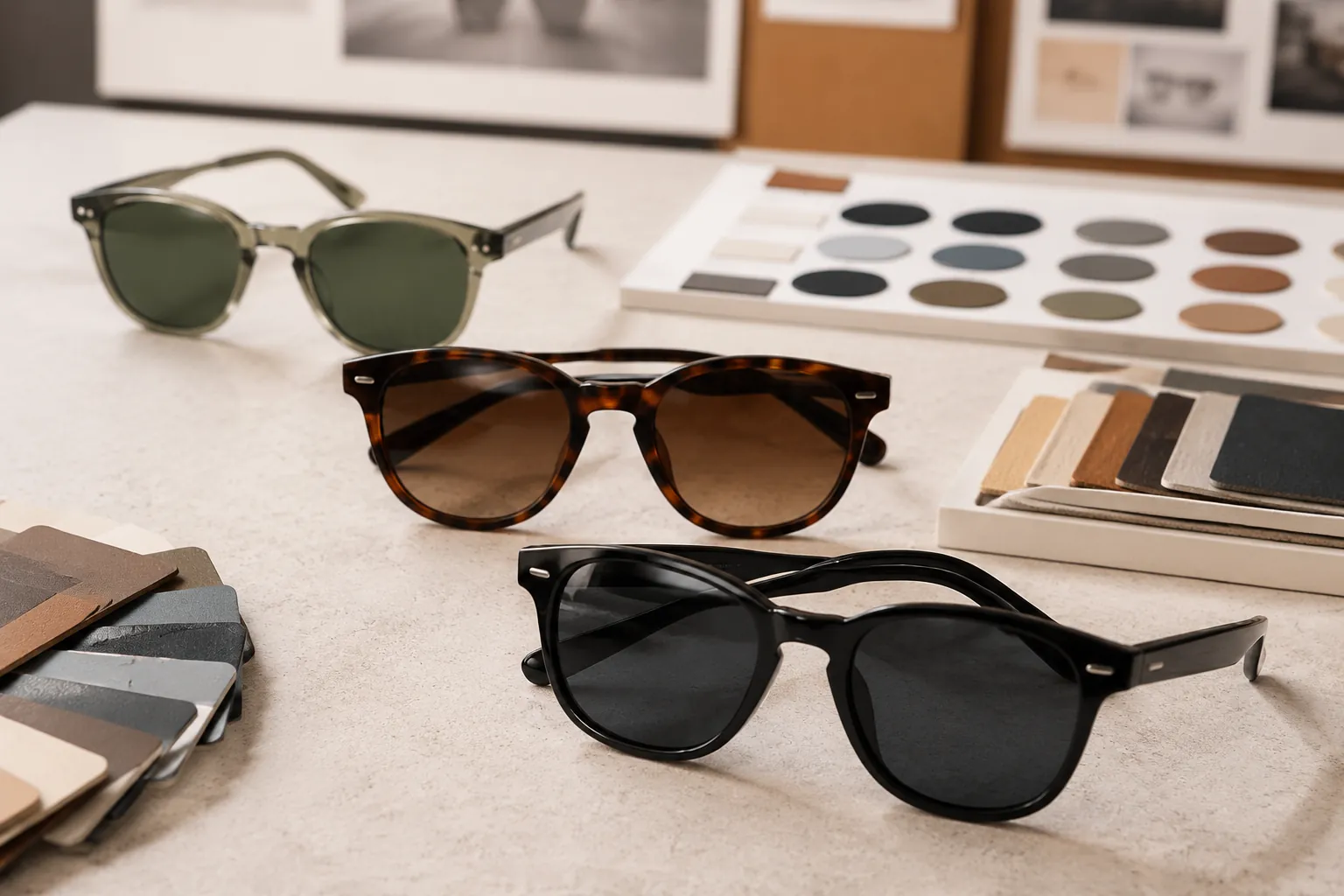
This guide is for brands, importers, distributors, and retailers planning a first or second sunglasses program without tying up too much cash in stock. The issue is not just ordering less. It is choosing the right style mix, using the right construction for each SKU, and planning for factory MOQ rules, sample approval, compliance, and reordering so the launch stays under control from the start.
Start with the real constraint: one launch, three styles, limited cash
Most buyers treat MOQ as one number. That is the wrong lens. For a three-style launch, the real constraint is the total commitment across sampling, tooling if needed, packaging, compliance work, finished goods, freight, and carrying inventory. Look only at per-style MOQ and you can still end up with a launch that is too large once the supporting costs are added.
For a private label sunglasses program, the best launch plan is usually not to split quantity evenly. One style should do most of the commercial work. One should support the assortment. One should be the test case. That reduces the chance of ending up with three weak SKUs and no clear read on what the market wanted.
A practical budgeting frame has three parts: sample spend, launch inventory, and error budget. Sample spend covers the physical samples and any revision round needed before approval. Launch inventory is the main cash outlay. Error budget is the amount of loss you can absorb if a color, fit, or packaging choice underperforms. If one weak style would damage the whole season, the order is too aggressive.
Practical rule: use one hero style, one supporting style, and one low-risk test style. Do not launch three equal bets unless you already have demand data or a retailer has specified the mix.
For a first order, a common structure is one style at around 300 pairs, one at 100 to 200 pairs, and one at the minimum quantity that still makes sense for testing. That creates enough presence for sampling, online testing, or small retail placement without forcing you into a large write-off if one style misses the market.
Choose styles by production risk, not just design taste
Three styles should not mean three different production headaches. In eyewear, the shape, material, decoration method, lens specification, and hinge design all affect lead time, QC load, and reject risk. A simple injected frame is not the same as an acetate frame with more finishing steps, and a metal-detailed frame is not the same as a one-piece molded style.
Material choice should follow the channel and the risk level of the launch. TR90 and similar injected materials are generally light, flexible, and forgiving on fit, which makes them useful for lower-risk test styles. Acetate can support a more premium feel, but it usually requires tighter control over polishing, edge finishing, and color consistency. Metal or mixed-material styles can look higher-end, but they add assembly steps and more points where alignment and cosmetic issues can appear.
| Style type | Best use | Typical production risk | Common tolerance sensitivities | Buying note |
|---|---|---|---|---|
| Injection molded TR90 or similar | Price-sensitive mass market | Low to medium | Temple symmetry, hinge alignment, lens fit | Useful for test launches and faster replenishment |
| Acetate frame | Higher perceived value | Medium | Polish quality, color match, edge smoothness | Use fewer colorways and simpler temple details at launch |
| Decorated or metal-detailed style | Brand-led retail programs | Medium to high | Plating consistency, print registration, screw torque | Keep decoration simple on the first order |
| Mixed-material premium style | Higher-margin hero SKU | High | Part fit, finish transitions, cosmetic reject rate | Only launch this if the sales channel can absorb the unit cost |
The key is to match the style to the factory process. A supplier with in-house injection molding, acetate cutting, CNC milling, lens tinting, decoration, and QC can usually manage a more coordinated launch than a supplier that outsources major steps. Less handoff friction. Fewer delays. Fewer surprises.
Use MOQ tiers to build the order mix
The most useful way to plan a three-style launch is to assign each style to a different risk bucket. The lowest quantity is for learning. The middle tier is for proving sell-through. The highest quantity is for the style you expect to reorder fastest. Compare landed unit economics, not just factory price, because freight, duties, cartons, and defect allowance can wipe out a small unit-price advantage.
Do not assume the lowest factory price is always the best choice. If a style is uncertain, paying slightly more for a smaller run can be cheaper than carrying unsold stock later. A low-quantity test that prevents a larger mistake is often the best margin protection available.
- Style A: around 300 pairs if it is your main commercial bet and the channel is already known.
- Style B: around 100 to 200 pairs if you need a second silhouette for assortment breadth or a different price point.
- Style C: the minimum viable quantity if you are testing shape, color, or customer response.
When comparing options, do the math on sell-through and liquidation, not only purchase price. A lower factory cost is not helpful if the style will not move. On the other hand, if the style has a proven reorder pattern, a larger opening quantity can reduce the risk of running out before the next production cycle is ready.
Before you place the order, estimate three things: expected gross margin per pair, realistic first-season sell-through, and the likely recovery value if the style needs to be cleared. That gives you a better view of true risk than unit price alone.
What the numbers usually look like in practice
Here is a simple planning model you can use before asking for quotes. It is not a factory quote and it should not be treated as one. Its purpose is to help you compare launch structures on the same basis.
| Order tier | Pairs per style | What you learn | Typical use case |
|---|---|---|---|
| MOQ test | 50 | Shape acceptance, color reaction, packaging fit, logo visibility | New design, new channel, or first-time supplier trial |
| Validation batch | 100–300 | Real sell-through, defect trend, carton durability, reorder readiness | Best for one style you already expect to move |
| Scaling batch | 1000+ | Repeat demand, replenishment timing, per-unit cost stability | Styles with proven reorder behavior and stable artwork |
If all three styles start at the smallest quantity, the launch may be cheap but the learning is limited. If all three start at a large scale, the inventory risk rises quickly. The middle path is usually the most practical: one style gets real volume, one gets moderate volume, and one stays at test quantity. That gives you enough data to understand which shape, tint, and color combination actually converts in your channel.
A workable first shipment could be 300 + 150 + 50 pairs, or 300 + 100 + 100 pairs depending on the sales channel. The exact mix matters less than the logic behind it. The goal is to place enough inventory to sell and test, while keeping one style deliberately small so the launch can be adjusted based on real demand.
Design the styles to share parts where possible
Factories do not like fragmented production, and buyers should not encourage it. Shared parts reduce setup work and simplify QC. If the three styles can share a lens tint family, a hinge specification, a temple core, a nose pad type, or a packaging size, production is usually easier and more consistent.
Many private label programs waste money by asking for three unrelated frames, three lens colors, three logo methods, and three packaging formats. That is not one launch. It is three separate projects. The more variation you introduce, the more likely you are to pay for extra proofing, more sample rounds, and more inspection work.
- Use the same lens base color across the first run where possible.
- Keep logo decoration to one or two methods, such as pad printing and metal logo plates.
- Limit one-off hardware unless the design truly requires it.
- Use the same carton and insert size across the launch set.
- Keep temple length, bridge feel, and lens category consistent unless you need a deliberate market split.
When a supplier can handle pad printing, laser engraving, and metal logo plates in-house, that can help with flexibility. But it should still be used carefully. Every added decoration method creates another chance for misregistration, adhesion problems, or cosmetic rejects. On a smaller order, even a small defect increase matters because there is less buffer.
As a rule of thumb, keep the first three styles to one frame family and no more than two decoration routes. For example: one molded frame with pad print, one acetate frame with a metal logo plate, and one test style with a simple logo mark. That is easier to manage than a launch built on three different structures and three packing specs.
Build your timeline backward from samples and bulk
For overseas B2B buyers, lead time often causes more problems than price. A typical workflow is sample production, sample approval, bulk production, and export preparation. The actual timing depends on the design, decoration, and packaging requirements, so the schedule should be planned backward from the required ship date rather than forward from the inquiry date.
Use a clear approval gate. Week 1 should confirm shape, material, lens category, decoration, logo placement, and packaging direction. Week 2 should close sample comments, including fit, finish, and any color changes. Bulk production should only begin after the final sample is approved in writing. If a buyer changes the logo method, lens spec, or packaging after approval, the schedule will need to be updated accordingly.
Samples should be checked for the things that matter in bulk: temple spring tension, hinge opening force, lens tint consistency, surface finish, and print placement. A hinge that feels acceptable on one sample can still become a problem in mass production if screw torque is not controlled. A lens tint that looks fine in photos may still need adjustment if your channel expects close visual consistency across styles.
Also remember that a three-style launch moves at the pace of the slowest style. If one design needs special tooling or a unique lens treatment, it can slow the entire shipment. If your launch date is fixed, keep the most complicated style out of the critical path and get the hero style approved first.
Control quality and compliance before you scale
Private label buyers often focus on appearance and leave compliance until the shipment is already moving. That creates avoidable risk. Compliance should shape the product brief from the start, especially if the sunglasses will be sold into more than one market.
The relevant references for sunglasses include CE EN ISO 12312-1 for EU-oriented sunglasses, ANSI Z80.3 for the U.S. performance context, AS/NZS 1067 for Australia and New Zealand, and REACH for chemical restrictions. FDA registration may be relevant to a supplier's business status or U.S. market preparation, but it is not the same thing as a product performance certificate. ISO 9001 and BSCI are useful indicators of management systems and social audit context, but they do not replace product testing or market-specific compliance requirements.
Ask for the exact lens category, material declaration, and test scope before production approval. If you sell through retail chains, also confirm whether the buyer requires barcode labels, country-of-origin marking, carton language, or specific packout instructions. Those details can affect the final artwork and packaging approval even when the frame itself does not change.
Quality control should use measurable checkpoints: color tolerance, coating consistency, lens insertion fit, screw torque, and surface defect limits. It is better to define where a cosmetic mark is acceptable and where it is not than to argue about it later. For example, many buyers will tolerate a minor mark on an interior temple area but will not accept a front-facing scratch, logo misprint, or lens haze.
For a three-style launch, ask the factory to define acceptance criteria per style. A metal-detail frame and an injection frame will not have identical cosmetic tolerance in practice. A simple launch spec should cover lens scratch limits, hinge cycle expectation, temple alignment, logo position tolerance, and packaging defect threshold. If those items are not documented, every dispute becomes subjective.
A simple buying playbook for the first three styles
If you want lower risk and clearer data, use a straightforward launch sequence. It avoids the most common mistakes and keeps the order structure easy to review internally.
- Pick one hero style that can carry repeat orders and define the main price band.
- Pick one supporting style that widens the assortment without adding unnecessary complexity.
- Pick one test style at the lowest viable quantity.
- Standardize as many components as possible across all three styles.
- Approve samples only after checking fit, finish, lens tint, and decoration under normal light.
- Place the bulk order in a quantity mix that matches expected sell-through, not preference.
- Set the reorder trigger before production starts.
The reorder trigger matters because sunglasses programs can sell faster than the next production cycle can replace them. A practical rule is to reorder when around 40% to 50% of launch inventory remains, adjusted for your channel speed and transit time. Faster online programs may need an earlier trigger. Slower wholesale or retail programs may allow more time, but the production and shipping calendar still needs to be built in.
For brands working with a capable factory, the advantage of this structure is simple: you can test with a small minimum, scale the winning style, and keep the launch organized enough to reorder cleanly. The best MOQ strategy is not the smallest order possible. It is the order mix that protects cash, supports production efficiency, and gives you enough data to place the second run with confidence.
Have a custom sunglasses project in mind?
Send us your styles, target market and quantities and we will return a detailed quote with MOQ, lead time and a sample plan.
Get a QuoteWhy source this from Wenzhou with LumiShades
Wenzhou in Zhejiang Province is widely regarded as China’s eyewear manufacturing capital, producing a large share of the world’s sunglasses. That concentration matters to buyers: a deep local supply chain for acetate sheet, hinges, lens blanks, plating and packaging means shorter component lead times, easier color and material matching, and a workforce with decades of eyewear-specific skill. LumiShades has manufactured in this ecosystem since 2009, and our vertical integration — in-house injection molding, acetate cutting, CNC milling, lens tinting, decoration and quality control — means no part of your order is quietly subcontracted to a workshop you cannot audit.
For international buyers, that vertical control translates into accountability. When a single factory owns every step, defects are traced and fixed at source rather than bounced between vendors, and your specifications survive intact from first sample to bulk. We back this with 15+ years of experience, shipments to 60+ countries, more than 5 million pairs produced per year and a 98.5% on-time delivery rate. Our certifications — CE EN ISO 12312-1, FDA registration, ANSI Z80.3, AS/NZS 1067, REACH, ISO 9001 and BSCI audit — mean the compliance documentation your market requires already exists. Explore our manufacturing capabilities and quality control process to see how this works in practice.
Frequently asked questions
Is 50 pairs per design enough for a real market test? Yes, if the goal is to test shape acceptance, fit feedback, packaging response, and logo visibility. It is not enough for broad retail coverage, but it is enough to learn whether the style deserves a larger second order. Use it to test one variable at a time so you know what drove the response.
Should all three styles use the same lens and frame material? Not necessarily, but shared components reduce complexity. If you can keep the same lens color family, one hinge spec, one packaging size, and one decoration method across the launch, production is usually easier to control and QC is easier to manage.
How do I decide which style gets the highest quantity? Give the largest order to the style with the clearest sales channel, the lowest production risk, and the strongest reason to expect repeat demand. In practice, that is usually the most commercial silhouette, not the most creative one. If one style already fits a proven price point, it is the best candidate for the highest opening quantity.
What certifications should I ask for before ordering? Match the requirements to the market. Common references include CE EN ISO 12312-1 for EU-oriented sunglasses, ANSI Z80.3 for the U.S. performance context, AS/NZS 1067 for Australia and New Zealand, and REACH for chemical restrictions. ISO 9001 and BSCI can support supplier qualification, but they do not replace product-specific testing.
How long should I expect from sample to bulk shipment? Timing depends on the design and approval process, so confirm the schedule with the supplier before you commit. A typical workflow is sample production, sample approval, bulk production, and export preparation. The fastest way to protect lead time is to freeze the spec before bulk starts and avoid changes after sample approval.
What decoration method is safest for a first launch? The safest method is the one the factory already controls well on your selected material and surface. For many first launches, pad printing or a metal logo plate is easier to manage than a more complex decoration stack. Keep the logo simple, use one method per style where possible, and avoid adding extra processes unless the order volume justifies them.
Ready to start?
Explore our shield & oversized sunglasses or request a quote — our sales team replies within 12 hours.
Request a Quote