
OEM vs ODM Sunglasses: Stock Frame or New Mold?
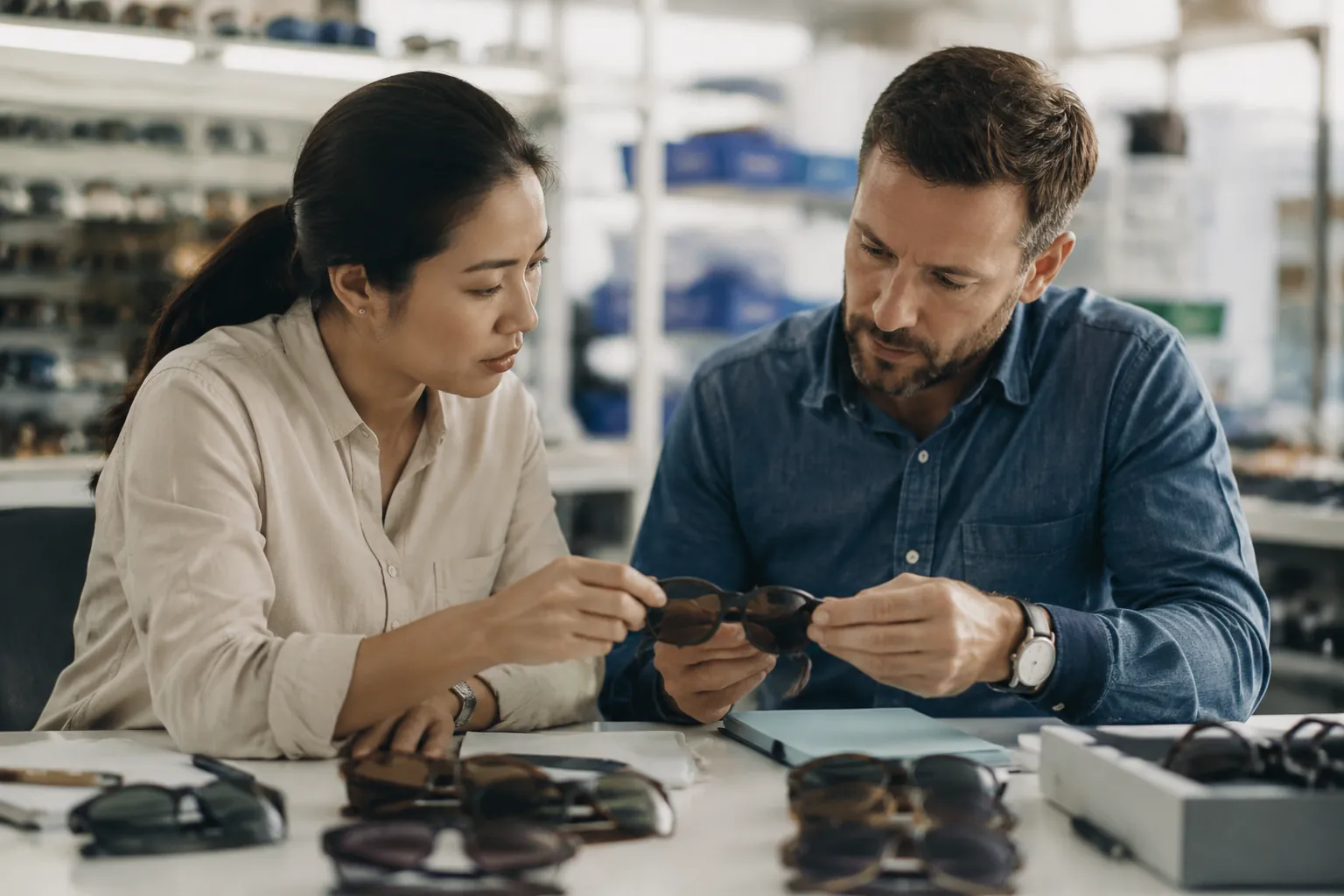
This guide is for brands, importers, distributors, and retail buyers deciding between an existing sunglasses frame and a new mold. The goal is practical: avoid unnecessary tooling, missed launch dates, vague sample approvals, and quotes that exclude lens specs, packaging, compliance, or inspection. The examples use standard custom-eyewear sourcing logic and LumiShades' stated ranges for MOQ, sampling, decoration, lens options, compliance support, QC, and bulk lead time.
The Short Rule: ODM for Speed, OEM for Control
ODM sunglasses usually means choosing an existing factory frame and changing commercial details: frame color, lens tint, polarization, logo, hardware finish, pouch, case, retail box, barcode label, or warning card. OEM sunglasses means developing a frame geometry for your order. That usually involves drawings or 3D files, tooling, trial samples, corrections, and a final approved golden sample.
The rule is simple. Use ODM when launch date, lower starting quantity, or cash-risk control matters most. Use OEM when shape, fit, construction, or exclusivity is part of the product value and repeat orders are likely.
For LumiShades ODM projects, selected stock frames can start from 50 pairs per design. Standard ODM samples usually take 7-10 days when the frame exists and the requested color, lens, logo, and packaging are straightforward. Bulk production is normally 25-35 days after golden sample approval, deposit, packaging files, and final lens specification. Pricing can improve at 300, 1000, and 5000+ pairs because setup time, material purchasing, decoration, inspection, and packing labor are spread across more units. A low high-volume target price still needs confirmation against the exact frame, lens, logo, packaging, inspection, and compliance scope.
OEM moves slower. Depending on frame complexity, material, tooling queue, and correction rounds, it may take 20-45 days or more before a useful production-tool sample is ready. That time can be worth it for a repeat model or proprietary fit. It is usually a poor choice for a small one-time promotion.
ODM vs OEM Comparison for Procurement Planning
| Decision factor | ODM existing frame | OEM new mold | Buyer control point |
|---|---|---|---|
| Best use | Seasonal drops, validation orders, promotional programs, retailer private label, distributor programs | Signature collection, exclusive silhouette, special fit, performance design, proprietary construction | Do not choose OEM just to change a logo, lens tint, frame color, or packaging. |
| Starting MOQ | LumiShades can start from 50 pairs per design on selected frames | Usually requires higher order confidence because tooling and engineering must be recovered over volume | Ask whether MOQ is per model, per color, per lens, per logo, or per total purchase order. |
| Sample timing | Typically 7-10 days for standard color, lens, and logo combinations | Often 20-45 days or more to the first useful production-tool sample | Clarify whether the sample is handmade, CNC, 3D printed, or made from production tooling. |
| Bulk timing | Usually 25-35 days after golden sample approval and complete order inputs | Usually 25-35 days after final tool approval and golden sample approval, not after concept approval | Mold correction time is separate from bulk production time. |
| Design tolerance risk | Lower because the frame has previous production history, although each lens and decoration combination still needs approval | Higher because shrinkage, lens groove, hinge alignment, opening angle, and fit are being proven | Define critical dimensions before tooling: lens width, bridge, temple length, front width, base curve, and opening angle. |
| Cost structure | No new main frame mold when using a stock frame; logo, lens, packaging, and testing costs may still apply | Tooling, drawings, trials, samples, correction work, and possible exclusivity costs may apply | Confirm mold ownership, storage, exclusivity, maintenance responsibility, and what happens if no reorder is placed. |
What You Can Customize on an ODM Frame
ODM is not just a logo on a generic frame. A clear ODM brief can create a credible private-label product without new frame tooling. The key is knowing the line between cosmetic changes and geometry changes.
- Frame material and color: Injection frames can use finishes such as gloss, matte, transparent, translucent, rubberized, or soft-touch, depending on the base material and mold surface. Transparent colors often look darker in thick areas and lighter in thin areas. Physical color chips and pre-production parts are more reliable than Pantone references alone. Acetate frames can offer richer patterns and layered sheet effects, but sheet availability, batch variation, and MOQ can affect timing.
- Lens specification: Common options include solid tint, gradient tint, mirror coating, polarized TAC lenses, nylon lenses, and UV400 performance when specified and verified. Category 3 lenses are common for bright outdoor conditions, but category, visible light transmittance, UV performance, labeling, and warning text must match destination-market requirements.
- Logo method: LumiShades can support common methods such as laser engraving, pad printing, hot stamping on suitable surfaces, and metal logo plates. Laser marking can be durable on compatible materials but may look subtle on dark temples. Pad printing is flexible and economical, but coated or curved surfaces should be checked for adhesion and rub resistance. Metal plates can look premium but add placement tolerance, attachment control, and assembly time.
- Hardware details: Screw color, hinge finish, temple-tip color, decorative pins, and small ornaments may be adjustable if the base design allows it. A 5-barrel hinge, spring hinge, wider hinge, or different hinge stop usually cannot be swapped in without checking the temple and front construction.
- Packaging: Microfiber pouch, EVA case, PU case, cleaning cloth, instruction card, barcode sticker, hangtag, display box, and master-carton markings can be matched to distributor or retailer requirements. Approve packaging files before bulk production. Otherwise finished goods can sit waiting for paper.
The hard limit is geometry. If you need to change bridge width, lens curve, rim thickness, pantoscopic angle, temple opening angle, nose fit, or lens-retention structure, the project may no longer be simple ODM. Those changes can affect tooling, lens cutting, comfort, durability, and compliance.
Where OEM New Mold Development Earns Its Cost
OEM makes sense when the frame shape creates value that a catalog frame cannot deliver. A cycling or fishing model may need a specific wrap angle, coverage, and temple grip. A fashion label may need a distinct temple profile or front shape. A kids' line may need smaller bridge dimensions, different temple behavior, and careful hinge selection. A stock frame may be close. Close is not always enough.
For injection sunglasses, tooling must account for plastic shrinkage, gate position, weld lines, ejector marks, surface texture, and parting line. A temple that looks balanced in CAD can warp after cooling if wall thickness changes too sharply. Buyers should identify critical dimensions and agree on acceptable tolerances before tooling starts. In eyewear projects, tolerance controls often focus on lens groove fit, lens-retention stability, temple length, hinge alignment, opening angle, and visible lens-to-rim gap. Exact tolerances should be set by material, design, and test method. Do not assume them.
Acetate OEM has different risks. Sheets are cut, CNC milled, tumbled, polished, heated, bent, and fitted with hinges. Color and pattern variation are normal characteristics of acetate sheets, so approval should reference the acceptable range, not one perfect sample. Thick acetate can polish unevenly if edge radii are inconsistent. A small bridge, nose-pad, or temple-angle error can make a frame sit crooked or feel tight.
OEM is also the right stage to build compliance into the design. Lens size, coverage, base curve, tint, polarization, and warning information can affect test results and labeling. If the destination market requires CE EN ISO 12312-1, ANSI Z80.3, AS/NZS 1067, REACH, or FDA registration-related documentation, discuss the test plan and document expectations before final tooling approval. Not after mass production.
Cost, MOQ, and Lead-Time Logic Buyers Should Use
The lowest unit price is not always the lowest program cost. A quote that excludes lens testing, packaging, logo durability checks, inspection, correction time, or market-specific documents may become expensive fast. Compare the full program: sample fees, freight, decoration setup, packaging tooling, compliance documents, inspection scope, rejected units, and lost selling time.
| Cost or time item | ODM impact | OEM impact | Procurement action |
|---|---|---|---|
| Main frame tooling | No new main frame mold when using an existing stock frame | New mold cost, trial time, and possible correction cost apply | Confirm mold ownership, exclusivity period, storage, maintenance, and reuse rights in writing. |
| Logo setup | Low to moderate depending on laser, pad print, hot stamping, or metal plate | Same as ODM, plus the logo may be integrated into the molded temple or a custom plaque | Request artwork size, exact position, color standard, placement tolerance, and adhesion or rub-test method. |
| Sample rounds | Usually 7-10 days for standard LumiShades ODM samples once inputs are complete | May include concept sample, tooling trial, correction sample, and golden sample | Approve fit, frame color, lens color, logo, packaging, and labeling separately so one unresolved detail does not block every decision. |
| Bulk production | Normally 25-35 days after final approval and complete order inputs | Normally 25-35 days after production tool approval and golden sample approval | Do not count mold correction, missing artwork, or missing lens confirmation as bulk production time. |
| Price breaks | Often improves at 300, 1000, and 5000+ pairs, subject to specification | Improves with volume after tooling and development costs are spread over more units | Ask for price breaks using the same frame, lens, packaging, QC, and compliance assumptions. |
| Hidden delay risk | Lens stock, packaging artwork, logo adhesion, inspection booking, document preparation | All ODM risks plus mold correction, shrinkage, warpage, lens-fit redesign, and fit approval | Create an approval calendar with dates for sample review, artwork approval, testing, inspection, and shipment booking. |
Many buyers should use ODM first, then OEM. Test shape direction, retail price, color acceptance, and channel demand with an existing frame. If sell-through proves the model and repeat volume looks likely, invest in OEM geometry for the next season.
Technical Risks That Turn Simple Orders into Delays
Sunglasses look simple. Production delays usually come from details that were not specified early. A complete RFQ should include frame dimensions, lens category, target market, packaging, logo method, inspection standard, compliance expectations, and required shipment date.
- Lens fit: A lens that is slightly too large can stress the rim. One that is too small can pop out or leave a visible gap. Wrap frames, shield styles, rimless frames, and semi-rimless designs need tighter review.
- Temple opening angle: If the hinge stop or temple angle is wrong, the frame can feel tight, loose, or uneven. This can become a return issue, not just a comfort preference.
- Material behavior: PC and TR materials can be light and impact resistant when processed correctly. Acetate can look premium but requires cutting, polishing, bending, and fitting control. Metal parts require plating and corrosion consideration suited to the target market and use case.
- Color matching: Transparent injection colors shift with wall thickness. Acetate sheet batches vary. Approve physical chips and pre-production parts rather than relying only on digital references.
- Surface defects: Sink marks, flow lines, scratches, weld marks, polishing waves, and coating defects are especially visible on glossy black, transparent, smoke, champagne, and mirror-lens combinations.
- Logo durability: Pad print on coated temples should be checked for adhesion and rub resistance. Laser marks should be checked for contrast, size, and position. Metal plates should be checked for placement consistency and attachment strength.
- Compliance mismatch: Lens tint, category, UV claim, polarization claim, warning label, and user information must match the destination market. A fashion lens still needs appropriate UV performance and labeling.
Ask which processes are handled in-house and which are subcontracted. If molding, lens processing, decoration, assembly, and QC are managed under one coordinated system, corrections are usually easier. The same teams can review the defect, assign responsibility, and fix it faster.
A Practical Sourcing Path Before You Request a Quote
Before choosing OEM or ODM, define the constraint that can kill the order. For a distributor, it may be delivery date. For a retail brand, it may be margin. For a founder-led label, it may be a unique silhouette. Let that constraint drive the manufacturing route.
Buyer rule: If the launch date cannot move, reduce design ambition. If the design cannot move, protect the schedule with earlier tooling, more sample time, and at least one correction round.
Use this process before requesting a formal quotation:
- State target quantity: 50 pairs for validation, 300 pairs for a small commercial run, 1000 pairs for better pricing, and 5000+ pairs for volume planning are different sourcing conversations.
- Define must-have specifications: Frame material, lens type, UV400 requirement, polarization, lens category, logo method, packaging, barcode, destination market, and shipment method.
- Ask for closest stock frames: For ODM, request photos, measurements, available colors, lens options, previous production notes, and any available test history for similar frame-and-lens combinations.
- Mark non-negotiable geometry: Lens width, bridge, temple length, front width, base curve, nose fit, hinge feel, and temple opening angle. If catalog frames cannot meet these requirements, move toward OEM.
- Confirm compliance path: LumiShades can support order-relevant documentation or testing pathways for CE EN ISO 12312-1, ANSI Z80.3, AS/NZS 1067, REACH, FDA registration, ISO 9001, and BSCI where applicable. Confirm which documents are available, which tests are required for the exact order, and who pays for new testing.
- Approve a golden sample: This should lock frame color, lens shade, lens category, UV or polarization claim, logo position, hinge feel, packaging, labels, and warning card before bulk production starts.
This prevents the common mistake: collecting ten low quotes that are not quoting the same sunglasses.
Final Decision Matrix for Common Buyer Scenarios
| Buyer scenario | Recommended route | Why | Watch-out |
|---|---|---|---|
| New brand testing 3-5 designs | ODM | Lower starting quantity and faster sampling help test shape, color, price, and channel response | Do not over-customize every SKU before demand is proven. |
| Importer filling a summer delivery window | ODM | Existing frames reduce tooling risk and can support 25-35 day bulk timing after final approval | Packaging files, lens confirmation, and compliance documents still need early approval. |
| Retailer private label with stable annual volume | ODM first, OEM later | Start with proven frames, then invest in exclusive geometry for strong sellers | Negotiate mold ownership, exclusivity, territory, and annual quantity before OEM development. |
| Brand with a signature frame concept | OEM | Shape, temple design, lens architecture, and fit are part of the product value | Allow correction rounds. Do not approve the first tooling trial from photos alone. |
| Performance or special-fit product | OEM | Wrap, bridge, retention, coverage, and comfort need engineering control | Test on real wearers and confirm compliance for the exact lens and frame combination. |
The safest answer is not always the most original one. For many B2B buyers, the right first move is a disciplined ODM program with clear lens, decoration, packaging, compliance, and inspection control. For buyers with volume, time, and a real design reason, OEM is worth the extra work because it can create a product that is harder to copy from a catalog.
Have a custom sunglasses project in mind?
Send us your styles, target market and quantities and we will return a detailed quote with MOQ, lead time and a sample plan.
Get a QuoteWhy source this from Wenzhou with LumiShades
Wenzhou in Zhejiang Province is widely regarded as China’s eyewear manufacturing capital, producing a large share of the world’s sunglasses. That concentration matters to buyers: a deep local supply chain for acetate sheet, hinges, lens blanks, plating and packaging means shorter component lead times, easier color and material matching, and a workforce with decades of eyewear-specific skill. LumiShades has manufactured in this ecosystem since 2009, and our vertical integration — in-house injection molding, acetate cutting, CNC milling, lens tinting, decoration and quality control — means no part of your order is quietly subcontracted to a workshop you cannot audit.
For international buyers, that vertical control translates into accountability. When a single factory owns every step, defects are traced and fixed at source rather than bounced between vendors, and your specifications survive intact from first sample to bulk. We back this with 15+ years of experience, shipments to 60+ countries, more than 5 million pairs produced per year and a 98.5% on-time delivery rate. Our certifications — CE EN ISO 12312-1, FDA registration, ANSI Z80.3, AS/NZS 1067, REACH, ISO 9001 and BSCI audit — mean the compliance documentation your market requires already exists. Explore our manufacturing capabilities and quality control process to see how this works in practice.
Frequently asked questions
Can I start with ODM and later make the frame exclusive? Sometimes, but do not assume exclusivity is automatic. You can first build a stronger private-label ODM version through frame color, lens choice, logo, packaging, and labeling. True exclusivity usually requires either a new OEM mold or a written agreement on an existing mold. Before ordering, confirm territory, duration, minimum annual quantity, whether the mold can be sold to other buyers, and what happens if you stop reordering.
What order quantity makes OEM sunglasses worth considering? There is no universal break-even quantity because tooling cost, frame complexity, lens type, margin, and reorder plans vary. As a practical rule, OEM is easier to justify when you expect repeat orders or several thousand pairs over time. For 50-300 pairs, ODM is usually safer unless the design has high strategic value, high margin, or a confirmed buyer who requires a unique frame.
Will an ODM frame pass compliance for the US, EU, Australia, or New Zealand? Only the exact frame-and-lens combination can be assessed. A stock frame with one lens may have suitable documentation, while the same frame with a different tint, mirror coating, or polarized lens may need new review. For the EU, discuss CE EN ISO 12312-1. For the US, discuss ANSI Z80.3 and FDA registration-related expectations. For Australia and New Zealand, discuss AS/NZS 1067. Also confirm REACH requirements where applicable. Ask which documents already exist, which tests are current, and whether your exact logo, lens, category, warning card, and labeling are covered.
What should I approve before bulk production starts? Approve a golden sample and written specification sheet. At minimum, lock the frame model, material, color, finish, lens tint, lens category, UV or polarization claim, logo method, logo size and position, hinge feel, temple opening, packaging, barcode or label details, warning card, carton marks, and inspection criteria. Bulk inspection should compare production against the approved sample and the written specification, not against memory or sales photos.
Why does the same sunglasses design have different prices at different quantities? The unit price changes because setup time, decoration preparation, material purchasing, packaging preparation, inspection, and QC labor are spread over more units at higher quantities. LumiShades commonly reviews price breaks at 300, 1000, and 5000+ pairs, but the comparison is only meaningful if the frame, lens, logo, packaging, compliance scope, and inspection standard stay the same. Ask for a price table using identical specifications.
Can a new OEM mold still need changes after the first sample? Yes. First tooling trials commonly reveal issues such as shrinkage, lens fit, visible surface marks, hinge angle, warpage, opening angle, or comfort problems. Plan time and budget for at least one correction round, especially for thick frames, wrap styles, shield lenses, semi-rimless structures, unusual temples, or tight lens grooves. Do not approve mass production until the corrected golden sample matches the agreed dimensions, fit, surface quality, lens retention, and packaging specification.
Ready to start?
Explore our shield & oversized sunglasses or request a quote — our sales team replies within 12 hours.
Request a Quote